How to Get Proof of Insurance: A California Guide
You're usually looking for proof of insurance when something has already gone sideways.
Maybe you're standing at a DMV counter and the clerk wants evidence of coverage before they'll move your registration forward. Maybe a police officer is waiting while your insurer's app spins and refuses to load. Maybe your lender, landlord, or employer sent a note that sounds simple enough until you realize you're not sure which document they need.
In California, this is manageable if you know what to ask for and where to send it. The hard part isn't usually buying insurance. It's getting the right proof, in the right format, fast enough to avoid a bigger problem.
Why You Need Proof of Insurance in California
A lot of drivers assume proof of insurance matters only after an accident. In practice, it comes up in ordinary moments. A traffic stop. A registration renewal. A DMV suspension notice you didn't expect. The stress spikes because the request is immediate, but the fix often depends on having the correct document already saved, printed, or emailed to yourself.
California treats proof of insurance as part of legal vehicle operation, not as an optional extra. The requirement got even more important when California's minimum auto insurance liability limits increased on January 1, 2025, to 30/60/15: $30,000 for bodily injury per person, $60,000 per accident, and $15,000 for property damage. Failure to provide proof of that coverage can lead to fines from $100 to $500, vehicle impoundment, and registration suspension, according to Nolo's summary of California car insurance requirements.
What catches people off guard
The common mistake is thinking, “I'm insured, so I'm fine.”
That's only half true. If you can't show proof when it's required, you can still end up delayed, cited, or pushed into extra DMV work. That's why learning how to get proof of insurance matters just as much as buying the policy itself. If you're reviewing liability options or checking whether your current policy still fits California rules, it helps to compare California auto insurance coverage options before you need the card in a hurry.
It matters beyond car insurance
The same pattern shows up with home insurance, renters insurance, and life insurance.
A mortgage company may want a declarations page or lender evidence of insurance. A landlord usually wants proof that your renters policy is active, with your name, address, and liability coverage visible. A life insurance beneficiary may need policy information and insurer contact details before a claim can move.
Practical rule: The right insurance document depends on who is asking. The DMV, a police officer, a landlord, and a lender usually do not want the exact same thing.
For auto insurance in California, keep one thought in mind. Proof isn't just about showing that a policy exists. It has to show that the policy is active, tied to the right vehicle, and usable in the format the requesting party accepts.
Instant Digital Access vs Traditional Paper Cards
People now get proof of insurance one of two ways. They either pull it from the insurer's app or website, or they request a paper or PDF card from the carrier or agent.
California allows either approach, but each one has trade-offs.
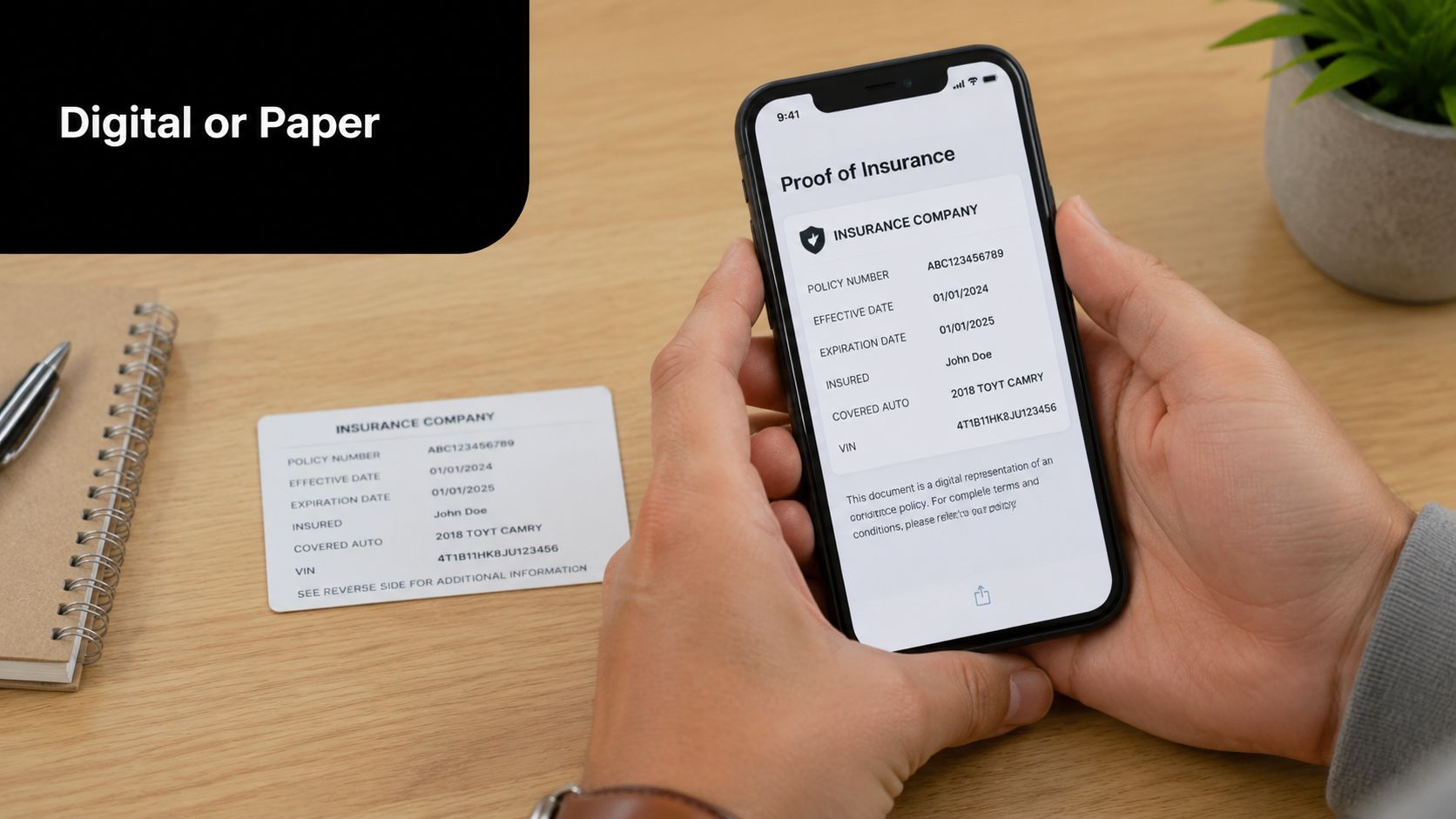
As of October 2022, California is one of 49 states that legally recognizes electronic proof of auto insurance, which means drivers can show an insurance card on a smartphone. The DMV also permits online submission to help with situations such as reinstating a suspended registration, as noted by Fielding Law's California insurance overview.
Using digital proof the smart way
Digital proof is fast when it works. It's often the best answer for an auto policy because the insurer updates it as renewals and vehicle changes process.
What works best:
- Log in before you drive: Open the insurer app while you're parked at home, not during a stop.
- Save a backup copy: Download the card or screenshot the ID card page if your insurer allows that format.
- Email it to yourself: That gives you one more place to pull it from if the app is down.
- Store offline if possible: Weak signal is a real issue in parking structures, rural areas, and some roadside stops.
What doesn't work well:
- Relying on memory: If you don't remember your password, digital proof becomes useless at the wrong time.
- Assuming every requestor wants a screenshot: Some parties prefer a PDF or insurer-generated document.
- Handing over a fully accessible phone casually: Keep the display limited to the insurance card screen.
If you need to turn screenshots or photos into a cleaner file for a landlord, lender, or employer, PDF BIRDS' image to PDF tools can help you combine them into one shareable PDF.
Getting a paper card or emailed card
Paper still wins in a few situations. It doesn't need battery, signal, or an app update. I usually tell clients to carry both. Digital is convenient. Paper is dependable.
A clean way to request proof is through your agent, broker, or insurer portal. If you also need broader document help for insurance questions, policy changes, and practical next steps, California policyholders often benefit from browsing insurance guides for California residents.
Please send my current proof of insurance for policy number [POLICY NUMBER].
I need a copy that shows the named insured, covered vehicle, policy effective dates, and current coverage status.
If available, please email both a PDF insurance card and any declarations or confirmation page relevant to my request.
Thank you.
Which option should you choose
Choose digital first if you need something immediately for a traffic stop, roadside exchange, or same-day DMV submission.
Choose paper or PDF if you're dealing with a landlord, lender, employer, or anyone who needs a file they can store in their records.
The best answer for most Californians is simple. Carry the paper card in the glovebox, keep the digital version on your phone, and email yourself a backup copy.
Decoding Your California Insurance Card
Getting the card is one step. Checking it is the part people skip.
That's where avoidable problems happen. I've seen drivers carry a card for the wrong vehicle, an expired renewal term, or a document with a name mismatch that turns a simple request into a long phone call.
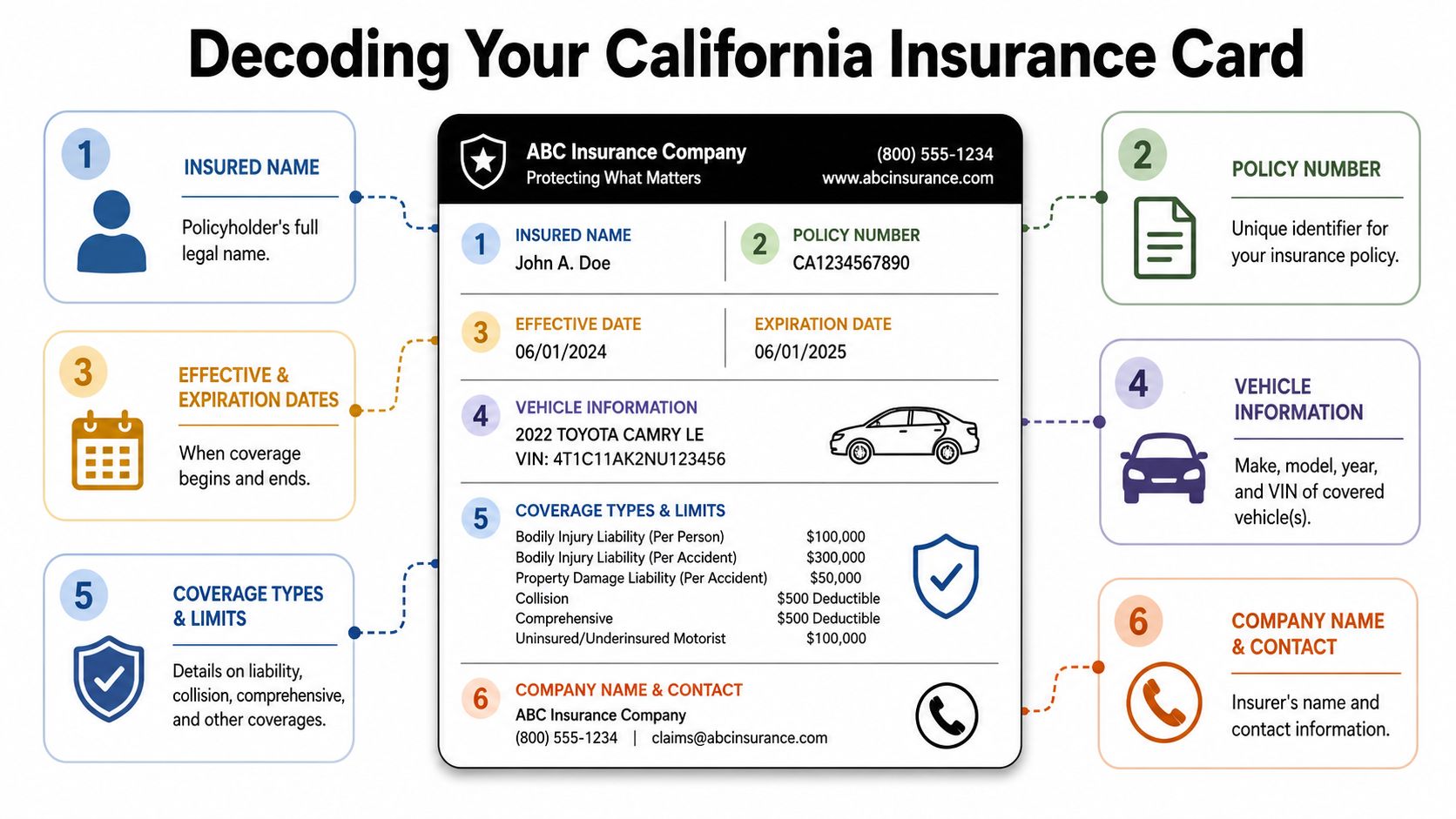
Under Cal. Code Regs. Tit. 13, § 82.00, a valid California Evidence of Liability Insurance Document must contain fifteen specific data points, including the insured's name, vehicle VIN, policy number, effective and expiration dates, insurer name and address, and the insurer's 5-digit NAIC number, as shown in the California regulation text at Cornell Law School.
The fields that matter most in real life
When you look at your card, focus first on these items:
- Named insured: Your legal name should match how you appear in the policy record.
- Vehicle details: Check the VIN, make, model, and model year if listed.
- Policy number: This is what the insurer and DMV use to locate the file quickly.
- Effective and expiration dates: An old card can cause unnecessary trouble even if the policy later renewed.
- Insurer details: Company name, address, and NAIC number help verify the carrier.
What to verify before you present it
The card should also reflect coverage that satisfies California's current minimum liability rules. If your policy renewed, changed carriers, or added a vehicle, don't assume your saved PDF is still current.
If the car on the card isn't the car you're driving, that card won't save you.
For auto insurance, the card is your front-line proof. For home insurance and renters insurance, the comparable document is often the declarations page or evidence of insurance form. For life insurance, proof usually means the policy summary, declarations, or carrier confirmation rather than a wallet card.
A quick review takes less time than fixing an error under pressure. Before you send or show any insurance proof, confirm the names, dates, and property or vehicle listed are exactly the ones involved.
Proof of Insurance for the California DMV
The DMV is where proof problems get expensive fast.
A lot of people first learn this after they receive a notice, try to renew registration, or find out the state doesn't show current insurance on file. At that point, the question isn't abstract anymore. It's whether the car can stay legally on the road.
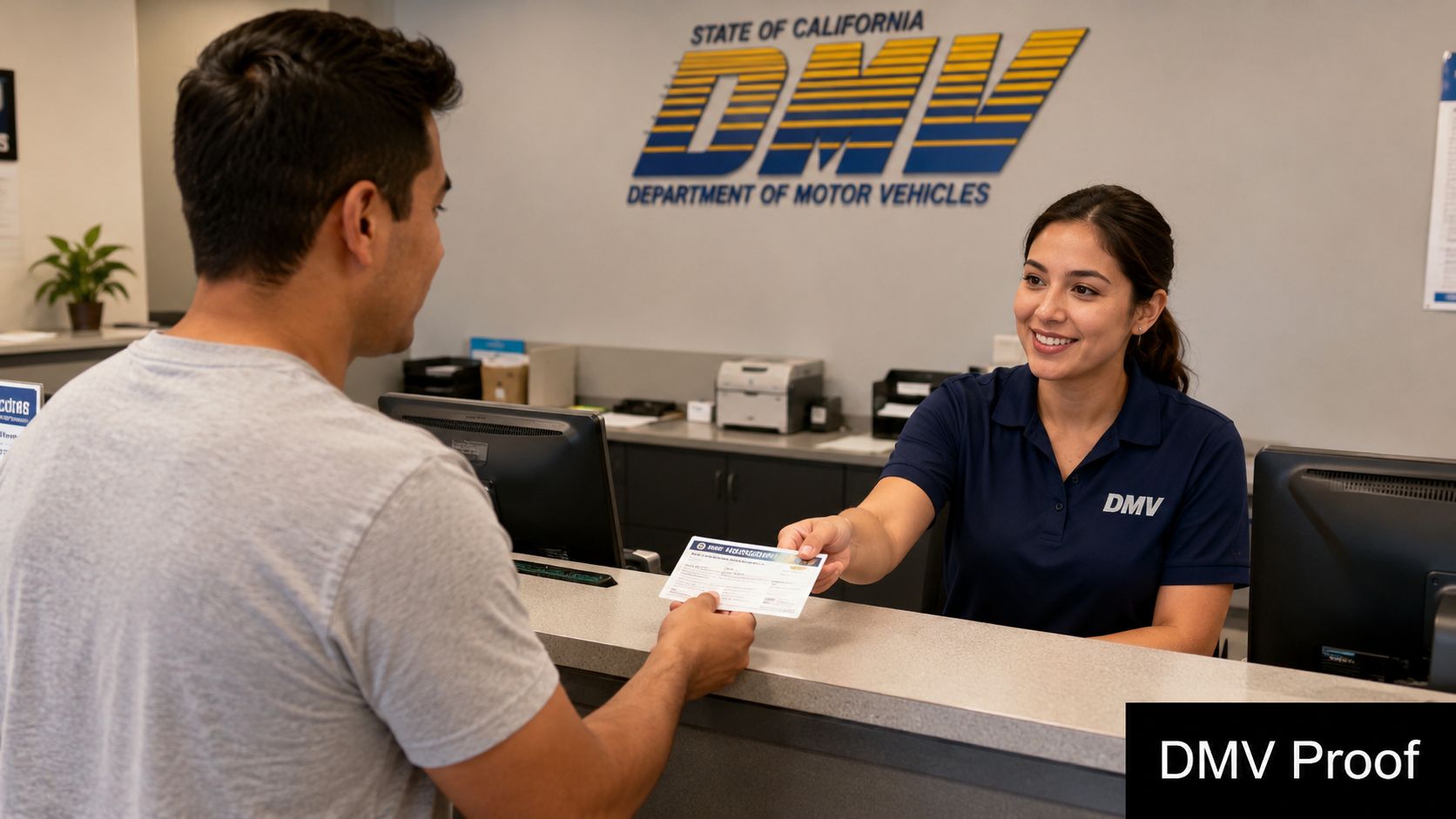
The California DMV states that if a vehicle owner fails to submit proof of insurance, the registration is automatically suspended. The vehicle cannot be operated or even parked on public roadways until proof is submitted online or via email to lift the suspension, according to the California DMV insurance requirements page.
When the DMV usually asks for proof
The request commonly comes up in these situations:
- Registration activity: New registration or renewal can trigger insurance verification.
- Mismatch in DMV records: Your insurer may have updated your policy, but the DMV file may not reflect it yet.
- Suspension resolution: You need to clear a registration suspension quickly.
- Post-lapse cleanup: Coverage may be active now, but the DMV still needs proof tied to the vehicle record.
If you want quick answers on common state filing and policy questions, California insurance FAQs can help you sort out the terminology before you start uploading documents.
The fastest way to fix a DMV proof issue
If the vehicle is insured now, act in this order:
Pull the current insurance document
Use the insurer app, portal, or agent-issued PDF. Make sure the vehicle and dates are correct.Check for matching details
The registered owner name, vehicle information, and active policy dates should line up with the DMV record as closely as possible.Submit electronically
California permits online or email submission for reinstatement-related proof. That's usually much faster than waiting for a mailed document.Save confirmation
Screenshot the submission page, save the sent email, or keep any confirmation notice.Don't drive or park on public roads until the issue is cleared
This is the part many people miss. A suspended registration limits not just driving, but public roadway parking as well.
What usually slows people down
The DMV doesn't care that you intended to fix it. It cares that the document received matches the vehicle and policy record.
Common sticking points include:
| Problem | Why it causes trouble | Better move |
|---|---|---|
| Old insurance card | Dates may show expired proof | Download a fresh card from the insurer |
| Wrong vehicle listed | DMV can't tie proof to the suspended registration | Confirm VIN and covered vehicle before upload |
| Name mismatch | Record review takes longer | Use the policy document that matches the DMV owner record |
| Waiting for mailed proof | Resolution takes longer than needed | Submit online or by email when allowed |
Important: If your registration is suspended, treat proof submission like a same-day task, not a weekend errand.
Handling Other Common Proof Requests
Not every proof request comes from the DMV. Many are routine, but each asks for slightly different information. That's why a single “insurance card” doesn't solve every problem.
Traffic stop or accident scene
For a police officer or another driver after a collision, auto insurance proof needs to be immediate and readable. The simplest version is your insurer-issued card, digital or paper, showing active coverage and the covered vehicle.
If your phone is acting up, use the paper backup. If the paper card is outdated, use the app only if you can pull up the live document without fumbling through logins.
Employer request
An employer may ask for proof if you drive for work, park in a controlled facility, or need to show coverage tied to a company requirement. In that setting, they often want a document they can store, not just a card flashed on a screen.
A PDF from the insurer is usually cleaner than a photo. For some business uses, a certificate-style document may be requested instead of a standard auto ID card.
Landlord request for renters insurance
For renters insurance, landlords usually want to see that the policy is active for the leased address. They may also ask whether liability coverage appears on the declarations page and whether the landlord or management company is listed in a specific way.
Tenants often encounter difficulty. They send a payment receipt or quote instead of an active policy document. A declarations page or insurer confirmation is usually better.
Lender request for home or auto insurance
A mortgage lender usually wants proof of home insurance that shows the property address, policy term, and insurer. An auto lender may ask for proof of physical damage coverage if the loan contract requires it.
The lender's version of “proof” is often more formal than what a driver carries in the glovebox. If they ask for evidence of insurance, send the declarations page or carrier-generated proof document, not a random screenshot.
Life insurance beneficiary questions
With life insurance, proof works differently. A beneficiary often needs the policy number, insured's full name, and carrier contact information before a claim can start. If the original policy packet isn't handy, begin with the insurer or agent and ask for guidance on policy identification and claim forms.
Proof of Insurance Cheat Sheet for Californians
| Scenario | Required Proof | Key Information Needed |
|---|---|---|
| Traffic stop | Auto ID card, digital or paper | Named insured, vehicle, policy dates |
| Accident exchange | Auto ID card | Insurer name, policy number, active dates |
| Employer request | PDF card or certificate-style proof | Employee name, policy status, vehicle if relevant |
| Landlord request | Renters declarations or active proof | Tenant name, rental address, liability coverage |
| Mortgage lender | Home insurance declarations or evidence of insurance | Property address, lender name if requested, policy term |
| Auto lender | Auto declarations or insurer proof | Vehicle, lienholder requirement, active coverage |
| Life insurance claim start | Policy details or carrier confirmation | Insured name, policy number, beneficiary information |
Special Cases SR-22 Filings and Lapses in Coverage
The hardest proof issues usually involve a court order, a DMV requirement, or a policy that exists but isn't easy to prove in the moment.
That's where people need less theory and more calm, direct action.
SR-22 filing in California
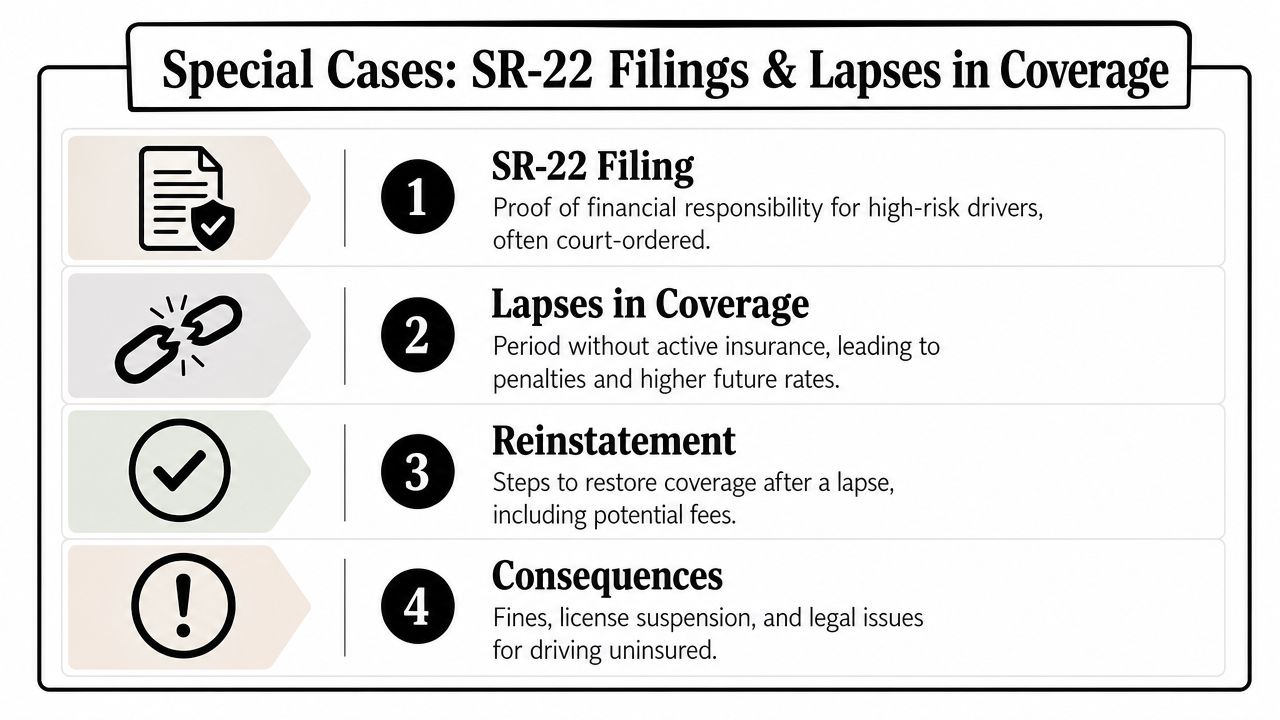
An SR-22 isn't the same thing as a regular insurance card. It's a certificate of financial responsibility filed by the insurer with the state. If the DMV or court requires one, the right move is to contact your insurer or agent and ask whether they can file it electronically.
That electronic filing matters. It's usually the quickest route when your license or driving privilege depends on the state receiving proof, not just you holding a card in your hand.
If any of the terms feel opaque, a plain-language California insurance glossary helps sort out the difference between an ID card, declarations page, and SR-22 filing.
If you're insured but can't show proof
This happens more than people expect. Payment timing, renewal processing, app issues, and clerical errors can all leave a person insured but empty-handed when proof is requested.
The NAIC notes that providers often can't verify coverage without documentation and recommends contacting insurers to request retroactive proof if premiums were paid, which is especially important when the problem involves timing rather than a true lack of insurance, according to the NAIC discussion of being insured but having no proof.
When you're in that spot, do this immediately:
- Call the insurer or agent while the issue is live: Ask for emailed proof or confirmation.
- Request retroactive proof if payment was made: That can help resolve a gap caused by processing delays.
- Ask for the exact document needed: A DMV upload, SR-22 filing, and landlord request all require different proof.
- Save every email and confirmation: If the first submission fails, your paper trail matters.
Don't argue from memory. Ask for a document the other side can actually accept.
That's the practical answer to how to get proof of insurance when things aren't straightforward. Get the insurer involved early, ask for the correct format, and keep copies of everything.
If you need help sorting out California auto insurance, home insurance, renters insurance, life insurance, SR-22 filings, or proof documents that need to match a DMV, landlord, or lender request, Mai & Associates can help you compare options and get clear next steps from a licensed California team.