How to Get Homeowners Insurance Quotes in California

You've received a non-renewal notice, and the first replacement quote looks affordable until you read the coverage section. It's a California FAIR Plan policy that addresses fire, but leaves liability, theft, water damage, and other everyday risks outside the policy. That isn't a complete homeowners insurance solution. It's the starting layer of a patchwork policy.
Learning how to get homeowners insurance quotes in California now requires more than entering an address and selecting the lowest premium. You need comparable dwelling limits, accurate property details, a realistic view of wildfire exposure, and a clear explanation of whether the quote comes from a standard carrier, a surplus lines insurer, or the FAIR Plan. The same discipline also helps when you compare California auto insurance, renters insurance, car insurance, and life insurance, because a low price means little if the policy doesn't match the protection you need.
Navigating the California Home Insurance Market
A homeowner in a moderate-risk California community can receive a non-renewal notice and assume the next step is simple: request several quotes, choose one, and move on. The problem appears when the first available option covers fire only through the FAIR Plan. The homeowner may believe they've replaced their policy, while liability lawsuits, stolen belongings, water damage, and temporary living expenses remain uninsured.
That scenario is increasingly common in high-risk markets. The California FAIR Plan's enrollment grew from about 124,000 policies in 2019 to more than 645,000 by late 2025, an increase of more than 400%, according to SPUR's analysis of California's insurance market. The FAIR Plan now covers roughly 10% of California residential policies, which means many homeowners are no longer comparing conventional, all-in-one homeowners policies.
Practical rule: Treat every quote as a coverage proposal, not a price tag.
California's insurance market is highly local. National homeowners premiums in major datasets ranged from about $2,628 to $2,927 per year in 2025–2026, while location-specific pricing varied sharply. One nationwide study listed San Jose at about $1,087 annually and Oklahoma City at $7,541, nearly a sevenfold difference, as reported in LendingTree's homeowners insurance data. Wildfire, hail, hurricane, and litigation exposure can create similarly wide differences between California communities, even when homes have comparable dwelling limits.
The quote source matters, too. An admitted carrier may offer a conventional policy if its underwriting rules fit the property. A surplus lines carrier may accept a risk that standard insurers decline, but the policy requires careful review. If neither provides a complete option, a FAIR Plan policy may need to be paired with a Difference in Conditions, or DIC, policy.
The practical objective is clear: obtain coverage that protects the structure, belongings, liability, and living arrangements, then confirm that the policy can reasonably survive renewal. Start with a broader view of the California home insurance market, rather than assuming the first available quote represents full protection.
Gathering Essential Documents and Property Details
Insurers can't price a California home accurately from an address alone. Before requesting quotes, assemble the information an underwriter will use to evaluate reconstruction cost, fire response, property condition, occupancy, and prior losses. Incomplete details produce estimates that can change at binding or trigger follow-up inspections.
Build the underwriting file first
Use this checklist:
- Claims history: Order the property's CLUE report and disclose prior losses consistently. A claim history can affect eligibility and pricing even when the current owner didn't cause the loss.
- Property basics: Record the exact square footage, year built, number of stories, foundation type, detached structures, and occupancy.
- Roof information: Document the roof's installation year, material, condition, and any replacement receipts. Older roofs may restrict carrier eligibility or lead to depreciated settlement treatment.
- Construction details: Note siding, framing, windows, fireplaces, solar equipment, pools, retaining walls, and high-end finishes.
- Major systems: Identify the electrical panel type, wiring updates, plumbing material, heating system, water heater, and any completed renovations.
- Fire protection: Confirm the distance to the nearest hydrant and fire station, plus available information about local fire protection.
- Wildfire mitigation: Photograph defensible-space work, vegetation clearing, access improvements, fire-resistant vents, and Class A roofing upgrades. Keep permits, invoices, and inspection records.
- Personal property: Create a room-by-room inventory, with receipts or photographs for jewelry, electronics, artwork, tools, and other valuable items.
- Occupancy and use: State whether the home is owner-occupied, tenant-occupied, seasonal, vacant, or used for short-term rentals.
The NAIC recommends setting dwelling coverage from the home's estimated rebuild cost, not its purchase price or market value. Its consumer shopping guidance also recommends contacting more than one agent or company and comparing at least three quotes with consistent limits, deductibles, and endorsements.
Standardize every submission
Give each insurer the same dwelling limit, personal property limit, liability limit, deductible, and requested endorsements. Ask for written confirmation of exclusions, roof settlement terms, wildfire restrictions, water backup options, ordinance or law coverage, and loss-of-use protection.
Don't guess about square footage or renovation dates. Check county permit records, closing documents, contractor invoices, and prior policy declarations. When an agent asks for photographs, send clear images instead of relying on a verbal description. Accurate preparation won't guarantee an affordable quote, but it prevents false comparisons and late underwriting surprises.
Choosing Between Online Tools and Local Agents
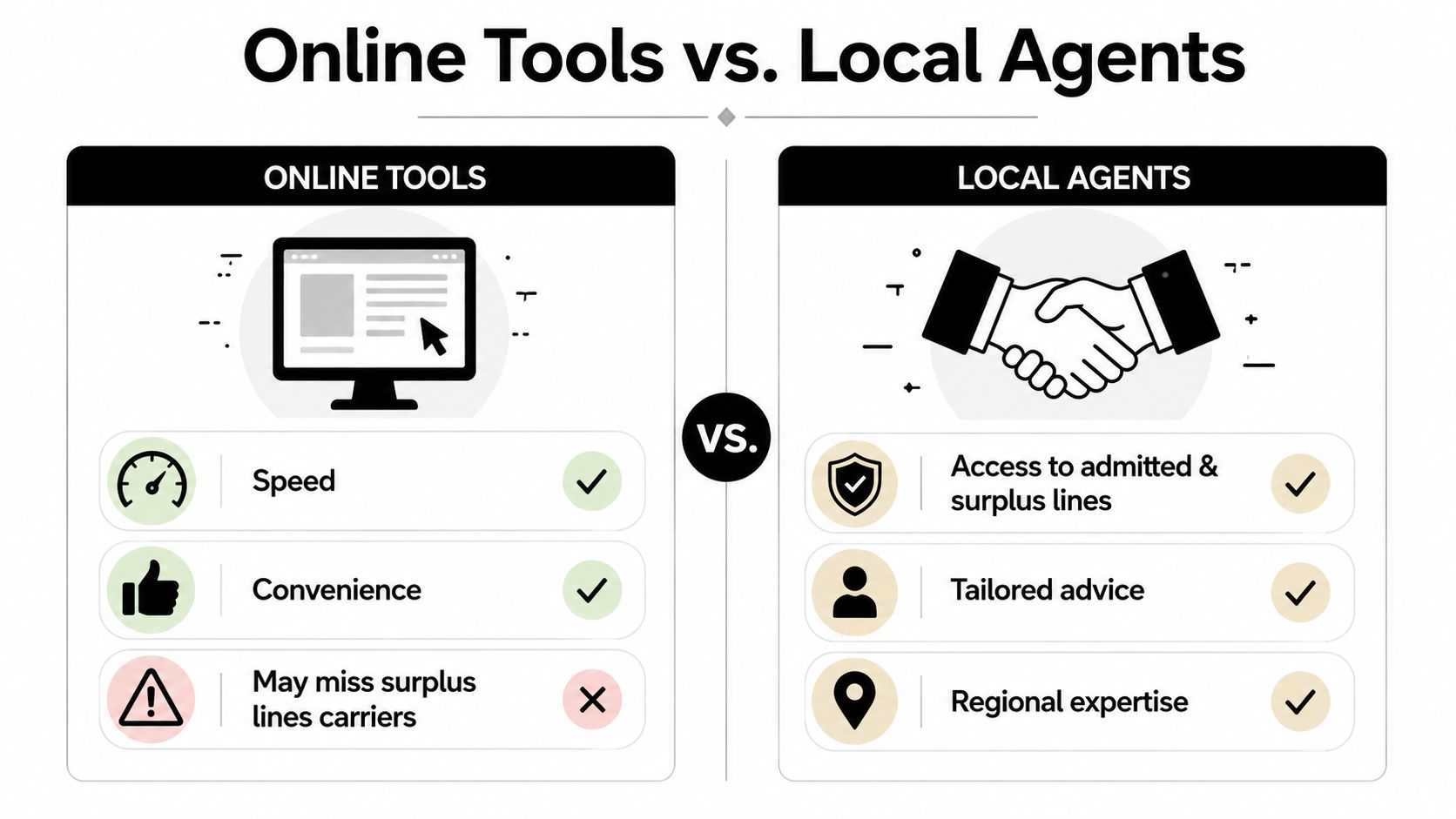
Online tools are useful when the property fits a conventional underwriting profile. They can collect an address, basic construction details, desired limits, and contact information quickly. For a newer urban home with ordinary construction and access to standard carriers, that speed may be enough to begin the process.
California's difficult risks require more. Many comparison platforms show only participating admitted carriers. They may not identify surplus lines options, initiate a FAIR Plan application, coordinate a DIC policy, or explain how two separate policies interact during a claim. A screen can display a premium. It usually won't tell you that the quote excludes liability or that the structure limit doesn't reflect the cost of rebuilding after a wildfire.
Use online tools for screening
Online quoting makes sense when you want to:
- Establish a baseline: See whether conventional coverage appears available before speaking with an agent.
- Save time: Enter standardized information once where the platform supports multiple submissions.
- Compare familiar products: Review ordinary home, auto, renters, or car insurance options when the risk isn't unusually complex.
But treat the result as preliminary. Read the declarations, exclusions, deductible structure, and roof provisions before comparing the price.
Use a local specialist for difficult placements
A licensed California agent who works with high-risk properties can ask more useful questions: Which carriers are writing in this ZIP code? Is the quote admitted or surplus lines? Does the property need the FAIR Plan? If so, who will arrange the DIC policy, and what does it exclude?
Ask the agent directly:
- Do you place both admitted and surplus lines coverage?
- Can you coordinate FAIR Plan and DIC policies?
- How will you calculate replacement cost?
- What happens if the roof, brush exposure, or prior claims affect eligibility?
- Who reviews the policy before renewal?
The same habit applies to other insurance decisions. A useful example is learning to compare service estimates by examining what's included, just as window cleaning pricing explained helps consumers distinguish a headline price from the actual scope of work.
For a California property with wildfire exposure, a local specialist is usually the more practical route. You can begin with a California insurance quote request, but insist on a complete coverage explanation before treating any result as an offer worth accepting.

Understanding California Rate Drivers and Wildfire Risk
A California homeowners quote reflects more than the house's size and age. Insurers evaluate reconstruction cost, location, fire protection, roof condition, claims history, vegetation, access for emergency crews, and the insurer's own appetite for that risk. Two nearby homes can receive different quotes because their construction, roof, defensible space, or underwriting history differs.
Wildfire models may incorporate vegetation density, terrain, defensible space, fire-station proximity, and other geographic features. Carriers can also consider broader market conditions, including reinsurance costs and their capacity to write additional California property.
Key California home insurance rate drivers
| Rate Driver | Impact Level | Description |
|---|---|---|
| Rebuild cost | High | Dwelling coverage should reflect the estimated cost to reconstruct the home, including local labor, materials, code requirements, and specialized features. |
| Wildfire exposure | High | Vegetation, terrain, access, defensible space, and regional fire conditions can affect eligibility and price. |
| Roof age and material | High | Roof condition can influence acceptance, inspection requirements, settlement terms, and deductible structure. |
| Claims history | High | Prior claims associated with the property or applicant can change underwriting decisions and pricing. |
| Fire protection | Medium to high | Fire-station access, hydrant availability, water supply, and emergency response resources help carriers assess loss severity. |
| Construction type | Medium to high | Framing, siding, windows, electrical systems, and other materials affect resilience and rebuilding expense. |
| Coverage design | Medium | Limits, deductibles, endorsements, and liability protection change the quote even when the address is identical. |
The replacement-cost distinction deserves special attention. Market value includes land and reflects what buyers may pay. Rebuild cost measures what it may take to reconstruct the dwelling after a covered loss. The NAIC warns that using the wrong basis can distort the dwelling limit and create a serious coverage gap.
FAIR Plan pricing also affects the broader market. The FAIR Plan announced an average 29.1% rate increase effective October 15, 2026, as reported by KQED's coverage of the California FAIR Plan. That increase is a future-dated 2026 policy change, not a universal forecast for every homeowner's premium. It does show why a quote must be tested against renewal affordability, not just the initial term.
Before buying, review practical mitigation guidance such as these fire damage restoration tips, then ask the agent how documented improvements may affect underwriting. For regional context, homeowners can also review Santa Rosa home insurance considerations.
The FAIR Plan and Supplemental Coverage Gaps
The California FAIR Plan is not a standard homeowners policy. Its residential dwelling fire policy covers fire, but homeowners must not assume it supplies the broader protection found in a conventional package. SPUR notes that California FAIR Plan coverage is limited to fire, which leaves gaps such as theft, water damage, and liability unless the homeowner obtains additional insurance.
That distinction changes the entire quoting process. A FAIR Plan premium is only one part of the price if the household also needs personal liability, contents coverage, water-related protection, and additional living expenses. The homeowner must compare the combined cost and terms of the FAIR Plan plus supplemental coverage against any admitted or surplus lines alternative.
How the patchwork works
A Difference in Conditions policy can fill important gaps beside the FAIR Plan. Depending on its terms, it may provide liability, personal property, theft, water damage, and loss-of-use coverage that the fire policy doesn't provide. It doesn't automatically make the two policies identical to a conventional HO-3 policy, so the exclusions, limits, deductibles, and claim coordination provisions require a line-by-line review.
Consider the claim scenarios before you bind:
- Falling tree: If the event doesn't create covered fire damage, the FAIR Plan may not respond to the property damage.
- Vandalism or theft: A fire-only policy doesn't replace stolen belongings or repair non-fire vandalism.
- Water damage: A burst pipe or certain water losses may require separate coverage.
- Liability lawsuit: If a guest is injured or alleges negligence, personal liability protection must come from another policy.
- Temporary relocation: If a covered loss makes the home unlivable, additional living expenses must be specifically included somewhere in the insurance stack.
Coverage question: “Does this quote protect my full household, or does it protect only the dwelling from fire?”
The FAIR Plan's residential dwelling fire policy has a maximum dwelling coverage limit of $3 million and can apply to owner-occupied homes, tenant-occupied homes, rentals to others, condo unit owners, and vacant homes for up to one year, according to a California FAIR Plan oversight presentation. Eligibility and policy terms still matter, and supplemental coverage may be essential.
Don't compare a FAIR Plan quote with a conventional quote by looking at the fire premium alone. Ask for a written schedule showing every layer, total cost, separate deductibles, exclusions, and who handles each part of a claim. California homeowners can use insurance coverage guides as a starting point, but the policy documents control.
Finalizing Your Policy with Expert Guidance
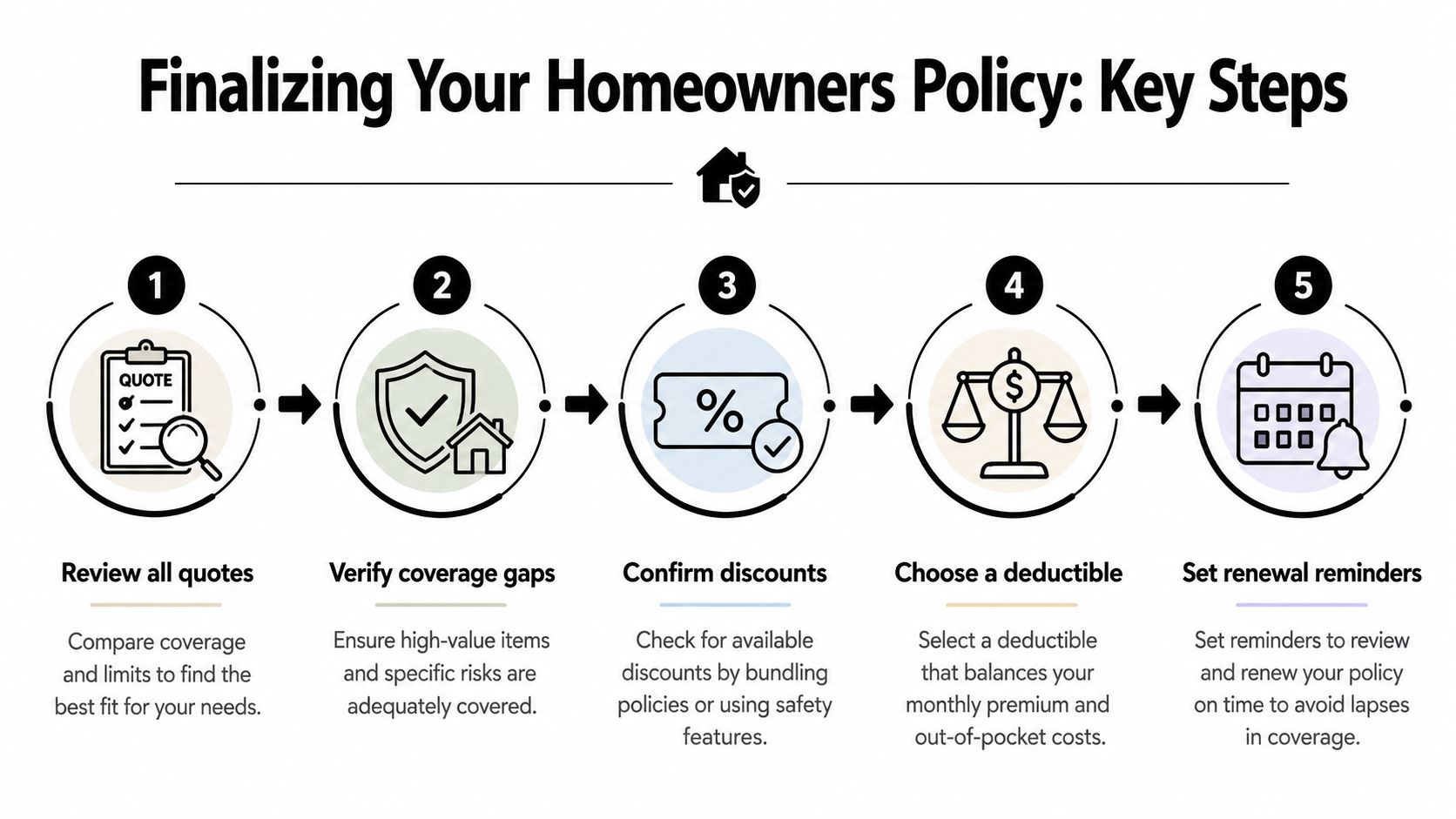
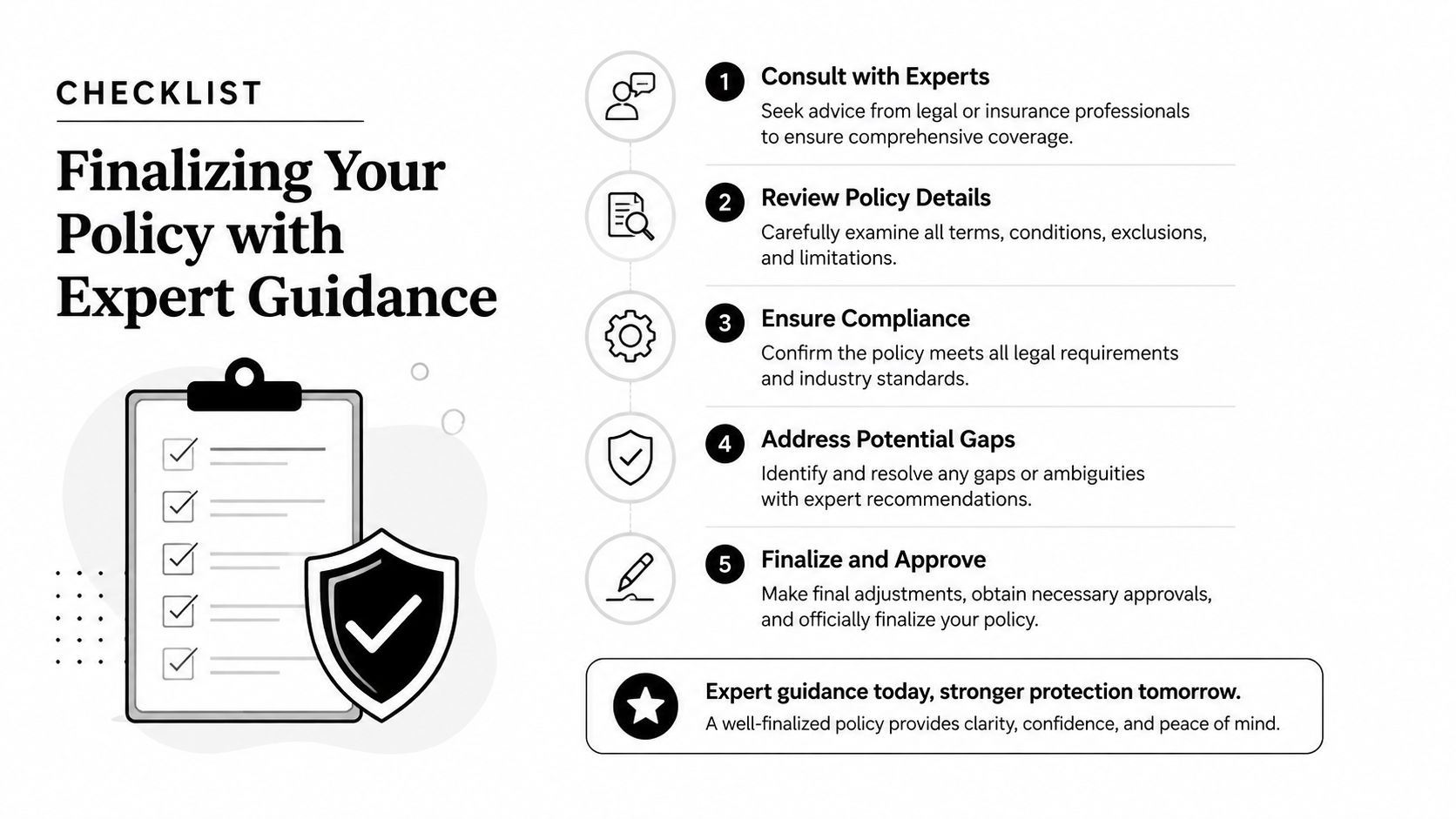
Getting a quote is an administrative milestone. Binding a policy that remains useful through inspection, renewal, and a claim is the test. Before you accept an offer, verify that the dwelling limit reflects estimated reconstruction cost, the deductible is financially manageable, and the policy includes the endorsements your property needs.
Use this final review:
- Confirm the insurance structure. Identify whether you're buying a conventional policy, surplus lines coverage, FAIR Plan protection, or a FAIR Plan and DIC combination.
- Read the exclusions. Look for wildfire, smoke, water, mold, theft, earth movement, roof settlement, matching, and ordinance or law provisions.
- Match the declarations. Compare dwelling, other structures, personal property, liability, medical payments, and additional living expenses across offers.
- Check the mortgagee clause. Give the lender's exact name and loan information to prevent escrow or evidence-of-insurance problems.
- Set the billing correctly. Confirm whether the lender pays through escrow or whether you'll pay the carrier directly, then keep proof of payment.
- Document mitigation. Send updated roof records, defensible-space photos, permits, and inspection reports to the agent and carrier.
- Schedule an annual review. Revisit construction costs, renovations, valuables, occupancy, auto insurance bundling, renters insurance needs, and life insurance beneficiaries before renewal.
Plan for renewal before the notice arrives
Carrier appetite can change between policy terms. A broker who tracks admitted and surplus lines markets can remarket the account before a deadline, identify whether a FAIR Plan review is necessary, and check whether the DIC layer still matches the household's needs. That ongoing review matters more than chasing a temporary introductory price.
Mai & Associates helps California consumers compare home, auto, renters, car, and life insurance options, including FAIR Plan reviews, earthquake coverage options, and wildfire protection strategies. Its licensed agents can assess available carrier options and help structure coverage combinations when a conventional policy isn't available.
Mai & Associates can help you compare California homeowners insurance quotes, review whether a FAIR Plan is missing liability or other protection, and coordinate supplemental coverage when needed. Visit Mai & Associates to request a no-obligation quote and discuss a policy structure that fits your property and renewal risks.