How to Get Homeowners Insurance After Being Dropped in California
Receiving a letter from your home insurer saying they're dropping you can be a gut punch. It’s stressful, but I want you to know it's a solvable problem. The key is to act deliberately and right away. You need to figure out your deadline, understand why you were dropped, and immediately start shopping around. Taking these steps turns a panic-inducing moment into a manageable task.

Why Insurers Are Dropping California Homeowners
That non-renewal notice can feel deeply personal. Trust me, it’s usually not. Most of the time, it's a cold, hard business decision driven by massive shifts in the California insurance market. Carriers are scrambling to manage their risk, which means they're dropping policies statewide—even for loyal customers who have never filed a claim for their home insurance or auto insurance.
This isn’t just a California problem, though it's certainly hitting us the hardest. Across the country, we’re seeing non-renewal rates spike in areas with high risk. Take Florida, where the rate jumped from 1% in 2019 to 3% in 2023. Here in the Golden State, carriers are facing a storm of frequent claims; in 2023 alone, 5.3% of insured homes filed one. An eye-watering 97.3% of those were for property damage.
It's a tough market for all types of California insurance, and understanding why this is happening is the first step to navigating it.
Common Reasons for Non-Renewal
Insurance companies are pulling back for a few big reasons. They almost always boil down to two things: broad market changes or specific risks tied to your property.
Heightened Wildfire Risk: This is, without a doubt, the number one reason in California. Insurers use increasingly sophisticated risk maps. If their latest model flags your home as being in or near a high-danger fire zone, they may non-renew you as part of a larger strategy to reduce their exposure. It doesn't matter if you've been there 30 years; if the map changes, your home insurance policy is at risk.
Claims History: One claim shouldn't get you dropped. But two or three in a short period? That’s a major red flag for an underwriter. It signals a higher risk profile, and the carrier might decide they’re no longer willing to take that bet. This isn't just about home insurance—they look at your entire claims history, including car insurance.
Home Condition and Maintenance: Insurers are doing more inspections than ever, both in-person and remotely using satellite photos. They're looking for signs of deferred maintenance. An old roof, trees with branches hanging over your house, or peeling paint can all be enough to trigger a non-renewal.
Geographic Pullback: Sometimes, it has absolutely nothing to do with you or your house. An insurer might just decide to stop writing policies in your entire ZIP code or county. It’s a portfolio-level decision they make to avoid having too much concentrated risk in one area that could be hit by a single wildfire or earthquake.
Non-Renewal vs. Cancellation: What You Need to Know
It's absolutely crucial to know the difference between a non-renewal and a cancellation. They are not the same thing.
A non-renewal is when your insurer decides not to offer you a new policy when your current one expires. In California, they must give you advance notice—usually 45 to 75 days. A cancellation is a mid-term termination. It's much more severe and typically only happens for specific reasons, like you stopped paying your premium or committed fraud.
Understanding which notice you've received is vital. A non-renewal gives you a runway to find new coverage before you have a lapse. A cancellation, on the other hand, is an emergency that requires immediate action.
If you’ve been non-renewed, it’s time to make a plan. The first thing you should do is see what your options look like. You can get an insurance quote right away to get a feel for the current market for California insurance policies.
That non-renewal notice in your hand is the starting gun. Here’s a table outlining the first critical steps we advise all our clients to take. Following this immediate action plan ensures you stay protected and in control.
Your Immediate Action Plan After a Non-Renewal Notice
| Action Item | Why It's Important | Pro Tip from Mai & Associates |
|---|---|---|
| Verify the Effective Date | This is your hard deadline. Missing it means a lapse in coverage, which can jeopardize your mortgage and leave you financially exposed. | Circle the date on your calendar. Set multiple reminders on your phone for 30, 15, and 7 days out. Don't let it sneak up on you. |
| Document Everything | Keep the non-renewal notice and any other correspondence. The reason for being dropped (if provided) is your starting point for finding a new carrier. | Create a dedicated folder—physical or digital. Scan the notice and save it to your computer and cloud storage. You'll need to share this with potential new agents. |
| Contact Your Agent | Your first call should be to an independent agent. They have access to multiple carriers and can shop the market for you much faster than you can on your own. | Don't just call one agent. Reach out to a well-connected independent agency like ours. We work with dozens of carriers, including ones that specialize in high-risk properties for home insurance. |
| Secure Temporary Coverage | If your deadline is approaching and you don't have a new policy, you may need a binder or a temporary policy from a plan like the CA FAIR Plan to avoid a lapse. | A lapse is a black mark on your insurance record and can make it harder and more expensive to get home insurance or auto insurance later. Don't risk it—any coverage is better than none. |
Taking these initial steps quickly and methodically will lay the groundwork for a successful search for a new policy. It’s all about staying organized and being proactive.
How to Shop for New Home Insurance When You've Been Dropped
Okay, you’ve gotten the non-renewal notice, and the clock is ticking. It’s easy to feel panicked, but now is the time for a clear, strategic plan. Let's be honest, finding new home insurance coverage in California's tough market isn't easy, but it is absolutely doable.
Your first instinct might be to start calling major insurance companies directly or plugging your info into a dozen different websites. It feels productive, but I can tell you from experience, it’s usually a fast track to frustration. You'll spend hours on hold, repeating the same painful story over and over, only to be rejected by automated systems that flag the exact issue that got you dropped in the first place.
There’s a much smarter way to tackle this.
The Independent Agent: Your Expert on the Inside
In a market like this, you need an advocate. That's the role of a good independent insurance agent.
Unlike a "captive" agent who works for a single brand (like State Farm or Farmers), an independent agent works for you. We aren't bound by one company's rigid underwriting rules.
At an agency like Mai & Associates, we have established relationships with dozens of insurance carriers. This includes the big names, but more importantly, it includes specialty insurers that don’t advertise on TV or show up on the first page of Google. These are the companies willing to look at properties that others won't, and they're often the key to getting a solid home insurance policy after a non-renewal.
How We Streamline Your Search
Think of us as your personal project manager for this entire process. Instead of you making 50 phone calls, you make one—to us. We handle the rest.
Here’s what that looks like in practice:
- One Application, Dozens of Carriers: You give us your information just once. We then take your unique profile and shop it to our entire network of insurers simultaneously. We can get a range of quotes back in a fraction of the time it would take you to do it yourself.
- Comparing More Than Just Price: A cheap policy is often cheap for a reason. We dig into the fine print for you, comparing not just the premium but the coverage limits, deductibles, and—most importantly—the exclusions. We lay out the options side-by-side so you can see exactly what you're getting for your money.
- Telling Your Story: We know what underwriters need to see to say "yes." We know how to frame your situation, highlight the home hardening you've done, and advocate on your behalf to get your application approved. This kind of insider expertise is priceless when you're considered a higher risk for California insurance.
The goal isn't just to find any policy; it's to find the right policy. A seasoned agent can often find savings by bundling your home insurance, auto insurance, renters insurance, and life insurance, which not only cuts your costs but also makes you a more valuable and "sticky" customer to the insurer.
When an insurance company holds multiple policies for you, they view you as a long-term partner, not just a transaction. This can make them far less likely to non-renew you down the road. If you're looking for more strategies, we cover many of them in our guide to comprehensive home insurance in California.
Finding the Right Company and Coverage
A critical part of our job is to place you with a financially stable company. We’ll look at an insurer’s A.M. Best rating, which grades their ability to pay out claims. You need to know that if the worst happens, your insurance company has the cash to make you whole.
We'll also talk through the right type of coverage for your specific situation. Maybe a standard HO-3 policy is perfect, or perhaps your risk profile now calls for a more specialized policy. If you’re in a wildfire zone, for instance, we won't waste your time with carriers that have a blanket ban on your area. Instead, we’ll go straight to the insurers that specialize in underwriting that specific risk for California insurance.
This targeted approach cuts through the noise, saving you time and stress, and ultimately connects you with a reliable company that wants your business.
Navigating The California FAIR Plan As Your Last Resort
Sometimes, no matter how many brokers you call or applications you fill out, every private insurance company says no. You’ve done everything right, but the answer is the same across the board. So, where do you turn when you’ve hit a wall with the traditional market?
For many California homeowners, the only option left is the California FAIR Plan.
It's a common myth that the FAIR Plan is a government agency or some kind of taxpayer-funded handout. It's not. The FAIR Plan is actually an insurance pool funded by all property insurers licensed in California. It was created by law to be the "insurer of last resort," offering basic fire coverage to high-risk homeowners who simply can't find it anywhere else.
When you're in this tough spot, how you shop for coverage makes a huge difference.
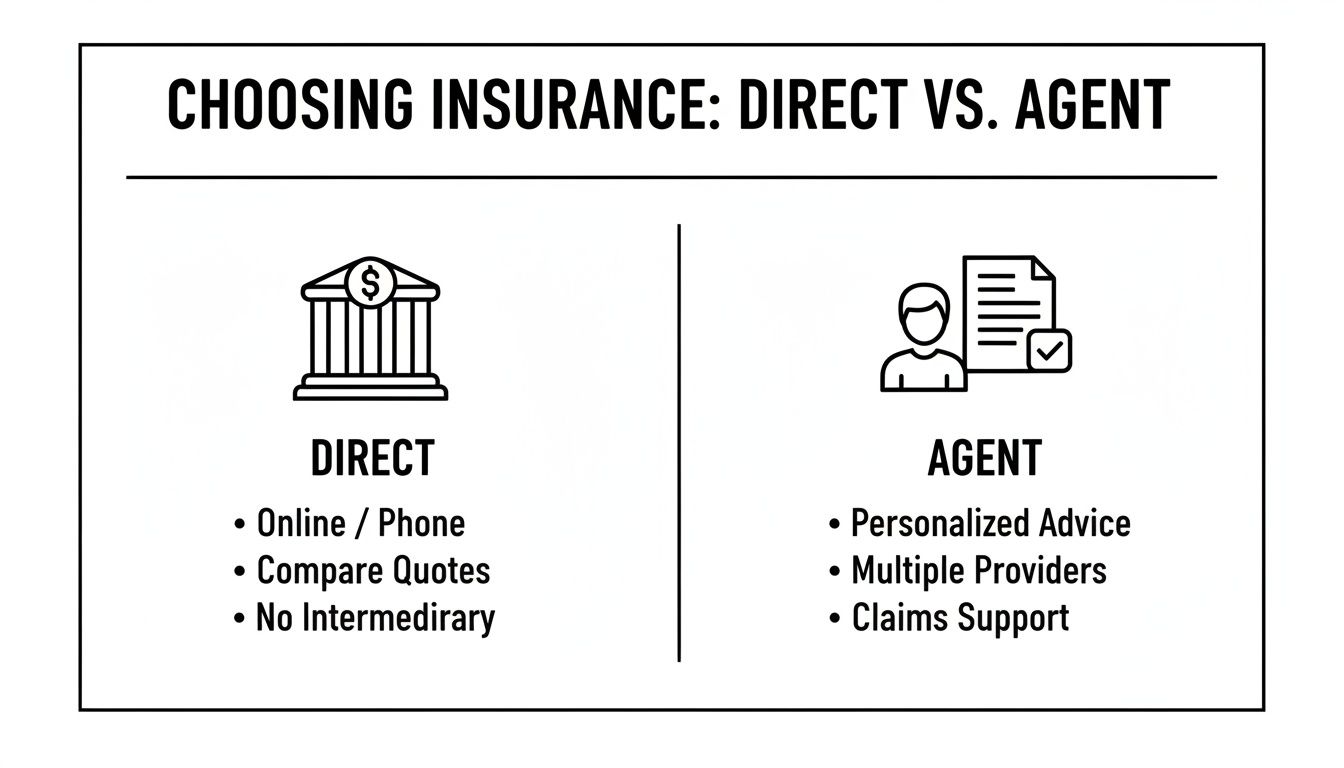
As you can see, going it alone means you're doing all the legwork. Working with an experienced agent gives you an advocate and access to options you might not find on your own—something that’s absolutely critical when you’re dealing with the complexities of the FAIR Plan for your California insurance needs.
What The FAIR Plan Covers—And What It Doesn't
This is the most important thing to understand: a standard FAIR Plan policy is not a normal homeowners insurance policy. It's a basic fire policy, and it only covers damage from a very short list of named perils.
What's typically covered by a basic FAIR Plan policy:
- Fire and lightning
- Internal explosion
- Smoke
That’s it. Seriously. Take a look at what’s missing: liability (if someone gets hurt on your property), theft, water damage from a burst pipe, or vandalism. These gaps are massive and could leave you financially devastated.
Key Takeaway: A standalone FAIR Plan policy is not complete home insurance. It's a foundational piece that protects your structure from fire, but it leaves you dangerously exposed to some of the most common and costly claims.
The state’s increasingly difficult insurance climate has pushed more and more people into this corner. The California FAIR Plan saw its policy count explode, reaching over 400,000 policies by 2023—a tenfold increase from pre-2019 levels. It's a situation we're seeing in other states like Florida, too, where severe weather is rewriting the rules for insurers.
To show you exactly what's at stake, here’s a direct comparison of a basic FAIR Plan policy and a standard homeowners (HO-3) policy.
California FAIR Plan vs. Standard Homeowners Policy
| Coverage Type | Standard HO-3 Policy | California FAIR Plan |
|---|---|---|
| Dwelling (Your Home) | ✅ Covered | ✅ Covered (for fire, lightning, explosion) |
| Liability | ✅ Covered | ❌ Not Covered |
| Theft | ✅ Covered | ❌ Not Covered |
| Water Damage (e.g., burst pipes) | ✅ Covered | ❌ Not Covered |
| Vandalism | ✅ Covered | ❌ Not Covered |
| Medical Payments to Others | ✅ Covered | ❌ Not Covered |
The table makes it crystal clear: relying solely on the FAIR Plan means you're gambling with your financial future.
The Two-Policy Solution To Get Complete Coverage
So, how do you close those dangerous coverage gaps? The solution is to buy a second, separate policy called a Difference in Conditions (DIC) policy.
A DIC policy, often called a "wrap-around," is specifically designed to work alongside the FAIR Plan. It adds the essential coverages that the FAIR Plan policy is missing.
This two-policy approach is how you build a complete homeowners insurance solution:
- California FAIR Plan Policy: Covers your home's structure from fire, lightning, and internal explosion.
- Difference in Conditions (DIC) Policy: "Wraps around" the FAIR Plan to add liability, theft, water damage, and other critical protections, bringing your total coverage much closer to a standard HO-3 plan.
Putting this puzzle together correctly is where things can get tricky. The two policies need to be structured perfectly to make sure there are no gaps between them. This is where an experienced independent agency like Mai & Associates becomes invaluable. We specialize in finding the right DIC policies and pairing them seamlessly with the FAIR Plan.
This two-policy strategy is often the only way to secure comprehensive protection in high-risk areas, providing a crucial lifeline for homeowners struggling to find home insurance in California. If you're weighing your options, you can find more expert advice in our guides section.
How to Lower Your Risk and Boost Your Home’s Insurability
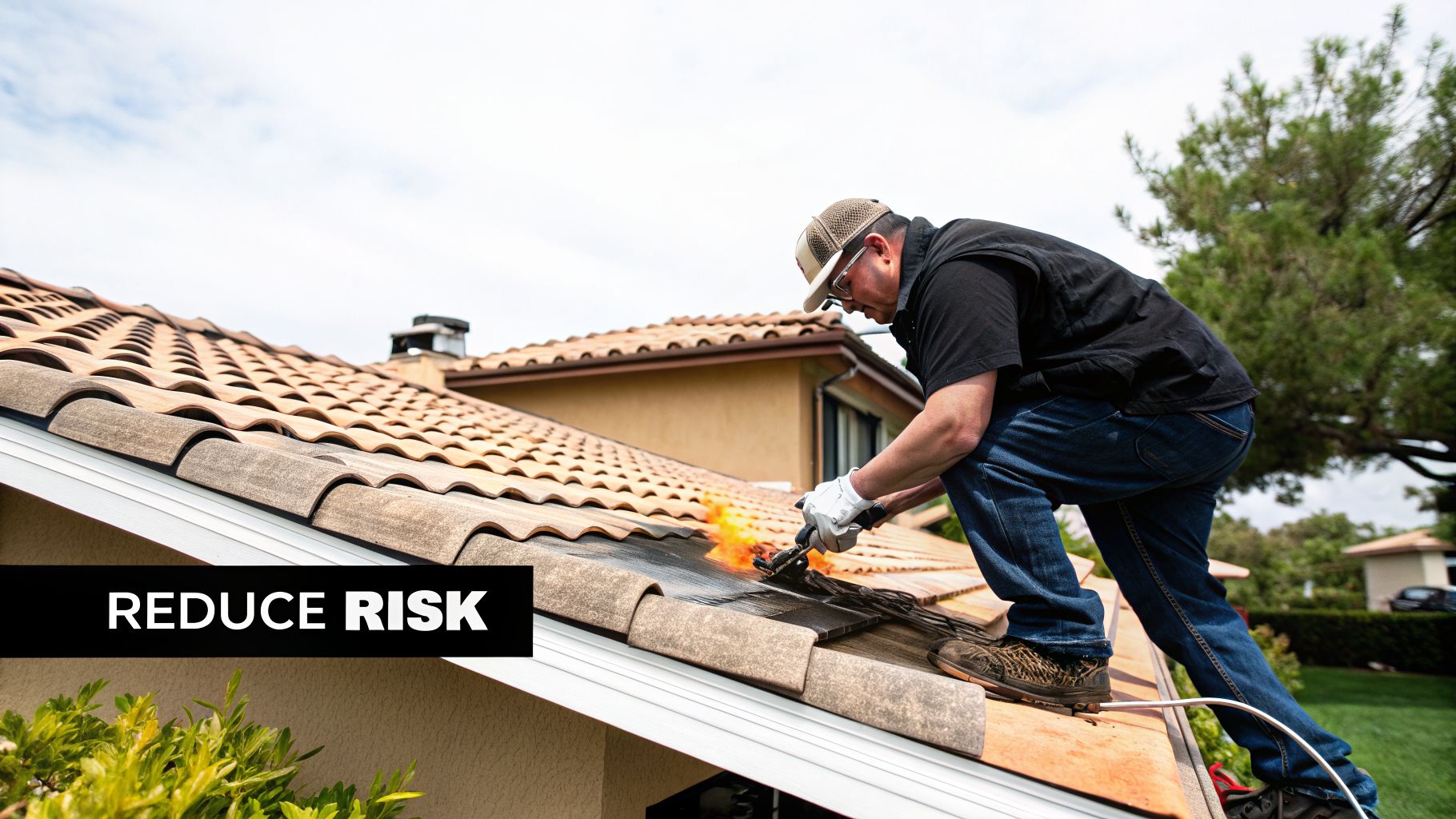 Getting a non-renewal notice is a blunt message: your insurance carrier thinks your home is too risky to cover. Your job now is to change that perception. By proactively making your home safer and more resilient, you can dramatically improve your insurability and become the kind of applicant that carriers want to insure.
This isn't about just checking a few boxes. It's a strategic investment in your property’s future. For California homeowners, that journey almost always starts with confronting the state's biggest peril: wildfire.
Fortify Your Home Against Wildfire
Insurers are using sophisticated satellite imagery and risk-scoring models to get a bird's-eye view of your home's wildfire exposure. The good news? You can actively influence that score. Taking real, tangible steps to harden your home can make all the difference in qualifying for private market home insurance.
Your first priority should be creating defensible space. This is mandatory in many parts of California and the single most critical step you can take. It’s all about creating a buffer zone by managing the vegetation around your home.
- Zone 0 (0–5 feet): Think of this as the "Ember-Resistant Zone." Clear away anything flammable—dead plants, dry leaves, and especially bark mulch. Swap them for non-combustible options like gravel or concrete pavers.
- Zone 1 (5–30 feet): This is the "Lean, Clean, and Green Zone." Keep your trees pruned, remove all dead vegetation, and make sure there’s plenty of space between shrubs to keep a fire from jumping between them.
- Zone 2 (30–100 feet): Known as the "Reduced Fuel Zone." Here, the goal is to thin out trees and brush to slow down an approaching fire, not stop it completely.
Beyond the yard, you need to harden the house itself. You can seriously reduce your risk profile and become much more attractive to insurers by implementing these 8 Fire-Safe Upgrades Every Bay Area Home Needs. These are precisely the kinds of improvements underwriters look for on an application.
Address Other Major Home Systems
While fire is top-of-mind, it’s not the only risk that gives insurers pause. They look at your home as a whole. Addressing other potential sources of claims is just as important in your mission to find a new homeowners insurance policy.
Focus on the "big ticket" items that are notorious for causing expensive claims.
The Roof: An old roof is one of the biggest red flags for an underwriter. They don't see shingles; they see a ticking clock on a future water damage or structural claim. If your roof is over 15-20 years old, getting it professionally inspected—and likely replaced—will make a huge difference.
Electrical and Plumbing: Outdated systems are another major headache for carriers. In an underwriter's eyes, old knob-and-tube wiring or galvanized pipes are just fires and floods waiting to happen. Upgrading to a modern electrical panel and copper or PEX plumbing can single-handedly move your application from the "no" pile to the "yes" pile.
Don’t just make the repairs—document them. Keep every receipt, permit, and contractor invoice. This paper trail is your proof to a new insurer that you’ve taken action to mitigate the very risks that worried them.
Embrace Smart Home Technology
Modern tech offers some surprisingly affordable ways to lower your risk. Installing smart home devices is a clear signal to insurers that you're a proactive homeowner, which can open doors to better eligibility and even discounts on your home insurance or car insurance bundle.
Consider these high-impact devices:
- Automatic Water Shut-off Valves: These can detect a leak and automatically cut the main water supply, preventing a small drip from becoming a catastrophic flood.
- Monitored Security Systems: A system that monitors for both burglary and fire can significantly lower your risk of two of the most common claims.
- Smart Smoke and CO Detectors: These send alerts straight to your phone, letting you react faster, even when you aren't home.
These improvements aren't just for peace of mind; they're powerful leverage. An independent agent, like our team at Mai & Associates, excels in presenting these mitigation efforts to underwriters. We often successfully move clients off the FAIR Plan and onto a private policy by showcasing these upgrades. For example, creating proper defensible space can cut premiums by 20% or more, while addressing other risks can make a previously uninsurable home attractive to multiple carriers.
Don't just toss that non-renewal notice in the bin and assume it's a done deal. While getting an insurer to reverse their decision is an uphill climb, it’s a fight worth having, especially if you think they got the facts wrong or you've made major upgrades to your home.
This isn't about pleading or just reminding them you've been a customer for a decade. In the current market, that’s not enough. This is about building a solid, evidence-based case that proves their risk assessment is outdated or just plain incorrect.
When an Appeal Actually Makes Sense
So, when is it worth the effort? You've got a real shot if you can pinpoint a clear error in the insurer's logic.
A formal reconsideration is your best move if:
- The decision was based on bad info. This happens more than you'd think. Maybe they dinged you for a wildfire risk score that used your neighbor's address, or an old inspection report flagged a "bad roof" that you actually had replaced last year.
- You've since fixed the problem. If you were dropped because of an ancient electrical panel and you've now had it completely modernized by a licensed pro, that’s a game-changer. You have new, crucial information to share.
- There was a simple misunderstanding. Perhaps an inspector saw a boat and flagged it as a risk, but it's not yours. Or maybe they found a registered LLC at your address for a side hustle you haven't operated in years.
In these situations, a polite, professional, and well-documented appeal can absolutely turn things around.
The goal here is simple: you need to give the underwriter a reason to change their mind. You're arming them with the documentation they need to justify keeping you as a policyholder.
How to Craft a Winning Reconsideration Request
Your request for an underwriting review needs to be buttoned-up and fact-driven. This isn't the time for emotion; it's about making your case so clear and easy that the insurer can't ignore it.
Think of your letter or email as a mini-dossier:
First, reference your policy number and the notice you received. State clearly that you're writing to request a formal reconsideration based on new information that directly impacts their assessment.
Next, address their stated reason head-on. Don't dance around it. If they said your roof's age was the problem, acknowledge that you understand their concern about it.
This is where you make your move. Counter their reason with hard proof. For that roof example, you’d follow up with, "Attached, please find the paid invoice and certificate of completion from ABC Roofing for a full architectural shingle roof replacement, completed on March 15, 2026."
Then, make it easy for them. Include a bulleted list of all the documents you’ve attached so nothing gets overlooked. This could be receipts for a new HVAC system, photos of your repaired deck, or a certificate for completing wildfire defensible space work.
Finally, wrap it up with a polite request for a new review of your file in light of all the new documentation.
If the situation gets tangled and you feel you're hitting a wall, having a basic understanding insurance law can give you crucial context on your rights and the insurer's obligations.
When It's Time to Call in the Department of Insurance
What if you've done everything right, presented clear evidence of a mistake, and the insurer still won't budge? Or what if you feel you were dropped for a reason that’s unfair or even discriminatory?
Your next call should be to the California Department of Insurance (CDI). Filing an official complaint with the CDI triggers a formal process where the state investigates your case. This is the right move if you were dropped without proper notice, if the insurer refuses to acknowledge corrective actions you've taken, or if you suspect discrimination.
The CDI can't force an insurance company to write you a policy, but they are powerful regulators. They can enforce state laws, mediate the dispute, and penalize insurers for bad practices. If you need help navigating this process, our team is here to help—you can always contact our team at Mai & Associates for personalized guidance.
Answering Your Top Questions After a Non-Renewal
Getting that non-renewal notice in the mail opens up a flood of questions. It's a stressful situation, and you need straight answers from someone who's been in the trenches. Let's cut through the noise and tackle the most common concerns we hear from California homeowners every day.
We get it. The insurance world, especially in California right now, can feel like a maze. But understanding why this happened and what to do next is the first step to getting things back on track.
How Fast Can I Get New Homeowners Insurance?
The honest answer? It depends, but you need to act fast. That non-renewal notice usually gives you a 45 to 75-day window before your coverage ends. If you start shopping the day you get the notice, that's almost always enough time.
Working with an independent agent like us here at Mai & Associates can really speed things up. We can pull quotes for multiple carriers at once, saving you from spending hours on the phone repeating the same information over and over. For a well-maintained home without any major red flags, we can sometimes lock in a new home insurance policy in a single day. The California FAIR Plan is also a solid backstop for getting basic coverage quickly to avoid a dangerous lapse.
The biggest hold-ups usually happen when a new insurance company wants to do an in-person inspection or asks you to complete some repairs before they'll agree to cover you.
Does Being Dropped Make It Harder to Get New Insurance?
It can, but it’s definitely not a lost cause. Every insurance carrier will look at your history, which is tracked in a national database called the Comprehensive Loss Underwriting Exchange (CLUE). This report shows any claims you've filed for your home and even your cars.
The reason you were dropped is what really matters to the next underwriter.
If your policy was non-renewed because your insurer decided to stop covering your entire ZIP code, other carriers understand that's a business decision, not a problem with you. But if you were dropped because of multiple claims, an old roof, or other issues specific to your property, you're going to face some tough questions.
This is exactly why you need to be upfront with your agent. When we know the full story, we can frame the situation correctly and show a new insurer how you’ve addressed the original problem, presenting you as a responsible homeowner.
Can I Be Dropped for Filing a Single Insurance Claim?
Unfortunately, yes. In today's tight California market, insurers are more sensitive to claims than ever before. While it's not a guarantee you'll be dropped, the type of claim makes all the difference.
A large liability claim, a dog bite, or anything that hints at a bigger underlying risk can easily trigger a non-renewal. From an insurer's point of view, claim frequency is often a bigger red flag than one big claim. We've seen homeowners get non-renewed for filing just two small claims in three years. If you think you need to file a claim for your home insurance or car insurance, it's always a good idea to talk with your agent first to weigh the potential impact on your renewal.
How Can an Agency Help in a High Wildfire Risk Zone?
For anyone in a high wildfire risk area, a good independent agent isn't just helpful—they're essential. We've spent years building relationships with the few specialty carriers still willing to write policies in these areas. These are companies you simply won't find on a Google search.
More importantly, we're experts in the two-policy solution that has become so common:
- First, we'll help you secure a basic fire policy through the California FAIR Plan.
- Then, we find a separate "Difference in Conditions" (DIC) policy to wrap around it, giving you the crucial coverage for things like liability, theft, and water damage.
An experienced agent can also give you a clear, actionable punch list for wildfire mitigation—like creating defensible space or using fire-resistant siding. Taking these steps can make your home far more attractive to private insurers, potentially helping you get better coverage and leave the FAIR Plan behind. This can even help you find better rates on your auto insurance when you bundle.
Trying to figure out California's insurance market by yourself is a tough road. At Mai & Associates, our licensed agents are experts at finding great, affordable coverage for your home insurance, auto insurance, renters insurance, and life insurance needs. Let us do the heavy lifting and find the right policy for you.