How to Get Car Insurance in California Made Simple
You've just bought a car in California, your registration deadline is approaching, and every quote seems to use different limits and coverage names. The fastest way to get covered is to start with the state's current legal requirements, prepare accurate driver and vehicle information, then compare policies that protect more than your registration status.
The process changed in a meaningful way on January 1, 2025. California no longer uses the long-standing 15/30/5 minimum as its baseline. If you're learning how to get car insurance in California today, you need to understand the new 30/60/15 limits, the price difference between minimum and full coverage, and the fallback options available when standard insurers won't write your risk.
What California Requires Before You Can Drive Legally
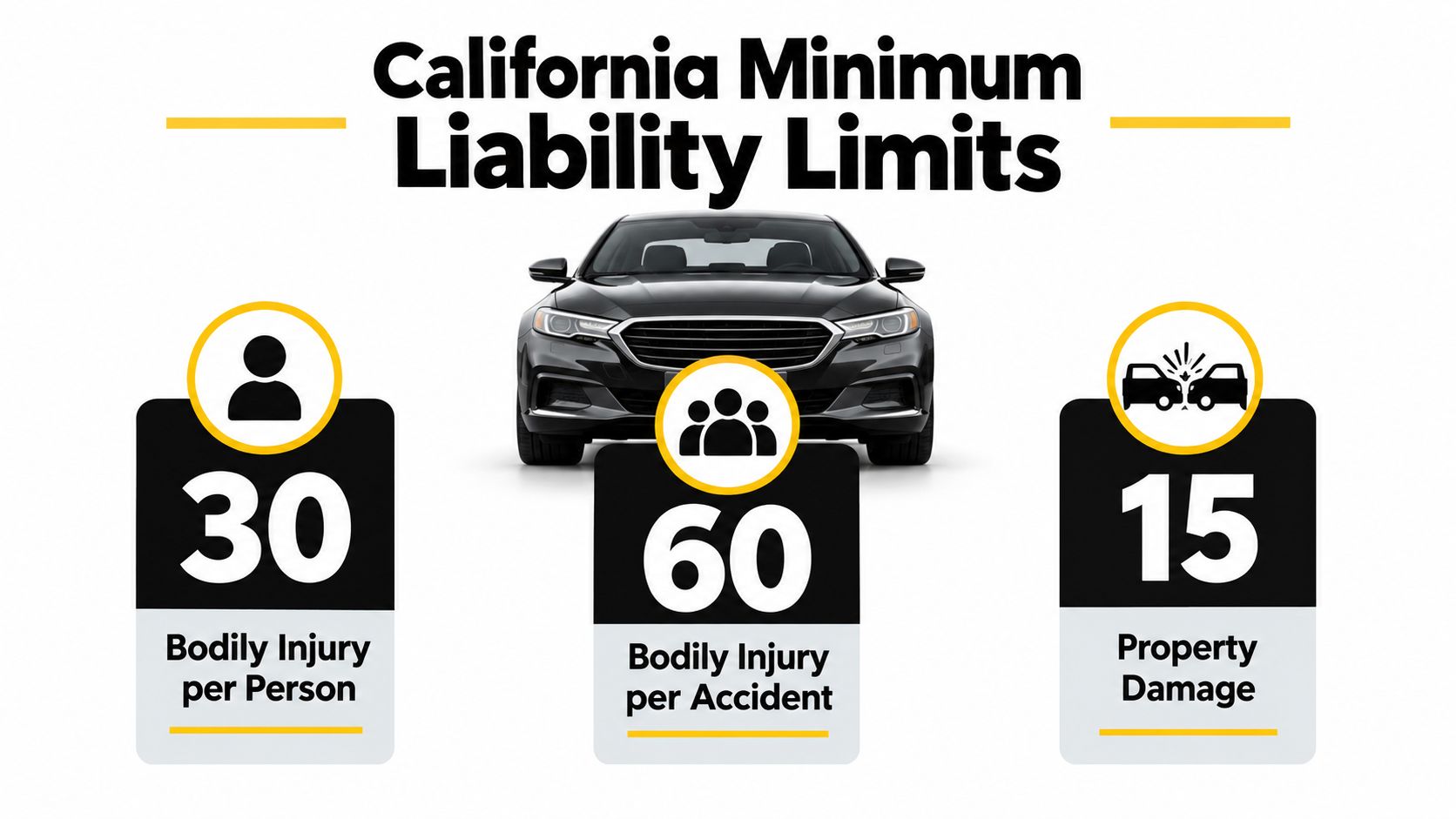
A first-time buyer may walk into the process expecting to choose any policy that says “California minimum.” That assumption can create a problem. California now requires private passenger vehicles to carry liability limits of $30,000 for bodily injury or death to one person, $60,000 for bodily injury or death to more than one person, and $15,000 for property damage. These limits are commonly called 30/60/15.
The change took effect on January 1, 2025, replacing the older 15/30/5 structure that California had used for decades. Policies that renew after the change may transition at renewal, so a driver buying or renewing coverage needs to review the declarations page rather than assume an older policy still reflects the current baseline. The California minimum coverage requirements are useful for checking how the limits apply to your situation.
What 30/60/15 actually protects
Liability insurance pays for damage or injuries you cause to other people, subject to your policy limits. It doesn't repair your own vehicle after a crash, and it doesn't automatically cover your medical expenses. The 30/60/15 limit is a legal floor, not a promise that every loss will be fully covered.
For example, the first number applies to one injured person. The second is the maximum bodily injury liability available for everyone injured in one accident. The property-damage limit applies to damage you cause to another vehicle, structure, or other property. A serious collision can create obligations that exceed these limits, which is why I recommend treating minimum coverage as a compliance option rather than an automatic protection recommendation.
Practical rule: Compare every quote at 30/60/15 first, then price higher liability limits before deciding that the lowest premium is acceptable.
California's Department of Motor Vehicles requires financial responsibility for vehicles operated or parked on California roads. You also need to carry evidence of insurance in the vehicle and provide it when requested by law enforcement, during registration-related transactions, or after a collision. You can review the state's requirements through this guide to auto insurance in California.
That connection matters. Insurance isn't separate from registration and daily driving. If your coverage lapses, you can face problems when using the vehicle on public roads even if the car itself is mechanically sound. Start your search by entering the 30/60/15 limits correctly, verify that the policy is active on the right date, and save proof where you can access it immediately.
Getting Ready to Shop and Comparing Quotes the Smart Way
Accurate information produces usable quotes. Before contacting an insurer or comparison agency, collect the details that affect eligibility, rating, and policy setup. A rushed application with an incorrect vehicle identification number or incomplete driving history can create a quote that changes later.
Build your quote file first
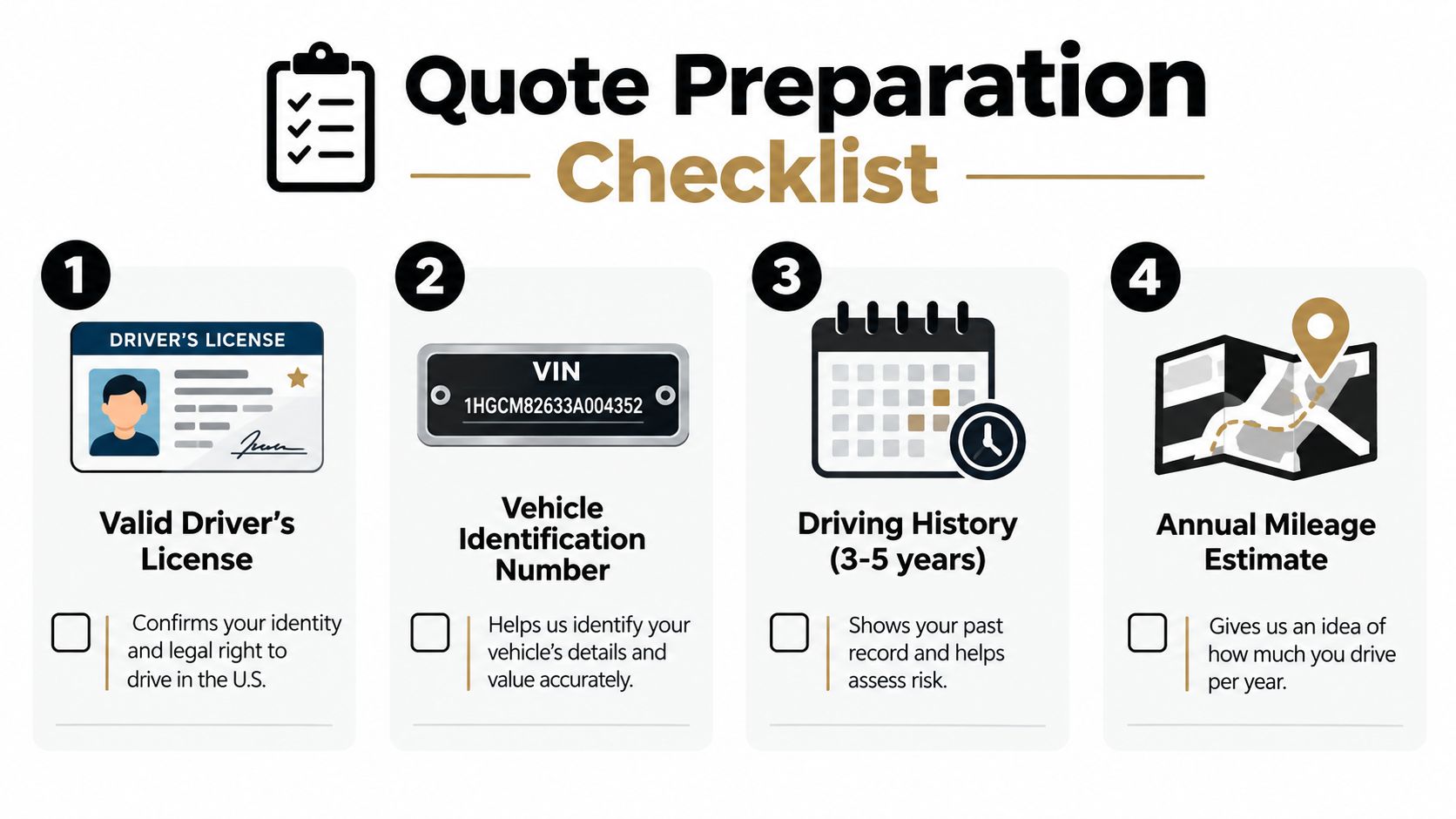
Have your valid driver's license, vehicle identification number, registration information, garaging address, and the names of every household driver ready. If you're insuring a recently purchased vehicle, use the VIN from the vehicle or purchase documents instead of guessing from memory.
You'll also need the vehicle's year, make, model, ownership or financing status, and estimated annual mileage. Answer questions about prior insurance and driving history. A carrier can revise a quote when the final application doesn't match the information used for the initial estimate.
Use this preparation checklist:
- Confirm every driver: Include licensed household members who may regularly use the vehicle.
- Verify the vehicle: Check the VIN character by character and identify whether a lender or lessor has an interest in the car.
- Review prior coverage: Note the current insurer, policy dates, and any lapse in coverage.
- Estimate mileage realistically: Use your commute, regular errands, and recurring trips instead of selecting an arbitrary low figure.
Compare equivalent policies
Never compare one carrier's minimum-liability quote with another carrier's full-coverage quote. Put the same liability limits, deductibles, vehicle use, drivers, and optional protections into each request. Only then can you tell whether a lower price reflects a better rate or just less protection.
A quote is also not a policy. Before paying, verify the effective date, listed vehicles, named drivers, deductibles, exclusions, and lender requirements. If you want a good starting point, you can get an insurance quote and use the resulting information as one comparison point.
Check the insurer, not only the price
California's insurance guidance emphasizes that rates, coverage terms, and insurer reliability vary across carriers. Confirm that the company is licensed to sell the coverage you're purchasing in California, especially if you're shopping through an unfamiliar website or dealing with a difficult risk.
Ask what happens if the carrier cannot complete underwriting, whether the quote is subject to inspection or documentation, and when proof of insurance becomes available. The right quote is one you can bind, maintain, and use when you need it.
Choosing Your Coverage Levels and Useful Add Ons
The legal minimum answers only one question: can you meet California's financial-responsibility requirement? It doesn't answer whether you can afford the consequences of a major crash, theft, vandalism, or damage caused by another driver.
Start with liability. Higher bodily injury and property damage limits cost more than 30/60/15, but they provide a wider buffer when your assets, income, family obligations, or regular driving exposure make the minimum uncomfortable. I generally view higher limits as the first protection upgrade to price because liability claims can affect more than the vehicle itself.
Match physical damage coverage to the car
Collision coverage helps pay to repair or replace your vehicle after a covered crash, subject to the deductible. Other-than-collision coverage addresses non-collision losses such as theft, vandalism, and certain natural-disaster damage. If you finance or lease the vehicle, the lender or leasing company will generally require physical damage protection under the contract.
For an older vehicle with limited market value, price the premium and deductible against what the vehicle is worth and what you could reasonably pay after a loss. For a newer, financed, or valuable vehicle, dropping collision or other-than-collision can leave you responsible for the loan balance or replacement cost after a covered loss.
A budget commuter might choose liability protection first and decide whether physical damage coverage makes financial sense. A driver with a financed vehicle should treat lender requirements as mandatory. Someone who owns an older vehicle outright may choose liability plus collision, or neither, depending on the vehicle's value and personal reserves.
Don't overlook uninsured motorists
California's Department of Insurance tracks uninsured-motorist exposure and specifically advises drivers to ask whether uninsured-motorist property damage is available when collision coverage isn't carried. Uninsured and underinsured motorist coverage can help address losses caused by a driver who has no insurance or insufficient limits.
That protection deserves a direct quote in California. A policy that looks inexpensive because it excludes useful protection may become expensive after a collision with an inadequately insured driver. Ask how bodily injury and property damage options work, whether they can be rejected, and what restrictions apply.
Set deductibles deliberately
A deductible is the amount you pay toward a covered physical-damage claim before the insurer pays the remaining covered loss. A higher deductible may reduce the premium, but it transfers more immediate cost to you. Choose an amount you could pay without borrowing money or skipping essential bills.
For plain-language explanations of policy choices and related protection topics, use the insurance guides while reviewing each quote. The goal isn't to buy every available add-on. It's to identify the losses you could not comfortably absorb and insure those first.
Saving Money Without Sacrificing Protection
California insurance pricing requires disciplined comparison. A widely cited 2025 estimate placed average annual full-coverage car insurance at $2,309, while minimum-liability coverage averaged about $751 per year, or roughly $63 per month, according to Insurify's California car insurance cost analysis. That comparison shows why your first decision, minimum liability or broader coverage, has such a direct effect on the bill.
The same source reported average full-coverage premiums around $2,333 at the end of 2025, while the California Department of Insurance noted upward premium pressure after the new minimum limits took effect. California drivers have also faced more than 30% cumulative increases since 2022, and insurers covering roughly 85% of the market raised premiums by more than one-third from 2023 to 2025, as summarized by California auto insurance laws and rates.

Reduce the bill in the right order
Begin with multi-carrier quotes using identical limits. Then ask about discounts tied to safe driving, multiple policies, vehicle safety features, defensive-driving qualifications where applicable, and payment arrangements. Insurers evaluate driver and vehicle information differently, so one carrier's price may not predict another carrier's price.
Bundling auto with home insurance or renters insurance can simplify billing and may produce a package discount. Renters insurance in California is commonly estimated at about $155 per year, or roughly $13 per month, according to NerdWallet's California renters insurance guide. Don't assume a bundle is cheaper, though. Compare the combined price against separate policies and confirm that the coverage remains suitable.
Your driving record and vehicle history also matter. Before buying a used car, review guidance on how car history affects premiums, then ask insurers how the vehicle's condition, claims history, and safety equipment may affect eligibility or pricing.
Use the California Low Cost option when necessary
If standard premiums exceed your budget, check whether you qualify for the California Low Cost Auto Insurance Program. It can provide a legal path for eligible low-income drivers, but it isn't a substitute for comparing regular-market coverage when you can afford broader protection.
Don't save money by removing coverage you need. A lower deductible can increase the premium, while a higher deductible can lower it but expose you to a larger bill. Review California insurance information for practical topics, then make one change at a time so you understand what reduced the price.
Providing Proof of Insurance and Handling Special Situations
A policy isn't fully useful until you can prove it. California requires evidence of financial responsibility in the vehicle, and you may need to provide it during a traffic stop, registration renewal, or after a collision. Keep a current insurance card in the car and store a digital copy where you can retrieve it without relying on an email search.
Check the policy number, vehicle description, named insured, insurer, and effective dates before driving. If you replace a vehicle, add a driver, move, or change how you use the car, tell the insurer promptly. Small administrative errors can become serious complications after a loss.
Keep it accessible: Active coverage that you can't document at the roadside is an avoidable operational problem.
When standard coverage is difficult to find
Drivers with serious violations, an SR-22 requirement, prior cancellations, a lapse, multiple claims, or unusual vehicle use may need a nonstandard market. An SR-22 is a filing that can demonstrate required financial responsibility after certain driving-related events. It isn't a separate type of insurance, so ask the carrier whether it can issue the filing and what policy conditions apply.
High-risk or wildfire-affected areas can also limit ordinary options. Check that every carrier is licensed in California, compare available terms, and ask whether the policy includes location-specific exclusions or inspection requirements. California's consumer guidance supports checking licensing and shopping across carriers because availability, rates, and policy terms differ.
If an insurer won't provide a quote, ask why. The reason may be vehicle eligibility, territory, driving history, documentation, or underwriting capacity. Then consider a licensed agent, a nonstandard carrier, or the California Low Cost Auto Insurance Program if you meet its requirements. A non-renewal notice deserves immediate attention because waiting can leave you scrambling close to the expiration date.
Protect yourself after a collision
Report a collision according to your policy instructions and preserve photos, contact details, repair information, and correspondence. If the crash wasn't your fault, ask how the claim will affect repairs, temporary transportation, and any available uninsured-motorist benefits.
A vehicle can also lose market value after an accident even after repairs. For an explanation of the legal issues surrounding that type of loss, review this resource on a diminished value lawyer. It isn't a replacement for your policy or claims adjuster, but it can help you identify questions to raise after a substantial collision.
Your Next Steps to Stay Covered and Confident
Getting car insurance in California becomes manageable when you follow a fixed order. Confirm the 30/60/15 legal baseline, collect accurate driver and vehicle information, compare equivalent quotes, choose liability and physical-damage coverage deliberately, and keep proof available after the policy is active.
Review the declarations page whenever the policy renews. Check the vehicles, drivers, addresses, limits, deductibles, lender information, and effective dates. A move, new job, new vehicle, added household driver, financing change, or change in driving habits can justify a fresh quote.
Keep a simple annual review habit
Use this short review:
- Verify compliance: Confirm that the policy meets California's current liability requirements.
- Reprice the policy: Request comparable quotes rather than accepting the renewal automatically.
- Reassess the vehicle: Consider whether collision and other coverage still fit the vehicle's value and your finances.
- Review household policies: Compare auto with home insurance or renters insurance, and consider whether life insurance needs have changed.
- Check high-risk options: If you receive a non-renewal or can't find standard coverage, contact a licensed agent before the policy ends.
Don't wait until a collision or DMV request exposes a documentation problem. Save the insurance card in the vehicle, keep a digital copy, and know how to reach your insurer's claims department.
For drivers who want help comparing carriers, Mai & Associates offers California auto insurance quotes along with home insurance, renters insurance, and life insurance support. The agency also handles coverage reviews for high-risk areas, including California Fair Plan and wildfire protection questions, so you can address related coverage gaps instead of treating car insurance as an isolated purchase.
Visit Mai & Associates to compare California auto insurance quotes with licensed guidance on limits, deductibles, and difficult-to-place risks. Request a no-obligation review today, and bring your current policy, vehicle information, and renewal date so an agent can help you move from a basic quote to dependable coverage.