How to Get California Auto Insurance: A Practical Guide
Getting auto insurance in California might seem complicated, but it really just boils down to a few key steps. You'll need to gather your information, figure out how much coverage you actually need, shop around for the best prices, and then seal the deal.
The most important part? Making sure you're both legally covered and financially protected before you ever have to file a claim.
Your Guide to California Auto Insurance
Let's be honest, finding the right auto insurance in the Golden State can feel like a chore. California has some of the highest premiums in the country for a reason—we've got everything from bumper-to-bumper traffic in LA to unique risks like wildfires. This guide is here to cut through all that noise and give you a straightforward plan for getting covered without breaking the bank.
We’ll walk you through the whole thing. We'll start with what paperwork to have ready, break down what all the coverage terms actually mean, and give you some pro tips for comparing quotes effectively.

For most drivers here, the real challenge is finding that sweet spot between great protection and a monthly payment that doesn't make you wince.
This is where working with an independent agency for your California insurance needs really pays off. Instead of you having to call a dozen different companies, we do the heavy lifting. We shop the market across multiple carriers for auto insurance, home insurance, renters insurance, and life insurance to find you the best possible deal.
If you want to dig a little deeper, feel free to explore our full library of insurance guides and resources.
Your California Auto Insurance Checklist
To help you see the entire process at a glance, we've put together a simple checklist. Think of it as your roadmap—from getting your documents in order to having your new policy active.
| Phase | Key Action | What You Need |
|---|---|---|
| Preparation | Gather Documents | Driver's License, Vehicle Identification Number (VIN), Address |
| Education | Understand Coverage | Learn about liability, collision, comprehensive, and uninsured motorist |
| Shopping | Compare Quotes | Review offers from multiple carriers to find the best rate |
| Finalization | Purchase & Activate | Make your first payment and receive your insurance ID cards |
Following these steps will ensure you're organized and ready to make an informed decision. Now, let's dive into the details.
Getting Your Ducks in a Row: What You'll Need
Before you even start shopping for auto insurance quotes, it's a good idea to get all your information together. Think of it like gathering your ingredients before you start to cook—it just makes the whole process faster and way less stressful. When you have everything on hand, an agent can give you a precise quote without any guesswork.
Insurers need these details to get a clear picture of who and what they're insuring. It's all about assessing risk, which is what ultimately determines your premium for any type of California insurance.
Who's Behind the Wheel?
First things first, the insurance company needs to know about every single person who will be driving the car. This is probably the biggest piece of the puzzle when it comes to your rate.
For every driver on the policy, make sure you have:
- Full Legal Name and Date of Birth: This is the basic starting point.
- Driver’s License Number: This is key. It lets the insurer look up your driving record, officially known as a Motor Vehicle Report (MVR), which lists any tickets or accidents.
- Home Address: Where you live and park your car matters a lot.
- Driving History: Be prepared to talk about any accidents or violations from the last 3-5 years. It’s always best to be upfront about this; they’re going to run your record anyway.
I can't tell you how many times people think they can "forget" a minor fender-bender from a couple of years back to save a few bucks. Insurers always find it, and it's much better to be transparent from the start. Trust me, it helps build a better relationship with your agent and carrier.
Having a clean driving record and showing you’ve had continuous insurance coverage in the past are two of the best ways to get a lower quote right out of the gate.
What Are You Driving?
Next up is the vehicle itself. The car you drive plays a massive role in what you'll pay. It’s no surprise that a shiny new sports car is going to cost more to insure than a 10-year-old sedan with top-notch safety ratings.
Here’s the car info you'll want to have ready:
- Vehicle Identification Number (VIN): This unique 17-digit code is like your car's social security number. It tells the insurer everything from the engine size to where it was built.
- Make, Model, and Year: For example, a 2022 Toyota Camry.
- Ownership Status: Do you own the car outright, are you financing it, or is it a lease? If you have a loan or lease, your lender will have their own insurance requirements you'll need to meet.
Where and How You Drive
Finally, insurers need to know a bit about your driving habits and where the car lives. Your garaging address—where the car is parked most nights—is a surprisingly big deal. Parking a car in a busy part of Glendale carries different risks, like theft or dings, than keeping it in a quiet suburban garage in Escondido.
You’ll also need to know:
- Primary Use: Is this your daily commuter car for work, used for business errands, or just for weekend pleasure trips?
- Annual Mileage: Be realistic about how many miles you drive each year. Driving less usually means you’ll pay less.
With all this information gathered, you’re in the perfect position to get a fast and accurate insurance quote without any last-minute scrambling.
Decoding California's Auto Insurance Requirements
Before you can get on the road, you need to understand what your auto insurance policy actually covers. It’s easy to get tangled up in the terminology, but in California, it all starts with the state's minimum liability requirements. Think of these as the absolute baseline you need to drive legally.
California law requires a liability structure known as 15/30/5. At first glance, those numbers might seem random, but they represent thousands of dollars in protection and define what an insurer will pay if you cause an accident.
What 15/30/5 Really Means
Let's unpack what this trio of numbers actually stands for. Each one corresponds to a specific type of damage you could be on the hook for after a crash.
- $15,000 Bodily Injury Liability per Person: This is the maximum your policy will pay for injuries to a single person in an accident you cause.
- $30,000 Bodily Injury Liability per Accident: This is the total your insurer will pay for all injuries combined in one accident, no matter how many people are hurt.
- $5,000 Property Damage Liability per Accident: This is the most your policy will cover to repair or replace the other person's car or any property you damaged, like a fence or mailbox.
These minimums are the legal floor, not a recommended safety net. They exist to offer a very basic level of financial recourse for others on the road.
Why State Minimums Are Rarely Enough
While carrying 15/30/5 coverage keeps you legal, it often falls dangerously short of covering the true costs of an accident today. A simple fender-bender can easily blow past the $5,000 property damage limit, and even minor injuries can quickly eclipse the $15,000 cap for one person.
Imagine this common scenario: you rear-end a newer SUV in Glendale. The driver and their passenger both complain of neck pain. The repair estimate for their vehicle comes to $9,000, and their combined medical bills hit $25,000.
Your minimum policy would cover just $5,000 for the car repairs and the full $25,000 for the medical bills (since it’s under the $30,000 per-accident limit). You would be personally responsible for the remaining $4,000 in vehicle damages, forcing you to pay out-of-pocket or even face a lawsuit for the difference.
This is exactly why most insurance professionals, including our team here at Mai & Associates, strongly advise clients to get higher liability limits. Opting for more robust protection, like 100/300/50, creates a much stronger financial shield for a relatively small increase in your premium.
To get started, the infographic below shows the essential documents you'll need to have handy.
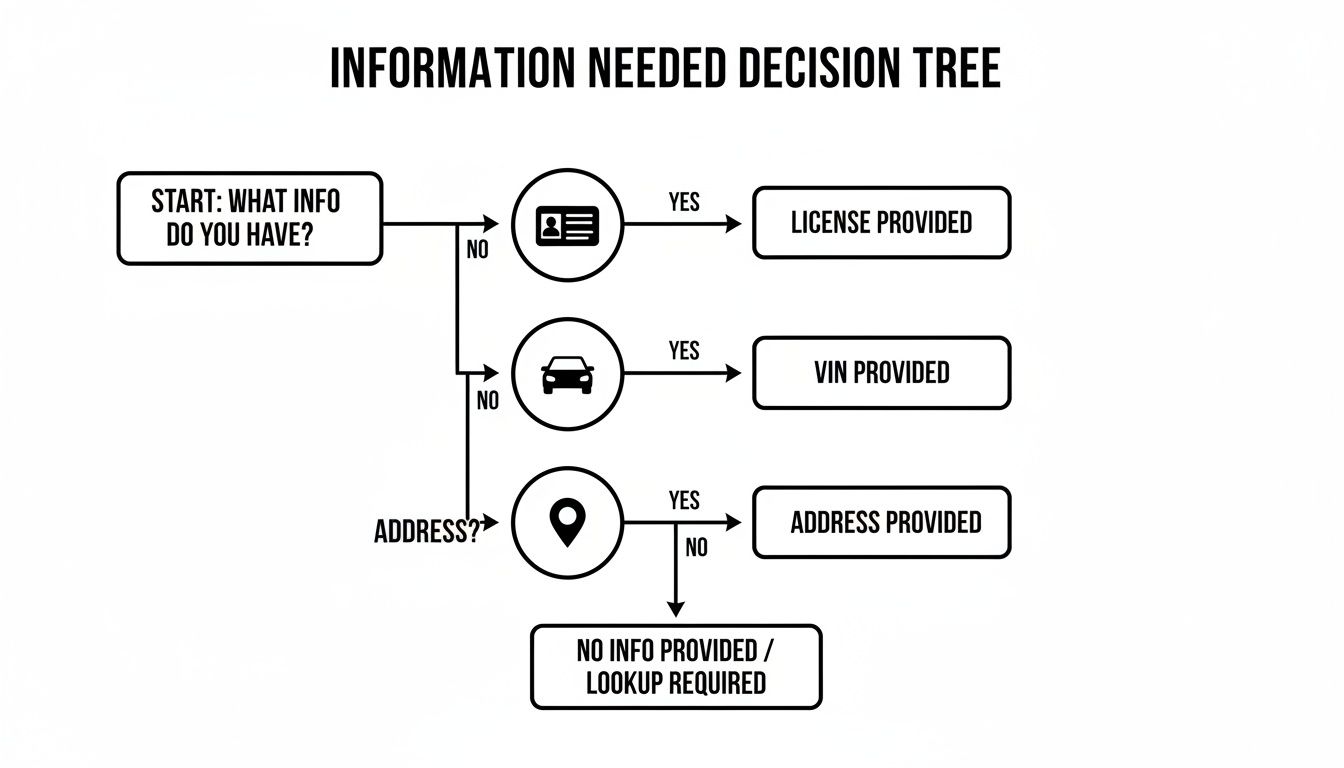
As the flowchart shows, your driver's license, vehicle VIN, and current address are the three core pieces of information every insurer needs to build an accurate quote for you.
Building a Stronger Policy Beyond Liability
To truly protect yourself and your own vehicle, you need to look beyond just liability. Optional coverages are what repair your car and cover a wider range of incidents, especially those common in California. The two most important are Collision and Comprehensive.
- Collision Coverage: This pays to fix or replace your car if it's damaged in a crash with another vehicle or an object (like a pole or guardrail), no matter who was at fault.
- Comprehensive Coverage: Sometimes called "other than collision," this protects you from damage caused by things like theft, vandalism, fire, falling objects, or natural disasters—a crucial coverage in wildfire-prone areas like Escondido.
With vehicle thefts on the rise, having Comprehensive is more important than ever. If your car gets stolen from your driveway in Costa Mesa, this is the coverage that helps you replace it. If you ever get stuck on these or other insurance terms, our auto insurance glossary offers clear, simple definitions.
One of the smartest ways to get this protection without breaking the bank is by bundling your policies. When you combine your California auto insurance with homeowners insurance or renters insurance, carriers often give you a significant discount. You can even bundle life insurance. An agent at Mai & Associates can run the numbers to show you exactly how much you could save on your total California insurance package.
How to Compare Insurance Quotes Like a Pro

Alright, you’ve got a few auto insurance quotes in hand. Now comes the most important part: figuring out which one is actually the best deal. It’s tempting to just grab the one with the lowest monthly payment, but that's a classic mistake I see all the time.
The reality is, that super-cheap quote might have a sky-high deductible that you'd struggle to pay out of pocket, or it could be missing a key coverage you thought you had. A few minutes of careful review now can save you a world of financial pain later.
This is where you need to look past the headline price and dig into what each policy truly offers.
Make Sure It's an Apples-to-Apples Comparison
First things first, you need to line up your quotes and make sure you’re comparing the same things. Of course, a policy with bare-bones liability is going to be cheaper than one with robust protection. Your job is to standardize them.
Pay close attention to these three areas on every single quote:
- Liability Limits: Do they all match? Check that the bodily injury and property damage limits (like 100/300/50) are identical.
- Deductibles: The Collision and Comprehensive deductibles ($500, $1,000, etc.) must be the same on each quote for a fair comparison. A lower deductible always means a higher premium, so this is a huge variable.
- Optional Coverages: Did you ask for add-ons like Roadside Assistance, Rental Reimbursement, or Uninsured Motorist Protection? Make sure they're either included or excluded across all the quotes you're looking at.
This is exactly where an independent agency becomes your secret weapon. Instead of you spending hours chasing down quotes and trying to normalize them, an agency like Mai & Associates does all that legwork for you. We can pull real-time rates from multiple carriers and lay them out in a simple, easy-to-read format so you know you're making a true apples-to-apples decision.
Once you’ve standardized the numbers, you can finally see which insurer is giving you the best price for the exact protection you want. For a deeper dive, it helps in understanding car insurance costs and how you can pay less so you know what factors are driving the numbers.
The Independent Agency Advantage
Trying to navigate the California insurance world alone can feel overwhelming. That’s why so many drivers in California team up with an independent agency. Think of us as your personal insurance shoppers, giving you access to rates and insider knowledge you just can't find on your own. For a closer look at your options, take a peek at our guide to auto insurance in Los Angeles.
Here’s what you get when you work with an independent agent:
- More Choices: We partner with a whole host of insurance companies—from the big national players to smaller regional specialists—to find the one that’s the perfect match for your situation.
- Real Expertise: We know the little details that don't show up on a quote summary. We can tell you which company has a stellar claims department or which one offers a unique endorsement that’s perfect for you.
- One-Stop Shop: We can help you compare not just car insurance, but also your home insurance, renters insurance, and life insurance. This is the easiest way to unlock some serious bundling discounts.
It's Not Just About the Price Tag
While cost is obviously a huge factor, it shouldn’t be the only one. The cheapest policy on the market is completely useless if the company is impossible to deal with when you actually need to file a claim.
Before you sign on the dotted line, take a second to check out the insurer's reputation. What are people saying about their customer service? How do they rank for claims satisfaction? A company that’s fair, responsive, and efficient during a stressful time brings a peace of mind that’s worth way more than the few bucks you might save each month.
In California, where risks like wildfires can impact your vehicle, having solid comprehensive coverage is a must. An agent can also help you plug critical gaps, like uninsured motorist protection—which is incredibly important when nearly 13% of drivers in the U.S. are on the road without any insurance at all.
Uncovering Every Last Discount to Slash Your Premium
After you've lined up a few quotes and can compare them apples-to-apples, it's time for the fun part: discount hunting. This is where you can really make a dent in your premium. Most drivers don't realize just how many savings are out there, and they end up leaving serious money on the table every year. This isn't just about checking a few boxes; it's a conversation with your agent to make sure you're not paying a penny more than you have to.
A good, experienced agent will do more than just take down your information—they'll actively look for ways to save you money. Here at Mai & Associates, we make it a point to ask about your job, how much you drive, and what safety features your car has. It’s our job to find every discount that applies to you for all your California insurance policies.
The Power of Bundling
If there's one "magic bullet" for lowering your insurance costs, it's the multi-policy discount. Insurers really value loyalty, and they'll give you their best rates when you trust them with more of your business. It's a win-win.
You can often unlock major savings by bundling your California car insurance with other policies, such as:
- Home Insurance: This is the classic combo and usually offers the biggest discount. It's especially crucial for homeowners in high-risk areas.
- Renters Insurance: Don't own a home? No problem. Bundling with renters insurance still knocks a decent amount off your premium.
- Life Insurance: While it's less common, combining life insurance with your auto policy is another smart way to cut down your total insurance bill.
We recently had a client near a high-risk wildfire zone in Escondido who saved 25% just by bundling their home and auto insurance. It’s a simple move that adds convenience and delivers real savings.
Digging for Personal and Vehicle Discounts
Beyond bundling, there's a whole world of discounts tied to you, your driving habits, and the car you own. Many of these are easy to get, but you won’t get them if you don’t ask.
Be sure to check if you qualify for these common savings:
- Good Student Discount: Got a student on your policy with a "B" average or higher? That's a discount right there.
- Low-Mileage Program: If you work from home or just don't drive much, let your insurer know. Fewer miles on the road means lower risk and a lower premium for you.
- Vehicle Safety Features: Modern cars are packed with safety tech. Anti-theft systems, anti-lock brakes, and airbags all help reduce your rate because they make your car safer.
- Pay-in-Full Discount: If you have the cash, paying your entire six- or twelve-month premium upfront almost always comes with a nice little discount.
One of the best discounts is also the simplest: be a good driver. A claims-free discount can save you 15-20% after just three years without an accident. It's the ultimate reward for staying safe on the road.
Finally, timing can play a role. A recent report showed that global commercial insurance rates fell for the fifth quarter in a row in Q3 2025 because of intense competition among insurers. While auto insurance in the U.S. has faced pressures from rising repair costs, the competitive market is still great news for consumers. It means now is an excellent time for California drivers to shop around and lock in a good rate. You can explore more about these global market trends on marsh.com to see the bigger picture. Working with an agency that keeps a pulse on these industry cycles can give you a real advantage.
Bringing Your Policy to Life: The Final Steps
You've done the hard work of comparing quotes and found the perfect policy. Now it's time to make it official. The final step is activating your coverage, which is usually as simple as making your first payment.
Think of this initial payment as the "on" switch. Once it's processed, your coverage is legally bound, and you're good to go. Your new insurance company will immediately send over your proof of insurance, which includes your ID cards and full policy documents. Make sure to stash a copy of that ID card in your glove compartment—and maybe save a digital version on your phone, too.
Get Set Up for Success
With your policy now active, a few quick moves can save you a lot of headaches later on. First, set up automatic payments. It’s the easiest way to guarantee you never miss a payment and risk a lapse in coverage, which can be a real nightmare.
Next, take two minutes and save your insurer’s claims hotline and customer service number in your phone's contacts. If you ever get into an accident, you’ll be rattled, and the last thing you want to do is scramble to find a phone number.
Your insurance agent isn't just there to sell you a policy. We're your advocate and resource for the long haul. Our job is to answer your questions, clarify your coverage, and guide you step-by-step through the claims process if the unexpected happens.
Why an Annual Check-In is Non-Negotiable
Your life changes, right? You might buy a house, get a new car, or add a teenage driver to the family (good luck!). Your insurance needs to change right along with you, which is why a yearly policy review is so important.
This quick chat is the perfect time to make sure your auto insurance still fits your life. It's also a great opportunity to explore new discounts or see if bundling your auto with home insurance, renters insurance, or even life insurance could save you a significant amount of money. Here at Mai & Associates, we make this a priority, reaching out to our clients for these yearly check-ins to ensure your protection always makes sense for your current situation.
Common Questions About California Auto Insurance
Let's be honest, figuring out car insurance can feel like a maze, especially with California's specific set of rules. Getting straight answers is the best way to feel good about the coverage you choose. We've pulled together some of the most frequent questions we hear from drivers to clear things up.
One of the first things people ask, especially when they're at the dealership ready to buy a car, is "How fast can I get insured?" You'll be glad to know you can almost always get covered the same day you apply. The process is built for speed—once you pick a policy and make the first payment, your proof of insurance usually lands in your inbox instantly.
This is a lifesaver when you need to show proof of insurance before driving your new car home. Working with an independent agent like us can really speed things along, getting you quotes and binding coverage right when you need it.
What if My Driving Record Isn't Perfect?
Maybe you've had a few bumps in the road. A less-than-perfect driving history or an SR-22 requirement doesn't mean you can't get insured in California. While some mainstream carriers might say no, plenty of others specialize in helping drivers who are considered higher risk.
It's important to know that an SR-22 isn't actually insurance. It’s simply a form, a certificate of financial responsibility, that your insurance company files with the DMV for you. Yes, your rates will likely be higher, but a good agent can shop around to find the most manageable price and give you practical advice on how to improve your record over time to bring those costs down.
One of the biggest—and most welcome—surprises for people moving to California is that their credit score has no impact on their auto insurance rates.
California is one of the few states that legally bans insurers from using credit history to calculate your premium. Instead, companies have to focus on what actually matters: your driving.
Factors that do affect your rates in California include:
- Your official driving record (any accidents or tickets)
- How many miles you drive each year
- Your years of driving experience
This law is a huge consumer protection, making sure your rates are based on your behavior behind the wheel, not your bank account.
What Does My Policy Really Cover?
It's natural to wonder what your policy covers beyond a standard fender-bender. For example, a cracked windshield is a common headache, and many drivers aren't sure how it's handled. Comprehensive coverage is the part of your policy that deals with non-collision damage, and you can learn more about whether your insurance coverage for windshield replacement falls under that protection.
It’s a perfect example of how different types of insurance—like auto insurance, home insurance, renters insurance, and life insurance—are all designed to protect you from very specific, and very different, kinds of risk.
Ready to find a California insurance policy that truly fits your life and budget? The licensed agents at Mai & Associates are here to help. We do the heavy lifting, comparing quotes from California's top carriers for your auto insurance, home insurance, renters insurance, and car insurance needs to find you great coverage at a great price. Get your free, no-obligation quote today at https://cahomeauto.com.