How to File a Car Insurance Claim in California
The process of filing a car insurance claim doesn't start in an office or on the phone—it begins the second an accident happens. What you do right there at the scene lays the groundwork for everything that follows. The key is to prioritize safety, exchange information without admitting fault, and meticulously document everything with your phone. Get these first steps right, and you're already on the path to a smoother claims process for your car insurance.
What to Do Immediately After a Car Accident
The minutes after a collision are a blur of adrenaline and confusion. It's completely normal to feel shaken up. But the actions you take in this critical window can make all the difference for your safety and your future insurance claim. Knowing how to handle the scene is the first real step in your auto insurance claim.
First things first: safety. If you can, move your car out of the flow of traffic to the shoulder. Flip on your hazard lights immediately to warn other drivers. Before you even think about getting out, do a quick check on yourself and your passengers for any injuries. If anyone is hurt, even if it seems minor, call 911 right away.
Securing the Scene and Getting Help
Even for a small fender-bender in California, it's almost always a good idea to call the police. An officer can secure the area, keep things from escalating, and, most importantly, create an official police report. Think of this report as a neutral, third-party account of the accident—it’s an incredibly valuable piece of evidence for your insurance adjuster.
When you talk to the other driver, stay calm. The goal is to swap information, not to argue about who’s to blame. This is crucial: never apologize or say anything like "It was my fault." Comments like that can be legally interpreted as an admission of guilt and used against you later. Just stick to the facts.
Expert Tip: A formal police report provides an unbiased narrative of the incident. This single document can significantly strengthen your claim, giving the insurance company a credible, official source to work from during their investigation.
Using Your Phone to Gather Critical Evidence
Your smartphone is your best friend at an accident scene. Before any cars are moved, turn it into your primary evidence-gathering tool.
- Capture the Big Picture: Take wide shots of the entire scene from several different angles. Make sure you get the positions of the cars, nearby traffic signs, and any skid marks.
- Zoom in on the Damage: Get detailed, close-up photos of the damage to your car and the other vehicle. Don't forget to snap a clear picture of the other car's license plate.
- Document the Conditions: Were the roads wet? Were there any huge potholes, or was there construction that might have been a factor? Take pictures of anything that seems relevant.
This simple flow shows you exactly what to focus on in those first chaotic moments.
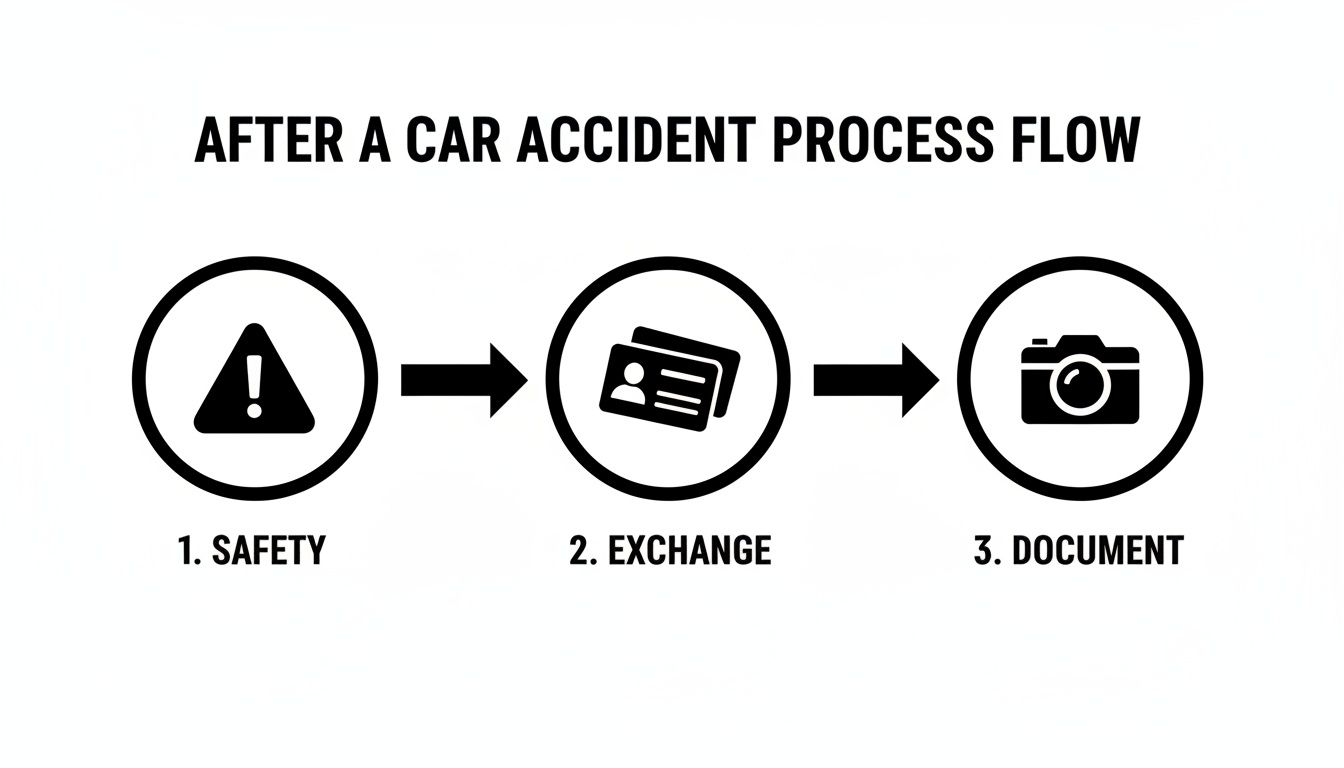
Remembering this sequence—Safety, Exchange, Document—is the key to building a solid foundation for your insurance claim. Before you leave, it's wise to have a checklist of all the information you need to gather.
Here is a quick-reference table outlining the essential details to collect from everyone involved and the scene itself.
At-the-Scene Information Checklist
| Information Category | Details to Collect | Why It's Important |
|---|---|---|
| Driver & Passenger Info | Full name, address, phone number, driver's license number. | Required for your insurer to contact all parties involved in the claim. |
| Vehicle Details | Make, model, year, color, license plate number, VIN. | Helps accurately identify the specific vehicles in the accident. |
| Insurance Information | Insurance company name, policy number, agent's contact info. | This is the core information needed to file a claim with their provider. |
| Accident Scene Details | Date, time, location (street names, nearest mile marker). | Establishes the official record of when and where the incident occurred. |
| Witnesses | Names and contact information of anyone who saw the accident. | Independent witness statements can be powerful supporting evidence. |
| Police Officer Info | Officer's name, badge number, and the police report number. | Crucial for obtaining a copy of the official report for your claim. |
Having this checklist on your phone or in your glove box can be a lifesaver, ensuring you don't miss a single critical piece of information when you're under stress.
The quality of your documentation directly affects your claim's timeline. Insurers want the "first notice of loss" (FNOL) fast, usually within 24-48 hours. Providing clear photos right away can slash claim processing time by 30–50%, helping your insurer resolve a straightforward claim in as little as 3–14 days. For more detailed breakdowns, you can explore our other California insurance guides.
Trying to remember all of this in the heat of the moment is tough. That’s where having an expert on your side comes in. A quick call to an agent at Mai & Associates can give you immediate, professional guidance on exactly what to do and say to protect your interests right from the start.
Reporting the Accident to Your Insurer
After you’ve taken a deep breath and collected everything at the scene, it’s time to officially report the accident to your insurance company. This first step is known in the industry as the "first notice of loss" (FNOL), and it's what kicks the entire claims process into gear. Don't wait on this—most insurance carriers want to hear from you within 24 to 72 hours.

You’ve got a few different ways to get this done, and each has its own benefits depending on your circumstances.
- Mobile App: This is usually the fastest route. Most apps let you upload photos and documents right from your phone, which can really get the ball rolling quickly.
- Phone Call: If your accident was complicated or you just have a lot of questions, talking to a live person is your best bet. You can explain the little details and get instant answers.
- Your Agent: Honestly, this is the most stress-free option. An agent from Mai & Associates can step in and report the claim for you, making sure every detail is accurate and presented in the best possible light from the start.
Whichever path you choose, a little prep work beforehand will make the entire conversation go much more smoothly.
Information You Need to File Your Claim
Before you open that app or pick up the phone, pull together all the notes and photos you took at the scene. Having it all in one place saves you from scrambling while you’re on the line with a claims representative.
Here’s a quick checklist of what you'll need:
- Your auto insurance policy number.
- The exact date, time, and location of the crash.
- A simple, factual account of what happened.
- The police report number, if you have one.
- The other driver’s full name, contact info, and insurance details.
- Your photos of the vehicle damage and the surrounding scene.
When you're describing the accident, just stick to what you know for sure. Avoid making guesses about things like how fast the other person was going or who was at fault. Just state the facts as you saw them—this kind of clarity helps your insurer move forward without hitting any snags.
Understanding the California SR-1 Form
Now, here in California, there's a separate but very important piece of paperwork you might have to handle yourself: the Report of Traffic Accident Occurring in California, or the SR-1 form.
You are required by law to file this form with the DMV within 10 days if the accident involved:
- Any kind of injury or, tragically, a death.
- More than $1,000 in total property damage.
Important Note: This is on you, not your insurance company. If you're required to file an SR-1 and you don't, the DMV can suspend your driver's license—even if you weren't at fault for the accident.
The form itself is pretty straightforward, asking for the basics about the drivers, cars, insurance, and a quick summary of the crash. It’s a crucial step you can't afford to miss.
How Your Mai & Associates Agent Can Help
Let’s be real—trying to keep track of forms, deadlines, and claim numbers right after an accident is overwhelming. This is exactly why having a dedicated agent from Mai & Associates in your corner makes such a difference. We can handle the initial report for you, make sure the facts are presented clearly, and walk you through every next step, including that SR-1 form. For more on policy details, take a look at our complete guide to auto insurance in California. Think of us as your personal advocate, here to get your claim started right so you can focus on what matters most.
Working with Your Insurance Adjuster
After you file your claim, you'll be assigned a claims adjuster. This person is your main point of contact at the insurance company, and their job is to figure out what happened, who's at fault, and what it's all going to cost. Think of them as the lead investigator on your case. Understanding their role is the first step to a smoother claims experience.
The adjuster will kick things off by digging into all the information you've provided—the police report, photos, your statement, and details from the other driver. From there, they'll schedule a time to inspect your vehicle's damage in person. This inspection is a pivotal moment for your claim.
Preparing for the Vehicle Inspection
To keep things moving, get organized before the adjuster shows up. Having a folder (digital or physical) with your documents ready to go can make a huge difference. Include any repair estimates you’ve already gathered and a copy of the police report. Clear, organized communication at this stage can seriously speed up the process.
The adjuster will create their own estimate for the repair costs, which will form the basis of your settlement offer.
Your Right to Choose: This is crucial for California drivers. You have the absolute right to choose which auto body shop repairs your car. Your insurance company might suggest shops in their "preferred network," but you are never obligated to use them. This puts you in the driver's seat, allowing you to work with a mechanic you already know and trust.
Comparing Repair Estimates: OEM vs. Aftermarket Parts
Once the adjuster gives you their estimate, it’s a smart move to get a couple of independent estimates from shops you trust. When you're comparing the paperwork, look closely at the type of parts they plan to use.
- Original Equipment Manufacturer (OEM): These are brand-new parts straight from your car's manufacturer, identical to the ones your car was built with.
- Aftermarket Parts: These are made by third-party companies. They're designed to fit and function like OEM parts but usually at a lower cost.
Your insurance policy will spell out which type of parts are covered. If you have your heart set on OEM parts but your policy only covers aftermarket, you may have to pay the difference out of pocket. It’s a small detail that’s worth clarifying early on. For a closer look at these and other common insurance terms, our insurance glossary is a great resource.
What Happens When a Car Is a "Total Loss"
Sometimes the damage is just too extensive. If the cost to fix your car is more than what the car is actually worth, the insurer will declare it a "total loss." We're seeing this happen more and more, especially with older cars. In fact, total-loss claims recently hit a record high, with 22.6% of all reported losses being declared total losses.
So, how do they decide? Insurers calculate your car's Actual Cash Value (ACV)—basically, what it was worth a minute before the crash. They look at the year, make, model, mileage, overall condition, and recent sales prices of similar cars in your area. If the repair bill gets close to or exceeds that ACV, it’s totaled.
The rise in total losses isn't random. While fewer accidents are being reported for collision coverage, the cost of parts and labor has skyrocketed. This has pushed some U.S. auto insurance rates up by as much as 16%. For you, this means an older car that gets into a wreck has a much higher chance of being declared a total loss than being sent to the shop. You can find out more about how these automotive insurance trends impact claims.
Negotiating a Fair Settlement Offer
What if you think the adjuster’s offer for your totaled car is too low? You don’t have to take it. You have the right to negotiate, but you need to come prepared with evidence.
Start by doing your own homework. Use resources like Kelley Blue Book or Edmunds to research your car’s value. The most powerful proof is finding listings for comparable vehicles for sale in your local area—this shows the real-world market price. Did you recently put on new tires or invest in a major repair? Dig up those receipts. They can add real value to your car and your claim.
Present your findings to the adjuster in a clear, polite, and organized way. A counteroffer backed by solid proof will always be more effective than an emotional plea. The goal is to work with the adjuster, not against them, to arrive at a fair value that truly reflects what your car was worth.
Managing Repairs and Rental Cars
Once your adjuster has inspected the damage, you can finally move on to the practical side of things: getting your car fixed and getting back on the road. This phase is all about coordinating payments, figuring out a rental car, and ultimately settling your claim. Knowing what to expect here can save you a lot of headaches and money.

The first thing on everyone's mind is usually, "Who pays the shop?" Insurance companies have a few common ways of handling this, and it often comes down to whether you choose one of their preferred shops or your own mechanic.
- Direct Payment: The simplest route. If you go with a shop in your insurer's network, they'll usually pay the shop directly for all covered repairs. You just handle your deductible.
- Check to You: Your insurer might mail you a check for the estimated cost of repairs, minus your deductible. From there, it's on you to pay the body shop.
- Joint Check: Sometimes, the check is made out to both you and the repair shop. This just means both of you need to endorse it before the shop can cash it.
No matter how the payment is handled, you'll always be responsible for your deductible. This is the amount you agreed to pay out-of-pocket when you set up your policy. You'll pay this directly to the shop when you pick up your repaired car.
Navigating Rental Car Reimbursement
If your car is going to be out of commission for a while, rental reimbursement coverage is a huge relief. But it's not a free-for-all; you need to know the limits before you rent.
Your policy spells out a daily limit (say, $30 per day) and a total limit (maybe $900 per claim). If the rental you want costs $40 a day, that extra $10 is coming out of your pocket. Likewise, if repairs drag on and you exceed that $900 total, you're on the hook for the rest.
Before you even think about booking a rental, confirm the exact coverage details with your adjuster. Get the daily and total maximums in writing so you can pick a car that fits your budget and avoid a nasty surprise on your credit card bill.
Pro Tip: Ask the repair shop for an honest, realistic timeline. If they mention that getting a specific part might cause delays, you can plan accordingly. You might opt for a cheaper rental to stretch your coverage dollars further.
Handling Supplemental Claims and Finalizing Your Settlement
It happens all the time. A mechanic starts tearing down the car and finds more damage hidden beneath the surface—a bent frame component or a cracked bracket that wasn't visible at first. When this occurs, the shop files a supplemental claim with your insurer.
This is simply a formal request for more money to cover the newly discovered, necessary repairs. Your adjuster will have to review and approve these added costs before the shop can proceed. It's a normal part of the process but be aware that it can add a few days to your repair timeline. Keep in touch with both the shop and your adjuster to make sure things don't stall.
Once the work is done and you’ve inspected your car, you'll get the final paperwork from your insurer. This almost always includes a release form. Signing it means you agree the payment is final and you release the insurance company from any more responsibility for this claim.
Do not rush this step. Read that release form carefully. Are you 100% happy with the repairs? Have all your rental car bills been handled? Once you sign, the case is closed for good. You can’t go back and ask for more money if another problem pops up later.
Avoiding Common Car Insurance Claim Mistakes
Knowing the steps to file a claim is one thing, but sidestepping the common pitfalls that can delay your payout—or shrink it—is another skill entirely. The claims process can be a minefield, and a few seemingly small missteps can have a huge impact on your final settlement. Think of it this way: knowing what not to do is just as important as knowing what to do.
Right off the bat, one of the biggest mistakes people make is simply waiting too long to report the incident. Life gets in the way after a collision, but insurers expect to hear from you promptly. We're talking within 24 to 72 hours. If you wait a week, it gives them an opening to question the details of the accident or even the severity of the damage.
Another classic error is disorganized or incomplete documentation. Blurry photos, no police report, or forgetting to grab witness information weakens your entire position. Your claim is only as strong as the evidence you bring to the table.
Don't Jump at the First Settlement Offer
After a wreck, all you want is for things to get back to normal. Insurance adjusters are well aware of this, and their first settlement offer can look mighty tempting because it promises a quick end to the whole ordeal. But that first number is almost always just a starting point—an opening bid in a negotiation.
Jumping on that offer without doing your homework can mean leaving serious money on the table, especially if your car is a total loss. The adjuster’s initial valuation might not factor in those new tires you just bought, recent upgrades, or the specific market value for your vehicle here in California.
A Pro Tip From Experience: Never say "yes" on the spot. Give yourself a day or two to breathe. Review their offer, pull up your car's value on a site like Kelley Blue Book, and gather receipts for any recent improvements. This is your leverage.
Know Your Policy Before You Need It
It’s a story we see all the time: a driver doesn't truly understand their own policy until they're trying to use it. That’s when they discover their rental car coverage has a painfully low daily limit or that they don’t have uninsured motorist protection. These are expensive surprises.
For instance, many people don't grasp the difference between their collision coverage and Uninsured Motorist Property Damage (UMPD). If an uninsured driver hits you, your collision policy will cover the repairs (minus your deductible), but UMPD is a separate, crucial protection that can save you from paying that deductible. Not knowing the specifics can cost you hundreds, or even thousands, out of pocket.
Here are the big ones to watch out for:
- Waiting Too Long: This gives the insurance company a reason to be skeptical. Report it fast.
- Accepting the First Offer: It's a negotiation. Their first number is rarely their best.
- Poor Documentation: A lack of photos, reports, and receipts cripples your bargaining power.
- Forgetting Your Agent Is on Your Side: A good independent agent is your advocate, not just someone who sold you a policy.
This is exactly where having an independent agent from Mai & Associates in your corner makes all the difference. We're here to be your advocate, translating the confusing jargon in your policy and making sure you know your rights. We can help you navigate the conversation with the adjuster, steering you clear of these common mistakes to get a fair and timely result for your car insurance claim. That same hands-on guidance applies to all your California insurance needs, from auto and home insurance to renters and life insurance.
The Financial Side: To File or Not to File?
Deciding whether to file a claim is a financial calculation. You have to weigh the immediate payout against the potential for higher premiums down the road. Recent industry data shows that while vehicle repair costs are climbing, injury-related claims are skyrocketing, with bodily injury severity jumping 9.2% in just one year.
To cover these massive payouts, many carriers are hiking up their rates. For California drivers, this means filing a claim for minor damage—something close to your deductible amount—could trigger a rate increase that costs you far more over the next few years than the repair itself. This is a critical decision point where talking to an agent before you file can save you a lot of money and regret. To see how these market forces are shaping the industry, you can explore the latest global insurance report.
Answering Your California Claims Questions
Even when you know the steps, the reality of a car insurance claim can bring up a lot of specific, often nagging, questions. Getting some clear answers ahead of time can make all the difference, giving you the confidence to make smart financial moves when you're under stress.
Here are some of the most common questions we get from California drivers, answered in plain English.
Will My Rates Go Up After Filing a Claim in California?
This is the million-dollar question, isn't it? The good news is that California has some strong consumer protection laws on this. The answer comes down to one thing: fault.
If you were not principally at fault for the accident, California law explicitly prohibits your insurance company from jacking up your rates or dropping your policy because of the claim.
Now, if you are found to be 51% or more responsible for what happened, you should probably expect to see a premium increase at your next renewal. The best way to shield yourself from this is with a policy feature called "accident forgiveness." It’s basically a one-time "get out of jail free" card for your first at-fault accident. Ask your agent if your car insurance carrier offers it—it’s worth its weight in gold.
What Happens if the Other Driver Doesn't Have Insurance?
It’s a situation that’s far too common on California roads, and it’s precisely why Uninsured/Underinsured Motorist (UM/UIM) coverage is so crucial. This is the part of your own policy that steps in to protect you when the driver who hit you can’t pay for the mess they made.
It breaks down like this:
- Uninsured Motorist Bodily Injury (UMBI): If an uninsured driver hurts you or your passengers, this covers your medical bills, lost income, and even pain and suffering.
- Underinsured Motorist (UIM): This kicks in when the at-fault driver has insurance, but their policy limits are too low to cover all your medical costs. It bridges the gap.
- Uninsured Motorist Property Damage (UMPD): This is optional coverage that pays for repairs to your car, usually up to $3,500, if you’re hit by an uninsured driver.
Without this coverage, you’re left holding the bag. It’s a non-negotiable safety net for any auto insurance policy in this state.
The Bottom Line: Think of UM/UIM as insurance against other people's irresponsibility. It makes sure you're not left financially stranded just because the person who hit you didn't have the right auto insurance coverage.
How Long Can an Insurer Legally Take to Settle a Claim in California?
Thankfully, California doesn't let insurance companies leave you hanging indefinitely. The state’s Fair Claims Settlement Practices Regulations lay out some very clear deadlines to keep things moving.
From the moment you report the claim, your insurer has to:
- Acknowledge your claim within 15 calendar days.
- Send you any necessary forms and instructions within 15 calendar days.
- Reply to any letter, email, or phone call from you within 15 calendar days.
- Formally accept or deny your claim within 40 calendar days after they get your completed proof-of-loss paperwork.
Knowing these timelines gives you real power. It allows you to hold your insurance company accountable and make sure they aren't dragging their feet.
Should I Bother Filing a Claim for Minor Damage?
This is more of a financial strategy question than a pure insurance one. There's no single right answer, but a little math can point you in the right direction.
First things first, get a repair estimate from a shop you trust.
Then, put that number side-by-side with your deductible. If the shop quotes you $600 for repairs and your deductible is $500, filing a claim only gets you $100 from the insurance company. In that scenario, paying out of pocket might be the smarter play to keep a small at-fault claim off your record. But if the damage is $2,500, filing is almost always the way to go.
A word of caution: what looks like a minor bumper scuff can sometimes hide thousands of dollars in damage to sensors, cameras, and support structures underneath. Before you decide, it’s always a good idea to talk it over with your agent. They can help you weigh the pros and cons for your specific situation.
For more answers to common questions about home insurance, renters insurance, car insurance, and life insurance, feel free to explore our comprehensive California insurance FAQ page.
Navigating a car insurance claim can feel overwhelming, but you don't have to figure it out on your own. The licensed agents at Mai & Associates are here to be your advocates, offering multilingual support and expert guidance every step of the way. For a no-obligation quote and personalized advice on all your California insurance needs, visit us at https://cahomeauto.com.