How to Dispute an Insurance Claim in California and Win
Getting that denial letter from your California insurance company can feel like hitting a brick wall. But here's something most people don't realize: it's rarely the final word. Think of it less as a "no" and more as the start of a negotiation.
When you dispute a claim, you're formally pushing back on their decision. You do this by building a logical case, backed by solid evidence, to show them exactly where their assessment of your auto insurance, home insurance, or life insurance claim went wrong. That denial letter isn't an ending; it's an invitation to provide more information.
Your California Insurance Claim Was Denied What Happens Next
Seeing a claim denied for your car insurance, home insurance, or life insurance in California is tough, but don't let it discourage you. This is just the insurance company's opening offer, not their last one.
A surprising number of initial denials are just due to simple clerical issues. It could be a missing document, some unclear information you provided, or even just an automated system that flagged something minor. Your first job is to figure out exactly why they denied it and then respond with a clear, organized argument.
And if this is happening to you, know that you're in good company. Denied claims are more common than you'd think. Recent studies show that nearly one in five insured adults (18%) had a claim denied in just the last year. This isn't isolated to one type of insurance, either—it's happening across the board with auto and home claims as insurers and policyholders clash more often.
This is a huge problem for the insurance industry. Poor claims experiences are a top reason customers leave, with some estimates suggesting that $170 billion in premiums could be at risk by 2027 as unhappy clients shop for new carriers. You can dig into the full research about these insurance claim trends to see the bigger picture.
Common Reasons for Claim Denials in California
By law, your insurance company has to give you a specific, written reason for denying your claim in California. Nailing down that reason is the first and most critical step in building your appeal. While the details of every situation are different, most denials for California auto, home, and life insurance policies fall into a handful of common buckets.
- Documentation Issues: This is easily the most common—and most fixable—reason for a denial. It can be as simple as a missing signature on a form, a failure to submit the police report after a car accident, or not providing a contractor's estimate for a home repair.
- Policy Exclusions: Every policy has a section detailing what it doesn't cover. For example, your insurer might deny a claim for water damage if it was caused by a flood and you don't have a separate flood insurance policy, a common issue in many parts of California.
- Disputes Over Liability or Cause: The insurer might argue that you were the one at fault in a car accident. For a home insurance claim, they could say the damage wasn't from a sudden, covered event but rather from a long-term maintenance issue like a slow leak you failed to fix.
- Lapsed Coverage: This one is straightforward. If your premium payment was late and your policy wasn't active on the date the incident occurred, the claim will almost certainly be denied.
A denial is not a personal judgment; it's a business decision based on the information the insurer has. Your goal is to provide new information that forces them to make a different decision.
Once you know their "why," you can start systematically taking their reasoning apart. This is how you begin to effectively dispute an insurance claim. For quick answers to other common questions, feel free to check out our extensive insurance FAQ section. This initial stage is all about setting the foundation for a successful appeal.
Gathering Your Evidence: The Definitive Documentation Checklist
Winning a California insurance dispute isn’t about who argues the loudest; it's about who has the best proof. Before you even think about writing a letter or making a call to challenge a decision, you need to build your case on a solid foundation of evidence.
Think of it like this: every photo, every email, every receipt is a brick in that foundation. A well-organized, comprehensive file tells the insurance company you're serious and that you have the facts to back up your claim. This is how you shift the conversation from their opinion to your proof.
This is a critical step because a denial letter is rarely the final word. It's often just the start of a negotiation.
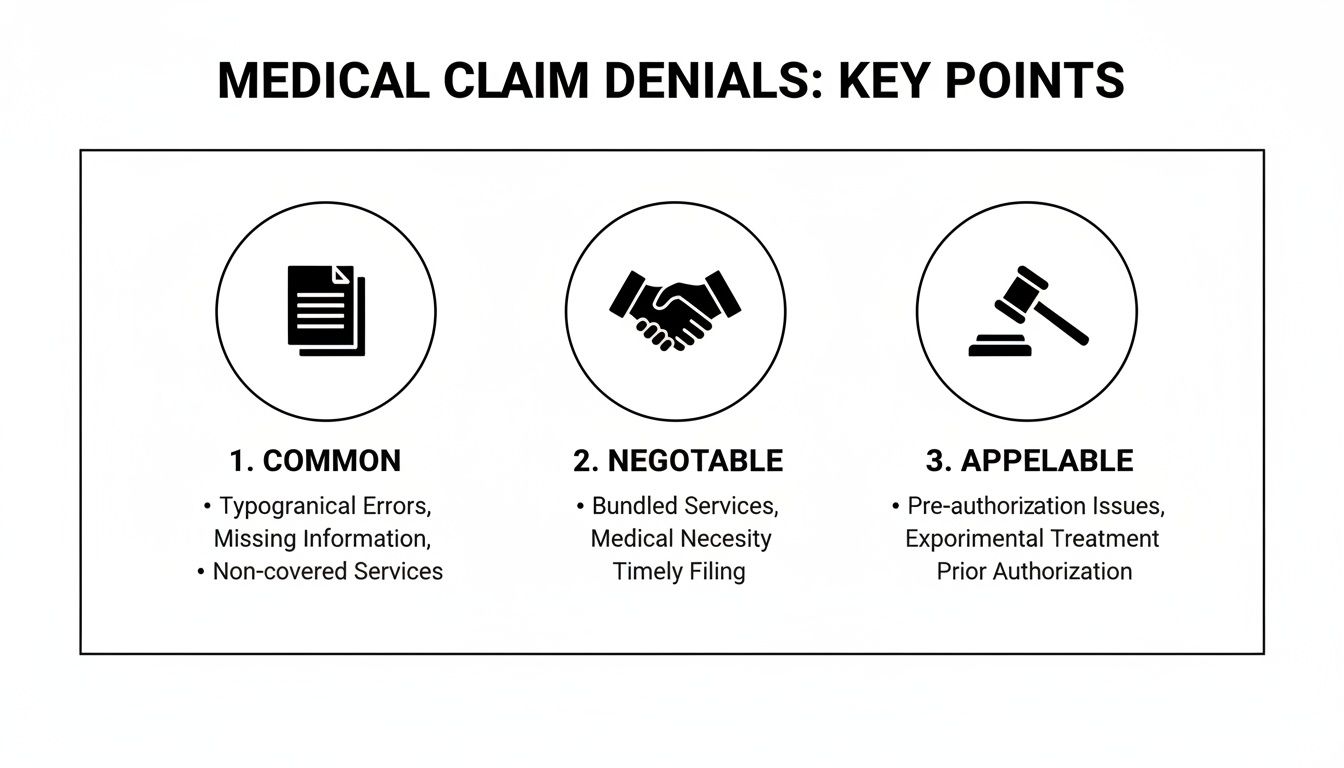
As you can see, a denial is a hurdle, not a wall. With the right strategy and documentation, it can absolutely be overcome.
Universal Documents Every Californian Needs
No matter what kind of claim you're filing—a fender-bender on the 405 or water damage in your Bay Area apartment—some documents are simply non-negotiable. Get a dedicated folder (physical or digital, your choice) and start by gathering these essentials.
- The Denial or Underpayment Letter: This is ground zero. The insurance company is required by California law to explain why they denied or underpaid you, pointing to the specific policy language they're using to justify their decision.
- Your Complete Insurance Policy: Don't just grab the summary page. You need the full contract for your auto, home, renters, or life insurance policy, including the declarations page and any add-ons (endorsements). This is the rulebook for your claim.
- All Written Correspondence: Every single email, letter, or even text message between you and the insurance company is evidence. Keep it all.
- A Detailed Phone Log: After every phone call, jot down the date, time, the name and ID of the person you spoke with, and a quick summary of what was said. These details can be surprisingly important later on.
To help you get organized, here’s a quick-reference guide for the specific documents you'll need for the most common claim types we see here in California.
Essential Documentation by Claim Type
| Document Type | Auto Insurance / Car Insurance Claim | Home/Renters Insurance Claim | Life Insurance Claim |
|---|---|---|---|
| Official Report | Police Report | Fire Report, Police Report (for theft) | Official Death Certificate |
| Proof of Loss | Photos/videos of vehicle damage, scene, injuries | Detailed home inventory, "before" photos of property | Full policy document |
| Valuation Evidence | Multiple independent repair estimates | Contractor bids, receipts/appraisals for valuable items | Any beneficiary designation forms |
| Third-Party Corroboration | Witness names and contact info | Reports from independent adjusters or engineers | Medical records (if cause of death is disputed) |
| Communication Log | Notes on all calls with adjuster, names, dates | Emails and letters with the claims department | All correspondence with the insurance company |
Gathering these specific documents strengthens your position significantly, showing the insurer that you're prepared to substantiate every aspect of your claim.
California Auto Insurance Claim Checklist
The moments after a car accident are a blur, but the evidence you gather then and in the following days is what will make or break your dispute over a lowball settlement or unfair liability finding on your car insurance claim.
Key Evidence for California Auto Claims:
- The Official Police Report: In any dispute over who was at fault, this objective report from law enforcement is often the most persuasive piece of evidence you can have.
- Photos and Videos: There's no such thing as too many. Get shots of all cars from every angle, skid marks, road conditions, traffic signals, and any visible injuries. A video walk-around is even better.
- Multiple Repair Estimates: Never accept the insurer's preferred shop estimate as the final word. Get at least two of your own from mechanics you trust. This is your leverage against a low offer.
- Witness Information: If anyone saw what happened, get their name and number. An independent account from a neutral party can completely change the outcome of a liability dispute.
Home and Renters Insurance Claim Checklist
For property damage—whether from a fire, a burst pipe, or a break-in—your goal is to prove the full value of what you lost. This includes the structure itself and every single item inside, as covered by your home insurance or renters insurance policy.
Your home inventory is the single most important document in a major property claim. Without it, you're trying to recall hundreds, maybe thousands, of items from memory during one of the most stressful times of your life. It's a nearly impossible task.
Key Evidence for Property Claims:
- A Detailed Home Inventory: List every damaged item with its replacement cost, when you bought it, and even a link to a similar item for sale online today.
- Receipts and Appraisals: For big-ticket items—jewelry, electronics, art, furniture—the original receipts or a formal appraisal are your best proof of value.
- Independent Contractor Bids: If the insurer's repair estimate feels light, get your own detailed bids from licensed California contractors. This is crucial for complex damage from wildfires or earthquakes.
- "Before" Photos: If you have photos or videos of your home before the damage, they are invaluable for showing the quality and condition of your property and possessions.
For a life insurance claim, the core documents are straightforward: the death certificate, the complete policy, and any forms the insurer provides. For a deeper dive into these topics, you can explore our full library of guides to California insurance for more detailed advice.
Taking the time to build this evidence file is the most powerful thing you can do to get the fair settlement you’re entitled to.
Writing a Persuasive Formal Dispute Letter
Now that you have all your evidence organized, it’s time to go on the offensive. The formal dispute letter is your opening move—a powerful tool that packages your collection of documents into a clear, professional argument. This isn't just a complaint letter; it's a structured, fact-based document that officially puts the insurer on notice that you're challenging their decision and spells out exactly what you expect.

The key is to be firm but professional. Getting emotional or making angry accusations only gives the adjuster a reason to dig in their heels or dismiss you. A logical, evidence-backed letter, on the other hand, is much harder to ignore.
Structuring Your Letter for Maximum Impact
Your dispute letter needs to be clean, concise, and easy for the adjuster to follow. Think of it as a roadmap you're creating for them, guiding them from their flawed decision to the correct one. Your evidence serves as the signposts along the way.
Always start with the basics: your name, address, policy number, and claim number right at the top. Then, in your opening sentence, get straight to the point—state that you are formally disputing the denial or underpayment of your claim, referencing the date of their decision letter.
From there, build your case step-by-step:
- Summarize Their Reasoning: Briefly state the position the insurer took and the reason they gave for it.
- Lay Out Your Counter-Argument: This is the heart of your letter. Methodically explain why their decision is incorrect, referencing specific language from your California auto insurance, home insurance, or life insurance policy.
- Connect the Dots with Evidence: For every point you make, cite the proof you’ve gathered. For example, you might write, "Your estimate completely overlooked the frame damage, which is detailed in the enclosed report from XYZ Auto Body."
- State Your Desired Outcome: Be crystal clear about what you want. This could be the full payment of a specific invoice, a re-evaluation of liability based on the police report, or coverage for a particular repair.
- Set a Firm Deadline: Wrap up by giving them a reasonable timeframe for a response, like 15 or 30 days, before you escalate the matter.
Key Elements to Include
To make sure your letter gets the attention it deserves, it needs to be more than just a summary. It has to be a compelling case.
- Reference Specific Policy Sections: Don't just say your policy covers it—prove it. Quote the exact language that supports your position. For example, "Under Section II, Coverage C of my homeowners insurance policy, this type of water damage is explicitly covered."
- Keep a Factual and Objective Tone: Avoid emotional language like "I feel" or "it's unfair." Stick to the undeniable facts: "The police report states..." or "The contractor's estimate confirms..."
- Have a Clear Call to Action: Don't leave them guessing. Be direct: "I expect a full payment of $5,700 to cover the repair costs outlined in the attached estimate."
- Get Proof of Mailing: This is non-negotiable. Always send your dispute letter via certified mail with a return receipt requested. This gives you legal proof of when they received it.
A well-written dispute letter forces the insurance company to create a paper trail justifying their position. If their reasoning is weak, this formal challenge is often enough to get them to reconsider their initial denial.
It helps to understand the environment insurers are working in right now. They're on high alert due to a surge in fraudulent claims, which are projected to exceed $80 billion annually across the globe by 2025. In 2023 alone, auto insurance fraud jumped 19%. This trend, which you can read the analysis on insurance fraud to learn more about, forces insurers to scrutinize every claim. Your meticulous documentation and professional letter are the best way to prove your claim is legitimate.
Following Up: The Phone Call Script
Once the letter is in the mail, your job isn't done. If you haven’t heard back by the deadline you set, it's time to pick up the phone. Go into the call prepared, calm, and ready to stick to your script.
Here’s a simple script to guide you:
"Hello, my name is [Your Name] and my claim number is [Claim #]. I'm calling to follow up on the formal dispute letter I sent via certified mail on [Date], which your office received on [Date]. In my letter, I requested a response by [Your Deadline]. Can you please give me an update on the status of my appeal?"
During the call, remember these crucial tips:
- Get the Adjuster's Full Name and ID Number: Write it down the second they say it.
- Document Everything: Note the date, time, and a quick summary of the conversation.
- Stay Calm and Focused: Stick to the facts of your case. Don't let them pull you into an argument.
- Confirm Next Steps: Before you hang up, ask, "What is the next step in this process, and when can I expect to hear from you?"
This one-two punch of a strong written argument followed by professional, documented follow-up shows the insurer you're organized, serious, and prepared to take the next step if necessary. For more tips on navigating these conversations, check out the helpful articles on our California insurance blog.
What to Do When the Insurance Company Still Won’t Budge
So, you’ve done everything right. You sent a detailed dispute letter, provided a mountain of evidence, and have been professional at every turn. Yet, the insurance company is still holding firm on their denial or lowball offer for your California insurance claim.
This is where many people get discouraged and give up. Don't. It’s a frustrating roadblock, for sure, but it’s also a predictable part of the process. When your first attempts don't work, it’s simply time to escalate and apply a different kind of pressure.

In California, once an insurer gets your dispute, they generally have about 30 to 40 days to conduct an internal review and get back to you. If that deadline comes and goes with nothing but silence, it's on you to follow up. A polite but firm email or phone call can get your claim back on the radar. But if they come back with the same unsatisfactory answer, it’s time to bring out the big guns.
Use Your Policy’s “Appraisal Clause” for Property Damage Disputes
Buried in most California home insurance and auto insurance policies is a powerful tool you probably don’t know you have: the appraisal clause. This is your secret weapon when the dispute is strictly about the cost of the damage—like when their estimate to fix your home is thousands less than your contractor’s.
Here’s how it works in a nutshell:
- You hire your own expert. You’ll need to find and pay for an independent appraiser to create a detailed assessment of the damage and repair costs.
- The insurer hires their expert. They do the same thing, getting their own appraiser to value the loss.
- They bring in a tie-breaker. If the two appraisers can't agree on a final number, they select a neutral "umpire" who listens to both sides and makes the final call.
This process is a game-changer because it takes the decision out of the claims adjuster’s hands and gives it to objective, third-party experts.
Heads Up: In California, the appraisal process is a form of binding arbitration. Once an award is made, you have a very tight window—just 100 days—to challenge it in court. If you miss that deadline, the decision is final.
File a Complaint with the California Department of Insurance
If the problem goes beyond just a disagreement over repair costs—for instance, if you think the insurer is purposely dragging their feet, misrepresenting your policy, or just acting in bad faith—your next move is to file a complaint with the California Department of Insurance (CDI).
The CDI is the state's watchdog. Their job is to make sure insurance companies play by the rules. Filing a complaint is a serious step that immediately puts your insurer on notice. No company wants a regulator looking over their shoulder, and this external pressure is often exactly what’s needed to get them to reconsider their position and treat you fairly.
The best part? It's free and you can do it online. Just be prepared to give them the details they need to launch an investigation.
What to Have Ready for Your CDI Complaint:
- Your personal contact information.
- The full, official name of your insurance company.
- Your policy and claim numbers.
- A clear, straight-to-the-point summary of your problem. Stick to the facts, include key dates, and state what you want to happen.
- Copies of your most important documents: the denial letter, your dispute letter, and any other critical evidence.
This isn’t just a venting session; it’s an official action that forces the insurance company to answer to a higher authority. You can get the ball rolling by heading over to the official California Department of Insurance complaint portal.
Knowing When to Call for Professional Help
Trying to fight a California insurance company on your own can feel like you’re hopelessly outmatched. While you are your own best advocate in the early stages, there are definite moments when the complexity—or the insurer’s flat-out refusal to be reasonable—means it's time to bring in the pros.
Knowing exactly when to make that call is crucial. It can save you from spinning your wheels and is often the key to getting the settlement you deserve.
Your Insurance Agent Is Your First Line of Defense
Before you even think about lawyers, your first call should be to your insurance agent. A great agent isn't just the person who sold you a policy; they are a licensed professional who should be in your corner, ready to act as your advocate.
A good agent lives and breathes the dense, tricky language of your California auto insurance, home insurance, or renters insurance policy. They can be a massive help in the early stages of a dispute and often keep things from escalating.
Here’s how a knowledgeable agent can immediately level the playing field for you:
- They'll decipher your policy. A good agent can find the specific language or endorsements in your policy that the claims adjuster might have conveniently overlooked or misinterpreted to deny your claim.
- They have back-channel access. Agents often have direct lines to people in claims departments and underwriting that you simply don't. A quick call from them can get your file a second look far faster than another letter from you.
- They can help you strategize. They’ll go over the denial letter with you and help craft a response that is professional, to the point, and tackles the insurer's arguments head-on.
This kind of support is more important than ever. A staggering 31% of claimants report being dissatisfied with their recent home and auto insurance claims experience. And for 60% of those unhappy customers, slow settlement speed was the main reason. You can discover more insights about these insurance industry trends. An agent can help slice through the red tape that fuels this frustration.
When to Hire a California Insurance Attorney
Your agent is a powerful first ally, but some fights require the legal muscle only an attorney can provide. Hiring a lawyer sends a very clear signal to the insurance company: you’re serious, you won’t be pushed around, and you’re ready to take them to court if that's what it takes.
You should seriously consider talking to an attorney who specializes in California insurance law if you see any of these red flags:
- You suspect bad faith. Is the insurer using deceptive tactics, dragging its feet for no good reason, or refusing to give you a straight answer for its denial? That smells like a bad faith claim.
- The situation is a legal mess. In a multi-car pile-up where everyone is pointing fingers, or a home damage claim involving multiple causes (like wind vs. flood damage), an attorney is essential to untangle the legal knots.
- The insurer gets aggressive. If you get a call from the insurance company’s lawyer or they start throwing around accusations of fraud, stop talking to them immediately and find legal counsel.
- The stakes are incredibly high. If your house burned to the ground or you’re facing life-altering injuries from an accident, you can't afford to go it alone. The financial risk is just too great.
Hiring an attorney doesn't automatically mean you're headed to a long, drawn-out court battle. Sometimes, all it takes is one strongly worded letter from a law firm to make an insurance company change its tune and offer a fair settlement.
Common Questions About California Insurance Disputes
After a claim gets denied or underpaid, you’re often left staring at a pile of paperwork and feeling completely lost. You have your policy, the insurer’s letter, and a whole lot of questions. We get it.
This section tackles the most common and urgent questions we hear from Californians fighting an insurance company’s decision. Let's clear up the confusion around the timelines, legal jargon, and tough spots you're likely to hit.
How Long Do I Have to Dispute a Claim in California?
This is a big one, because missing a deadline can kill your dispute before you even get started. The legal window you have to sue an insurance company is called the statute of limitations, and in California, it varies.
- Property Damage (Home, Renters & Auto): For physical damage to your property, you generally have three years from the date the damage happened to file a lawsuit.
- Breach of Contract: If your argument is that the insurer simply didn't follow the rules in your written policy for auto, home, renters, or life insurance, California law usually gives you four years.
But here's the catch: don't wait that long. Your policy almost certainly has its own, much shorter deadlines for filing an appeal or demanding an appraisal. The denial letter starts the clock. Read it immediately and look for any deadlines they mention.
Missing a deadline spelled out in your policy can give the insurer a perfect excuse to ignore your appeal, even if you’re still within the legal statute of limitations. Time is not on your side here.
What Is Insurance Bad Faith and How Do I Recognize It?
"Bad faith" isn't just a term for bad customer service—it's a serious legal violation. It means an insurer has failed to treat you fairly and honestly without a good reason. California law requires them to uphold their end of the bargain.
Spotting bad faith is about seeing a pattern of unreasonable behavior. Look out for these red flags:
- They barely investigate your claim or drag their feet for months.
- They intentionally misinterpret your policy’s language to deny coverage.
- They go silent, delaying payments or communication without any explanation.
- They refuse to give you a clear, written reason for their decision.
If you think your insurer is acting in bad faith, your documentation is everything. Log every phone call, save every email, and note every delay. This is a major accusation, and it’s usually the point where you need to stop and talk to an experienced California insurance attorney.
Can I Dispute My Insurer’s Repair Estimate for My Car or Home?
Yes, absolutely. You are never obligated to accept your insurance company's first estimate or use their "preferred" contractor or body shop. This is one of the most common fights in both auto insurance and home insurance claims in California.
You have every right to get your own estimates from licensed, reputable professionals that you trust. If their numbers come in much higher than the insurer’s, you’ve got powerful ammunition for your dispute.
When you send your formal dispute letter, include your independent estimates. Make sure you clearly point out why the insurer's offer is too low. Maybe their estimate missed hidden frame damage on your car, specified cheap, low-quality materials for your roof, or didn't account for what labor actually costs here in California.
Think of it as a negotiation. Your counter-offer, backed by expert opinions, is your best tool. This same principle applies if you're a renter dealing with a loss—you can learn more about those rights in our guide to renters insurance in California.
Will Disputing a Claim Make My California Insurance Premiums Go Up?
This is the number one fear that keeps people from fighting for what they're owed. Let's be clear: a California insurer cannot legally retaliate against you just for disputing a claim. You are exercising a right you paid for with your premiums.
With that said, the original claim itself—like an at-fault car accident—could still affect your future rates. Your premium is based on your overall risk and claim history, not on whether you appealed a single settlement.
Your first priority has to be getting the full and fair payment you’re entitled to. Don't let the fear of a potential rate hike stop you from challenging a bad denial or a lowball offer.
Trying to navigate a complex insurance dispute alone is tough. At Mai & Associates, our team of licensed California agents can break down your policy, explain your coverage, and give you the expert guidance you need to decide on your next move. Get a no-obligation policy review and see how we can help. Learn more at https://cahomeauto.com.