How to Compare Life Insurance Policies: A California Guide

Picking the right life insurance in California isn't as complicated as it might seem. When you get down to it, comparing policies really comes down to three things: what you personally need financially, how the policy is built, and how reliable the insurance company is over the long haul. This guide will walk you through a practical framework, moving beyond the generic advice you see everywhere else.
Starting Your Life Insurance Comparison

The first thing to understand is that comparing life insurance policies is a deeply personal decision, not an off-the-shelf purchase. This is especially true for us here in California. Between the high cost of living, our diverse financial goals, and even unique property risks, a cookie-cutter approach just doesn’t cut it.
This process is about so much more than chasing the lowest monthly premium. It’s about securing a promise for your family’s future, whether that means covering a mortgage in Glendale or simply ensuring your loved ones in the Bay Area have a financial cushion.
Why a Local California Focus Matters
Looking at insurance through a California lens brings specific challenges and opportunities into focus. For instance, a generic online calculator rarely grasps the financial reality of living here. Whether you're thinking about life insurance on its own or alongside your California auto insurance, the local context is everything.
This is exactly where having an expert in your corner makes a world of difference. A California-based agency like Mai & Associates just gets it. We understand the nuances and can point you toward policies that genuinely fit your life.
Finding the right policy means matching its features to your life's specific chapters. It’s a balance of affordability today and dependable protection for all your tomorrows.
At Mai & Associates, our specialty is helping Californians find that clarity. We don't just find you a policy; we help you understand your options by comparing top-rated carriers for life, car insurance, and renters insurance. Our goal is to make sure your financial safety net is both seamless and strong.
To get started, you can learn more about securing life insurance in California with our detailed resources. Think of this guide as your first step toward that peace of mind.
Figure Out How Much Coverage You Really Need
Before you even start looking at policies, you have to know what you’re shopping for. It's tempting to just use a quick online calculator, but those tools rarely capture the full picture, especially for life here in California. The right coverage amount isn't just some big number; it's a specific, thoughtfully calculated safety net for the people you care about most.
Think of it this way: you're creating a financial roadmap for your family to follow if you're not around. The goal is to give them the resources they need to live comfortably without the added stress of financial hardship.
Go Beyond a Simple Formula
A great place to start is with the DIME method—it stands for Debt, Income, Mortgage, and Education. It’s a solid framework that covers the biggest financial bases.
- Debt: Tally up every non-mortgage debt your family would be left with. We’re talking car loans, lingering student debt, and any credit card balances.
- Income: How many years would your family need your income to stay afloat? A good rule of thumb is to multiply your annual salary by 10 to 15 years, but you’ll want to adjust that based on how old your kids are and your spouse's ability to earn.
- Mortgage: Put down the entire remaining balance. Paying off the house is one of the most powerful things you can do for your family's stability, and it’s a huge deal given California's property values.
- Education: Project the future cost of college for your kids. This number can be intimidating, but it’s an essential piece of the puzzle for most families.
Let’s put this into perspective. Imagine a family living in Westlake Village. They might have a $900,000 mortgage, need to replace a $150,000 annual income for ten years, and plan to send two kids to college. Suddenly, a generic online suggestion for coverage seems wildly inadequate.
Don't Forget Final Expenses and Future Goals
Once you have that initial number from the DIME method, it's time to fine-tune it. This is where the planning gets personal and really starts to reflect your family’s unique situation.
You'll also need to account for final expenses. Funerals and other end-of-life costs can easily add up to $10,000 to $20,000. Factoring this in from the start ensures your family won’t have to pull from other funds meant for their future.
Your ideal coverage amount isn't set in stone. It's a living number that should be revisited after big life changes—like buying a new home in Escondido, welcoming another child, or getting a major promotion.
Nailing down this number is the single most important step in learning how to compare life insurance policies. Once you have a realistic target for your death benefit, you can start evaluating your options with clarity. It shifts the process from a guessing game to a strategic one, making sure the policy you end up with delivers real security.
Term vs. Permanent Life Insurance: The First Big Decision
When you start looking at life insurance, your first major crossroad is choosing between term and permanent coverage. I often tell my clients to think of it like renting versus owning a home.
Term life insurance is like renting. It’s straightforward, affordable, and gets you the protection you need for a set period—say, 20 or 30 years. You get a huge amount of coverage for a relatively low cost, but at the end of the term, you don't have anything to show for it. Just like a lease, it ends.
Permanent life insurance, on the other hand, is like buying a home. It’s a bigger financial commitment upfront, but it’s yours for life and builds equity—or in this case, cash value—over time.
There's no single "best" answer here. The right choice really hinges on where you are in life and what you want this policy to do for you.
Term Life Insurance: Maximum Protection When It Matters Most
For the vast majority of families I work with, especially here in California, term life insurance is the hands-down winner. It's designed for one primary job: to provide the biggest possible safety net for the smallest possible price during your most financially vulnerable years.
Think about a young family just starting out in a place like Costa Mesa. They’ve got a mortgage, car payments, and the high cost of raising kids. Their biggest fear is leaving their loved ones with all that debt. A 30-year term policy gives them a massive death benefit that can cover everything, precisely when they need that protection the most. Once the term is up, the kids are likely independent and the house is paid off, so the need for that level of coverage has passed.
The industry data backs this up. After a huge surge in sales in 2021, term life premiums bounced back again in 2023. People recognize its value. It's simple, powerful protection without the high costs or complexities of permanent policies. If you're interested in the market dynamics, LIMRA's forecast on individual life insurance trends offers some great insights.
This decision tree helps visualize how your personal financial picture—your income, debts, and goals—shapes your coverage needs.
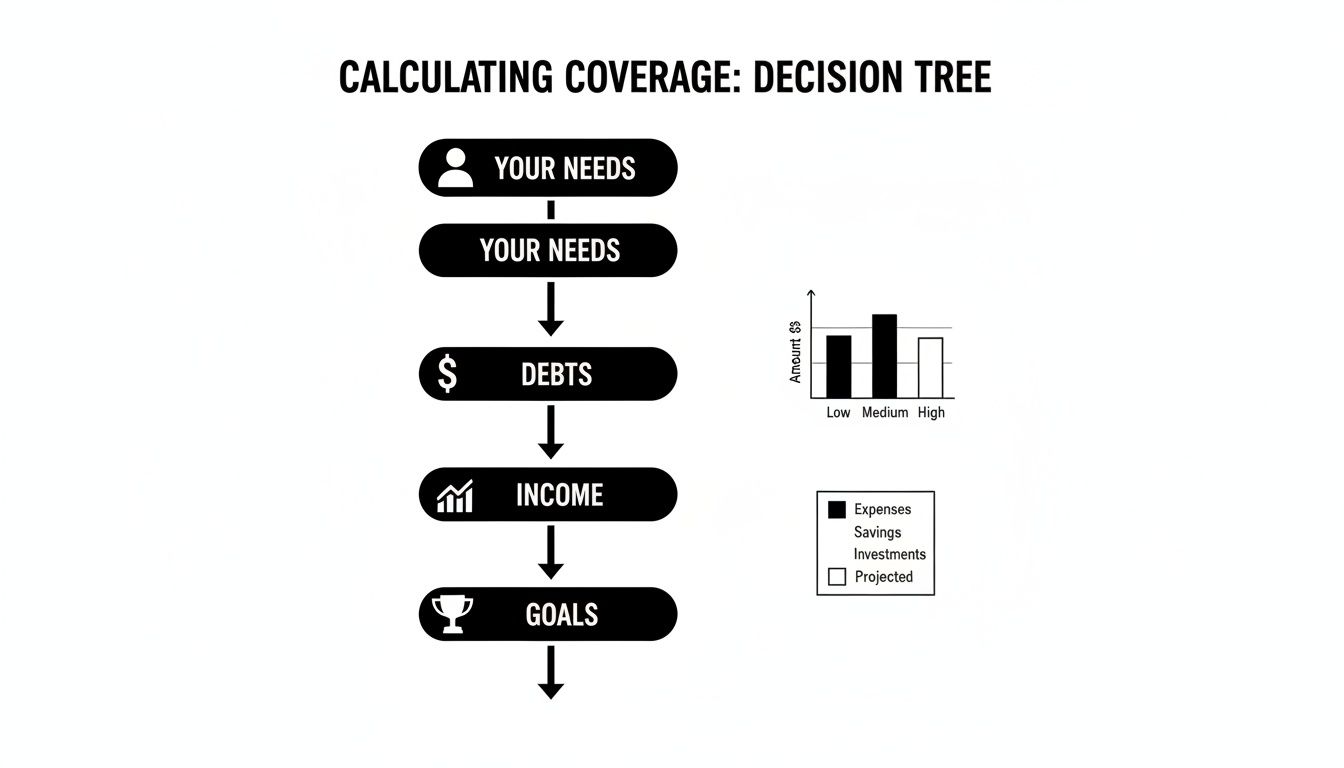
As you can see, it all starts with your real-world obligations.
Permanent Life Insurance: A Financial Tool for a Lifetime
Permanent policies like whole life or universal life are a different animal entirely. They are designed to last your entire life, but their real power lies beyond just the death benefit. They come with a cash value component that grows, tax-deferred, over the years.
This cash value is a living benefit. It’s a pool of money you can borrow against for an emergency, use to supplement your retirement income, or even tap into to help pay the policy premiums later in life. It transforms the policy from a simple safety net into a flexible financial asset.
Permanent life insurance isn't just about what you leave behind. It’s a versatile financial instrument for estate planning, legacy building, and creating tax-advantaged wealth.
Who is this for? Imagine someone in their 50s who has maxed out their other retirement accounts. A permanent policy can provide another avenue for tax-deferred growth while also guaranteeing their heirs receive a tax-free inheritance. It's also a crucial tool for business owners or individuals with large estates who need a way to provide liquidity to cover estate taxes.
Grasping this fundamental difference between temporary protection and a lifelong financial tool is the absolute first step to making a smart life insurance choice.
A Deeper Look at Premiums, Riders, and Exclusions
Once you’ve settled on the big-picture choice—term versus permanent life—it’s time to roll up your sleeves. The real comparison work happens in the details. That monthly premium is the number everyone focuses on, but honestly, it only tells you a tiny part of the story.
The key to finding genuine value, not just the cheapest price, is understanding what's baked into that cost and what it truly buys you.
Insurers are all about risk. Your premium is a direct reflection of how much risk they think they’re taking on by covering you. Your age, health, and family medical history are the big ones. But your lifestyle matters, too. A smoker or a scuba diver will almost always pay more than a non-smoker with a desk job. Being completely upfront on your application is the best way to get a solid quote that won't change later.
Customizing Your Coverage with Riders
Think of your life insurance policy like a base-model car. It gets you from A to B, but the optional features—the riders—are what make it a perfect fit for your life. These add-ons can dramatically expand what your policy can do for you, and knowing what’s available is a huge part of a smart comparison.
Here are a few of the most valuable riders I always tell my clients to look for:
- Accelerated Death Benefit: This is a big one. It lets you tap into a portion of your death benefit while you're still alive if you get a terminal diagnosis. It's often included at no extra cost and can be a financial lifesaver for medical bills.
- Waiver of Premium: If you become totally disabled and can't work, this rider steps in and pays your premiums for you. It ensures your policy doesn't disappear right when your family needs that protection the most.
- Child Term Rider: For a small cost, you can add a bit of term life coverage for all your children under one rider on your own policy.
There are many different riders out there, and the terminology can get confusing. If you come across terms you don't recognize, our comprehensive insurance glossary is a great place to get clear, simple definitions.
Uncovering Exclusions and the Fine Print
Just as critical as what a policy covers is what it doesn't. These are the exclusions—the specific situations where an insurer won't pay out the death benefit. Skipping the fine print here is a mistake you can't afford to make.
A standard exclusion you'll see in almost every policy is the "suicide clause." This means the policy won't pay if the insured dies by suicide within the first two years. Other common exclusions can involve death during a felony or from a high-risk hobby that wasn't disclosed on the application.
This is where you move beyond price tags and compare the real, underlying value of different policies. It’s interesting to see how much people around the world prioritize this security. In Hong Kong, for example, the life insurance ownership rate is a massive 79%, while it’s closer to 54% here in the U.S.
What that tells me is that experienced consumers compare policies based on the depth of their features, not just cost. For our Mai & Associates clients in wildfire-prone areas like Escondido, California, this means looking for more than a generic policy. It means finding coverage that truly understands and fits the realities of their lives. You can dive deeper into these global life insurance statistics to see how different markets approach this.
How to Vet Insurer Strength and Underwriting
A life insurance policy is a long-term promise. It’s a promise that, decades from now, the company you choose will be there for your family. That's why when you’re comparing policies, you’re not just comparing features—you're comparing the companies making that promise.
Getting this right boils down to two critical checks: confirming the insurer is financially solid and understanding their underwriting process. One ensures they can pay the claim, and the other determines the actual price you'll pay.

Decoding Financial Strength Ratings
Think of independent rating agencies as the financial watchdogs of the insurance world. They dig deep into a company's balance sheets and business practices to gauge its ability to pay claims now and in the future. Their letter grades are the result of that intense scrutiny.
You'll want to check the ratings from the big players:
- A.M. Best: This is the one I always check first. They specialize in insurance, and their A++ or A+ (Superior) ratings are the gold standard.
- Standard & Poor's (S&P): Focuses heavily on long-term stability. You're looking for ratings of AA (Very Strong) or better here.
- Moody's: Another key agency that assesses creditworthiness. Top marks from them are Aaa and Aa.
I tell all my clients the same thing: a strong financial rating is non-negotiable. A smaller, lesser-known company might dangle a slightly lower premium, but sticking with insurers rated 'A' or higher gives you something priceless: confidence that the promise will be kept.
Mastering how to compare life insurance policies means looking beyond the price tag. It's about securing your family’s future, whether that involves their day-to-day living expenses or ensuring their home insurance and car insurance can be paid.
What to Expect from the Underwriting Process
Underwriting is the nitty-gritty part where an insurer figures out your personal risk level and sets your final premium. That initial quote you see online? It’s just an estimate. The real price is locked in only after they've reviewed your full story.
This usually involves a detailed application and, for most policies, a quick medical exam. They're looking at your current health, your family's medical history, lifestyle factors (like smoking or a history of DUIs), and even risky hobbies. Think skydiving or scuba diving.
Here’s a piece of advice I can't stress enough: be completely honest. Hiding a medical condition or that you're a weekend rock climber might seem smart, but it can be grounds for the company to deny a claim later. Being transparent from the start ensures you get an accurate, ironclad rate you can depend on. Understanding what underwriters are looking for helps you prepare and puts you in the best position to secure great terms.
Let's Put It All Together: Your Next Move
You've done the hard part. You now know what to look for when comparing life insurance policies—from understanding the nuances of term vs. whole life to checking an insurer’s financial stability. The next step is moving from theory to reality.
It’s one thing to read about coverage amounts and premiums, but it’s another thing entirely to see how those numbers stack up for your specific situation right here in California. This is where you turn information into a solid plan.
Finding the Right Fit for Your Family
The most direct path forward is to look at real quotes from highly-rated insurance carriers. This is how you'll find that sweet spot between the right amount of protection and a premium that comfortably fits your budget.
At Mai & Associates, this is what we do all day, every day. Our licensed agents take the legwork out of the process for you. We don't just pull a single quote; we go to bat for you, shopping the market to bring back several options. We’ll lay them out side-by-side so you can clearly see the differences. Our expertise isn't just limited to life insurance, either—we can help with everything from California auto insurance to renters insurance.
We're also committed to making sure you understand every detail. Our team can walk you through your options in English, Spanish, Armenian, Russian, and Vietnamese. You should feel completely confident asking any question that comes to mind.
The right policy isn't just about the price—it's about clarity. A personalized quote gives you the chance to look past the marketing and see exactly what you're getting, ensuring it truly protects what matters most.
There’s no pressure and no obligation. Just clear, straightforward answers.
Take a few minutes to get your personalized insurance quote and see what your options look like. Our team is here and ready to help you lock in that peace of mind.
Still Have Questions? Let's Cover the Common Ones.
Even with a solid plan, a few practical questions almost always pop up when you're getting down to the final details. It's completely normal. Getting straight answers to these common queries is the last step to feeling truly confident in your choice. Here are a few we hear all the time from our clients here in California.
How Often Should I Revisit My Life Insurance Policy?
Think of your life insurance policy like any other part of your financial plan—it needs a check-up now and then. A good rule of thumb is to review it every few years.
More importantly, you should always take another look after a major life event. Did you just get married? Buy a home in Glendale? Welcome a new baby? Land a big promotion? These are all perfect triggers to reassess. Life moves fast, and your coverage needs to keep up.
Is a Medical Exam a Must-Have for Life Insurance in California?
Not necessarily. It really depends on the policy you’re after. While most traditional, high-coverage policies will require a medical exam to lock in the best possible rate, the industry has changed a lot.
Many insurers now offer “no-exam” or “simplified issue” policies. The convenience is a huge plus—you can often get covered in days, not weeks. The trade-off is that these policies might have higher premiums or lower coverage caps. We can help you figure out if the convenience is worth the potential extra cost for your situation.
Can I Actually Own More Than One Life Insurance Policy?
Absolutely. In fact, it can be a really savvy strategy. It's often called “laddering,” and it allows you to customize your coverage for different needs and timelines without overpaying.
For instance, you might have a large 20-year term policy that’s big enough to cover the mortgage until your kids are grown. Alongside it, you could have a smaller whole life policy designed to handle final expenses, no matter when they occur. This layered approach often provides more targeted and affordable protection.
Remember, comparing insurance isn't just a one-time task. It's an ongoing part of a healthy financial plan that adapts as your life changes, protecting everything from your family's future to your California home insurance needs.
For more answers to common questions about life, auto, and home insurance, you can explore our detailed California insurance FAQ page for additional insights.
Ready to find coverage that fits your life and budget? The team at Mai & Associates is here to provide clear, personalized quotes and expert guidance. Visit us at https://cahomeauto.com to get started.