How to Choose Life Insurance: A Practical Guide for California

Choosing the right life insurance policy is one of the most important financial decisions you'll ever make. It can also feel overwhelming. But when you break it down, it's really about figuring out who relies on you, what they'd need financially if you were gone, and finding the most effective way to provide that safety net.
We're going to walk through this process together, step-by-step. From understanding your real needs to navigating California-specific challenges, this guide is designed to give you clarity and confidence in choosing the best California insurance for your family.
Securing Your Family’s Future With the Right Life Insurance
Think of life insurance as a promise you make to your family. It’s a guarantee that even if you’re not there, they'll have the financial stability to keep going—to stay in their home, pay the bills, and pursue their dreams.
The need for this kind of protection has never been more apparent. The global life insurance market hit a staggering $3.1 trillion in 2024 and is on track to reach $4 trillion by 2028. The U.S. alone accounts for nearly 27% of that market. These aren't just numbers; they represent millions of families recognizing that this is a fundamental part of responsible financial planning. For a deeper dive, you can explore more life insurance statistics on Feather Insurance's blog.
Why Life Insurance Matters Now More Than Ever
A good life insurance policy is incredibly versatile. It's designed to step in and handle the major financial burdens so your loved ones don't have to during an already difficult time.
Specifically, it can help them:
- Handle final expenses without dipping into savings, covering everything from medical bills to funeral costs.
- Wipe out major debts like a mortgage, car loans, or lingering student debt.
- Replace your income so day-to-day life can continue without financial strain.
- Secure future dreams, whether that’s funding a college education or ensuring a partner has a comfortable retirement.
Think of it this way: You insure your house with home insurance and your car with auto insurance to protect your assets. Life insurance protects the people who make that house a home. It’s the human side of financial protection.
For those of us in California, there are a few extra layers to consider. We'll get into how things like community property laws can impact your beneficiaries and why bundling your life insurance, home insurance, and car insurance policies can unlock some serious discounts. It’s all about building a plan that’s truly designed for your life here.
Term vs. Permanent Life Insurance: Deciding What Fits Your Life
When you first start looking at life insurance, you’ll quickly hit a major fork in the road: term or permanent? Think of it like deciding whether to rent or buy a home. One choice gives you flexibility and affordability for a set period, while the other is a lifelong asset you can build on over time.
This decision really shapes your entire financial safety net, so getting a handle on the core differences is crucial. There's no single "best" answer—the right fit comes down to your current stage of life, your financial goals, and what you ultimately want the policy to do for your family.
Understanding Term Life Insurance: The Straightforward Safety Net
Term life insurance is the simplest and, frankly, the most affordable option out there. It’s designed to cover you for a specific window of time, or "term"—usually 10, 20, or 30 years. If you pass away during that term, your beneficiaries get the payout. If you outlive the term, the coverage just ends. Simple as that.
It's pure protection without any bells and whistles, which makes it a fantastic tool for covering temporary, high-cost financial responsibilities.
Let’s imagine a young family in Los Angeles who just bought a home with a 30-year mortgage and has two young kids. A 30-year term policy is a perfect match. It's a cost-effective way to make sure that if a primary earner dies unexpectedly, the family can:
- Pay off the mortgage so they can stay in their home.
- Cover day-to-day living expenses by replacing that lost income.
- Fund future plans, like sending the kids to college.
The policy lines up perfectly with the years they need the most protection. Once the house is paid off and the kids are on their own, their need for a huge death benefit usually goes down, which is right around when the policy expires.
This direct approach is also why so many people think life insurance costs a fortune. It doesn't have to. A healthy 35-year-old in California could lock in a $500,000, 20-year term policy for under $30 a month. That's a tiny price for a whole lot of peace of mind.
To help you see where you might land, this flowchart breaks down the decision-making process.
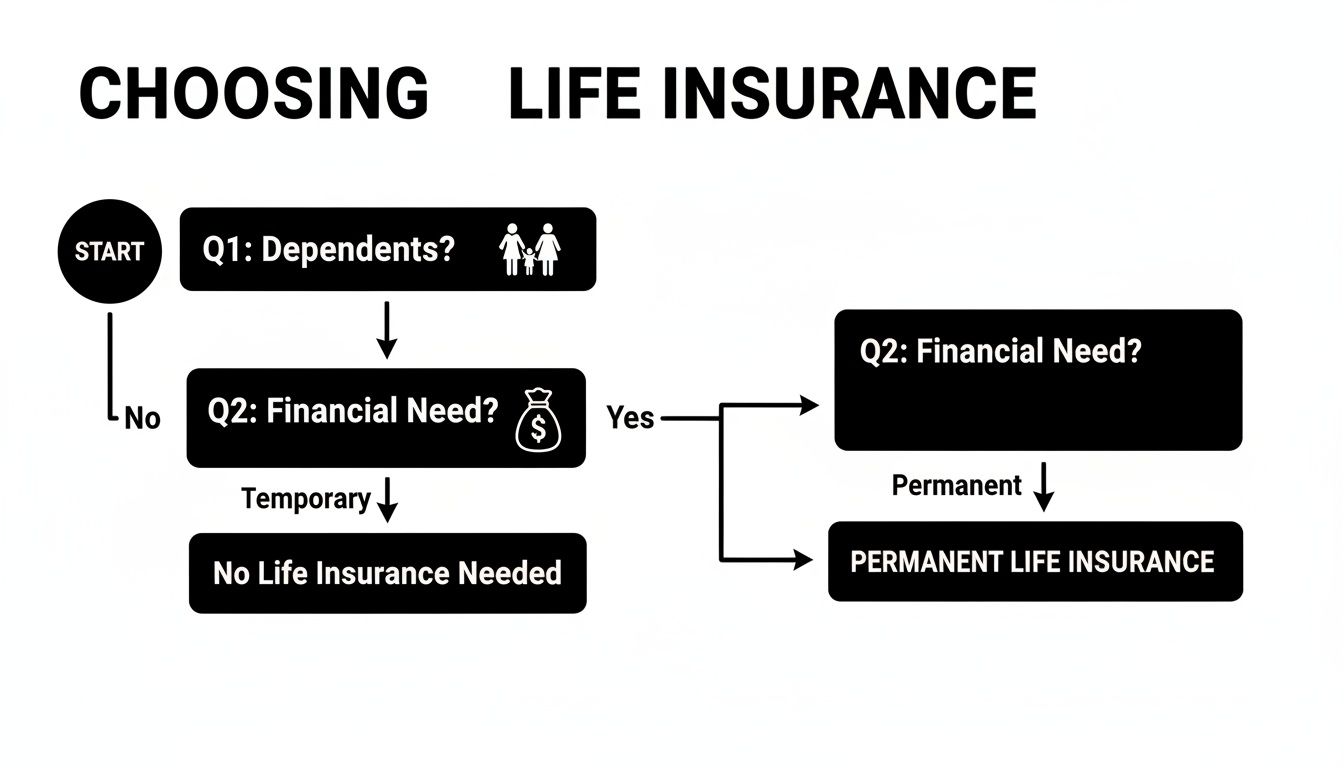
As you can see, the choice really boils down to whether your financial needs are temporary (like a mortgage) or will last a lifetime (like estate planning).
Exploring Permanent Life Insurance: Lifelong Coverage with a Savings Twist
Permanent life insurance, just like it sounds, is built to last your entire life as long as you pay the premiums. It's a bit more involved than term insurance because it bundles a death benefit with a savings element called cash value. A slice of your premium covers the cost of the insurance itself, and the rest gets funneled into an account that grows over time, tax-deferred.
You'll run into a few different types, but the two most common are:
- Whole Life Insurance: This is the predictable workhorse. It comes with fixed premiums, a guaranteed death benefit, and a guaranteed growth rate on your cash value. Very stable.
- Universal Life Insurance: This one offers more wiggle room. You can often adjust your premium payments and even the death benefit amount as your financial life changes.
A permanent policy is less about covering income for a specific chapter and more about a long-term financial strategy. People use it for estate planning, leaving a legacy, or even to pull from in retirement.
Think about a small business owner in San Francisco. A permanent policy can be a powerful financial tool. The cash value can be borrowed against to inject capital into the business or used as collateral for a loan. Down the road, it can provide the cash needed to handle estate taxes, making sure their heirs get the full value of what they built. It's a multi-purpose tool that evolves with you.
If you're new to terms like "cash value" or "death benefit," our comprehensive insurance glossary can get you up to speed with clear explanations.
Making the Right Choice for Your California Life
So, which one is it? Honestly, it doesn't always have to be an either/or decision. A lot of people find that a blended strategy works best. For example, you might get a large term policy to cover the mortgage and kid-raising years, paired with a smaller permanent policy for final expenses and leaving a legacy.
Here's a quick side-by-side to help you weigh your options:
| Feature | Term Life Insurance | Permanent Life Insurance |
|---|---|---|
| Coverage Duration | For a specific term (e.g., 10, 20, 30 years) | Lifelong, as long as premiums are paid |
| Primary Purpose | Income replacement, debt payoff | Estate planning, legacy building, cash value |
| Cost | Lower premiums, more affordable | Significantly higher premiums |
| Complexity | Simple and straightforward | More complex, includes an investment piece |
| Cash Value | None | Yes, accumulates tax-deferred |
At the end of the day, the best way to pick a policy is to match it to your personal financial timeline and goals. Ask yourself: what do I need to protect, and for how long?
Calculating How Much Coverage You Actually Need

You’ve probably heard the old rule of thumb: just buy life insurance worth 10 times your annual salary. It’s a decent starting point, I suppose, but it's far too generic for a decision this important. In a state like California, where the cost of living is what it is, that simple formula can fall dangerously short.
Your family’s situation is unique, and your coverage should be, too. Instead of grabbing a number out of thin air, a more deliberate approach ensures you’re not overpaying for coverage you don’t need—or worse, leaving your family underprotected. Let's bring some clarity to what often feels like a guessing game.
One of the most practical methods I've used with clients for years is the DIME method. It’s a simple acronym that helps you focus on the four pillars of your family's financial security: Debt, Income, Mortgage, and Education.
Breaking Down the DIME Method
So, how does this work in the real world? The DIME method is all about adding up four key financial obligations to land on a total coverage amount that actually fits your life.
Here’s a quick rundown:
- D for Debt: First, tally up all your non-mortgage debts. We’re talking car loans, student loans, credit card balances, and any personal loans. The goal is to wipe these burdens clean for your loved ones.
- I for Income: Think about how much of your annual income your family would need to maintain their lifestyle. Then, multiply that by the number of years they’ll need that support. A good benchmark is until your youngest child turns 18 or finishes college.
- M for Mortgage: This one's easy. Just add the full remaining balance on your mortgage. For most families, this is their largest debt, and paying it off would provide incredible stability.
- E for Education: If you have kids, you need to think about college or vocational training. Estimating those future costs now ensures their educational dreams stay on track, no matter what.
This approach gives you a much clearer picture of your actual financial responsibilities. For more strategies tailored to California residents, feel free to check out our other insurance and financial planning guides.
A California Family Calculation Example
Let's put this into practice with a hypothetical family of four living in a California suburb. Here’s what their financial picture might look like:
- Debt: They have $25,000 left on a car loan and $10,000 in credit card debt, for a total of $35,000.
- Income: The primary breadwinner earns $100,000 a year. They figure they need to replace this income for 15 years until their youngest is financially independent. That comes out to $1,500,000.
- Mortgage: Their remaining mortgage is $500,000.
- Education: They estimate needing $100,000 per child for college, so that’s $200,000.
Now, let's do the math:
$35,000 (Debt) + $1,500,000 (Income) + $500,000 (Mortgage) + $200,000 (Education) = $2,235,000
In this scenario, a $2.25 million policy would give them real peace of mind. Compare that to the generic "10x salary" rule, which would have suggested a policy of only $1 million—a massive shortfall.
This method helps you buy with purpose. You're not just picking a number out of thin air; you’re building a specific, needs-based financial safety net for the people you care about most.
Getting this calculation right has never been more important. U.S. individual life insurance premiums are forecasted to hit a record $15.9 billion in 2024, with sales expected to grow another 2-6% in 2025. This tells us people are waking up to the need for adequate financial protection. As demand rises, it becomes even more critical to calculate your needs accurately and make sure your policy truly reflects your family's financial reality.
Finding and Comparing the Best Insurance Carriers

Once you've nailed down how much coverage you need, it's time to find the right company to hold that policy. This part of the process is crucial—it's not just about chasing the lowest price. You’re looking for a dependable partner who will be there for your family years or even decades down the road.
A cheap quote from a shaky company isn't a good deal; it's a gamble you can't afford to lose. That's why the first thing I always tell my clients to check is a carrier’s financial stability.
Check the Carrier's Financial Report Card
Think of a life insurance policy as a very long-term promise. You have to be absolutely sure the company has the financial muscle to keep that promise. The easiest way to do this is by looking at their financial strength ratings from independent agencies like A.M. Best, Moody’s, or Standard & Poor’s.
These agencies are the watchdogs of the insurance world. They dive deep into an insurer’s finances and grade their ability to pay claims, even during a major economic downturn.
- Aim high. I always recommend looking for carriers with a rating of ‘A-’ or better. This tells you they have an "Excellent" or "Superior" capacity to meet their obligations.
- Get a second opinion. Don't just look at one rating. Cross-referencing two or three agencies gives you a much clearer picture of their long-term health.
A strong financial rating is your peace of mind. It’s the closest thing to a guarantee that the benefit you're planning for will actually get paid.
Look Beyond the Numbers at Service and Policy Features
Financial health is non-negotiable, but the day-to-day experience you and your family have with the company matters, too. Terrible customer service can make an already stressful time infinitely worse for your loved ones.
You can get a sense of a company's service record by checking its complaint index with the National Association of Insurance Commissioners (NAIC). This tool shows you how a company’s complaints stack up against others of its size—a high complaint ratio is a serious red flag.
Dig into the policy features as well. Does it offer a conversion option to turn your term policy into a permanent one later on? Can you add valuable riders, like an accelerated death benefit if you're diagnosed with a terminal illness? These details provide critical flexibility as your life evolves.
Before you commit, it's a good idea to research a few carriers to see how they stack up.
Key Factors for Carrier Comparison
| Evaluation Factor | What to Look For | Where to Find It |
|---|---|---|
| Financial Strength | Ratings of 'A-' or better | A.M. Best, Moody's, S&P |
| Customer Service | Low complaint index, positive online reviews | NAIC Complaint Index, Google, BBB |
| Policy Convertibility | Ability to convert term to permanent life | Policy documents, ask an agent |
| Available Riders | Accelerated death benefit, waiver of premium | Carrier's website, policy brochure |
| Underwriting Process | Speed, medical exam requirements, leniency for health issues | Agent insights, company websites |
This checklist helps ensure you’re not just looking at price, but at the total value and reliability of the carrier.
The Smartest Way to Compare Quotes
You could spend the next week calling a dozen different insurance companies, repeating your personal information over and over again. Or, you could work smarter.
Using an independent insurance agency like Mai & Associates is a much more efficient path. We aren't tied to a single company. Instead, we work with a wide network of top-rated carriers, which means we can shop the market for you. This lets you compare multiple quotes and policy options in one place, saving you a ton of time and often uncovering better rates than you'd find on your own.
When you're ready to see your options, you can easily get life insurance quotes online from several trusted providers.
Better yet, you get professional guidance. A good agent can help you make a true apples-to-apples comparison, pointing out the subtle but important differences in policy language that you might otherwise miss. It's about finding the best overall value, not just the rock-bottom price.
Getting the Best Rates: A Guide to the Underwriting Process
The word underwriting sounds technical, maybe even a little scary. But all it really is is the insurance company’s way of getting to know you. Think of it as their due diligence—a deep dive into your overall risk profile to figure out what your premium should be.
This is where the rubber meets the road. They look at your age, your current health, your family's medical history, and your lifestyle. Everything from your driving record (just like with car insurance) to whether you're into risky hobbies like skydiving gets factored in. Knowing how this works ahead of time is your key to presenting yourself in the best possible light and locking in a great rate.
What Happens During the Application and Exam?
The whole thing kicks off with your application, which is mostly a detailed questionnaire about your health and how you live. Be upfront and honest. Hiding something now could cause a denied claim later, which defeats the entire purpose of getting the policy.
For most policies, the next step is a quick medical exam. Don't sweat this part. A medical professional can meet you at your home or office, and it’s usually over pretty quickly.
Here’s what they’ll typically do:
- Check your height, weight, and blood pressure.
- Take small blood and urine samples.
- Go over your medical history to confirm what you put on the application.
The big thing to remember is this isn't a test you can pass or fail. It’s simply about painting an accurate picture of your health. The more precise the details, the fairer your final rate will be.
If you've applied for home insurance in a California high-risk fire zone, you know how much the little details matter. It's the same idea here. The carrier needs a complete picture to price your policy correctly.
Simple Tips for a Smooth Underwriting Experience
You can’t change your age or your genetics, but you absolutely can take a few small steps to make sure your medical exam goes as smoothly as possible. A little preparation can make a surprising difference in your results.
In the days leading up to your exam, just focus on some healthy basics.
- Drink plenty of water: Hydrating well for 24 hours beforehand helps ensure your blood and urine tests give clear results.
- Watch what you eat and drink: It's smart to avoid alcohol, caffeine, and super salty or fatty foods for a day or so. These can temporarily skew your blood pressure and cholesterol numbers.
- Take a rest day: A tough workout can elevate protein levels in your urine, so maybe skip the gym the day before your appointment.
- Get some sleep: A good night's rest helps keep your blood pressure and heart rate down, giving a more accurate reading of your typical state of health.
These aren't life-altering changes, but they can genuinely impact your results. A better outcome could easily bump you into a more favorable health class, which translates directly to lower premiums. Just like with auto insurance or renters insurance, the data you provide is what sets the price. A little prep work puts the odds in your favor.
What California Residents Need to Know About Life Insurance
Living in California comes with its own set of financial rules, and your life insurance plan needs to account for them. The Golden State has a few unique quirks, from community property laws to high estate values, that can directly impact how your policy works. Getting these details right is the key to making sure your family is truly protected.
Community Property Can Complicate Things
Here’s a big one: California is a community property state. This isn't just legal jargon; it has real-world consequences for your life insurance.
If you pay your policy premiums with money earned during your marriage (which is considered community funds), your spouse could have a legal claim to half of the death benefit. This holds true even if you named someone else, like a child from a previous marriage, as the sole beneficiary.
For blended families or anyone with a complex estate plan, this can create unintended conflicts. It’s critical to work with an advisor who understands California insurance law to structure your beneficiary designations correctly. This small step can prevent a world of legal trouble for your family down the road.
Protecting Your Estate and Legacy
With California's property values, it's not hard for a family's estate to be worth a substantial amount. While California doesn't collect its own estate tax, a large estate can still trigger federal estate taxes.
This is where life insurance becomes a powerful tool. It provides immediate liquidity—cash—so your heirs can cover any tax bills without being forced into a fire sale of the family home or other assets.
Think of it this way: a well-planned life insurance policy gives your family breathing room. It ensures the assets you spent a lifetime building are preserved and passed on as you intended, instead of being sold off under pressure to pay taxes.
Properly structuring your policy ensures the death benefit arrives exactly when it's needed most, making it one of the most effective ways to preserve wealth in California.
A Smart Way to Save: Bundling Your Policies
Here's a practical tip that many Californians overlook. You can often get a better deal by bundling your life insurance with your other policies, like auto insurance, home insurance, or even renters insurance.
Carriers love loyalty, and they reward it with multi-policy discounts that can add up to real savings.
For instance, by placing your car insurance and a new life insurance policy with the same company, you might get a nice discount on both premiums. It also just makes life simpler, giving you one point of contact for your major policies. It’s a straightforward strategy to get the most value for your money.
At Mai & Associates, we’re experts at finding these bundling opportunities for our clients, ensuring you get the comprehensive coverage you need without overpaying.
Common Questions About Choosing Life Insurance
Even after doing all the homework, it's natural to have a few last-minute questions pop up. Getting those final details ironed out is what really builds confidence in your decision. Let's walk through some of the things people ask us most often.
Do I Always Need a Medical Exam for Life Insurance?
Not necessarily. The old-school image of a nurse coming to your house isn't always the reality anymore. While a traditional policy often requires an exam to get the best rates, the industry has definitely opened up.
Many carriers now offer simplified issue policies. These skip the physical exam and rely on a detailed health questionnaire instead. You'll also find guaranteed issue policies that ask no health questions at all. These are a solid option if you need coverage fast or have significant health issues, but be aware—they usually cost more and offer lower coverage amounts. For a healthy individual, going through the exam process typically locks in the most affordable premium.
Can I Change My Life Insurance Policy Later On?
Absolutely. Most policies have built-in flexibility because life rarely stays the same. The majority of term life policies, for instance, come with a conversion privilege. This is a huge benefit, as it lets you convert your term policy into a permanent one later on, with no new medical exam required.
This can be a lifesaver if your financial situation changes or if your health takes a turn, making it tough to qualify for a new policy. You can also usually lower your coverage amount if your financial obligations shrink—say, after the mortgage is paid off. Just keep in mind that increasing your coverage almost always means starting a fresh application and going through the underwriting process again.
Think of your life insurance as a dynamic tool, not a "set it and forget it" purchase. Life evolves, and your coverage should be able to adapt. A conversion option is one of the best ways to future-proof your financial safety net.
What Happens if I Outlive My Term Life Insurance?
This is probably one of the most common questions we hear, and the answer is refreshingly simple. If you outlive the term, the policy simply expires. You stop paying, the coverage ends, and there's no payout.
And that's okay! That’s exactly what term insurance is designed for: to provide a massive amount of protection for a low cost during the years you need it most. While some niche policies have a "Return of Premium" (ROP) feature that refunds your payments, they are significantly more expensive. Once your term is up, you can always apply for a new policy, but expect the cost to be higher because you'll be older.
For more detailed answers, feel free to dive into our comprehensive California insurance FAQ page.
Ready to put a plan in place that protects your family's future and fits your budget? The licensed agents at Mai & Associates are here to make it happen. We deliver same-day quotes from multiple top-rated carriers, helping you find the absolute best value for your California life, auto, and home insurance.
Get your free, no-obligation quote from Mai & Associates today!