Guide: how to choose home insurance coverage for California homeowners
Choosing the right home insurance feels like a big task, but it really boils down to three key decisions: figuring out how much it would cost to rebuild your house from scratch (Dwelling Coverage), adding up the value of everything you own (Personal Property), and protecting your finances from potential lawsuits (Liability).
For us here in California, it's not quite that simple. We have to layer on protections for our unique risks, like wildfires and earthquakes, to make sure a standard policy is actually enough. This is a crucial part of managing your overall California insurance portfolio, which may also include auto, renters, or life insurance.
Decoding Your California Home Insurance Policy
Picking a home insurance policy in California is more than just an item on a to-do list; it’s one ofof the most important financial decisions you'll make to protect your biggest asset. It’s easy to get lost in the jargon, but when you break it down, a good policy really rests on three core pillars. Get these right, and you've built a solid foundation for your financial safety.
This visual gives you a quick look at how these three essential parts of your policy fit together.
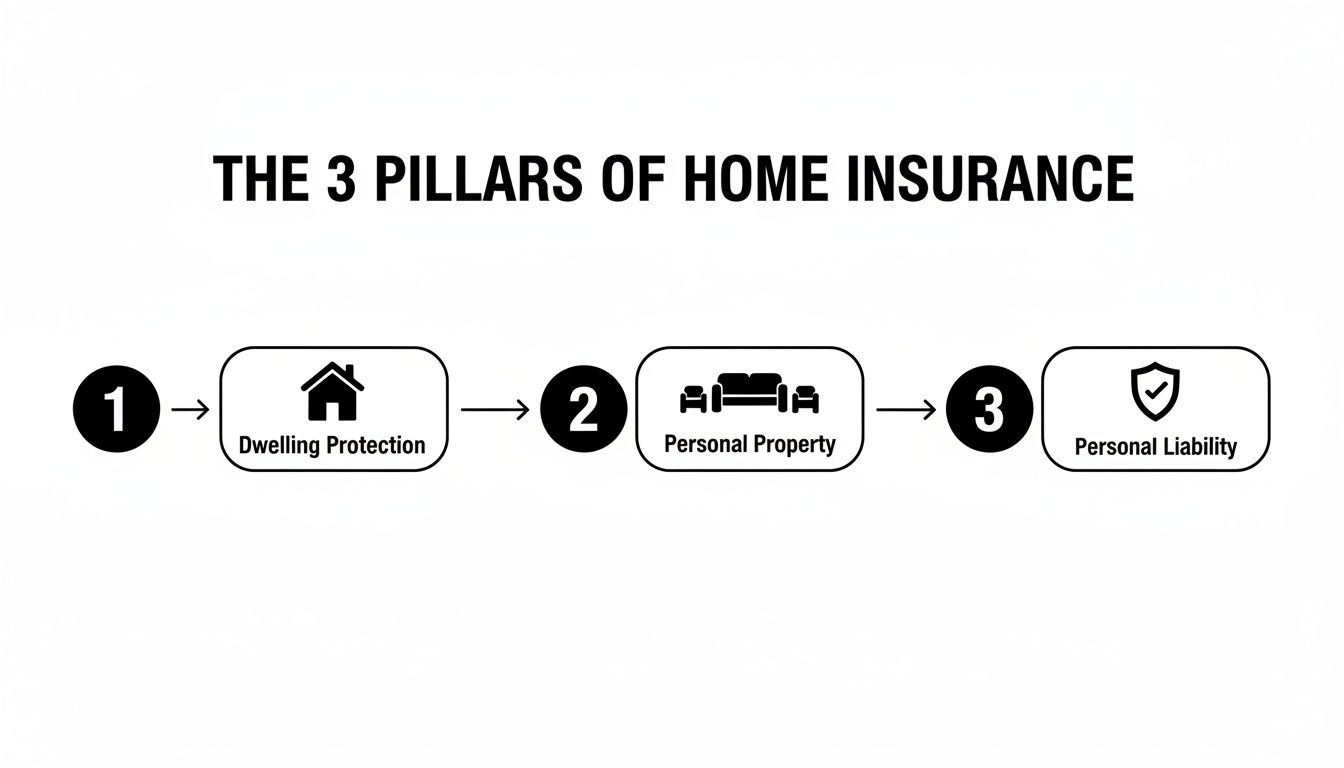
Think of it this way: Dwelling, Personal Property, and Liability are the three legs of the stool. If one is too short, the whole thing becomes unstable.
At its core, a homeowners policy is designed to cover these three fundamental areas. Here's a quick breakdown to get you started.
The Three Pillars of Home Insurance Coverage
| Coverage Type | What It Protects | Why It's Critical for Californians |
|---|---|---|
| Dwelling | The physical structure of your house—roof, walls, foundation, built-ins. | Soaring rebuild costs and wildfire risk mean your coverage amount must be accurate to avoid huge out-of-pocket expenses. |
| Personal Property | Everything inside your home, like furniture, electronics, clothes, and art. | Often underestimated, this coverage is vital for replacing your life's possessions after a total loss from a fire or major theft. |
| Liability | Your financial assets against lawsuits if someone is injured on your property. | Protects your savings, investments, and future earnings from a slip-and-fall or other accident that happens at your home. |
Getting these three components dialed in correctly is the key to having a policy that actually works for you when you need it most.
The Foundation: Dwelling Coverage
Let's start with the absolute bedrock of your policy: dwelling coverage. This is the part that protects the physical structure of your house—the walls, the roof, the foundation—if it's damaged by something like a fire or a major storm.
A critical point here: this has nothing to do with your home's market value or what you paid for it. Dwelling coverage is all about the replacement cost—the real-world price tag to rebuild your home from the ground up with today's labor and material costs.
And those costs have gone through the roof. With construction prices jumping 20-30% since 2020, being underinsured is a massive risk. If you don't insure for 100% of your home's replacement cost, you could face a coinsurance penalty, which might slash your claim payout by as much as 20%. For Californians in high-risk areas, the stakes are even higher. We've seen a 25% jump in homeowners turning to the California FAIR Plan as traditional insurers pull back from places like Glendale and Costa Mesa.
Protecting Your Life Inside: Personal Property
Next up is your personal property. This covers all the stuff inside your home—your furniture, TV, clothes, kitchenware, you name it. It's so easy to underestimate how much all of it is actually worth.
Most policies will offer a default amount, usually a percentage of your dwelling coverage, but blindly accepting that is a common mistake. The only way to know if you have enough is to do a home inventory. Go room by room and tally it all up. You’ll probably be surprised.
Your Financial Shield: Liability Coverage
Finally, there’s personal liability coverage. This is your financial shield if someone gets hurt on your property and decides to sue. It could be a delivery driver slipping on your porch or a friend tripping over a sprinkler head during a backyard barbecue.
This coverage steps in to handle legal defense fees and potential settlements, protecting your savings, investments, and other assets from being wiped out. If you're fuzzy on any of these terms, our comprehensive glossary of insurance definitions is a great place for a quick refresher on all types of California insurance.
Figuring Out How Much Coverage You Actually Need
Alright, we've covered the basic building blocks of a home insurance policy. Now comes the most critical part: putting real dollar amounts to those coverages. This is where the rubber meets the road, and getting it right can be the difference between a smooth recovery and a financial nightmare.
Frankly, this is where most people get tripped up. They either overpay for coverage they don't need or, far worse, leave themselves dangerously underinsured when disaster strikes. Let's make sure that doesn't happen to you.

Dwelling Coverage: It's All About Replacement Cost
Here’s the single biggest mistake I see homeowners make: they insure their home for its market value. Your home's market value—what you could sell it for—is completely different from its replacement cost.
Replacement cost is what it would take, in today's dollars, to rebuild your home from scratch on your lot. Think new materials, current labor rates, and updated building codes. In California, with our sky-high construction costs, the gap between market value and replacement cost can be massive.
Your dwelling coverage needs to be set at 100% replacement cost. No exceptions. Insuring for less is a gamble you can't afford to lose, especially in wildfire-prone areas where a widespread disaster can cause rebuilding costs to surge overnight.
Taking Stock of Your Stuff: The Home Inventory
Next up is everything inside your home. A standard policy usually provides personal property coverage as a percentage of your dwelling limit, often 50% to 70%. That might be enough for some, but for many, it's a huge shortfall waiting to happen.
The only way to know for sure is to create a home inventory. This sounds daunting, but it doesn't have to be a weekend-long project.
- Quick Video Tour: Just walk through your house with your smartphone, recording a video of each room. Narrate what you're seeing, open closets and drawers, and call out more expensive items.
- Photo Album: Snap photos of your valuables, especially electronics, jewelry, and art. Get a clear shot of any serial numbers. Save everything to a cloud service like Google Drive or Dropbox.
- Use an App: There are great apps out there designed specifically for home inventories that let you scan barcodes and attach digital receipts.
Don't skip this. Statistics show that 40% of home insurance claims involve personal property, with the average payout around $15,000. The scary part? Many homeowners are underinsured by a staggering 30-50%. This problem is especially acute for those with renters insurance in places like Westlake Village or Costa Mesa, where a hot rental market often means tenants have more valuable belongings than they realize.
Covering Your Most Prized Possessions
Here's a little secret hidden in the fine print of every policy: sub-limits. Even if you have $200,000 in personal property coverage, the policy might cap the payout for stolen jewelry at $1,500 or firearms at $2,500.
To see what your policy might pay, it's a good idea to understand how these caps work. This guide on Insurance Policy Limits Explained Simply offers a great breakdown.
This is where a scheduled personal property endorsement (sometimes called a "floater" or "rider") becomes your best friend. It’s an add-on that provides specific, itemized coverage for your valuables.
My Advice: If you own valuable jewelry, art, collectibles, musical instruments, or high-end cameras, you absolutely need to schedule them. This endorsement provides broader, "all-risk" coverage, usually with no deductible, ensuring you get the full appraised value back.
A Tale of Two Homeowners
Insurance is never one-size-fits-all. Imagine two different Southern California clients I might work with:
- The San Diego County Family: They live in a 3,000-square-foot house in a high-risk wildfire zone. Their top priority is maxing out their dwelling coverage to account for inflated rebuilding costs. They also need solid "Other Structures" coverage for their detached garage, built-in BBQ island, and expensive landscaping.
- The Orange County Condo Owner: This client, living in a Costa Mesa high-rise, has much lower dwelling needs because the HOA's master policy covers the building itself. Their focus is on high-limit personal property coverage for an art collection and designer wardrobe, plus generous "loss of use" coverage in case a building-wide issue forces them out for months.
See the difference? Their needs are worlds apart. As you continue to tailor your own policy, feel free to browse our other helpful guides on California insurance for more insights.
Beyond the Walls: Protecting Your Finances with Liability and Loss Of Use
Your home insurance policy is about so much more than just the house itself. It’s a financial shield, and two of its most critical—and often misunderstood—layers are Personal Liability and Loss of Use.
Getting these wrong can leave your entire financial world exposed, even if your house itself is fine. Let's dig into why they matter so much.
The Million-Dollar Question: What’s Your Liability Limit?
Life is unpredictable. A delivery driver slips on your wet porch. Your dog gets a little too excited and nips a neighbor. A guest at your weekend barbecue trips over a sprinkler head and takes a nasty fall.
These seem like minor mishaps, but they can spiral into major lawsuits. Suddenly, you're facing hundreds of thousands of dollars in medical bills, legal fees, and potential settlement payouts. This is precisely what personal liability coverage is for. It protects your assets—from your savings and investments to your future income—if you're held responsible for injuring someone or damaging their property.
A shocking number of standard policies default to a liability limit of just $100,000. Here in California, that amount is a drop in the bucket. It can easily be wiped out by attorney fees alone, before you even start talking about a settlement.
How Much Liability Coverage Is Enough?
A good starting point is to have enough liability coverage to at least match your total net worth. Take a quick inventory of your assets:
- Home equity
- Savings and checking accounts
- Investment portfolios (stocks, bonds, 401ks)
- Other valuable property, like cars or a boat
If you've built up $750,000 in assets but only have a $300,000 liability limit, you have a $450,000 gap. A single serious lawsuit could financially ruin you.
Enter the Umbrella Policy: Your Financial Raincoat
For most California homeowners, the smartest and most affordable way to close that gap is with an umbrella policy. Think of it as a secondary layer of protection. It only kicks in after the liability limits on your home and auto insurance policies have been exhausted.
For a relatively small premium, you can easily add an extra $1 million or more in liability protection. It’s one of the best investments you can make to secure your financial future against a worst-case scenario.
What Happens When You Can't Go Home?
Now let's talk about the other unsung hero of your policy: Loss of Use coverage. You might also see it called Additional Living Expenses (ALE). This coverage is your lifeline if a fire, major water leak, or another disaster forces you out of your home.
Being displaced is incredibly expensive. You’re suddenly on the hook for:
- A hotel stay or a temporary rental
- Eating out because you don't have a kitchen
- Laundry services
- Boarding your pets
- Extra gas for a longer commute
ALE is designed to cover these extra costs so you can maintain your family's standard of living while your home is being rebuilt. It stops a catastrophe from becoming a long-term financial bleed.
Typically, this coverage is set at 20-30% of your dwelling limit. So, a home insured for $500,000 would likely have $100,000 to $150,000 available for these temporary expenses. In California, where wildfire evacuations can drag on for weeks or months, this is an absolutely essential piece of your policy.
Understanding both liability and loss of use is central to learning how to choose home insurance coverage that truly protects you. And the need is growing—liability claims in the U.S. shot up by 15% between 2020 and 2025, partly due to a trend of larger jury awards. While a basic policy might offer $100,000 to $300,000 in liability, if your home is in the $1-2 million range, you should be looking at much higher limits, especially when severe injury awards have been known to average $10 million. You can learn more about the growing home insurance market and its trends on gminsights.com.
Navigating California-Specific Wildfire and Earthquake Risks
A standard homeowners policy covers a lot, but for those of us in California, what it doesn't cover can be financially devastating. Two of our biggest threats—wildfires and earthquakes—are almost always excluded from a basic policy.
Figuring out how to close these gaps is probably the most critical part of choosing home insurance that will actually protect you when you need it most.
It’s easy to assume all fire damage is covered, but that's a dangerous misconception. A kitchen fire is one thing. A wildfire is a completely different beast in today's insurance world.
The Growing Challenge of Wildfire Insurance
As wildfire seasons get longer and more intense, many well-known insurance carriers have simply stopped writing new policies in areas they consider high-risk. This has left hundreds of thousands of homeowners scrambling for options.
If this sounds familiar, you’ve likely heard about the California FAIR Plan. It’s crucial to understand what it is—and more importantly, what it isn't.
What is the California FAIR Plan? The FAIR Plan isn’t a government agency. It’s an association of all licensed property insurers in California, acting as the "insurer of last resort." It provides a very basic fire policy for homeowners who can't get coverage anywhere else. Think fire, lightning, and internal explosion. That's about it.
A FAIR Plan policy by itself is dangerously incomplete. It leaves you completely exposed to common risks like theft, a burst pipe, or someone getting injured on your property.
To get the comprehensive protection you need, you have to pair it with a second policy called a Difference in Conditions (DIC) policy from a private insurer. This DIC policy is designed specifically to fill in the gaps left by the FAIR Plan. An independent agency like Mai & Associates is experienced in packaging these two policies together to create a solid, complete solution.
Confronting California’s Shaky Ground
Just like wildfire risk, the constant threat of earthquakes demands a special strategy. Let me be perfectly clear: damage from an earthquake is never covered by a standard home insurance policy. You have to buy it as a separate, standalone policy.
For any California homeowner, this is non-negotiable. One major quake could destroy your home in seconds. Without earthquake insurance, you'd be stuck with a mortgage on a pile of rubble and no money to rebuild your life.
Given our state's seismic activity, taking the time to create a detailed earthquake home inventory is a smart, proactive step. It helps you understand what you stand to lose and ensures you're properly prepared to recover.
Your Earthquake Coverage Options
When you're ready to buy earthquake insurance, you generally have two main paths to choose from. Each has its own pros and cons when it comes to cost, deductibles, and exactly what gets covered.
1. California Earthquake Authority (CEA) The CEA is a publicly managed, privately funded organization that provides most of the earthquake policies in the state.
- Deductibles: CEA deductibles are a percentage of your dwelling coverage, typically ranging from 5% to 25%. Choosing a higher deductible will lower your premium.
- Coverage: Policies are broken down with separate limits for your house, your personal belongings, and your living expenses if you're displaced. Just know that coverage for things like pools or masonry walls is limited.
- Access: You can only get a CEA policy through a participating insurer—usually the same company that provides your homeowners policy.
2. Private Insurance Companies A growing number of private insurers are now offering their own standalone earthquake policies, and sometimes they can offer more flexibility than the CEA.
- Deductibles: They also use percentage-based deductibles, but the available ranges might be different.
- Coverage: You might find broader coverage options with a private policy, like higher limits for other structures on your property or more robust personal property protection.
- Cost: Premiums can be very competitive with the CEA, but it really depends on your home's location and the specific carrier.
Sorting through the details of wildfire and earthquake coverage can feel overwhelming, but it's an essential part of building a secure financial future here in California. You can explore more about tailoring your home insurance in California on our site or by speaking directly with one of our licensed agents. We do this every day and can make the process much simpler.
Comparing Quotes and Selecting the Right Insurer
You've put in the legwork to figure out exactly what kind of protection your home needs. Now comes the moment of truth: finding an insurance partner who will be there for you when it counts. This isn't just about chasing the lowest price—it's about finding real value and a company you can trust to make you whole again.
Comparing insurance quotes can feel tedious, but trust me, a little diligence here can save you a world of headache later. The key is to make sure you’re doing an "apples-to-apples" comparison. A cheap premium can often hide high deductibles or coverage gaps that leave you dangerously exposed.
Look Beyond the Price Tag
When quotes start rolling in, it's natural to let your eyes drift to the bottom-line cost. Fight that urge. Instead, lay them out side-by-side and dig into the details.
- Coverage Limits: Are the dwelling, personal property, and liability limits identical on every quote? If one is way cheaper, it's often because an agent has quietly lowered a critical coverage amount to win on price.
- Deductibles: Pay close attention to the standard deductible. Also, look for any special, and often much higher, deductibles for specific events like windstorms or, in some areas, wildfires. A low premium might be hiding a $10,000 deductible you can't realistically afford.
- Endorsements: Did you ask for earthquake coverage or sewer backup protection? Make sure those specific add-ons are actually included in each quote. These are frequently left off to make a policy appear more affordable.
To make this easier, we've created a simple checklist. Use it to line up the details from each quote so you can see exactly what you're getting for your money.
Home Insurance Quote Comparison Checklist
This table is your best friend when comparing policies. Fill it in for each quote you receive. It forces you to look at the crucial details and will highlight any major differences in coverage that might explain a price gap.
| Coverage Feature | Carrier A Quote | Carrier B Quote | Carrier C Quote | Notes/Questions for Agent |
|---|---|---|---|---|
| Dwelling (Coverage A) | $ | $ | $ | Is this Guaranteed Replacement Cost? |
| Personal Property (C) | $ | $ | $ | Is this Replacement Cost or ACV? |
| Liability (E) | $ | $ | $ | What are the medical payment limits? |
| Loss of Use (D) | $ | $ | $ | Is there a time limit (e.g., 24 months)? |
| Standard Deductible | $ | $ | $ | |
| Wildfire Deductible | $ / % | $ / % | $ / % | Does this apply to all fire damage? |
| Earthquake Coverage? | Yes/No | Yes/No | Yes/No | What is the deductible percentage? |
| Sewer Backup? | Yes/No | Yes/No | Yes/No | What is the coverage limit? |
| Annual Premium | $ | $ | $ | Are there payment plan fees? |
Once you've compared the numbers, you can confidently ask an agent, "Why is your quote $300 cheaper when the coverage seems identical?" The answer might reveal a lot.
Vet the Insurance Carrier
Not all insurance companies are created equal. The cheapest policy on the market is worthless if the carrier is a nightmare to deal with during a claim or isn't financially sound.
An insurer's claims satisfaction rating is one of the most important, yet overlooked, metrics. It tells you how real customers felt about their experience during one of the most stressful times of their lives. A low price isn't a bargain if you have to fight for months to get your claim paid fairly.
Before you sign on the dotted line, do a quick background check. Look up the company’s financial stability rating from an agency like A.M. Best. You want to see an "A" rating or better, which signals they have the financial strength to pay claims, even after a major disaster. A quick search for online reviews and consumer reports on their claims process is also time well spent.
Captive Agent vs. Independent Agency
When you're shopping around, you’ll run into two types of agents.
A captive agent works for one company, like State Farm or Farmers. They can only sell you policies from that single carrier. That’s perfectly fine if that one company happens to be the best fit for you, but you’ll never know what else is out there.
On the other hand, an independent agency—like Mai & Associates—works with many different top-rated insurance companies. We do the shopping for you. We can bring you several competitive options for home, car, and even life insurance, explain the pros and cons of each, and help you find the absolute best blend of coverage and cost. It saves you time and gives you a much clearer picture of the market.
Key Questions to Ask Your Agent
An insurance agent should be your trusted advisor, not just a salesperson. Don't hesitate to ask direct questions to make sure you’re getting what you need.
- Is this a replacement cost or actual cash value policy?
- What is the company's A.M. Best financial strength rating?
- What discounts can I qualify for? (Think bundling home and auto, security systems, etc.)
- Can you give me a quick rundown of what your claims process looks like?
- What's your agency's track record with claims satisfaction?
Taking these steps ensures you’re not just buying a piece of paper, but investing in genuine peace of mind. When you're ready to start comparing quotes from California's leading carriers, you can easily get a personalized insurance quote online or give our office a call.
Your Top Home Insurance Questions, Answered
Even after doing your homework, you're bound to have questions when it comes to picking the right home insurance. That's completely normal, especially here in California where things can get a little complicated. Let's tackle some of the most common questions we hear from homeowners just like you.
How Much Is This Going to Cost Me in California?
That’s the million-dollar question, isn't it? The truth is, the cost of home insurance in California is all over the map. It really boils down to your specific address and your home's unique profile. The single biggest driver of high premiums right now? Wildfire risk. A home tucked away in a high-risk corner of San Diego County will have a dramatically different price tag than a similar house in a low-risk spot in Orange County.
Of course, other factors come into play, too:
- Your home's age and construction: An older home, or one with lots of custom details, simply costs more to rebuild from the ground up.
- Your past claims: If you've had to file a few claims in recent years, insurers will see that as a higher risk.
- Your safety setup: Good news! Things like monitored security systems, smoke detectors, and fire sprinklers can often earn you a discount.
While it's tough to give a statewide average that means much, you should brace yourself for costs that are generally higher than the national average. One of the best ways to bring that cost down is by bundling your home and car insurance with the same company. But at the end of the day, the only way to get a real number is to get a personalized quote.
What's the Deal with Deductibles? How Do I Pick One?
Think of a deductible as the portion of a claim you agree to pay yourself before the insurance company steps in. Let's say you have a $2,500 deductible and a kitchen fire causes $20,000 worth of damage. You'd cover the first $2,500, and your insurance would handle the remaining $17,500. Simple as that.
My Two Cents: I always tell clients to think of their deductible as their co-pay for a catastrophe. The more you're willing to pay out-of-pocket (a higher deductible), the less you'll pay every year in premiums. It's a direct trade-off.
The best strategy is to choose the highest deductible you could comfortably write a check for tomorrow without it causing a major financial headache. This gives you the best savings on your premium, but still ensures you can actually use your insurance when disaster strikes. It makes no sense to pick a $10,000 deductible just to save $30 a month if you don't have that cash sitting in an emergency fund.
Does My Homeowners Policy Cover Flood Damage?
This is a huge one, and the misunderstanding can be devastating. The answer is almost always a firm "no." A standard homeowners policy does not cover damage from flooding—we're talking about water from overflowing rivers, storm surges, or even just heavy, widespread rain that soaks the ground.
To get that protection, you need a separate flood insurance policy. Most are offered through the National Flood Insurance Program (NFIP), but we're seeing more private options pop up, too. And don't think you're safe just because you don't live on the coast. We've seen flooding in California communities that were never considered at risk. It’s always a good idea to check the federal flood maps for your address.
What Is the California FAIR Plan? Do I Need It?
The California FAIR Plan is our state's "insurer of last resort." It's not a government agency but an association of all the insurance companies that do business here. Its purpose is to offer basic fire insurance to homeowners who can't get it from a traditional carrier—a situation that's becoming all too common for folks in high-risk wildfire areas.
But it's critical to know what you're getting. A FAIR Plan policy is extremely basic. It only covers damage from fire, lightning, and internal explosions. That's it. It provides no coverage for some of the most common claims, like:
- Theft or a break-in
- Water damage from a burst pipe inside your home
- Liability protection if a guest gets hurt on your property
Because of these massive gaps, you have to pair it with a second policy called a "Difference in Conditions" (DIC) policy. This is also important for those seeking renters insurance, as the FAIR plan does not offer a renters equivalent. An independent agent's job is to help you put that puzzle together correctly.
Navigating the world of California home, auto, and life insurance is a lot to handle, but you don’t have to go it alone. The licensed agents at Mai & Associates are here to cut through the confusion, compare quotes from top-rated companies, and help you build a plan that truly protects what matters most. Get your no-obligation quote online today!