How to Calculate Home Replacement Cost for California Homes

Figuring out your home's replacement cost boils down to one core idea: you multiply the total square footage by the local cost to build per square foot, and then you tweak that number for all the things that make your house your house—unique features, specific materials, and any necessary code upgrades.
A critical point right from the start: this value is not your home's market price or what you see on Zillow. It’s strictly what it would cost to rebuild your home from scratch if it were completely destroyed.
Your Home's True Value for Insurance Purposes
One of the biggest (and most expensive) mistakes I see California homeowners make is confusing their home's market value with its replacement cost. They are two completely different numbers, and mixing them up can leave you dangerously underinsured and facing a massive financial shortfall after a disaster. Getting this right is the absolute first step to building a solid California insurance plan, whether it's for your home, your car, or your future.
Market value is simply what your home would sell for today. It’s swayed by things that have nothing to do with lumber and labor, like:
- Land Value: A huge slice of any California property's price is the dirt it sits on, which you don't have to rebuild after a fire.
- Location and Neighborhood: Being in a great school district or near a popular downtown can send a sale price soaring.
- Curb Appeal: Beautiful landscaping and a charming exterior add to market value, but they aren't part of the core cost to rebuild the structure itself.
Replacement cost is a different beast entirely. It’s a nuts-and-bolts construction calculation—the total amount of money it would take to rebuild your home exactly as it was, with similar quality and materials, after a total loss.
Replacement Cost vs Market Value At a Glance
To clear up any confusion, it helps to see these two values side-by-side. They serve very different purposes and are influenced by entirely different factors.
| Factor | Replacement Cost | Market Value |
|---|---|---|
| Primary Use | Insurance coverage calculation | Real estate sales & investment |
| Main Components | Labor, materials, permits, architectural fees | Land, location, comparable sales, economy |
| Land Value | Excluded | A major component |
| Volatile Factors | Supply chain costs, labor shortages, building codes | Buyer demand, interest rates, neighborhood trends |
This table shows why relying on a market value for insurance is a recipe for disaster. They are apples and oranges.
The Problem with Using Market Value
Setting your insurance coverage based on a Zillow estimate or what your neighbor’s house just sold for is a terrible idea. Think of it this way: market value is the price of an original, famous painting. Replacement cost is what you'd pay a skilled artist to create a perfect replica after the original was lost in a fire. The first artist's fame and market buzz are irrelevant when all you need to pay for is canvas, paint, and labor.
A home in a sought-after California beach town might sell for $2 million. But if $1.2 million of that is tied up in the land value alone, the actual cost to rebuild the structure might only be $800,000. Insuring it for the full $2 million means you're just throwing money away on coverage you can never actually claim.
On the flip side, we're increasingly seeing situations where rebuilding costs more than the home's market value, thanks to skyrocketing material prices and skilled labor shortages. For a deeper dive into these and other insurance terms, you can learn more about key concepts in our glossary.
Ultimately, getting the replacement cost right is the foundation of a reliable home insurance policy. It's what ensures you’ll have the funds to truly put things back together again.
The Starting Point for Your Replacement Cost Estimate
Now that we’ve sorted out the crucial difference between market value and replacement cost, let’s get practical. The first step in figuring out how much it would actually cost to rebuild your home starts with a simple, foundational formula. This is the same baseline calculation we use as professional agents before we start fine-tuning the details.
The basic formula is: Total Square Footage x Local Cost Per Square Foot = Baseline Replacement Cost.
This quick calculation gives you a solid starting number, but its accuracy completely hinges on the two figures you plug into it. A wild guess just won't work, especially in a market as complex and varied as California's.
This is the core of the process, as this simple flowchart shows.
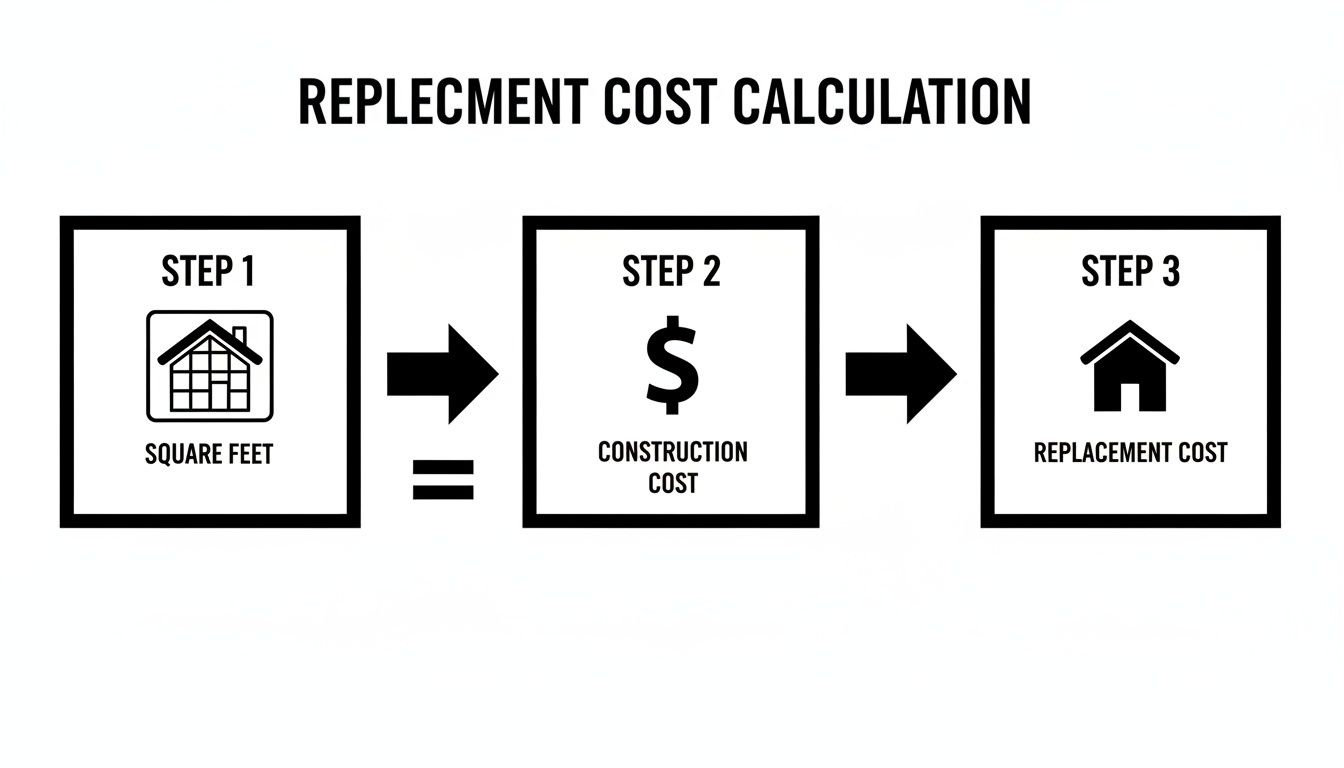
As you can see, getting an accurate rebuild estimate is all about combining your home’s size with what it really costs to build in your specific neighborhood.
Sourcing Your Home's Square Footage
First things first, you need the official total finished square footage of your home. This isn't just the main living area you walk through every day; it's any finished, livable space under the main roof. We’ll account for unfinished basements, attics, and garages separately later on.
You can usually track this number down in a few reliable places:
- County Assessor's Website: Your local California county assessor’s office maintains public records on your property, and this almost always includes the official square footage. It's usually the easiest and most trusted source to find.
- Original Blueprints or Building Plans: If you have access to your home's original plans, they'll have the precise measurements for every room and the total living area.
- Appraisal Documents: Check the paperwork from your home purchase or any recent refinance. A professional appraisal will contain a detailed breakdown of your home’s square footage.
It’s critical to use the official "livable" or "finished" square footage. This figure is the bedrock of your entire replacement cost calculation.
The Challenge of Finding Local Construction Costs
The second piece of the puzzle—the local cost per square foot—is where things get tricky. This is exactly where many online calculators fail California homeowners, because a national average is basically useless here. The cost to build a home in Escondido is worlds apart from the cost in Glendale or Westlake Village, all thanks to huge differences in labor rates, material transport costs, and local demand.
While you might see a national median rebuild cost of around $280 per square foot, that number is dangerously misleading for most Californians. Our local labor and material prices mean a typical 2,500-square-foot home could easily cost over $700,000 to rebuild—far more than any national average would suggest.
Real-World Example: Imagine a 2,500-square-foot home. In a standard Midwestern suburb, using the $280/sq. ft. average might lead to a $700,000 replacement cost estimate. But here in a California suburb where local construction costs are closer to $400/sq. ft., that exact same home would require $1,000,000 in coverage. Relying on a generic number would leave that California homeowner $300,000 underinsured.
This is precisely why partnering with a local California insurance agency like Mai & Associates makes all the difference. We don't use generic online tools. We subscribe to professional-grade valuation software that provides current, localized construction cost data right down to your zip code, ensuring your starting number is grounded in reality.
If you're looking to become a more informed homeowner, you can explore our other educational guides. Next up, we’ll dive into the specific features of your home that can significantly adjust this baseline number.
Details That Drive Up Your Rebuild Cost
A basic per-square-foot estimate is a great starting point, but it's just that—a start. Now we get into the details that can swing your final rebuild cost by tens or even hundreds of thousands of dollars. This is where professional appraisers and insurers separate a rough guess from a reliable figure for your home insurance policy.
Think about it this way: two homes can share an identical 2,500-square-foot footprint, but one might cost $200,000 more to rebuild. That massive difference isn't about size. It's about the unique materials, finishes, and features that make your house your home.

The Nine Key Characteristics That Matter Most
Calculating a home's replacement cost isn't guesswork for insurance pros. We've moved far beyond simple formulas, now using powerful software that analyzes dozens of data points for incredible accuracy.
Interestingly, research from the valuation experts at Verisk found that just nine specific characteristics get you most of the way there. When they used only these nine details, the estimate was within 9.1 percent of a full, highly detailed valuation. You can read the full research about these critical property characteristics on Verisk.com to see how they zeroed in on what truly matters.
These are the nine factors we focus on to dial in your estimate:
- Year Built: Older homes often mean sourcing special materials or finding craftspeople who can replicate original work, which costs more.
- Total Finished Square Feet: This is our foundational number, and it remains the single biggest cost driver.
- Quality Grade: Is your home builder-grade, semi-custom, or a fully custom build with high-end everything?
- Number of Stories: A two-story home requires more complex framing, scaffolding, and structural engineering than a single-story of the same size.
- Foundation Type: A concrete slab is much cheaper to pour than building a full basement or a raised foundation.
- Finished Percentage of Lowest Level: A finished basement with a media room and bath is a world away from a simple storage cellar in terms of cost.
- Exterior Wall Finish: The price of stucco, brick veneer, and wood siding varies dramatically in both materials and labor.
- Garage or Carport Presence: The size and finish level of an attached garage absolutely contribute to the total rebuild cost.
- Number of Fireplaces: Every fireplace adds a significant cost for the masonry, flue, and finishing work.
Beyond the Basics: Custom Features and Finishes
While those nine factors build a solid baseline, it's the personal touches that often push the final number higher. These are the elements that define your home's character, quality, and ultimately, its value.
Take your kitchen and bathrooms. Just upgrading from standard laminate countertops to high-end quartz or marble can easily add $10,000 to $30,000 to a rebuild. It's the same story with flooring—upgrading from basic carpet to hardwood or luxury vinyl plank adds up quickly across an entire house.
A common mistake I see is homeowners overlooking these "small" details. A gourmet kitchen with commercial-grade appliances, custom cabinetry, and a full-height stone backsplash can easily add $75,000 to a rebuild compared to a standard kitchen package. If that's not accounted for in your policy, you'd be paying for that upgrade out-of-pocket after a total loss.
Architectural complexity is another big one. A simple, rectangular "box" house with a gable roof is cheap to frame. A home with multiple rooflines, turrets, and dormers requires more materials, intricate cuts, and much more skilled labor, increasing both time and expense.
Getting the Square Footage Right
An accurate calculation of your home's living area is the critical first step. Getting this number right ensures every subsequent adjustment for quality and features is built on a solid foundation. If you need a refresher on what counts as living space, experts in the field offer great primers on how to calculate square footage correctly.
Remember that all these features are additive. Each one builds on the last, which is why a detailed home inventory is so valuable. Taking the time to walk through your home, room by room, and document these features helps you see your home through the eyes of an appraiser. This process is key to ensuring nothing gets missed and you arrive at a truly accurate replacement cost.
Navigating California's Unique Insurance Challenges
Rebuilding a home in California comes with a set of financial hurdles you just won't find anywhere else. The Golden State’s unique landscape, strict building regulations, and intense economic pressures add serious layers to any replacement cost calculation. Frankly, ignoring these factors is one of the fastest ways for a homeowner or renter to find themselves tragically underinsured after a disaster.
Think of your baseline estimate as a starting point. It needs a major reality check once you start plugging in the California-specific variables. We're not talking about minor tweaks; we're talking about substantial costs that can pile on tens, or even hundreds, of thousands of dollars to your final rebuild bill. These are the hidden expenses that can make or break your ability to recover fully.

Surging Labor and Material Demands
Picture this: a major wildfire sweeps through a region. Suddenly, the demand for qualified contractors, lumber, and drywall skyrockets. This creates a classic supply-and-demand crunch that sends prices through the roof. A project that might have cost $400 per square foot under normal circumstances could easily jump to $500 or more when thousands of your neighbors are all trying to rebuild at the exact same time.
This isn't a "what if" scenario. It’s a harsh reality we’ve seen play out in communities from Los Angeles County all the way up to the Bay Area. Your replacement cost calculation must account for this potential "demand surge," or the money you have simply won't stretch far enough when you need it most.
The High Cost of Code Compliance
One of the biggest and most overlooked expenses is bringing your new home up to today's building codes. Your original home was built to the standards of its era, but if it's destroyed, the rebuilt structure has to meet the latest, far more stringent California regulations for things like earthquake and wildfire safety.
These mandatory upgrades can include:
- Seismic Retrofitting: Bolting the house to its foundation or adding shear walls to keep it standing during an earthquake.
- Wildfire Safety Mandates: Installing ignition-resistant roofing and siding, multi-pane tempered glass windows, and clearing defensible space around the property.
- Modern Utility Standards: Overhauling electrical and plumbing systems to meet current energy efficiency and safety rules.
Let's be clear: these are not optional add-ons. They are legally required and can add a massive amount to your total rebuild cost. This is precisely why Ordinance or Law coverage is non-negotiable for California homeowners. It's a vital policy endorsement designed to help pay for these mandatory—and expensive—code-related upgrades.
Overlooked but Expensive Post-Disaster Costs
The math doesn't stop with the structure itself. Several other major expenses pop up immediately after a disaster strikes.
After a fire, the first step isn't framing walls; it's clearing away tons of hazardous debris. This isn't a simple cleanup. Debris removal is a specialized, costly process that can easily run into the tens of thousands of dollars, and it's not always automatically covered in a basic dwelling limit.
On top of that, homes on hillsides or slopes face another expensive problem: slope stabilization. A fire can completely destroy the vegetation that holds the soil in place, creating a serious risk of mudslides. The cost to shore up the land before construction can even begin is another significant expense that a comprehensive insurance plan has to account for.
When you're trying to pin down your home's total replacement cost, you have to think about all the structures on your property. Getting a handle on current building prices, like looking at what an ADU costs in California, can give you a really helpful benchmark. This kind of local knowledge is absolutely crucial, especially if you're in a high-risk zone or relying on the California FAIR Plan. It’s what turns abstract risks into a concrete, insurable strategy—and it’s where an experienced agent can make sure these unique California risks are properly addressed in your policy.
Connecting Your Calculation to Your Policy
You've done the hard work and landed on a solid replacement cost number. That's a huge step. But here's the reality: that number is just a number until it's properly reflected in your home insurance policy. Now, we need to make sure your insurance contract actually backs up your calculation.
This is where the fine print matters. A lot. Getting this part wrong can turn your careful estimate into a useless piece of trivia, leaving you financially exposed right when you need protection the most. This same level of detail applies when reviewing your auto insurance or life insurance policies to ensure they meet your needs.
Replacement Cost vs. Actual Cash Value
Let's start with the single most important detail in your policy: does it pay Replacement Cost Value (RCV) or Actual Cash Value (ACV)? The difference isn't just semantics; it can be the difference between rebuilding your life or facing a massive financial shortfall.
Replacement Cost Value (RCV): Think of this as "new for old." This coverage is meant to pay what it actually costs to rebuild your home with similar materials and quality, right up to your policy limit. It doesn't factor in depreciation.
Actual Cash Value (ACV): This is the one to watch out for. It pays the replacement cost minus depreciation. Depreciation is the value your home's components have lost over time due to age, wear, and tear.
An ACV policy might look tempting with its slightly lower premium, but the payout can be shockingly low. Imagine your 15-year-old roof gets ripped off in a storm. With an ACV policy, you won’t get the funds for a brand-new roof. You’ll get the value of a well-worn, 15-year-old roof—which might cover less than half the cost of a new one.
The Coinsurance Penalty: Why the 80% Rule Matters
Even with a solid RCV policy, you're not entirely in the clear. You have to be aware of a clause called the "coinsurance requirement," often known as the 80% Rule. Insurers put this in place to make sure you're insuring your home for a responsible amount—at least 80% of its full replacement cost.
If you dip below that 80% threshold, they can hit you with a penalty on your claim payout, even for a small, partial loss.
Let's walk through an example. Your home's replacement cost is $1,000,000. To satisfy the rule, you need to carry at least $800,000 in dwelling coverage.
What happens if you only insured it for $700,000? You're underinsured. If a fire causes $200,000 in damage, the insurer won't just write you a check for $200,000. They'll apply a penalty formula, and your payout will be significantly less, leaving you to foot a large portion of the bill yourself.
This is precisely why getting your replacement cost calculation right is so critical. It’s not just about picking a number; it’s about meeting your policy’s terms to ensure you get paid what you expect.
Essential Policy Add-Ons for California Homeowners
In a state like California, a standard policy often isn't enough. With the constant threat of wildfires and surging construction costs, you need a bigger financial safety net. To get a complete overview of your options, you should learn more about home insurance in California and what it covers.
Here are two endorsements I almost always recommend:
Extended Replacement Cost: This is a must-have. It adds a buffer—usually 25% to 50%—on top of your dwelling coverage limit. If your limit is $800,000, a 25% extension gives you access to an extra $200,000, for a total of $1,000,000. This is your best defense against the sudden spike in labor and material costs that always follows a major disaster.
Guaranteed Replacement Cost: This is the gold standard of protection, though it's becoming harder to find and more expensive. It does exactly what it sounds like: the insurer agrees to pay the full cost to rebuild, no matter how much it exceeds your policy limit.
Tying your detailed estimate to a policy that's built for real-world risks—with the right endorsements—is the final, crucial step. It’s what turns that number on a piece of paper into real financial protection for your biggest asset.
Why Your Coverage Needs an Annual Check-Up
Figuring out your home's replacement cost is a fantastic first step, but it’s definitely not a "set it and forget it" task. Think of your coverage amount more like a living document. It needs to be reviewed regularly to make sure it's keeping up with the real world. A number that was spot-on two years ago might leave you dangerously underinsured today.
Why? Because the very things that make up your home's value are always shifting. Lumber prices can skyrocket, skilled labor can get tight (and expensive) after a regional disaster, and your local government might enact new building codes that tack on unexpected construction costs. Sticking with an old estimate is a huge financial gamble.
When to Reassess Your Coverage
So, when should you pick up the phone and call your agent? The two biggest triggers are always life changes and market shifts. It's crucial to connect with your agent after:
- A Major Renovation: If you've put in a new kitchen, added a bathroom, or finished the basement, your old replacement cost is officially out of date.
- Significant Market Volatility: After a year of high inflation or major supply chain headaches, it’s just smart to check in and see where you stand.
Insurance pros often recommend homeowners work with their agent every 3 to 5 years to run a new replacement cost estimate. This really speaks to how volatile construction costs have become. It's also why many of us now see extended replacement cost coverage as a must-have; it adds a crucial buffer to your policy limit to protect against inflation. You can find more of these valuation guidelines over at IRMI.com.
This regular check-up is the foundation of a solid relationship with your agent. It’s all about making sure your biggest asset is protected based on today's reality, not yesterday's numbers.
When you're ready for a no-obligation policy review, our team at Mai & Associates is here to help you get an updated insurance quote that reflects the true cost of rebuilding in today's market.
Common Questions We Hear All the Time
Even after walking through the steps, it's natural to have more questions about figuring out your home's replacement cost. This stuff can get tricky, especially when you're a California homeowner juggling policies for your home, car, and family's future. Our expertise covers home insurance, auto insurance, renters insurance, and life insurance across California.
Let’s tackle some of the most common questions we get from clients at our agency.
What Happens If My Replacement Cost Is Calculated Too Low?
This is the biggest risk homeowners face. If you underestimate what it would cost to rebuild, you end up underinsured.
Should the worst happen and your home is a total loss, your insurance check simply won't cover the full bill. You'd be left staring at a huge financial gap, forced to either dig deep into savings, take on new debt, or settle for a smaller, less-equipped home. In a place like California, where construction costs can skyrocket after a major wildfire or earthquake, a small miscalculation can become a massive problem. Getting this number right is your first line of defense.
Should I Include the Value of My Land in the Replacement Cost?
Absolutely not. Your land's value has no place in a home replacement cost calculation. Remember, homeowners insurance—even a policy supplemented by the California FAIR Plan—is there to rebuild the structure itself.
After a fire, your land will still be there. Factoring its value into your coverage inflates your dwelling limit and forces you to pay higher premiums for protection you can't ever use. We only want to insure what can actually be lost and needs to be rebuilt.
A big part of our job as California insurance agents is making sure clients aren't paying for coverage they don't need. When we exclude land value from a home policy, it often frees up budget that can be put to much better use—like adding crucial earthquake coverage or boosting liability limits on an auto insurance policy.
How Do Detached Structures Affect My Calculation?
Things like a detached garage, a guesthouse (ADU), or a separate workshop usually fall under your policy’s “Other Structures” coverage. Most standard policies default this coverage to 10% of your main home's dwelling limit, and for many people, that’s plenty.
But what if you have a large, custom guesthouse or a workshop filled with expensive equipment? That default 10% probably won’t cut it. You need to calculate its replacement cost separately and talk to your agent. We can add a specific endorsement to your policy to increase that limit and make sure everything is properly protected. This is also a great time to review your renters insurance if you lease out an ADU.
Why Did My Insurance Company's Estimate Differ From My Contractor's?
This happens all the time, so don't be alarmed. It's rare for these two numbers to match up perfectly right away. Insurance companies use sophisticated software that pulls in constantly updated data on local labor and material costs for every zip code in California. A contractor, on the other hand, gives you a quote based on their current schedule, their go-to suppliers, and the immediate costs for your specific project.
Often, the insurer's calculation also includes "soft costs" that a builder might not factor in upfront, like permits, architectural drawings, and the cost of clearing debris. The best move? Share your contractor's detailed bid with your insurance agent. We can compare the two, find out where the differences are, and adjust your dwelling coverage to reflect real-world rebuilding costs.
Trying to navigate home insurance, auto insurance, renters insurance, and life insurance in California can feel overwhelming, but you don't have to do it alone. At Mai & Associates, our licensed agents have the local expertise to help. We're happy to provide a no-obligation review of your current policies to find gaps and ensure you're getting the right protection at the best possible rate.
Visit us online to get a personalized quote and gain the peace of mind that comes with knowing you're properly covered.