How to appeal insurance claim denial in California: practical steps
Getting that denial letter from your insurance company feels like hitting a brick wall. Whether it’s for a fender-bender on the 405 or smoke damage to your home in the mountains, it's easy to feel defeated. But here's something most California policyholders don't realize: that denial is often just the opening bid in a negotiation. It is absolutely not the final word.
The first instinct might be to call your adjuster, angry and frustrated. My advice? Don't. Take a deep breath. The key to turning a "no" into a "yes" is a calm, methodical, and evidence-based approach. We're going to build a case for your California auto insurance or home insurance claim that they can't ignore.
Your First Steps After a Claim Denial

Before you can fight back, you need to understand exactly what you're fighting. Insurance companies don't just deny claims for no reason; there's always a specific justification, even if it feels flimsy. Your first job is to pinpoint that reason.
Why Your Claim Might Be Denied
I’ve seen denials for just about every reason under the sun, from the incredibly simple to the maddeningly complex. Most of them fall into a few common buckets, affecting everything from car insurance to life insurance in California.
Let's break down what these denials really mean and how you should react.
Common Reasons for Claim Denials and Your First Move
| Reason for Denial | What This Really Means | Your Immediate Action Plan |
|---|---|---|
| Paperwork Errors | You missed a signature, forgot to include a document, or filled out a form incorrectly. This is often an automated rejection. | Don't panic. This is the easiest one to fix. Call your adjuster, ask exactly what’s missing, and resubmit the corrected information immediately. |
| Coverage Exclusions | The fine print in your policy specifically states that the type of damage you suffered isn't covered. Think floods or earthquakes in a standard California home insurance policy. | Time for a deep dive. Get your full policy document (not just the summary page) and read the "Exclusions" section word-for-word. Look for any ambiguity. |
| Lapsed Policy | The insurer says you didn't pay your premium on time, so your policy wasn't active on the date of the incident. | Check your bank records. Pull up proof of payment—a canceled check, a bank statement, or an email confirmation. Clerical errors happen. |
| Disputes Over Liability | For an auto insurance claim, the insurance company has decided you were the one at fault, even if you believe otherwise. | Gather evidence. Collect the police report, witness statements, and photos from the scene. Your version of events needs solid proof to back it up. |
| Lack of Prior Authorization | More common with certain home repairs, this means you were supposed to get the company's approval before starting work. | Review your communications. Did you notify them? Do you have an email or call log? Argue that the work was an emergency to prevent further damage. |
Understanding these common roadblocks is the first step. For more insight, some excellent resources outline what to do when insurance denies a claim.
The Power of Persistence
You'd be shocked how many Californians simply accept the initial denial and walk away. This is a huge mistake.
Here in California, with our unique risks from wildfires and earthquakes, claims get intense scrutiny. It’s no surprise that denials for reasons like 'excluded services' (16%) or 'lack of prior authorization' (9%) are common. But the data shows that a surprising number of appeals are successful—if you just take the time to fight.
Think of the denial as the insurance company's opening argument, not the final judgment. Your appeal is your chance to present a compelling counter-argument, backed by evidence they simply cannot ignore.
This guide will give you that actionable roadmap. It’s time to challenge the decision and fight for the coverage you’ve been paying for, whether it’s for your car insurance, home insurance, renters insurance, or life insurance policy.
Decoding Your Denial Letter and Policy

The roadmap to overturning a denial is hiding in plain sight. It’s tucked away in the very documents your insurance company sent you: the denial letter and your policy. These aren't just pieces of paper; they are the rulebook for this fight. It’s time to put on your detective hat.
Every single denial letter is legally required to give a specific reason for the decision. Don't just skim it—dissect it. Insurance policies are dense and confusing by design, which is why efforts toward democratizing access to legal documents are so important. Your job is to pinpoint the exact clause or phrase the insurer is hanging their hat on.
Translating Insurance Jargon into Plain English
Insurers communicate in a language of their own, full of specific terms that justify their decisions. Getting a handle on this vocabulary is your first move in taking apart their argument.
Here’s a look at what some of the most common denial reasons really mean:
- Excluded Peril: This is their way of saying, "We don't cover that." For a California home insurance policyholder, common exclusions are earthquakes or floods, which require separate, specific policies.
- Material Misrepresentation: They're claiming you weren't completely truthful when you applied for the policy. Maybe you understated the mileage you drive for your car insurance or didn't mention a home business.
- Insufficient Documentation: This one's simple: you haven't sent enough proof. It’s a frequent roadblock for renters insurance claims where receipts or photos of stolen items are missing.
- Wear and Tear: The insurer believes the damage happened slowly over time from normal use or neglect, not from a sudden event. This pops up all the time in both auto insurance and home insurance denials in California.
Once you’ve identified their reason, you know exactly where to focus your attention in your policy. For a deeper dive into more terms, our glossary is a great resource.
The insurer is betting you won’t read the fine print. Your first major advantage comes from doing just that—finding the specific policy section they’ve cited and questioning their interpretation of it.
Cross-Referencing the Denial with Your Policy
With the denial reason in hand, it’s time to grab your full insurance policy. If you can't find your copy, log into your insurer's online portal or call your agent and ask them to email it to you right away. Now, zero in on three key areas.
- The Declarations Page: Think of this as the cover sheet for your entire policy. It lists your name, policy number, coverage limits, and any special add-ons (endorsements) you paid for. Make sure your personal details are correct and that the coverage limits make sense for your claim.
- The Definitions Section: Whatever you do, don't skip this. Your policy provides its own legal dictionary for terms like "occurrence," "covered property," or even "resident." The company's entire denial might hinge on how they define a single word.
- The Exclusions Section: This is the fine print where the insurer lists everything they won’t cover. Read it with a critical eye, looking for vague language or exceptions that could actually work in your favor.
Let’s say your renters insurance claim for a water-damaged laptop was denied, with the insurer blaming "wear and tear" on an old pipe in your Costa Mesa apartment. You’d immediately pull up your policy, find the "Definitions" for wear and tear, and scour the "Exclusions" section. If the pipe burst suddenly, you have a solid argument that this was an "accidental discharge of water"—a covered event—and not a slow, predictable maintenance issue. This methodical approach turns their own logic into your battle plan.
Building Your Case with Strong Evidence

Alright, you've dissected the denial letter and you know exactly where you and the insurance company disagree. Now it's time to shift from reacting to proactively building your case. A winning appeal isn't built on angry letters or emotional arguments; it’s built on cold, hard proof.
Your mission is to gather so much compelling evidence that it systematically dismantles the insurer's reason for denial. Think of yourself as the lead detective on your own case. Every photo, document, and statement you collect should be a direct counterpoint to their argument. If they cited "insufficient documentation," you’re going to give them a mountain of it. If they questioned the cause of damage, you’ll bring in experts who say otherwise.
Essential Evidence for California Auto Insurance Claims
When it comes to car insurance denials in California, the proof you need really depends on the situation. A denial based on who's at fault after a chaotic pile-up on the I-5 requires a completely different set of evidence than a dispute over the cost of bumper repairs.
Here’s what your evidence toolkit should look like for a California auto insurance claim:
- The Official Police Report: This is your starting point. If you spot any errors in the report, don't just let it slide. You can formally request an amendment or submit a supplemental report to add your side of the story.
- Witness Statements: Track down anyone who saw what happened. A signed and dated statement from a neutral bystander can be a game-changer. Be sure to get their full name and contact info.
- Photos and Videos: Don't just snap a few pictures of the dent. Document the entire scene—skid marks, road conditions, traffic signals, and the position of the cars. If you have timestamped dashcam footage, you might just have the single most powerful piece of evidence possible.
- Independent Repair Estimates: Never settle for the single estimate provided by the insurer's "preferred" body shop. Get at least two or three of your own quotes from mechanics you trust. This is how you prove the true cost of getting your car fixed right.
Gathering Proof for Home and Renters Insurance Denials
Property claims can feel like an uphill battle, especially for those of us in high-risk California areas. Whether your claim was denied under the California FAIR Plan or your renters insurance policy is refusing to cover a theft, the burden of proof unfortunately falls on you.
Imagine you're curating an exhibit of your loss for a jury. You need to document every single thing.
Strong evidence tells a story that leaves no room for doubt. Weak evidence invites questions and gives the insurer an excuse to stand by their original decision. Your job is to make your case airtight.
For instance, say a wildfire damage claim under your California home insurance was denied because the insurance company alleges you failed to maintain proper defensible space. Your evidence must shut that argument down. Receipts for brush clearance, dated photos of your property's perimeter, or an invoice from a fire mitigation service are exactly what you need.
Creating a Detailed Inventory of Lost Items
For any claim that involves personal property—which is central to most home insurance and renters insurance policies—a simple list of "what's gone" just won't cut it. You need to build a professional-grade inventory.
For each major item, document the following:
- Item Description: Get specific. Not just "TV," but "Samsung 55-inch 4K Smart TV, Model QN55Q80A."
- Date of Purchase: If you don't know the exact date, a close estimate is better than nothing.
- Original Cost: Dig for those receipts, credit card statements, or even confirmation emails. Proof of what you paid is powerful.
- Estimated Replacement Cost: Research the current price for a similar new item.
- Photos or Videos: This is where being a photo-hoarder pays off. Pictures of the items in your home before the disaster are invaluable.
This level of detail makes it incredibly difficult for an adjuster to lowball the value of your possessions. To dive deeper into protecting your assets, feel free to explore our other insurance guides for more detailed strategies. By methodically assembling your proof, you turn a simple request for reconsideration into a powerful, fact-based demand for what you're owed.
Drafting a Powerful Appeal Letter
This is where you make your stand. Your appeal letter isn't just a formality; it's your official, on-the-record response to the insurance company’s denial. It needs to be sharp, factual, and impossible to ignore. A sloppy or overly emotional letter just gives the adjuster an easy out to rubber-stamp their original decision.
Forget about venting your frustration. This is about building a logical, evidence-based case that systematically proves your claim is valid under the terms of your policy. Your single goal is to make it easier for the reviewer to say "yes" than to find a reason to say "no" again. Every single sentence must serve that purpose.
The Anatomy of an Effective Appeal Letter
Think of your letter less like a personal plea and more like a legal brief. It has to be organized, professional, and straight to the point. Ditch the generic templates you might find online—your letter has to be tailored specifically to your claim, your policy, and the evidence you've gathered.
From my experience, every successful appeal letter has these core components:
- The Basics Up Front: Start with your name, policy number, claim number, and the date of loss right at the top. Your very first sentence should be direct: "I am writing to formally appeal the denial of my claim." No ambiguity.
- Just the Facts: Briefly summarize what happened. Stick to the absolute facts—date, time, location, and a quick, neutral description of the incident.
- The Point-by-Point Rebuttal: This is the heart of your letter. Go through their denial letter and address each reason they gave, one by one. I recommend quoting their exact reason for denial and then immediately presenting your counter-argument.
- Cite Your Policy: This is critical. You need to point to the specific sections of your California auto insurance or home insurance policy that prove your claim should be covered. For instance, "As per Section III, 'Covered Perils,' sudden and accidental discharge of water is a covered event."
- Evidence Inventory: Create a clear, itemized list of every single document you're including with the letter. Think police reports, contractor estimates, photos, expert opinions—everything.
Keep a firm but completely professional tone. Emotion is the enemy of a successful appeal. You want to present your case with the calm confidence of someone who knows they have the facts on their side.
Turning Their Logic Against Them
One of the most powerful things you can do is use the insurance company’s own policy language to dismantle their argument. They denied you based on their interpretation of a clause; your job is to present a more accurate interpretation, backed by the evidence you’ve collected.
Let’s say your car insurance claim for a tire blowout was denied due to "wear and tear." Your rebuttal needs to be laser-focused. You’d argue that the damage wasn't from gradual deterioration but from a sudden failure caused by a road hazard—an event that is covered under your comprehensive policy. Then you’d immediately point to the photos of the road debris and the report from your mechanic to prove it. See how that works?
Finalizing and Sending Your Appeal
Before you send anything, proofread your letter. Then proofread it again. Have someone else read it. A polished, error-free letter signals that you are serious, organized, and not going away.
Always, always send your appeal letter and all its attachments via certified mail with a return receipt requested. This gives you irrefutable proof of exactly when they received your package, which is absolutely crucial for holding them to their response deadlines. This simple step creates a legal paper trail that protects you and keeps the insurance company accountable.
Playing by the Rules: The California Appeals Process
Even the most well-written appeal letter with airtight evidence won't get you far if you don't follow the proper procedure. In California, the insurance appeals process runs on a strict schedule with very specific rules. Think of it as a roadmap—stray from the path, and you risk having your appeal dismissed on a technicality before it's even read.
Once you submit your internal appeal, a new clock starts ticking for the insurance company. They are legally required to acknowledge your appeal and give you a decision within a specific timeframe. This isn't just them being polite; it's a state requirement meant to keep you from being stuck in limbo.
Don't Miss Your Deadlines
The most important deadline is the one you have to meet: the window for filing your appeal. This date is supposed to be in your denial letter, but let's be honest, it's often buried in fine print.
For most auto insurance, home insurance, and other common policies in California, you generally have 180 days from the day you receive the denial letter to file your first internal appeal. The first thing you should do is find that date and mark it on your calendar. Missing it could mean forfeiting your right to challenge the decision.
To build a winning appeal, you need to hit three key points.
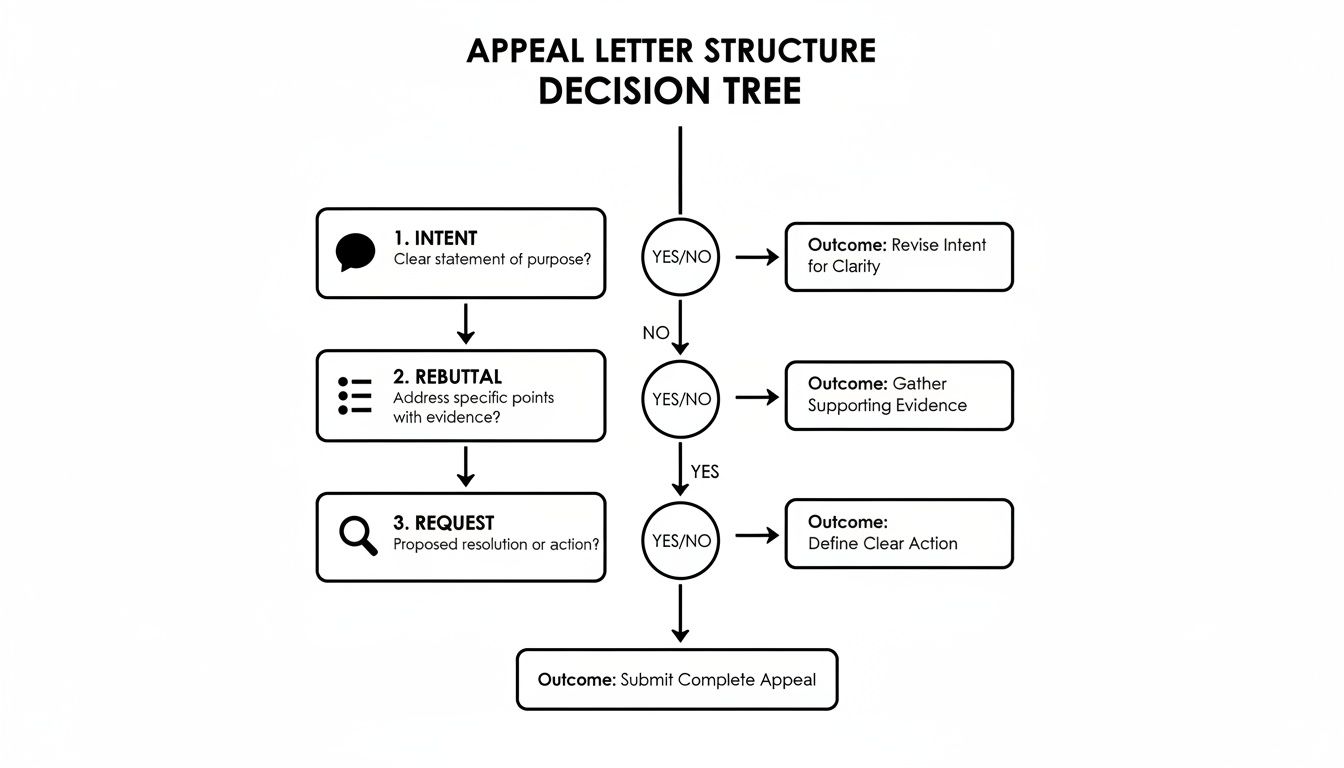
This decision tree breaks down the core of a strong appeal letter: clearly stating your intent, systematically rebutting their reasons for denial with facts, and making a specific request for what you want—a re-evaluation and payment.
Internal vs. External Appeals: What's the Difference?
Your first step is always an internal appeal. This is just a formal way of saying you’re asking the insurance company to take a second look at its own decision. A different adjuster or a review committee—someone who wasn't involved the first time around—will re-evaluate your claim using the new information you've provided.
If they still say no, don't give up. The next step is often an external review. This is a huge advantage because it brings in a neutral, independent third party to review the entire case. This reviewer can uphold or overturn the insurer's decision, and their ruling is typically binding. While common in health insurance, this option is available in other situations, too.
The data shows that persistence is key. While nearly 15% of all claims get denied at first, a surprising 54.3% are eventually overturned when policyholders keep fighting through the appeals process. And for Californians worried about bad faith denials—where an insurer didn't bother with a proper investigation—it’s good to know those appeals succeed more than 50% of the time.
Don't let a second denial discourage you. Many claims are finally won during the external review, simply because a fresh, unbiased set of eyes is looking at the facts for the first time.
When to Call in the Pros
Sometimes, you've done all you can, and it's time to bring in professionals who fight insurance companies for a living. Knowing when to call for backup is a strategic move that can dramatically shift the odds in your favor.
You have two main allies in this fight: public adjusters and attorneys.
- Public Adjusters: These are state-licensed experts who specialize in property claims. If you're dealing with a complicated home insurance claim from a California wildfire or have major water damage, a public adjuster is an invaluable resource. They'll document everything, take over all communication with the insurer, and negotiate a settlement for you, usually for a percentage of the final payout.
- Insurance Attorneys: If you suspect your insurer is acting in bad faith—deliberately delaying, lowballing, or using shady tactics—it’s time to talk to an attorney. An attorney can sue for breach of contract and seek damages that go beyond your original claim. This is your ultimate weapon when the system has failed you.
Making the right call at the right time is everything. For simple questions or clarifying your policy, like understanding your options for comprehensive auto insurance in California, your agent at Mai & Associates should be your first call. But when the stakes are high and the dispute is complex, bringing in a specialist gives you the expertise you need to level the playing field.
Turning to the California Department of Insurance for Help
So, you’ve gone through the entire internal appeals process, and your insurance company is still holding firm on their denial. It’s a frustrating spot to be in, and it's easy to feel like you've hit a dead end. But you haven't. In California, you have a powerful ally you can turn to: the California Department of Insurance (CDI).
Filing a complaint with the CDI isn't just about filling out more paperwork. It's a serious step that brings your case to the attention of a state regulator with the authority to investigate your insurance company's actions.
Think of the CDI as a referee. Their whole job is to make sure insurance companies are following the rules laid out in the California Insurance Code. When you file a complaint, you’re telling your insurer that you're not backing down and you’re ready for a government body to take a close look at how they've handled your claim.
When Should You File a Complaint?
The right time to file a complaint with the CDI is after your internal appeal has been denied and you genuinely believe the insurance company is treating you unfairly. It’s an especially critical step if you suspect they are operating in bad faith.
It might be time to get the CDI involved if:
- The insurance company is dragging its feet and unreasonably delaying a decision on your appeal.
- They're being vague or refusing to give you a clear, written explanation for their denial.
- You feel their interpretation of your home insurance or renters insurance policy is just plain wrong or unfair.
- It seems like they never conducted a proper, thorough investigation into your car insurance claim.
Taking this step often forces the insurer to give your case one last, much more serious review. It signals that you know your rights as a policyholder and you won’t be brushed aside.
The CDI is your advocate when you feel like the deck is stacked against you. In 2021 alone, their consumer services team handled over 144,000 requests for assistance and helped Californians recover more than $137 million in claim benefits.
How the Complaint Process Works
Filing a complaint is straightforward and designed for consumers—you don't need a lawyer to do it. All you need is your organized evidence and a clear, simple explanation of your dispute.
First, get your documents in order before you even start the form. You'll want copies of your denial letter, your appeal letter, any emails or letters you've exchanged with the insurer, and all the supporting evidence you've gathered along the way.
Next, head to the CDI's online portal to complete their complaint form. It will ask for your policy details, information about the claim, and a summary of what happened. Stick to the facts and be as clear and concise as you can.
Finally, you’ll upload all the documents you organized. This is your opportunity to lay out your case and show the CDI investigator exactly why you believe the insurer's decision was incorrect.
This isn't an uncommon path. Across the board, fully-insured claims see a denial rate of 20.4%—that's roughly one in five claims getting rejected. Yet, a 2023 KFF survey revealed that only one out of every ten adults with a denied claim actually files a formal appeal, even though those who do often succeed. It shows that persistence can really pay off.
What to Expect After You File
Once you submit your complaint, the CDI reviews it and assigns it to a consumer services officer. This officer will then contact your insurance company directly and request a formal response to your complaint, along with all the documentation from their side of the story.
While the CDI can't force an insurer to pay a claim if the denial doesn’t break a specific law, their involvement adds significant pressure. They can mediate the dispute and help push for a resolution. If they discover the company did violate the insurance code, they have the power to impose fines and other penalties. Often, just the threat of this kind of scrutiny is enough to make an insurer reconsider its stance and come back with a fair settlement offer for your life insurance or property claim.
Common Questions About California Insurance Appeals
The insurance appeal process can feel like a maze, especially when you're already stressed out from an accident or damage to your home. It’s completely natural to have questions as you try to figure out how to challenge a claim denial. I've put together answers to some of the most common questions I hear from Californians to help you get started.
This isn't just about theory; it's about giving you the confidence to move forward, whether you're dealing with a denied claim for your car insurance, home insurance, renters insurance, or even a life insurance policy.
How Long Do I Have to File an Appeal in California?
This is one of the most critical questions, and the answer is almost always hiding in plain sight: right in your denial letter. For most California auto insurance, home, and life insurance policies, you typically have 180 days from the day you get the denial notice to submit an internal appeal.
But you should never, ever assume that’s the case. Some policies have different timelines, so it's absolutely essential to read your denial letter and policy documents to find the exact deadline.
Missing this window can mean giving up your right to challenge the decision entirely. I always tell my clients to circle the date they received the denial and start preparing their appeal that same day. Time is not on your side here.
Should I Hire a Public Adjuster or an Insurance Attorney?
Knowing when to call in a professional is a strategic move. While you can handle plenty of appeals on your own, sometimes the complexity of the claim just calls for an expert.
- Public Adjusters: These are state-licensed pros who live and breathe property damage claims. If you're facing a complicated home insurance claim in a wildfire area or have massive water damage, a public adjuster can be your best advocate. They document everything, negotiate directly with the insurer, and work on a percentage of your final settlement.
- Insurance Attorneys: An attorney is who you call for legal disputes. You should seriously consider hiring one if you suspect your insurer is acting in bad faith—like intentionally dragging out your claim or using deceptive tactics. An attorney can file a lawsuit and fight for damages that go beyond just your claim amount.
The right choice really depends on your situation. For a complex home damage assessment, a public adjuster is probably your best bet. For a legal battle over bad faith, you absolutely need an attorney.
Your own insurance agent can often give you some initial guidance on whether your situation warrants bringing in a specialist. They can't offer legal advice, but they can definitely help you understand the next steps.
Will Appealing My Claim Make My Premiums Go Up?
This is a common fear that stops a lot of people from fighting a denial, but it's largely unfounded. Appealing a claim denial will not directly cause your insurance premiums to increase.
Insurance rates are calculated based on risk factors—your driving record, where you live, and your overall claims history. While filing a bunch of claims over time can impact your future rates, the act of appealing a wrongful denial is a protected consumer right.
When your appeal is successful, it just means the insurer is now doing what it was contractually obligated to do in the first place. You aren't being penalized for making them honor the policy you paid for.
Can My Insurance Agent Help Me with an Appeal?
Yes, absolutely. A good insurance agent is your first and most accessible ally in the appeals process. While they can’t act as your lawyer, the support they can provide is invaluable.
Your agent can help you:
- Understand the Denial: They can translate the confusing jargon in your denial letter and help you pinpoint exactly why your claim was rejected.
- Review Your Coverage: They know your policy inside and out and can help you find the specific language that backs up your claim.
- Communicate with the Insurer: Your agent can act as a go-between, contacting the claims department on your behalf to clear up simple misunderstandings or errors that may have led to the denial.
- Guide Your Next Steps: They can offer practical advice on how to structure your appeal and what evidence you'll need to gather.
Think of your agent as your trusted guide. They are on your side and want to see your valid claim paid. They can give you the initial support and direction you need to start your appeal on the right foot. For more detailed answers, you might be interested in our dedicated FAQ page covering a wider range of insurance topics.
Navigating the insurance world can be challenging, but you don't have to do it alone. The licensed agents at Mai & Associates are dedicated to helping Californians understand their policies and advocate for their rights. If you're facing a denied claim or just want to make sure you have the right coverage in place, contact us today for a no-obligation consultation at https://cahomeauto.com.