How Much Life Insurance Do I Need? A California Guide
Figuring out the right amount of life insurance can feel like a shot in the dark. A good, classic starting point is the old rule of thumb: aim for 7 to 10 times your annual income. It's a quick way to get a baseline number that would replace your paycheck for a solid number of years.
But let's be honest—that simple multiplier is just the beginning of the conversation, especially when planning your overall financial protection, which includes not just life insurance but also your auto insurance and home insurance.
Your Realistic Life Insurance Starting Point
You’ve probably heard that 7 to 10 times income rule, and it hangs around for a reason. It gives you a foundational safety net to start thinking about. The problem is, for most people—especially here in California—that simple math often doesn't cut it. The cost of living is just too high.
A truly realistic number needs to account for the full picture of your family's financial life. It’s not just about replacing a paycheck. Your coverage needs to be robust enough to wipe out major debts and lock in those long-term goals you've been working toward. When considering your overall California insurance needs, from car insurance to renters insurance, life insurance is the piece that protects your family's future income.
To help you get a clearer picture, this quick checklist covers the core areas we look at when building a real-world financial safety net.
Quick Life Insurance Needs Checklist
| Financial Obligation | What to Consider | Example Calculation Component |
|---|---|---|
| Income Replacement | How many years of your salary would your family need? | $100,000 salary x 10 years = $1,000,000 |
| Mortgage Payoff | The remaining balance on your home loan. | Remaining Mortgage: $450,000 |
| Other Debts | Car loans, student loans, credit card balances. | Total Debts: $50,000 |
| Education Funding | Future college costs for your children. | Future College Costs: $200,000 |
| Final Expenses | Funeral costs, medical bills, estate settlement fees. | Estimated Final Expenses: $15,000 |
This checklist helps shift the focus from a simple income multiplier to a detailed, needs-based analysis. It’s about building a plan that truly reflects your life and obligations.
The Real Cost of Living and Future Plans
When you start adding things up, you see why a more personal calculation is so important.
Mortgage and Other Debts: Your life insurance payout should, at a minimum, be large enough to clear the mortgage, car loans, credit card balances, and any other significant debts. This alone can be a huge relief for your family.
Future Education Costs: If you have kids, funding their college education is a massive expense. A well-planned policy can ensure those dreams stay on track, no matter what.
Maintaining Your Family's Lifestyle: The ultimate goal is to allow your family to maintain their standard of living without financial stress. This means covering everything from daily bills to future plans, and even continuing to fund their retirement savings.
As you dive deeper, you’ll run into specific industry terms and policy details. If any of the language seems confusing, our comprehensive insurance glossary is a great resource to help you understand exactly what you're looking at. Making an informed decision is the most important part of this process.
If you're ready to move beyond the simple "10 times your income" rule of thumb, you're in the right place. That formula is a decent starting point, but it often misses the mark. To get a number that truly reflects your family's needs, we need to dig a little deeper.
Financial pros use a few trusted methods to get a much more accurate picture. Let's walk through three of the most effective ways to figure out how much life insurance you actually need. Each one gives you a different perspective on your financial responsibilities, helping you build a safety net that covers everything from the mortgage to your kids' future dreams.
This visual gives you a great overview of how it all connects—your income is the engine that pays for today's debts and funds tomorrow's goals. Life insurance is designed to keep that engine running if you're not there.
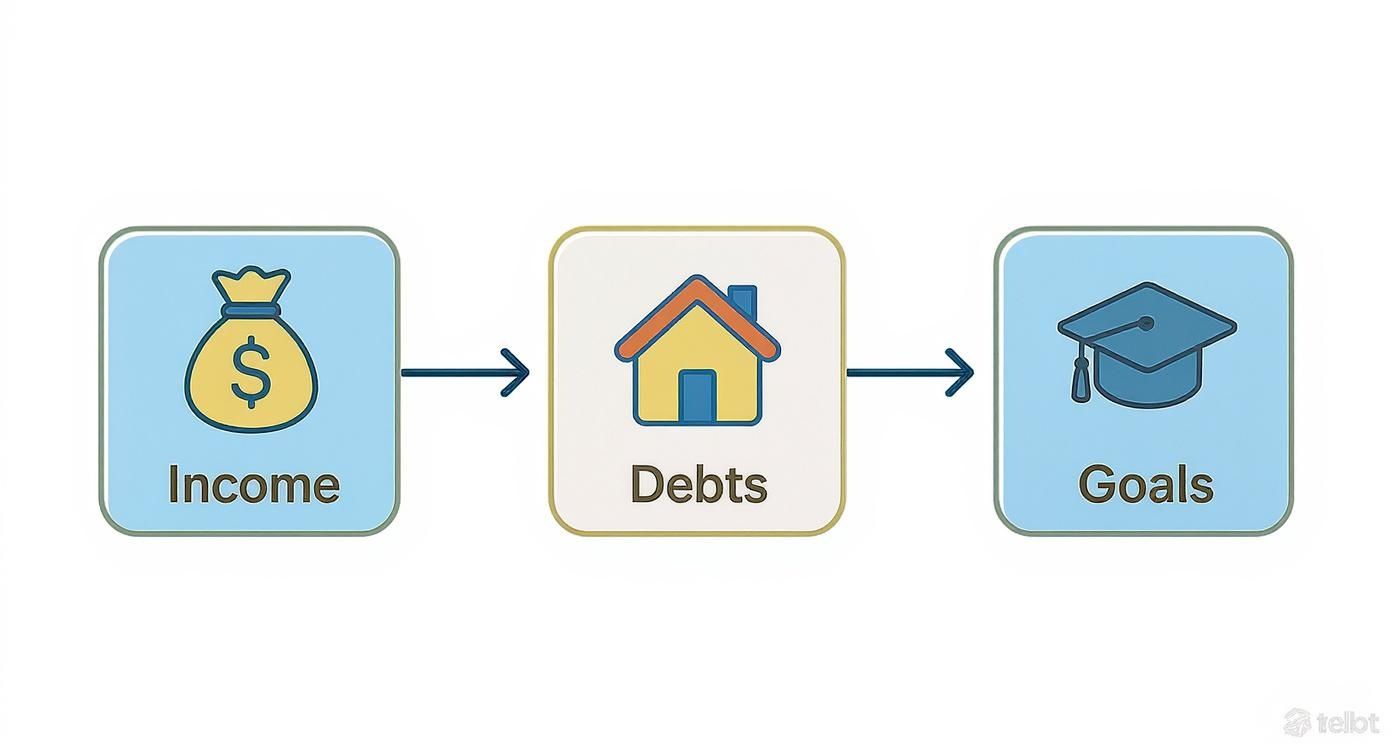
As you can see, the goal is to create a financial bridge that covers your biggest obligations, from your home loan to college tuition.
The DIME Method
A fantastic and easy-to-remember approach is the DIME method. It's an acronym that helps you quickly tally up four of the biggest financial burdens your family would face without you.
- D - Debt: First, add up all your non-mortgage debts. Think car loans, student loans, and any outstanding credit card balances. The idea is to give your family a clean slate.
- I - Income: How many years of income would your family need to replace? A common target is 10 to 15 years. Multiply your annual salary by that number.
- M - Mortgage: Add the entire remaining balance of your mortgage. Paying off the house is one of the most powerful ways to provide long-term stability and peace of mind.
- E - Education: Finally, estimate the future cost of sending your kids to college or vocational school. This can be a huge expense, so it’s critical to plan for it.
Summing up these four numbers gives you a really solid baseline for your coverage. The only real downside is that it doesn't factor in any savings or existing life insurance policies you might already have in place.
Let's See It in Action: A California Family
Picture a family living in Escondido. They have a $450,000 mortgage, $40,000 in combined car and student debt, and they want to put away $150,000 for their child’s college fund. The main breadwinner earns $90,000 a year and wants to replace that income for 10 years ($900,000).Their DIME Calculation:
$40,000 (Debt) + $900,000 (Income) + $450,000 (Mortgage) + $150,000 (Education) = $1,540,000 in total coverage.
Comprehensive Needs-Based Analysis
For a truly customized number, the needs-based analysis is the gold standard. It’s the most thorough approach because it goes a step further than DIME by accounting for the assets you already have. This prevents you from being over- or under-insured.
Here's the logic: you add up all of your family's future financial obligations, from immediate funeral costs to long-term income replacement. Then, you subtract all the available resources they could tap into—things like savings, investment accounts, and any existing life insurance policies.
The number you're left with is the precise coverage gap you need to fill. It’s about buying exactly what you need, no more and no less. If you'd like to see more detailed examples, we have several in our collection of helpful insurance guides.
The Human Life Value Approach
Another way to look at it is the Human Life Value (HLV) method. This approach calculates the total economic value you provide to your family for the rest of your working life. It's less about specific debts and more about replacing the full financial contribution you represent.
To do this, you start with your annual income and then subtract personal expenses, taxes, and other costs. You then multiply that net amount by the number of years you have left until your planned retirement.
This method really frames the financial loss in a powerful way, reinforcing that life insurance isn't just about paying off the house—it's about protecting your family's entire way of life.
Adjusting Your Coverage for Life in California

The standard formulas for life insurance are a decent starting point, but they often don't tell the whole story here in the Golden State. Life in California comes with unique financial pressures that can seriously inflate the amount of coverage your family will actually need. A generic online calculator just isn't built to understand our local realities. The same is true for calculating your home insurance or auto insurance needs; local factors matter.
The elephant in the room is the incredibly high cost of living. A $1 million policy might sound like a fortune in other parts of the country. But in cities like San Francisco, Los Angeles, or San Diego, that money can disappear a lot faster than you think.
This means your income replacement calculation has to be grounded in reality—what it truly costs to live here, not what some national average suggests.
Factoring in California Sized Mortgages
For most California families, the single biggest debt is the mortgage. We live in one of the country's most expensive real estate markets, which means our home loans are often significantly larger than the U.S. average. This is a critical factor when bundling California insurance policies, as both home insurance and life insurance need to adequately cover this major asset.
If your life insurance is only based on a simple income multiplier, there’s a real risk it won't be enough to pay off the house. That could force your family into an impossible choice: struggle with massive monthly payments or sell their home during an already devastating time.
Your life insurance death benefit should be large enough to completely eliminate the mortgage. This is one of the most powerful gifts of stability you can provide, giving your family the security of a paid-off home.
Leaving your loved ones on solid financial ground means tackling these big debts head-on in your planning.
Beyond the Obvious California Costs
It’s not just housing. Other California-specific factors can and should influence how much life insurance you carry. Your policy needs to be robust enough to handle the financial curveballs that are unique to living here.
Think about these additional points:
- State Income and Property Taxes: California has some of the highest state income tax rates in the nation. Your income replacement math needs to reflect this, making sure your family receives enough to cover their actual take-home pay needs.
- Estate Planning Nuances: While the federal estate tax exemption is high, California's probate process can be notoriously slow and expensive. A well-designed life insurance plan provides immediate cash to handle legal fees and estate costs without forcing your heirs to sell off assets.
- Wildfire and High-Risk Considerations: If you're in a high-risk area, your home insurance and auto insurance premiums are likely higher. Your life insurance should provide a big enough cushion to cover these inflated, ongoing costs for your family down the road. Our team at Mai & Associates constantly reviews policies to make sure they align with the unique risks of life insurance in California.
This problem of being underinsured is more common than you'd think. One study pointed to a global mortality protection gap of around $414 billion a year. Here in the U.S., about 42% of adults feel they need more coverage. Accounting for these California details is how you close that gap for your own family.
Choosing The Right Policy: Term vs. Permanent

Once you've landed on a coverage number, the next big question is what kind of policy to get. This is where we connect the financial "why" behind your calculation with the practical "how" of a specific product. This is similar to choosing between basic liability and full coverage for your car insurance—the right choice depends on your specific needs.
The two main roads you can take are term life insurance and permanent life insurance. They're built for very different jobs, and understanding that difference is key to getting your financial strategy right.
At its core, the concept is simple: term insurance is for a specific window of time, and permanent is for your entire life. This one distinction drives everything else—from the cost of your premiums to the flexibility you have down the road. Let’s break down when each one makes the most sense.
The Case For Term Life Insurance
For most people, especially young families and new homeowners, term life insurance is the go-to solution. It's straightforward and incredibly cost-effective.
You simply choose a coverage amount (like the $1.5 million we figured out earlier) and a term length, usually 10, 20, or 30 years. If you pass away within that term, your family gets the payout. If the term ends and you're still kicking, the policy simply expires.
Think of it as a powerful safety net for your most financially vulnerable years. It’s perfect for covering specific, high-cost responsibilities that have a clear end date.
- Your Mortgage: A 30-year term policy is a perfect match for a 30-year mortgage, guaranteeing your family can keep their home.
- Raising Kids: A 20-year policy can provide a financial backstop until your children are grown, independent, and through college.
- Major Debts: Shorter terms are great for covering other big obligations, like a business loan or a hefty car note.
The biggest selling point for term life is its affordability. Since it’s pure protection with no complex investment component, you can secure a massive amount of coverage for a surprisingly low monthly premium. This makes it an absolute workhorse for protecting families in California.
The Role Of Permanent Life Insurance
Permanent life insurance—a category that includes policies like whole life and universal life—is a different animal altogether. As the name suggests, it’s designed to cover you for your entire lifetime. As long as the premiums are paid, the policy and its death benefit are guaranteed.
But it’s more than just lifetime coverage. The defining feature of a permanent policy is its cash value component. A piece of every premium you pay gets funneled into a separate account that grows on a tax-deferred basis. This cash value becomes an asset you can borrow against or even withdraw from while you're still alive.
This makes it a more specialized tool for very specific long-term goals:
- Lifelong Dependents: If you’re caring for a child with special needs who will require financial support for their entire life.
- Estate Planning: It can provide the cash needed to pay estate taxes or to leave a guaranteed, tax-free inheritance.
- Asset Diversification: For some, the cash value serves as a conservative, stable part of their overall financial portfolio.
Term Life vs. Permanent Life Insurance At A Glance
Choosing between term and permanent isn't about which one is "better"—it's about which one is the right tool for your specific financial job. This table breaks down the core differences at a glance.
| Feature | Term Life Insurance | Permanent Life Insurance |
|---|---|---|
| Coverage Duration | A specific period (e.g., 10, 20, 30 years) | Your entire lifetime |
| Primary Purpose | Income replacement and debt coverage for a set time | Lifelong protection and estate planning |
| Cost | Lower premiums, more affordable | Significantly higher premiums |
| Cash Value | No cash value component | Builds a tax-deferred cash value you can access |
| Best For | Young families, mortgage protection, budget-conscious buyers | High-net-worth individuals, estate planning, lifelong needs |
Ultimately, the best strategy depends entirely on your family's needs, your budget, and your long-term goals. For many Californians, a solid term policy is the perfect foundation, providing robust protection when they need it most.
Ready to see what this looks like for you? The easiest way to compare your options and find a policy that fits your calculated needs is to get an insurance quote online.
Common Life Insurance Mistakes (and How to Sidestep Them)
Figuring out how much life insurance to buy feels complicated, and frankly, it's easy to get it wrong. I've seen it happen time and again. People fall into a few common traps that can leave their families in a tough spot. Let's walk through them so you can avoid making the same missteps.
One of the biggest blunders is simply underestimating how much coverage you actually need. A lot of people grab a simple "income multiplier" rule of thumb they find online, but that often doesn't account for the full picture. A massive California mortgage, student loans, and future college costs can leave a huge gap if you're not careful. The goal isn't just to replace a paycheck for a few years; it's to wipe the financial slate clean for your family.
Another classic mistake is treating life insurance like a one-and-done purchase. You buy a policy and file it away, never to be seen again. But your life isn't static, and your coverage shouldn't be either.
Your Policy Needs a Regular Tune-Up
A policy that felt perfect five years ago might be dangerously inadequate today. Think of it like a financial health check-up. You need to revisit your coverage—including your auto insurance, home insurance, and life insurance—whenever a major life event shakes things up to make sure it's still doing its job.
When should you pull out that policy and give it a look?
- You get married or divorced. This completely changes your financial picture and who you need to protect.
- You buy a home. That new mortgage is a massive liability that your policy needs to cover.
- You have a child (or another one!). Kids come with decades of expenses, from diapers to diplomas.
- You get a big raise or promotion. As your income grows, so does your family's lifestyle. Your policy should keep pace.
Ignoring these milestones is how families end up underinsured right when they need the money most.
The Beneficiary Blunder You Can't Afford to Make
This next one is a real doozy, and it can create a legal mess. It’s naming your minor child as the direct beneficiary on your policy.
Your heart is in the right place, but insurance companies legally cannot pay out a large sum of money directly to a minor. What happens instead? The courts get involved. A legal guardian has to be appointed by a judge to manage the money until your child is an adult. It's a slow, expensive, and public process that may not reflect your wishes at all.
The right way to do this is to set up a trust for your child or name an adult custodian under the Uniform Transfers to Minors Act (UTMA). This ensures the money is managed according to your instructions.
Getting these details right is what separates a policy that works from one that creates chaos. With life insurance claims paying out a staggering $831 billion globally in 2023, it's clear how much families rely on this support. You can explore more insights about life insurance trends and statistics to see just how crucial proper planning is. Steering clear of these common mistakes ensures your policy delivers on its promise.
Answering Your Lingering Life Insurance Questions
Even after running the numbers, a few common questions always seem to come up. These are the details that can make or break a solid financial plan, so let’s tackle them head-on.
We've heard these from countless California families, and getting the answers straight is the final step to feeling confident in your decision.
Does My Partner Need a Policy, Too?
This is a big one, and the answer is an emphatic yes. It’s a huge mistake to overlook the financial contribution of a stay-at-home parent or a partner who earns less. Their work has a massive economic value that you’d have to pay to replace out-of-pocket.
Think about the new bills you’d immediately face:
- Childcare: A full-time nanny or daycare in California can easily become one of your largest monthly expenses.
- Household Help: Suddenly, you might be paying for cleaning services, meal prep, and transportation just to keep the household running.
- The "CEO" Role: A stay-at-home parent is often the family's chief logistics officer. Replacing that level of management and coordination is no small feat.
Insuring a non-working spouse gives the surviving partner the funds to handle these new responsibilities without having to sacrifice their own career or the family's financial footing.
Is the Free Policy from My Job Good Enough?
It's a nice benefit, but almost never enough. Group life insurance through an employer is a great starting point, but it's not a complete solution. Most of these policies only offer a payout of one to two times your salary.
As we’ve seen in the examples, that amount barely scratches the surface for most California families. It won't cover a mortgage, replace a decade of lost income, and pay for college. Even worse, if you leave your job, that coverage usually disappears.
Can I Own More Than One Life Insurance Policy?
You absolutely can. In fact, it's a savvy move called "laddering." This strategy involves buying multiple policies with different coverage amounts and term lengths to align with specific financial goals.
For instance, you could have a larger 30-year term policy that covers the entire mortgage, paired with a smaller 20-year policy specifically to cover the kids' college education. This is often more affordable than one giant policy because you aren’t paying for maximum coverage longer than you actually need it.
Should I Revisit My Policy After a Big Life Change?
Yes, without a doubt. Life insurance isn't a "set it and forget it" product. Your policy needs to grow and change right alongside your life, otherwise you risk leaving your family with a major coverage gap.
Treat major life events as a trigger for a quick policy review. Getting married, buying a home, or having a baby are all perfect times to reassess. Each of these milestones adds new financial responsibilities, and your life insurance needs to be updated to match. A new home purchase, for example, is a great time to re-evaluate both your home insurance and your life insurance.
Protecting your family’s future is one of the most important financial decisions you'll ever make. At Mai & Associates, our licensed agents specialize in helping Californians find the right auto insurance, home insurance, renters insurance, and life insurance solutions. We work with you to compare options from top carriers, ensuring you find a policy that fits your calculated needs and your budget.