How Much Is Renters Insurance? A Quick Guide to Costs
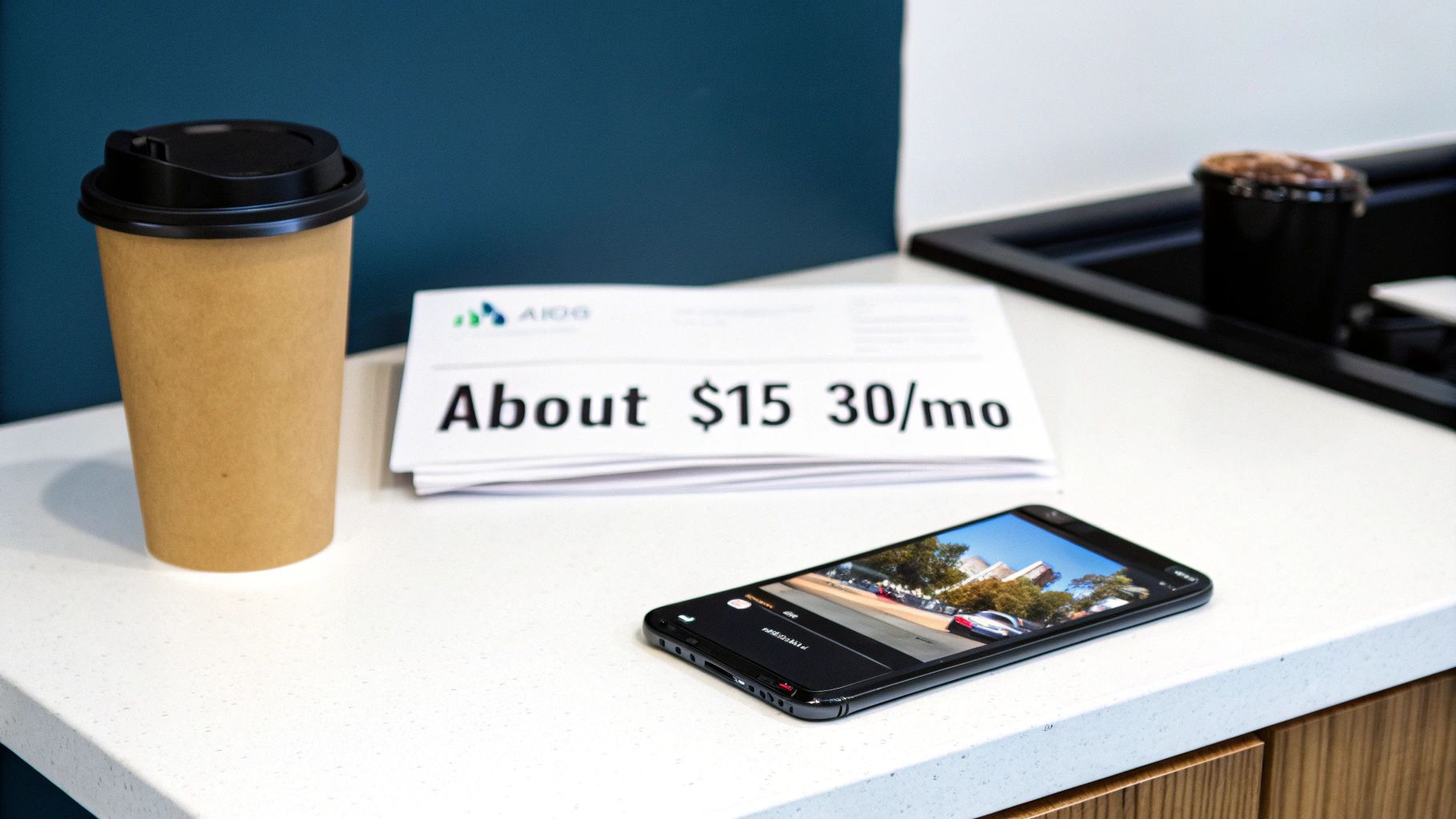
For most renters in California, a standard policy will run you somewhere between $15 and $30 a month. That’s it. We're talking about the cost of a few lattes or your favorite streaming service.
It's a pretty small price to pay for a massive financial safety net, protecting everything you own and shielding your bank account when things go sideways. While that range is a good ballpark figure, what you'll actually pay for your California insurance comes down to your specific situation and where you live.
Understanding the True Cost of Renters Insurance
When people ask, "how much is renters insurance?" what they’re really asking is, "what does it cost to protect my world?" It helps to think of it less as another monthly bill and more like a financial shield.
For a surprisingly low fee, you get real peace of mind. You know you're covered if your laptop gets stolen from a coffee shop, a kitchen fire ruins your furniture, or a friend slips and gets hurt in your apartment. This kind of affordable protection is a cornerstone of smart financial planning for any renter. It’s designed to stop one bad day from spiraling into a long-term financial mess. Instead of wiping out your savings to replace everything, your policy is there to help you get back on your feet.
A Growing Market Means Better Prices
The demand for this coverage is undeniable. The renters insurance industry is booming, with revenues projected to hit $5.9 billion in 2025. This surge is largely thanks to more people moving to cities where renting is the norm. With over 300 companies in the mix, all this competition is great for keeping prices down. You can check out more renters insurance trends from industry experts at IBISWorld.
This competitive environment is fantastic news for you. It means finding a policy that fits your budget is easier than ever. Insurers are always looking for ways to offer better value, whether it's through bundling discounts with your auto insurance or rewarding you for having smoke detectors.
What Determines the Final Number
So, how does that general $15-$30 estimate get translated into your specific monthly premium? A few key factors come into play, and understanding them is the first step to getting the best possible rate.
- Your Coverage Amount: This is the big one. How much are all your things worth? The more personal property coverage you need to replace your stuff, the higher the premium.
- Your Chosen Deductible: This is what you agree to pay out-of-pocket before insurance kicks in on a claim. Choosing a higher deductible usually lowers your monthly payment.
- Your Location in California: Where you live matters. Rates can vary quite a bit between, say, Los Angeles and Sacramento, based on local risks like theft rates.
- Your Claims History: If you have a track record of being claim-free, insurers see you as a lower risk and often reward you with a lower premium.
By looking at these elements, you can start to see how an insurance company puts together your quote and, more importantly, where you might have opportunities to save.
What Your Renters Insurance Premium Actually Buys You
When you pay that monthly premium for renters insurance, you’re not just checking a box for your landlord. You're buying a powerful, three-part financial safety net designed to protect your belongings, your savings, and your peace of mind.
Most standard renters policies—whether you’re in a Glendale home or a Westlake Village apartment—are built on three core pillars. Once you see what they are, you'll understand just how much value you're getting for that small monthly cost.
Personal Property Coverage: Your Stuff is Covered
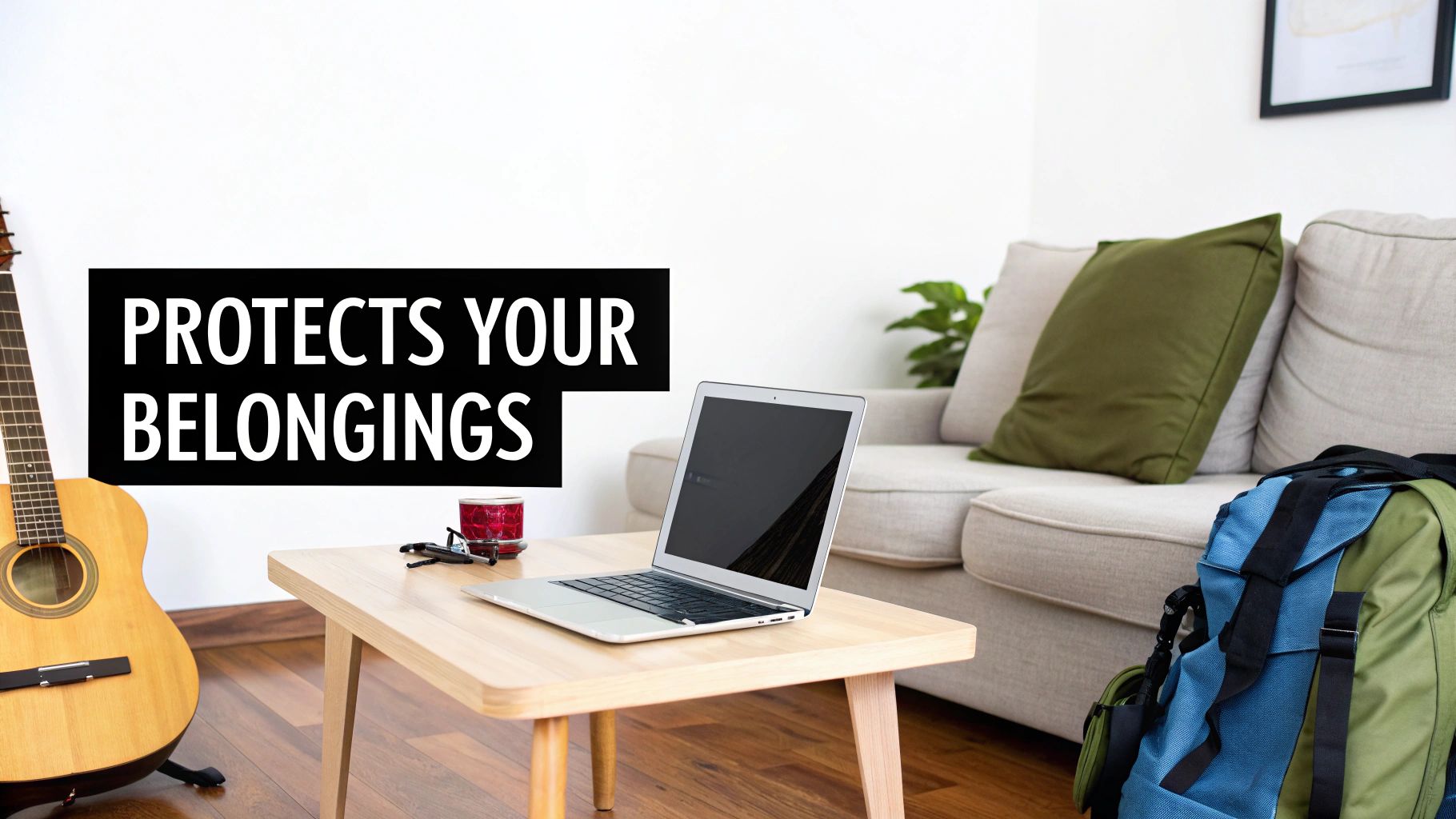
This is the part everyone thinks of first: Personal Property Coverage. It’s the financial backstop for everything you own inside your rental. From the couch and TV to your clothes and laptop, this coverage helps you replace your things if they're stolen or damaged in a covered disaster.
Take a quick mental inventory of your place. Your work computer, the bike you ride on the weekends, all the furniture you spent time picking out—it adds up faster than you think. In our experience, most renters are shocked to realize the total value of their belongings can easily top $20,000.
This coverage protects your possessions against common risks, like:
- Fire and smoke damage: If a kitchen fire ruins your furniture and electronics, your policy helps cover the replacement cost.
- Theft and vandalism: Someone breaks into your apartment? This helps replace stolen items like your laptop or jewelry. It often even covers theft from your car.
- Water damage from internal sources: A pipe bursts and soaks your rug and speakers. This coverage is your first line of defense.
Better yet, this protection isn't just confined to your four walls. If your laptop gets stolen from your car or a coffee shop, your renters policy often covers that loss, too. It’s security that travels with you.
A standard renters insurance policy acts as a comprehensive defense, covering your belongings not just from theft but also from common disasters like fire and internal water damage, which can happen to anyone at any time.
Liability Coverage: Your Financial Bodyguard
Next up is Personal Liability Coverage, and honestly, it might be the most important—and most overlooked—part of your policy. Think of it as a financial bodyguard. If someone is accidentally injured in your home and you're found responsible, this is what protects you.
Here’s a real-world scenario: a friend comes over, slips on a wet kitchen floor, and breaks their arm. They could sue you for medical bills, lost wages, and more. Without insurance, you’d be paying those costs, which could run into tens of thousands of dollars, right out of your own pocket.
This is where liability coverage jumps in to handle things. It helps pay for:
- Medical bills for the injured person.
- Your legal defense fees if you're sued.
- Damages you might be ordered to pay by a court.
Standard policies typically start with $100,000 in liability protection, which shields your savings and future income from a single, unfortunate accident. For just a few dollars a month, this component alone provides incredible value.
Additional Living Expenses: Your Temporary Lifeline
Finally, there’s Additional Living Expenses (ALE) coverage. Think of ALE as an emergency fund that kicks in if a disaster, like a fire or a major pipe burst, makes your apartment unlivable.
If you’re suddenly forced to move out while your place is being repaired, where would you go? Paying for a hotel and eating out every night gets expensive fast. ALE is designed to cover those extra, unexpected costs so you can maintain your normal standard of living without draining your savings.
This coverage reimburses you for reasonable expenses, including:
- Hotel bills or the cost of a temporary rental.
- Restaurant meals if you can't use your kitchen.
- Laundry services and other essential living costs.
ALE is the lifeline that keeps a major headache from turning into a full-blown financial crisis. It gives you the stability you need to get back on your feet. Together, these three coverages transform your small premium into a powerful tool for financial security.
What Goes Into Your Renters Insurance Rate?
Your renters insurance quote isn't just a number pulled out of thin air. Think of it as a custom price tag built just for you, pieced together from different parts of your life and where you live. Insurance companies are in the business of calculating risk, and each of these pieces helps them create a premium that matches your specific situation.
Getting a handle on these factors is the key to understanding your rate—and more importantly, how you can actually influence it. Some things are in your control, while others are set by your surroundings. Let's pull back the curtain on what really shapes your renters insurance bill in California.
The Levers You Can Pull
The most direct impact on your premium comes from the choices you make when you buy your policy. These are the dials you can turn to find that perfect balance between solid protection and a price that fits your budget.
- Coverage Limits: This is simply the maximum amount your policy will pay out if you file a claim. If you want $50,000 in personal property coverage instead of $20,000, you’re getting more protection, but your premium will be a bit higher. It’s a straightforward trade-off.
- Your Deductible: This is the amount you agree to pay yourself before insurance steps in. Let's say your laptop, worth $2,000, gets stolen. With a $500 deductible, you’d pay the first $500, and the insurance company would cover the remaining $1,500. Choosing a higher deductible, like $1,000, signals to the insurer that you're willing to handle more of the smaller costs yourself, which almost always lowers your monthly payment.
By tweaking these two things, you can fine-tune your policy's cost. The goal is to find that sweet spot where you sleep well at night knowing you're covered, without breaking the bank.
Where You Live and Your Track Record
Beyond your policy settings, a lot of what determines your rate is based on factors you don't directly control. Insurers are experts at sizing up risk, and a big part of that comes down to your address and your history with past claims.
Your ZIP code matters. A lot. An apartment in a Los Angeles neighborhood with a high theft rate will almost certainly come with a higher premium than a similar place in a quiet Sacramento suburb. Insurers dive deep into local data, looking at everything from crime statistics to how often weather-related claims pop up in the area.
The Bottom Line: Your premium reflects risk. Things like local crime rates, how close you are to wildfire zones, and even the age of your building all get baked into the final price you pay.
Your personal claims history is the other big piece of this puzzle. If you’ve filed several claims in the past few years, an insurer might see you as a higher risk and charge more. On the other hand, a clean record with no claims can lead to better rates and sometimes even a "claim-free" discount. This is exactly why it often makes sense to pay for a minor repair out-of-pocket instead of filing a small claim that could haunt your rates for years.
California-Specific Risks and Other Details
Living in the Golden State means dealing with some unique environmental threats, and insurance companies definitely take notice. Even though a standard renters policy doesn't typically cover earthquake or wildfire damage directly, living in an area prone to these events can still drive up your base premium due to the overall higher risk.
A few other personal details can also nudge your rate one way or the other:
- Credit History: In California, insurers are allowed to use a credit-based insurance score to help set your premium. Statistically, a strong credit history correlates with filing fewer claims, so it can often help you secure a lower rate.
- Roommates: Thinking of sharing a policy? It can sometimes raise the cost. Adding another person means more belongings and another person's liability risk under one roof, which an insurer has to account for.
- Pets: Believe it or not, Fido can affect your insurance. Some companies view certain dog breeds as a higher liability risk, which could lead to a higher premium or, in some cases, make it tougher to find coverage.
The global demand for renters insurance is climbing, jumping from $94.79 billion in 2024 to an estimated $100.99 billion in 2025. That's a 6.5% growth spurt, largely fueled by more people choosing to rent in cities. You can explore these trends in the global renters insurance market report on ResearchAndMarkets.com. With a growing market, insurers are constantly fine-tuning how they price risk. By understanding how they see you, you’re in a much better position to find a great policy at a fair price.
How Insurance Costs Vary Across California Cities
When you start shopping for renters insurance, you’ll quickly find that your address plays a huge role in the price you're quoted. It's a simple truth: where you live matters. Just like home prices fluctuate from one neighborhood to the next, so do insurance rates. A policy in a bustling city center like Los Angeles is going to look different than one for a quiet suburb in Sacramento, and for good reason.
Insurance companies are all about data. They dig into neighborhood-specific stats on everything from theft and vandalism to the frequency of fire and water damage claims. This local risk profile is a core ingredient in calculating your premium, which is why a personalized quote for your California insurance is the only way to know for sure what you’ll pay.
A Tale of Four Cities
Let's look at how this plays out in the real world. Here’s a quick comparison of what you might expect to pay for a standard renters policy across four major California hubs. These are just estimates, of course, but they paint a clear picture of how location moves the needle.
We've put together a table to show how sample monthly renters insurance costs can vary across some of California's biggest metropolitan areas for a standard policy.
Estimated Monthly Renters Insurance Premiums Across California Cities
| City | Estimated Monthly Premium | Key Local Cost Factors |
|---|---|---|
| Los Angeles | $20 - $30 | High population density and elevated property crime rates in certain areas increase perceived risk for insurers. |
| San Diego | $18 - $25 | Rates are often competitive, but factors like proximity to canyons with wildfire risk can influence premiums. |
| San Francisco | $17 - $24 | Dense urban living risks are often offset by strong building codes and excellent fire department response. |
| Sacramento | $15 - $22 | Generally lower property crime rates compared to larger coastal cities help keep premiums more affordable. |
As you can see, while the differences aren't massive, they reflect the unique risk profile of each city. The core factors—your coverage limits, deductible, and location—all work together to determine your final price.
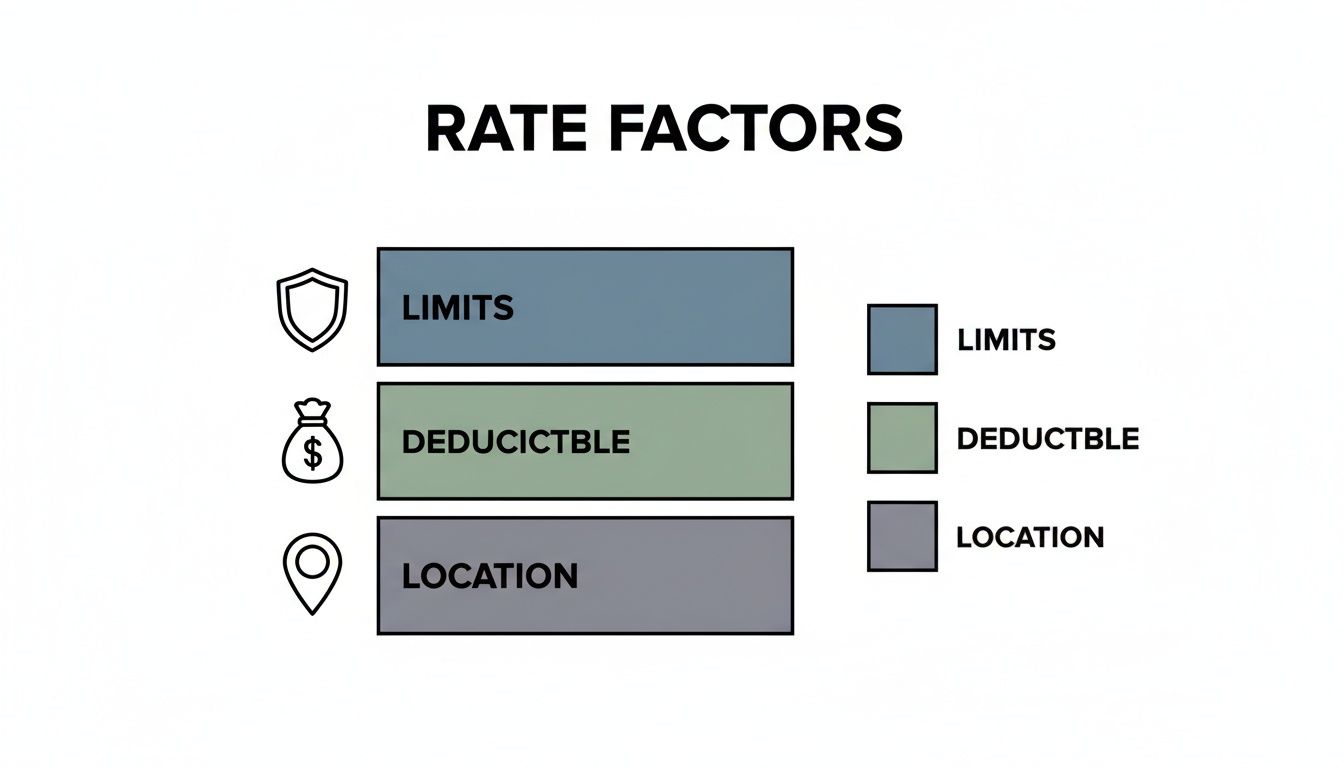
This graphic is a great reminder that while you can adjust your coverage limits and deductible to manage costs, your location is the fixed variable that sets the foundation for your premium.
The Why Behind the Price Tag
So, what’s really driving these price differences? It all comes down to data-driven risk assessment.
For example, if your ZIP code has a higher-than-average number of car break-ins, your premium might be a touch higher. Why? Because renters insurance often covers your personal belongings even when they're stolen from your vehicle. This is an important consideration when comparing car insurance and renters policies.
Similarly, living near an area with a history of wildfires or other natural disasters can subtly nudge your rate up, as insurers see it as a generally riskier environment. This is the same logic they apply to pricing home insurance, where location is king.
Key Takeaway: Your premium is a direct reflection of the calculated risk associated with your specific address. Insurers use localized data to predict the likelihood of a claim, making your location a primary driver of your final cost.
While these city-level numbers give you a ballpark idea, they really highlight the importance of getting a quote based on your exact address. North America currently accounts for over 40% of the global renters insurance market, and the U.S. is leading the charge thanks to its huge renter population.
This competitive landscape is great news for Californians, as it helps keep prices reasonable even in pricier cities. For a surprisingly low monthly cost, you can get tens of thousands of dollars in protection for your stuff.
Smart Ways to Lower Your Renters Insurance Bill
Knowing what goes into your renters insurance rate is one thing, but actually using that knowledge to save money is where it counts. The great news is you have more control over your premium than you might think. With a few smart adjustments, you can easily lower your monthly payment without giving up the protection you need as a California renter.
These aren't complicated industry secrets. They're just practical, time-tested ways to make your coverage more affordable. Let's walk through how you can keep more cash in your wallet, from simple policy tweaks to discounts you probably already qualify for.
Bundle and Save with a Multi-Policy Discount
One of the easiest and most effective ways to slash your insurance cost is by bundling. If you already have auto insurance, ask your provider about combining it with a renters policy. This almost always unlocks a multi-policy discount, which can easily save you 10% or more on both policies.
Think of it like a loyalty reward. Insurance companies appreciate customers who bring them more business, and they pass those administrative savings on to you. It also makes your life simpler, giving you one company and one agent to call for all your California insurance needs.
Combining your auto and renters insurance doesn’t just save you money; it builds a stronger relationship with your insurer. That can translate to better service and a smoother claims process down the road.
Adjust Your Deductible
Your deductible is the amount you pay out of pocket before your insurance coverage starts paying on a claim. Think of it as your share of the risk. It’s also one of the quickest ways to change your premium.
- Higher Deductible = Lower Premium: If you raise your deductible from $500 to $1,000, your monthly rate will drop. You're simply telling the insurance company you’re willing to handle smaller claims on your own.
- Lower Deductible = Higher Premium: A lower deductible means you pay less if something happens, so your premium will be a bit higher to reflect that.
The trick is to find your sweet spot. You want a deductible high enough to get a good discount but low enough that you could comfortably write a check for that amount tomorrow if you had to. Don't set a deductible you can't afford. For more tips on finding the right balance, check out our other California insurance guides.
Cash In on Safety and Security Discounts
Insurance is all about managing risk. So, when you take steps to make your rental safer, your provider will often thank you with a discount.
Most insurance companies will lower your rate for having basic safety features like:
- Smoke detectors
- Fire extinguishers
- A burglar alarm or home security system
- Deadbolt locks
These items show the insurer that you're less likely to file a claim for fire or theft, making you a less risky client. Always be sure to mention every safety and security feature in your home when you're getting a quote—each one could chip away at your premium.
Common Questions About Renters Insurance in California
Jumping into the world of insurance can feel a bit overwhelming, and you probably have a few questions. That's completely normal. When it's about protecting your stuff and your financial well-being as a renter here in California, getting straight answers is the first step to feeling confident in your coverage. Let's walk through some of the most common things people ask.
A big one we hear all the time is, "Do I have to get this?" Legally speaking, no. California state law does not require you to have renters insurance. But here's the catch: your landlord absolutely can require it. In fact, it's a very common clause in lease agreements today. They do this to make sure their property is protected and that you have liability coverage in case of an accident.
Are Earthquakes and Wildfires Covered?
This is the quintessential California question, and it's a critical one. Your standard, off-the-shelf renters insurance policy almost certainly does not cover damage from earthquakes or wildfires. These are typically considered separate, high-risk events and are listed as exclusions.
But that doesn't mean you're out of luck. You have a couple of options:
- Earthquake Coverage: This can usually be added as an "endorsement" (think of it as an add-on) to your renters policy. You can also get a standalone policy from a provider that specializes in it, like the California Earthquake Authority (CEA).
- Wildfire Coverage: Now, a standard policy covers a fire that starts in your kitchen. Wildfire is a different beast. Depending on where you live, especially in a high-risk area, you might need a specific endorsement for full protection. It's vital to talk this through with your agent.
How Much Coverage Do I Actually Need for My Stuff?
Trying to guess the value of your personal belongings can feel like plucking a number out of thin air. There's a much better way: a home inventory. It sounds more intimidating than it is. Just walk through your apartment, room by room, and make a quick list of your major items—your couch, TV, laptop, clothes, bed, etc.—and jot down what it would cost to buy them new today.
A home inventory is a game-changer. Not only does it help you land on the right coverage amount, but if you ever have to file a claim, having that list ready will make the entire process incredibly faster and less stressful.
Most people are genuinely shocked when they see the final number. It’s not uncommon for the total value to top $20,000 or more. The goal is to choose a limit that lets you replace everything without having to raid your personal savings.
Is It a Good Idea to Share a Policy with My Roommate?
On the surface, splitting a renters insurance policy with a roommate seems like a smart way to save a few bucks. While it does cut the monthly cost, it can open the door to some real headaches.
Think about it this way: if your roommate has to file a claim, it gets recorded on your shared policy history. That could make your insurance more expensive down the road, even if it had nothing to do with you. You also have to be sure the coverage limit is high enough for everyone's belongings combined. For most people, the simplicity and safety of having your own individual policy is well worth the small extra cost.
If you're looking for more answers, we've covered a wide range of topics on our California Insurance FAQ page.
Time to Find Out Your Real Rate
We've covered a lot—from national averages and city-specific costs to the nitty-gritty details that can nudge your premium up or down. But at the end of the day, there's only one number that truly matters: yours.
Those averages are a great starting point, but the only way to know exactly how much renters insurance will cost you is to get a personalized quote. Your unique situation, from the stuff you own to your building's location, creates an insurance profile that’s all your own. For what often amounts to less than a couple of fancy coffees a month, you get a powerful financial safety net.
This is where having an independent agent in your corner makes all the difference. Think of them as your personal shopper in the insurance world. They know the ins and outs of the California insurance market and can quickly compare plans from different top-rated companies to find you the best deal. It beats spending your weekend filling out endless online forms, and you can be confident you’re not leaving money on the table.
Let an Expert Do the Heavy Lifting
A good agent doesn't just sell you a policy; they get to know you. They understand the unique risks we face here in California and can help you figure out what you truly need. They’ll look at your whole picture—not just your renters insurance, but also your auto insurance. And if you're thinking about home insurance or life insurance down the road, they can help with that, too. This approach often uncovers smart ways to bundle policies and save money.
Working with an agent means you're not just buying a policy; you're gaining a partner dedicated to protecting your financial well-being. They provide tailored advice that a generic online form simply can't match.
Getting covered shouldn't feel like a chore. With the right help, you can get a straightforward, no-pressure quote that fits your life and your budget. Ready to see just how affordable peace of mind can be?
Take the next step and request a personalized California insurance quote today.
At Mai & Associates, we make finding great, affordable coverage simple. Talk to one of our licensed agents for a free, same-day quote.