How Much Is Car Insurance in California Costs Explained
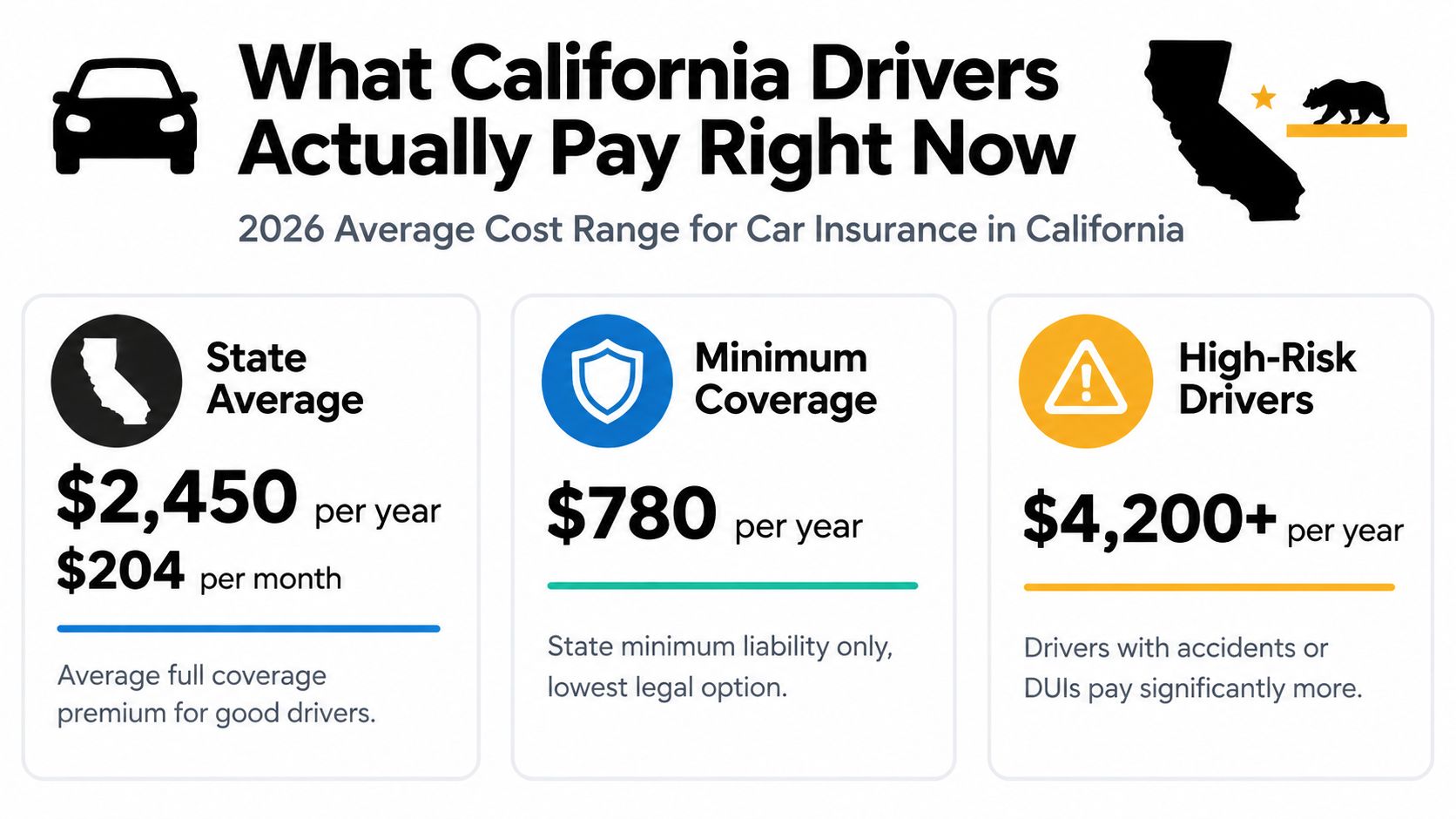
Full coverage car insurance in California commonly costs $1,775 to $2,569 per year, or about $148 to $214 per month. Minimum coverage generally falls around $751 to $827 per year, or approximately $63 to $69 per month, with the final quote shaped by your driver profile, ZIP code, vehicle, and coverage limits.
A California driver can receive one quote that feels manageable and another that seems shockingly high, even when both quotes cover the same car. A clean driving record, a high-risk ZIP code, an expensive-to-repair vehicle, and broader protection can all change the result.
The better question isn't, “How much is car insurance in California?” It's, “What should insurance cost for my exact situation, and am I comparing equivalent policies?” Statewide averages provide a useful starting line, but they don't predict your personal premium. The California Department of Insurance maintains a premium comparison tool for California drivers that can help illustrate how rates vary among insurers.
Introduction What California Drivers Actually Pay Right Now
A first-time buyer in California might enter a ZIP code, see an annual premium in the low thousands, and assume the insurer made a mistake. A neighbor with the same model car might pay much less, while another driver across town receives a substantially higher quote. Those differences usually reflect underwriting details, not random pricing.
The 2026 estimates show why averages can be confusing. One comparison places California full coverage at about $148 per month, with liability-only coverage near $69 per month, while other datasets place full coverage closer to $202 to $214 per month and state minimum coverage around $63 to $97 per month. Annual estimates cluster around $1,775 to $2,569 for full coverage and roughly $751 to $827 for minimum coverage, depending on the source and methodology. See the California car insurance cost comparison for the underlying range and methodology differences.
Why the statewide average isn't your quote
An average combines many different drivers and policies. It may include someone with a long clean record, someone with a recent claim, an older vehicle with liability-only coverage, and a newer financed vehicle with collision and full protection.
Your quote can move because of:
- Driver profile: Age, experience, household drivers, and driving history affect expected risk.
- ZIP code: Insurers evaluate local claim frequency, congestion, theft exposure, repair activity, and catastrophe risk.
- Vehicle: A car with costly parts or specialized repair needs can cost more to insure.
- Coverage limits: Higher liability limits and broader physical damage protection increase the premium.
- Deductible: A higher deductible can reduce the premium, but you'll pay more after a covered loss.
California remains a relatively high-cost auto insurance market, although estimates differ sharply by coverage type and methodology. The practical response is to use the average as a benchmark, then compare matching policies from several carriers. A quote review through Mai & Associates California insurance services can help you compare auto insurance alongside home, renters, or life insurance needs.
Understanding Coverage Levels and What You Are Paying For
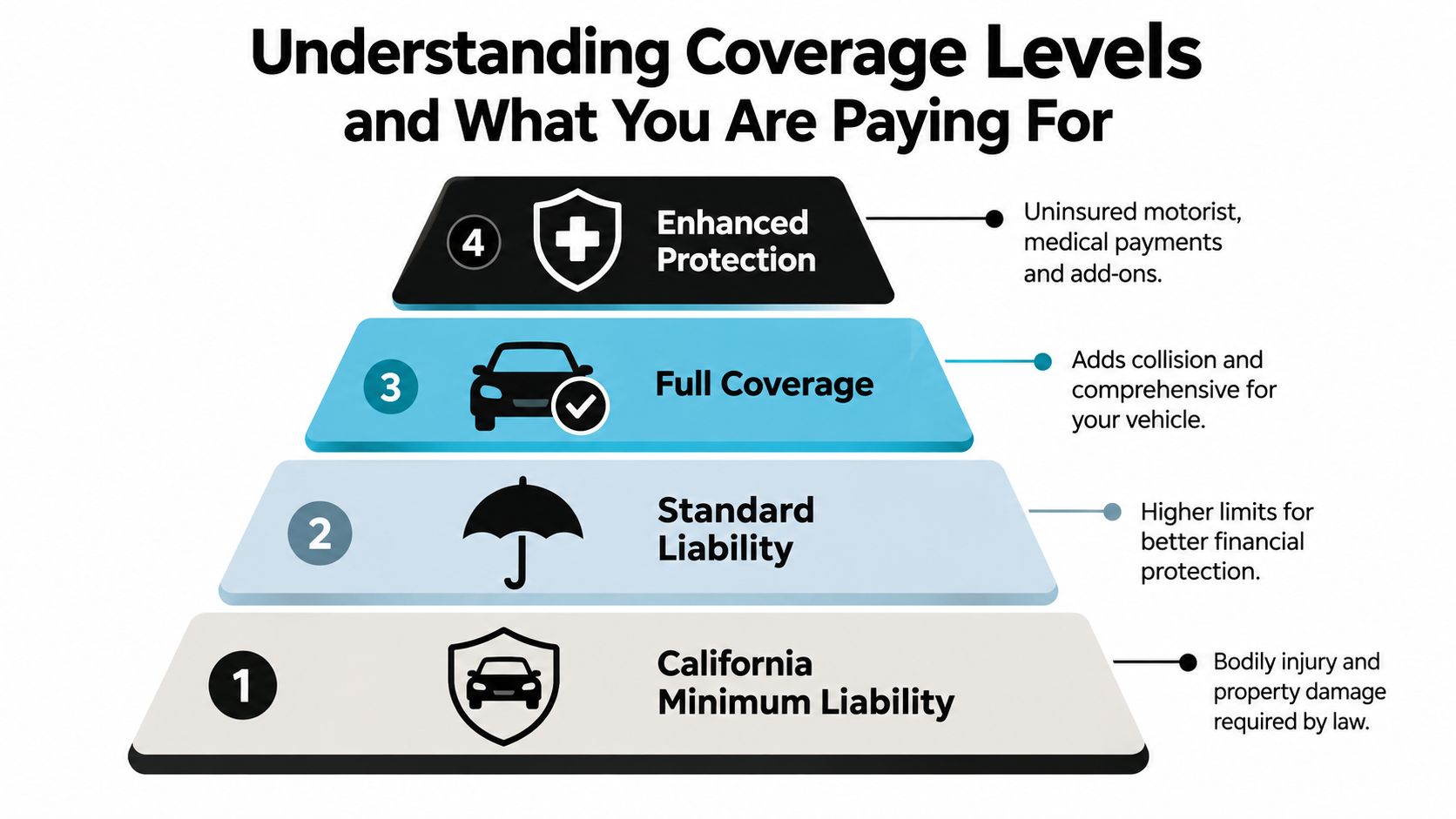
Think of car insurance as a set of protective layers. The bottom layer helps you meet California's legal responsibility requirements. Higher layers protect your finances more broadly, including damage to your own vehicle and injuries caused by drivers who lack enough insurance.
The cheapest policy isn't automatically the most economical policy. A low premium can leave you responsible for repair bills, medical expenses, or legal claims that exceed your limits.
Start with liability protection
Liability insurance pays for covered injuries or property damage you cause to another person, subject to your policy limits. California requires liability coverage, but the legal minimum is only a starting point for deciding how much protection makes sense.
Minimum liability generally produces the lowest legal premium because it provides the narrowest protection. It doesn't pay to repair your vehicle after a collision you cause, and it may not fully protect your assets if a serious claim exceeds your limits.
Many drivers choose higher liability limits instead. This raises the premium, but it also creates a larger financial buffer if another party seeks compensation after a serious crash. The right limit depends on your assets, income, vehicle use, and comfort with risk.
Coverage rule: Compare quotes only after confirming that the liability limits, deductibles, and included protections match.
Add protection for your vehicle
Collision coverage generally addresses damage to your vehicle from a collision, subject to the deductible. Other-than-collision coverage addresses covered non-collision losses, such as theft, vandalism, falling objects, or weather-related damage. Together, they're often called full coverage, although full coverage isn't a single standardized policy and can include different limits and add-ons.
A lender or leasing company may require collision and coverage. Even without a loan, consider the vehicle's value and whether you could replace it or repair it after a loss.
Review the optional layers
Uninsured and underinsured motorist coverage can help protect you when another driver has no insurance or not enough insurance. Medical payments coverage may help with certain accident-related medical expenses, subject to policy terms. These options raise the premium, but removing them can create a serious gap.
For broader California Insurance guidance, including auto, home, renters, and other policy decisions, you can consult the California insurance guides. The key is to choose protection deliberately instead of selecting the lowest number on a quote screen.
Key Factors That Drive Your California Car Insurance Rate
Two California households can own identical vehicles and still receive very different premiums. Insurers evaluate the likelihood and potential cost of a claim, using information about the driver, vehicle, location, and prior insurance experience.
The driver behind the wheel
Age and driving experience influence how insurers assess risk. A newer driver usually has less experience managing traffic, weather, and unexpected situations. A household policy can also change when a young driver is added, because the insurer is evaluating the combined risk of the listed drivers.
Driving record and claims history matter because past incidents can indicate future claim exposure. At-fault collisions, violations, and claims may affect eligibility or pricing at renewal. The circumstances matter, including who was responsible and how severe the loss was.
A driver with a clean record may still receive a high quote if the vehicle, ZIP code, or selected protection creates a higher expected cost. Conversely, a driver with a less favorable history may find a better option by comparing carriers rather than accepting the first renewal offer.

The location and vehicle
ZIP code risk helps explain why nearby drivers can pay different rates. Dense traffic, theft patterns, repair activity, and wildfire exposure vary by location. A driver in a busy urban area may face a different claims environment from someone in a lower-density suburb, even if the commute is similar.
Vehicle make, model, and repair cost also affect the premium. A car with expensive sensors, specialized parts, or higher theft exposure may cost more to repair or replace. Safety equipment can help in some rating models, but it doesn't guarantee a lower quote.
Use and coverage history
Annual mileage and vehicle use help insurers estimate exposure. A vehicle used for a long daily commute presents a different risk profile from one driven occasionally. Business use, rideshare activity, and regular long-distance travel may require specific policy treatment.
Insurance history and eligibility factors can also influence the rate. Continuous coverage, prior cancellations, and the accuracy of the application may affect how carriers evaluate a new policy. California rating rules limit how insurers may use certain factors, so ask an agent to explain what information is affecting your quote.
You can change coverage selections and shop carriers quickly. Your driving record, claims history, and insurance history usually improve only with time and consistent responsible driving.
Real World Price Examples by Driver Profile and Situation
Price examples are most useful when they show why the number changes, not when they pretend to predict an exact premium. The profiles below are illustrations of rating logic, not guaranteed quotes. They use qualitative ranges because a precise annual price would require a carrier, ZIP code, vehicle, limits, deductible, and complete driving history.
| Driver Profile | Coverage Level | Estimated Annual Range | Key Price Driver |
|---|---|---|---|
| Teen driver on a family policy | Broad coverage matching the household vehicle | Higher than the household's established-driver premium | Limited experience and household risk |
| 30-year-old clean-record commuter in a suburban ZIP | Full coverage | Often near the market's standard full-coverage range | Vehicle, commute, limits, and location |
| Urban driver with a recent at-fault accident | Full coverage or enhanced liability | Potentially well above the standard range | Recent at-fault loss and urban claims exposure |
| Senior driver with low mileage | Liability-only or full coverage | May fall below or near a standard profile depending on vehicle and history | Low usage balanced against age and coverage choices |
A teenager added to a family policy may change the household premium more than the parents expect. The insurer isn't just rating the teenager's vehicle. It may evaluate access to household vehicles, driving experience, and the possibility that the new driver uses a more expensive car.
The clean-record commuter offers a clearer benchmark. A driver in this profile may still see different rates from carriers because one insurer may price the vehicle or ZIP code more favorably than another. Matching deductibles and liability limits is critical before deciding which quote is cheaper.
An urban driver with a recent at-fault accident can face a more difficult shopping process. The insurer may reassess the driver at renewal, and the accident's severity, claim payment, and responsibility can all influence the result. After a total loss, policyholders should also understand what affects a fair insurance payout after a total loss, because the vehicle settlement and the future premium are separate issues.
A senior driver with low mileage may reduce exposure through limited use, but low mileage doesn't erase the effects of vehicle value, location, claims history, or selected protection. Drivers in the Los Angeles area can compare location-specific considerations through Los Angeles auto insurance guidance.
The useful comparison isn't “Which profile gets the lowest price?” It's “Which parts of my profile can I change, and which coverage choices keep me financially protected?”
Why California Costs More and How the Market Is Trending
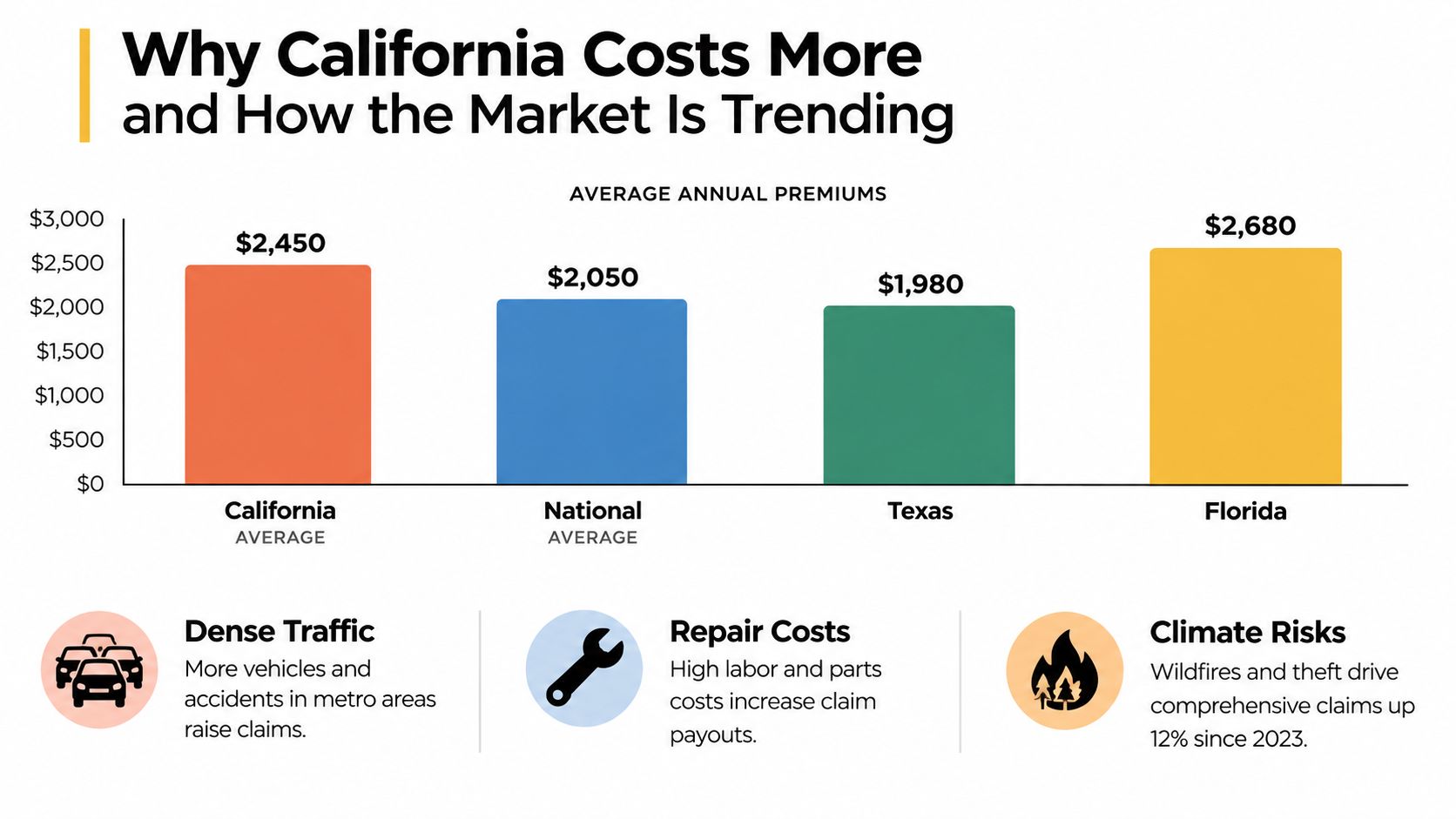
California prices attract attention because the state often lands above national full-coverage averages in independent comparisons. One market estimate places California full coverage at $202 per month, compared with a $187 national average, while another estimates California costs about $400 above the U.S. mean and ranks it as the 10th most expensive state. These figures come from different datasets, so they shouldn't be combined into one definitive statewide price. The comparisons are summarized in California auto insurance market data.
The claims environment matters
California combines several pressures that can increase claim costs:
- Dense traffic: More vehicles and congestion can create more opportunities for collisions, especially in major metropolitan areas.
- Repair inflation: Labor, parts, calibration, and specialized technology can make modern vehicle repairs more expensive.
- Litigation exposure: Liability claims can involve legal costs and larger disputes over responsibility and damages.
- Wildfire-prone ZIP codes: Catastrophe exposure can affect coverage and carrier appetite in vulnerable locations.
These pressures don't affect every driver equally. A suburban driver with an older vehicle may experience the market differently from an urban driver with a newer car parked outdoors in a wildfire-exposed area.
Volatility makes shopping important
California's market has also been volatile enough that recent rate movement and carrier availability matter alongside personal history. One 2026 projection indicated that California auto insurance rates would rise by only 1% that year, even though another dataset showed an overall annual average of about $2,281, with minimum coverage at $1,312 and full coverage at $3,001. The figures come from different methodologies and shouldn't be treated as a single market quote. Historical context is discussed in Experian's California car insurance cost overview.
A separate comparison placed California's overall average near $146 per month, versus a $142 national average, showing how the apparent gap can be small in one sample and much larger in another. That spread is exactly why drivers should request multiple quotes with identical information and coverage.
Proven Ways to Lower Your Premium Without Losing Protection
Reducing a premium works best when you remove unnecessary cost, not necessary protection. Use the following checklist during a policy review.
- Compare carriers with identical limits: Ask each insurer to quote the same liability limits, collision and deductibles, and optional coverage. A lower price may reflect thinner protection.
- Bundle compatible policies: Combining auto with home or renters insurance may create a package discount. Review the combined premium and coverage, not just the auto line item. Renters insurance is generally much less expensive than auto insurance. One California estimate places the average near $155 per year, or about $13 per month, while another places it closer to $192 per year, depending on assumptions and carrier mix. The California renters insurance cost comparison explains the range.
- Choose deductibles deliberately: A higher deductible can lower the premium, but only choose one you could pay after a covered loss. The cheapest monthly option can become stressful if the out-of-pocket amount is unaffordable.
- Ask about mileage programs: If you drive infrequently, ask about low-mileage or usage-based programs. Read how the program measures driving and whether the data collection fits your preferences.
- Use eligible driver discounts: Ask about good-driver, defensive-driving, student, and household discounts. Eligibility rules vary, so don't assume a discount applies until the carrier confirms it.
- Review vehicle-specific savings: Safety equipment, anti-theft features, and storage arrangements may affect pricing. They won't override every other rating factor, but they're worth reporting accurately.
- Audit the policy annually: Check listed drivers, garaging address, vehicle use, mileage, lienholder information, and coverage limits. Removing a former vehicle or correcting an outdated commute can prevent avoidable costs, but don't understate use to obtain a lower rate.
- Protect personal property separately: Renters insurance can cover personal property and liability under its own policy. A benchmark policy may assume $20,000 in personal property coverage, $100,000 in liability limits, and a $500 deductible, with one estimate at $204 per year under those assumptions. See the California renters coverage benchmark before choosing limits.
Don't drop full coverage on a vehicle you couldn't replace comfortably, and don't reduce liability limits without considering your financial exposure. A same-day comparison quote is useful only when the policy remains suitable after the price drops.
Conclusion Your Next Step to an Accurate California Quote
The statewide answer to “how much is car insurance in California” is a range, not a promise. Full coverage commonly sits in the low thousands annually, while minimum coverage generally costs less, but your ZIP code, vehicle, driving record, mileage, limits, and deductible determine where your quote lands.
Three decisions deserve the closest attention:
- Coverage level: Decide whether minimum liability, higher liability limits, or full coverage fits your vehicle and financial situation.
- Deductible: Choose an amount you could pay without creating a financial emergency.
- Carrier choice: Compare multiple insurers using identical information instead of renewing automatically.
California drivers also need to coordinate auto insurance with broader protection. Homeowners may need to review wildfire exposure, earthquake options, or California Fair Plan arrangements. Renters should protect personal property and liability, while families may need life insurance that supports long-term financial obligations.
A personalized quote review can uncover both savings and coverage gaps. Use the California insurance quote request to provide your information, then ask the agent to explain every major difference among the available options. If you're in a high-risk or Fair Plan area, request a policy review rather than assuming that limited availability means you must accept inadequate protection.
The most affordable policy is the one that fits your budget without leaving a dangerous gap after a serious loss. Compare carefully, ask direct questions, and make the final decision based on protection as well as premium.
Mai & Associates helps California drivers compare auto insurance options from multiple carriers, while also reviewing home, renters, life, Fair Plan, earthquake, and wildfire protection needs. Visit Mai & Associates for a no-obligation quote review and practical guidance from licensed California agents.