How Much Is Average Car Insurance in 2026?
TL;DR: In 2026, the national average cost of car insurance is $2,697 per year for full coverage and $820 per year for minimum coverage. California runs higher, with full coverage averaging $3,119 per year, so the key question for drivers here isn't just how much is average car insurance, but why your own price can land well above or below that mark.
A lot of people ask for the average because they want a quick benchmark. That's smart. You need some starting point before you can tell whether your quote is reasonable or overpriced.
But car insurance doesn't work like buying the same gallon of milk at every store. It works more like a custom risk score in a game. You start with a base number, then the insurer adds or subtracts based on the details of your driver profile, your car, your ZIP code, and the coverage choices you make. In California, that gets especially important because wildfire exposure, dense traffic, theft patterns, and neighborhood-level claim trends can all push rates around.
If you also carry home insurance, renters insurance, or life insurance, the bigger picture matters even more. Your auto policy often doesn't live in isolation. The way your policies fit together can affect both your protection and your budget.
The 2026 Car Insurance Cost Landscape
The national averages give you a useful anchor. According to Bankrate's 2026 average car insurance analysis, full coverage averages $2,697 per year, or $225 per month, and minimum coverage averages $820 per year, or $68 per month. The same analysis says California drivers pay among the highest premiums in the country, with full coverage averaging $3,119 annually.
That gap matters. It tells you California drivers are shopping in a tougher market before any personal factor even enters the picture.

What an average can and can't tell you
An average is like the posted starting price on a car. It gives you a ballpark, not your final total.
Two California drivers can ask for the same coverage and get very different numbers. One may have a clean record, live in a lower-risk area, and drive a modest sedan. Another may commute through heavy traffic, park on the street, or own a car that's expensive to repair. Both are "average California drivers" in a broad sense, but insurers won't price them the same.
That's why average cost questions often create confusion. People assume average means normal, and normal means what they should pay. It doesn't. It only gives you a benchmark for comparison.
Practical rule: Use the average to judge the market. Use your own quote to judge your situation.
Why California often feels expensive
California combines several cost pressures in one place. Large urban areas bring dense traffic. Some neighborhoods see more theft or vandalism. Some regions face wildfire concerns that affect how people think about full coverage and vehicle protection.
Even statewide averages don't capture that local variation very well. A driver in one part of Southern California may face a very different insurance picture than a driver in a quieter inland or coastal area.
For readers comparing broader California insurance topics, including auto, home, renters, and life coverage, this California insurance blog resource can help frame how these policies fit together.
Think in terms of a base rate
A simple way to understand pricing is to picture a starting score. The insurer begins with a base rate for a coverage type. Then it adjusts up or down based on risk signals.
Those adjustments come from four big buckets:
- Who you are as a driver: your driving history, age, and other rating factors allowed in California
- Where you live: your ZIP code, local traffic, claim patterns, and theft exposure
- What you drive: repair cost, safety features, and how likely the vehicle is to be stolen or heavily damaged
- What you buy: minimum liability, full coverage, deductible choices, and policy add-ons
Once you see insurance this way, the pricing feels less mysterious. It's still frustrating sometimes, but it starts to make sense.
How Your Driver Profile Shapes Your Premium
Insurers don't price only the car. They price the combination of the car and the person driving it.
A good analogy is a recipe. Your premium is the final dish, but your driver profile is a big part of the ingredient list. If one ingredient changes, the price can change with it.
Your driving record carries real weight
The clearest example is an at-fault accident. According to Experian's California car insurance breakdown, a single at-fault accident can increase rates by 42 to 65 percent, with an example moving from a $2,133 baseline to $3,025 or more.
That jump is why a clean record is often your strongest long-term money-saving tool. It doesn't just help this year's premium. It can shape several renewal cycles.
If you're new to auto insurance, many people stumble on this concept. They think one incident is a one-time problem. In practice, one accident can keep affecting what you pay for a while, depending on the carrier and timing.
Marital status can affect pricing too
Experian also notes that married drivers often see a 4.6 percent discount compared with single drivers in California. That doesn't mean marriage makes someone a better driver on command. It means insurers use many rating variables to estimate the likelihood and size of future claims.
This is one of those areas where people understandably raise an eyebrow. Insurance pricing isn't making a moral judgment. It's using a statistical model.
Insurance pricing works more like a scorecard than a reward system. The insurer is asking, "How likely is a claim, and how costly might it be?"
California limits some pricing factors
California has its own rules. One important example is that sex-based pricing is restricted under Proposition 103, so insurers here don't use gender the same way some other states do.
That matters because people often read national advice and assume it applies the same way in California. It doesn't always. State rules can change which rating factors matter and how much weight they carry.
Younger and less-established drivers usually feel more pressure
Age and driving experience often move together. A newer driver usually has less history for the insurer to evaluate, and less experience behind the wheel. That uncertainty tends to make pricing harder on younger drivers.
If you're helping a teen, college student, or first-time policyholder, the sticker shock can feel personal. It usually isn't. It's the insurer pricing for limited experience and higher perceived risk.
A simple way to read your own profile
If you want to make sense of your quote, break it into two groups.
You usually can't quickly change these factors:
- Your age
- Your years of driving history
- Your marital status
- Your prior claims or accidents already on record
You often can influence these factors over time:
- Keeping a clean driving record
- Avoiding lapses in coverage
- Choosing a vehicle that's cheaper to insure
- Reviewing your policy before renewal instead of auto-piloting it
Sample Annual California Car Insurance Rates by Driver Profile (2026)
| Driver Profile | Average Annual Premium |
|---|---|
| Baseline example before an at-fault accident | $2,133 |
| Same driver after a single at-fault accident | $3,025+ |
| Married driver | $1,576 |
| Single driver | $1,649 |
The table above pulls together the specific California and related driver-profile examples cited in the Experian-backed data already discussed. It's not a universal rate card. It's a snapshot that shows how one profile detail can shift cost.
Why people misread their quote
Many drivers compare themselves to a friend and say, "We're about the same age and both drive decent cars, so why is mine higher?" Usually, the hidden differences are in record history, prior coverage history, household setup, or address details.
That's also why online estimates can feel inconsistent. If one form asks more questions than another, you may not be seeing the same driver profile reflected in both quotes.
A smart next step is to review the quote line by line and ask: what part of my profile is being priced most heavily here?
Why Your California ZIP Code Is a Major Cost Factor
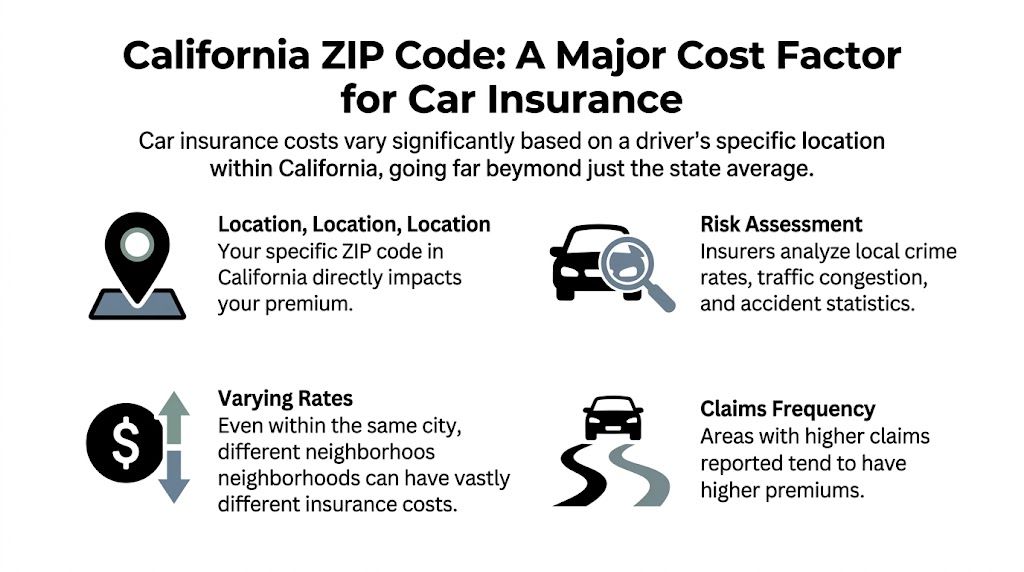
A lot of drivers think state matters, city matters, and then that's about it. In reality, your ZIP code can have a huge effect on what you pay.
California's approach gets especially granular. Your premium isn't based only on "living in California." It's based on the local conditions insurers expect around your daily driving and parking environment.
Los Angeles and San Diego show the pattern clearly
According to SoFi's California car insurance cost overview, Los Angeles premiums average $3,066 to $4,246 annually, while San Diego averages $1,820 to $2,727 annually. The same source ties the difference to increased collision frequency in Los Angeles that runs 15 to 20 percent higher than San Diego.
That's the kind of comparison that helps people understand pricing. Insurers aren't just charging more because a city is famous, crowded, or expensive in a general sense. They're looking at claim-related conditions tied to where cars are driven, parked, and repaired.
A clean driver can still pay more just because of location
The same SoFi analysis gives a simple example: a 40-year-old driver with a clean record might pay $233 per month in Los Angeles versus $159 in San Jose.
That example catches many people off guard. Same age. Clean history. Different city. Big pricing gap.
If you've ever moved and then seen your premium change even though nothing else changed, this is why. The insurer updated the local risk environment attached to your address.
What insurers are trying to estimate
A ZIP code acts like a local risk map. It can reflect several claim-related patterns at once:
- Traffic congestion: more cars packed into the same roads can mean more collision opportunities
- Theft and vandalism exposure: some areas generate more vehicle-related losses
- Claim frequency: if insurers see more claims coming from a local area, rates often reflect that
- Repair environment: some locations can be more expensive or more complex when claims get repaired and processed
Insurance assessment is similar to weather forecasting. The insurer doesn't know whether you'll have a claim tomorrow. It does know what the broader local pattern has looked like.
A ZIP code isn't a verdict on you as a driver. It's the insurer's shortcut for estimating the environment around your vehicle.
Even neighborhoods in the same region can price differently
Broad city averages stop being enough. Two drivers in the same metro area can still see noticeable differences because insurers are rating at a more local level than the city name alone suggests.
That's especially relevant across varied California markets such as Glendale, Westlake Village, Escondido, and Costa Mesa. A driver commuting through dense urban corridors and parking on the street may face a different pricing picture than someone in a quieter neighborhood with less congestion or lower theft exposure.
What to do with this information
You usually can't move just to improve your auto premium. But you can use ZIP code awareness to make better shopping decisions.
Try this approach when reviewing quotes:
- Use the same address on every quote request so you're making a true apples-to-apples comparison.
- Keep coverage levels identical across insurers. If one quote has lower protection, it may look cheaper for the wrong reason.
- Ask how garaging and parking are being counted. The way your vehicle is stored can matter.
- Re-shop after a move. Even a short move across the same county can produce a different result.
If your area has high wildfire risk, this local review can also matter beyond auto insurance. It may affect how you think about full coverage on your vehicle, and it can connect with broader home insurance and California Fair Plan conversations for your household.
Deconstructing Your Coverage and Vehicle Choices
Some parts of your premium feel fixed. Your address is your address. Your driving history is already written. But your coverage choices and vehicle choices give you more room to steer the outcome.
This is the part many drivers skip because policy terms sound technical. They don't need to.
What the basic coverage pieces actually do
Liability coverage pays for damage or injuries you cause to others, up to your policy limits. It's the foundation of an auto policy and the part California drivers legally focus on first.
Collision coverage helps repair or replace your car if you hit another vehicle or object, regardless of fault in many claim situations.
Coverage for non-collision losses is the part people often misunderstand. It usually addresses non-collision losses such as theft, vandalism, falling objects, and weather-related damage. In California, that's especially important in areas where wildfire exposure is part of everyday planning.
Full coverage costs more, but it changes your risk
Minimum coverage can lower your premium because you're buying less protection. Full coverage costs more because it protects more of your own vehicle too.
The key question isn't just "Can I get a lower bill?" It's "What would I have to pay out of pocket if something happened tomorrow?"
That tradeoff becomes clearer in wildfire-prone areas. If your car is damaged outside a collision event, the cheaper policy may not feel cheap anymore.
Your deductible is a cost lever
A deductible is the amount you agree to pay before the insurer steps in on a covered claim. Choosing a higher deductible usually lowers the premium. Choosing a lower deductible usually raises it.
This is like deciding how much small risk you're willing to keep in your own pocket. Some drivers prefer a lower monthly bill and can comfortably handle a larger out-of-pocket hit. Others want more predictability even if the premium is higher.
Before raising your deductible, ask yourself one plain question: if I had a claim this week, could I actually afford to pay that amount?
Your vehicle matters more than people expect
Insurance companies look closely at the car itself. A modest vehicle that's cheaper to repair often lands differently than a luxury model, performance car, or vehicle with expensive parts and sensors.
Safety features can help the risk picture too, but the overall vehicle profile still matters. The insurer is asking how costly the car is to repair, how likely it is to be stolen, and what kind of claims tend to follow that model.
A simple coverage decision framework
If you're choosing between options, try this checklist:
- Start with your car's value: If replacing the car would be financially painful, fuller protection usually deserves a closer look.
- Think about local risks: Street parking, theft exposure, and wildfire concerns can change what feels "optional."
- Match the deductible to your savings: A lower premium only helps if the deductible is realistic for your budget.
- Review the car's condition: Before renewing or adjusting coverage, a practical resource like this car safety inspection checklist from Express Lube & Car Care can help you think through vehicle condition, maintenance, and issues that may affect how you use and protect the car.
Auto doesn't sit alone in the household budget
Coverage choices also interact with your broader insurance picture. A household balancing car insurance with home insurance, renters insurance, or life insurance may want consistency in deductibles, stronger liability planning, and fewer gaps between policies.
That's why the cheapest standalone auto quote isn't always the best total decision. The better question is whether your protection makes sense across your life, your vehicle, and your California risks.
Actionable Strategies to Lower Your Car Insurance Bill
You can't control every rating factor, but you can do a lot more than many understand. The best savings usually come from a handful of smart moves done together, not one magic trick.
And in California, shopping matters more than people think. According to Progressive's car insurance cost guide, rate variations among carriers can exceed 50 percent for identical coverage levels, and bundling home and auto policies can lead to discounts of 10 to 25 percent.

Compare quotes the right way
This is the first move because it can change everything else. If different carriers price the same risk differently, you need multiple quotes to know where you stand.
But the comparison has to be clean:
- Match coverage line by line: liability limits, deductibles, collision, damage from other incidents, and optional features should all match
- Use the same driver information: even a small difference in annual mileage or garaging details can distort the result
- Check the payment view: compare annual and monthly cost, but don't assume the cheapest monthly option is the cheapest overall
A lot of drivers think they're comparing quotes when they're really comparing different products.
Bundle where it makes sense
If you also need home insurance, renters insurance, or even want to review broader household planning that includes life insurance, bundling can be worth asking about.
The discount is only part of the benefit. Bundling can also simplify renewals, billing, and coverage reviews. For many households, it becomes easier to spot overlap or gaps when policies are considered together.
Review your deductible with honest math
A higher deductible can reduce your premium. That can be a solid move if you have emergency savings and want to lower the recurring cost.
But don't treat this as free savings. You're trading a smaller bill now for a larger bill later if you file a claim. Some drivers are comfortable with that trade. Others aren't.
Ask about every discount you might qualify for
Insurers don't always surface every possible discount in the way you expect. Ask directly.
Good questions include:
- Is there a multi-policy discount?
- Is there a telematics or safe-driving program?
- Is there a discount for paying in full instead of monthly?
- Are there vehicle-based discounts tied to safety features?
- Is there a household or driver-history discount I may be missing?
Short, direct questions often uncover more than generic "Anything else available?" conversations.
Small discounts stack. A savings opportunity that seems minor on its own can matter once it's layered with other changes.
Don't over-insure an older vehicle automatically
Some cars benefit from full protection. Others may have reached a point where the cost of carrying certain coverages deserves another look.
That doesn't mean dropping protection blindly. It means checking whether the premium still lines up with the vehicle's value, your savings, and your local risk environment.
Use annual reviews instead of auto-renewing on autopilot
Insurance drifts. Your life changes. Your commute changes. Your car ages. Your housing situation changes too.
A yearly review is one of the simplest ways to keep costs under control, especially if your household needs have expanded beyond auto into renters, home, or life insurance. For more practical policy-planning resources, this California insurance guide library is a useful place to continue your research.
Find Your Best Rate with Mai & Associates
Average rates are helpful, but they don't buy your policy. Your actual premium depends on the mix of details insurers use to price your situation.
That's why the smartest move isn't chasing a random average. It's getting your own numbers reviewed carefully, with the same coverage compared across multiple carriers.
Why personalized quote review matters
One insurer may weigh your ZIP code more heavily. Another may respond better to your driving history or vehicle profile. A third may fit your household best if you also need home insurance, renters insurance, or life insurance.
For California drivers, that complexity gets bigger in wildfire-prone regions, dense urban markets, and households that need to coordinate multiple policies. A generic online estimate often misses those details.
What a strong local agency should help you do
A good quote review should do more than hand you a premium. It should help you answer questions like:
- Am I comparing identical coverage, or just a cheaper-looking version?
- Does my deductible fit my real budget?
- Do my auto and home or renters policies work well together?
- If I live in a higher-risk area, are there coverage gaps I haven't noticed?
For many Californians, language support matters too. Insurance gets easier when the conversation is clear and nothing is lost in translation.
Where Mai & Associates fits in
Mai & Associates is built for this kind of California-specific review. The agency works with drivers and households across the state and helps clients compare options for auto insurance, home insurance, renters insurance, and life insurance in a way that matches real budgets and local risks.
That includes support for more complex situations such as California Fair Plan reviews and households thinking through wildfire and earthquake exposure alongside everyday insurance decisions.
If you want a direct next step, you can request a no-obligation California insurance quote from Mai & Associates. For many drivers, that's the fastest way to move from "how much is average car insurance" to "what's the best rate for me?"
Frequently Asked Questions About Car Insurance Costs
Some of the most common questions about car insurance don't need a long explanation. They need a clear one.
Does my car's color affect my insurance rate
No. Insurers focus on the vehicle's make, model, repair profile, claim history, and other rating details. The paint color itself isn't the thing driving the premium.
Does car insurance get cheaper as I get older
It often gets easier when a driver has more experience and a solid record, but age doesn't work alone. Your driving history, address, vehicle, and coverage choices still matter. A move, a claim, or a different car can change the result even if you're getting older.
Do I need different coverage if I use my car for work
Sometimes, yes. Personal auto insurance and business use don't always fit together neatly. If you drive for work beyond ordinary commuting, ask whether your current policy matches how the car is really being used.
Is minimum coverage always the cheapest smart option
It's often the cheapest upfront option, but not always the wisest one. The real test is whether you'd be comfortable covering major out-of-pocket costs yourself after a loss.
If I accidentally put the wrong fuel in my car, would insurance help
That depends on the policy and the exact situation. Misfuelling questions come up more than people expect, and coverage can be very specific. If you want a plain-English overview of that issue, this guide to insurance cover for misfuelling incidents is a helpful reference.
Should I shop for insurance only when my renewal arrives
No. Renewal is common, but not the only time to compare. A move, marriage, new vehicle, added driver, or change in household insurance needs can all justify a fresh look.
Where can I find answers to common California policy questions
If you want quick answers on common coverage topics, billing questions, and policy basics, the Mai & Associates FAQ page is a practical resource.
If you'd like help comparing auto insurance, home insurance, renters insurance, or life insurance in California, Mai & Associates offers no-obligation quotes, multilingual support, and guidance suited for California drivers and households. Whether you're trying to lower your car insurance bill, review coverage in a wildfire-prone area, or bundle multiple policies, their team can help you sort through the options clearly.