How Much Auto Insurance Coverage Do I Need in California
You're standing at the kitchen table, renewal notice open, wondering if your current car insurance is enough or just the cheapest thing that kept your DMV record clean. That's the moment most California drivers realize the legal minimum and real protection are two very different things.
If you're asking how much auto insurance coverage do I need, start with this blunt answer, more than the state minimum if you have anything to lose. In California, that usually means looking past compliance and toward what a serious crash could do to your savings, paycheck, and home.
Why Most California Drivers Are Underinsured
A lot of drivers renew by reflex. They see a familiar premium, assume the policy is fine, and never ask what happens if they rear-end a newer SUV, injure someone, or total a car that's worth far more than the minimum limit. That's how people end up legal on paper and exposed in real life.
California's minimum liability rules are a floor, not a shield. Older state summaries still show 15/30/5 in some places, while newer California guidance and major insurance references also list 30/60/15, which is why you should always check current state rules before you bind a policy. Washington State, by comparison, requires at least $25,000/$50,000/$10,000, and Alaska's higher floor reaches 50/100/25, which shows how widely state minimums can vary. See the state-by-state overview in this California insurance guide for a practical starting point: California auto insurance rules and coverage basics.
The problem is simple. The legal minimum is built to keep you compliant, not to keep you solvent after a serious loss. A single injury claim can eat through a low limit fast, and a modern vehicle repair bill can blow past a tiny property damage cap with almost no effort.
Practical rule: if a policy only answers the question “am I legal,” it's not answering the question that matters most, “am I protected?”
That's why California drivers need to think like owners, not just policyholders. Your real question isn't whether you can buy the cheapest liability limit. It's whether that limit would survive a crash without putting your wages, savings, or house at risk.
Auto Insurance Coverage Types Explained
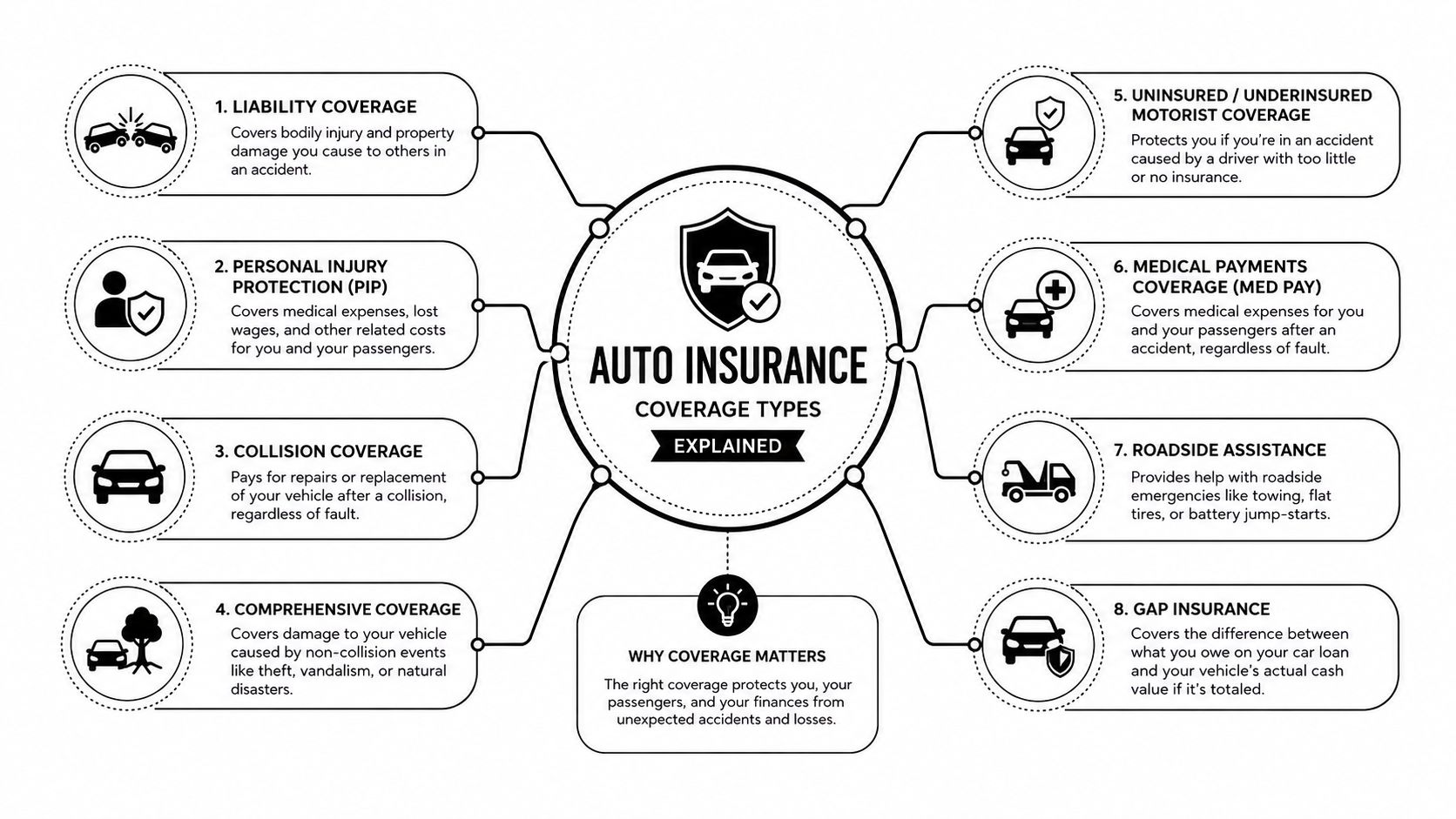
The lines on your declarations page aren't random. Each one pays for a different kind of problem, and if you understand that split, you can stop guessing and start choosing coverage on purpose. A useful consumer explainer on the difference between coverage types and how to avoid paying for more than you need is how much coverage is enough.
Liability pays for damage you cause to other people
Bodily injury liability covers injuries to others when you're at fault. Property damage liability covers the other person's car, fence, mailbox, or whatever else you hit. If you clip a parked vehicle in Los Angeles and push it into another car, this is the part of your policy that gets tested first.
Collision and comprehensive protect your own car
Collision pays to repair or replace your car after a crash, regardless of fault. Non-collision losses handles non-crash losses, things like theft, vandalism, fire, weather damage, and animal strikes. If you still owe money on the vehicle, lenders usually care a lot about these two coverages because they protect the collateral.
Uninsured and underinsured motorist coverage fills the gap
UM and UIM coverage step in when the other driver has no insurance or too little. That matters in California because the driver who hits you may carry only the minimum, which often doesn't come close to the actual repair or injury bill. If your policy includes this protection, it can keep another person's bad coverage from becoming your financial problem.
Medical payments handle smaller immediate costs
Medical payments coverage, sometimes called MedPay, helps with medical expenses after a crash, usually for you and your passengers. It's not a replacement for health insurance, but it can help with quick costs while fault is being sorted out.
For a plain-English glossary while you compare quotes, use the definitions in the California insurance glossary.
The key is to read each line item as a job description. Liability protects other people, collision and other-than-collision protect your vehicle, UM and UIM protect you from underinsured drivers, and MedPay helps bridge short-term medical costs. Once you see the policy that way, the right limits get much easier to judge.
California Minimums Versus Expert Recommended Limits
California's minimum auto liability requirement is 30/60/15, meaning $30,000 bodily injury liability per person, $60,000 bodily injury liability per accident, and $15,000 property damage liability per accident. That keeps you legal, but it doesn't make you well protected. Consumer Reports says experts commonly recommend 100/300/100, and Forbes also places 100/300/100 above the minimum as a stronger liability tier.
| Coverage Type | California Minimum | Expert Recommended |
|---|---|---|
| Bodily injury per person | $30,000 | $100,000 |
| Bodily injury per accident | $60,000 | $300,000 |
| Property damage per accident | $15,000 | $100,000 |
The gap matters because accident severity doesn't care about the state floor. A crash that injures two people or damages a newer vehicle can move past the minimum fast, and California drivers usually have more assets to protect than the minimum assumes. Minimum coverage is a compliance tool, not an asset-protection strategy.
Why the floor is so low
State tables show bodily injury minimums can be as low as $10,000 in some jurisdictions and as high as $50,000 per person/$100,000 per accident in others, while property damage minimums can sit at $5,000 or $10,000. That spread proves the legal requirement is not a real measure of what a serious crash costs. It only tells you what lawmakers decided you must buy to drive.
Why 100/300/100 is the standard target
The reason experienced agents keep pushing 100/300/100 is simple. It gives you breathing room if a crash turns ugly, and it better matches the stakes of modern liability exposure. If you own a home, have savings, or earn a decent income, you're not shopping for compliance. You're shopping for protection.
The wrong comparison is “what's the cheapest legal option?” The right comparison is “what limit keeps me from losing assets if I'm sued after a major crash?” That's why minimums are where the conversation starts, not where it should end.
How to Calculate Your Personal Coverage Needs
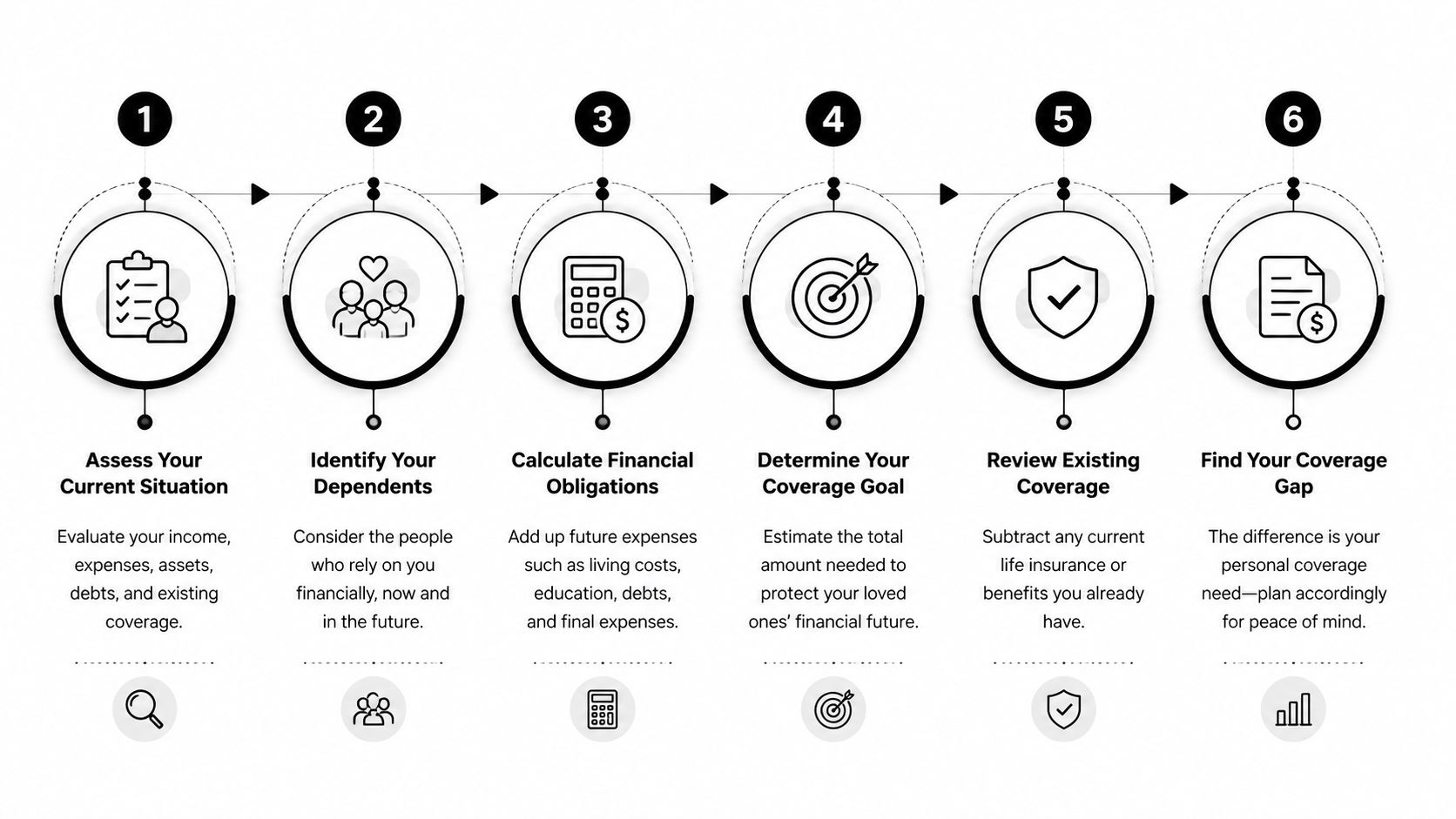
The cleanest way to size liability is to anchor it to your net worth. NerdWallet recommends adding up your assets and subtracting liabilities, then buying bodily injury liability at least equal to that amount. That's the right instinct because liability insurance exists to pay claims you're legally responsible for after an at-fault crash. NerdWallet's coverage guide lays out that net-worth approach clearly.
Start with what you own and owe
List your cash, investments, home equity, and other assets, then subtract debts and liens. What's left is the amount you'd want to protect if someone sued you after a serious wreck. If that number is low, your liability target can be lower. If it's high, your liability limits should rise with it.
Practical rule: your auto liability should be high enough that one bad afternoon on the freeway doesn't threaten the rest of your finances.
Three real-world profiles
A young renter with little saved and no home equity can usually focus on strong liability without overbuying physical damage coverage on an old car. A mid-career homeowner with a mortgage, retirement savings, and equity should lean much harder into liability because there's actual wealth at risk. A high-net-worth family with significant equity and investments should stop thinking in minimums altogether and look at high liability limits plus umbrella protection.
The same logic applies to vehicle financing. If you have an auto loan or lease, lenders generally require collision and other coverage because they want the car itself protected. That's not optional if the contract says otherwise, and even when it is optional, the lender's requirement is a clue that the vehicle still has meaningful financial value.
Use the vehicle as the second test
Ask whether you could replace the car tomorrow without scrambling. If the answer is no, collision and coverage for other events besides collisions deserve a serious look. If the answer is yes, then you can decide whether the premium is worth the protection based on your own cash flow, not old blanket rules.
For a deeper quote review checklist, use the planning material in this California insurance guide. That's where your numbers turn into actual policy limits.
Rethinking Collision and Comprehensive on Older Vehicles
The old advice says to drop collision and full-coverage once a car gets older. That advice is too blunt for today's market. Recent reporting shows U.S. auto insurance prices rose 18.6% year over year in June 2024 according to CPI reporting, and repair costs have been pushed higher by pricier parts, labor, and more advanced vehicle technology. Liberty Mutual's auto coverage explainer captures the broader repair-cost problem that drivers are now facing.
Market value is only part of the decision
A car with modest resale value can still be expensive to fix. If replacement parts are hard to source or labor is costly, the actual claim can look nothing like the car's auction value. That's why I don't like the lazy habit of dropping physical damage coverage just because a vehicle is old.
A better way to think about it is this. If you can't comfortably absorb the loss of the car, or if a repair would cost far more than you can stomach out of pocket, keep the coverage. If replacing the car would create a transportation crisis, the premium may be worth paying even on an older vehicle.
Check the car's real worth before you cut coverage
Before you remove collision or full coverage, look up the vehicle's current value and compare it with what you'd lose if it were stolen or totaled. A practical place to start is how to check used car worth. That number won't make the decision for you, but it gives you a real baseline instead of a gut feeling.
The right question is not “Is this car old?” It's “Could I replace it, repair it, or live without it if something happens next week?” That answer matters more than age. Older cars with good reliability and low replacement tolerance often still deserve coverage, while disposable vehicles may not.
I've seen too many drivers treat physical damage coverage like a luxury when it was really their transportation safety net. If the car keeps your job moving, dropping the coverage can create a bigger problem than the premium ever did.
Personal Factors That Change Your Coverage Needs
Coverage shouldn't stay frozen while your life changes. A renter with no assets, no commute, and a paid-off sedan has a different risk profile than a homeowner with equity, school pickups, and a long freeway drive every day. The policy should follow the life, not the other way around.
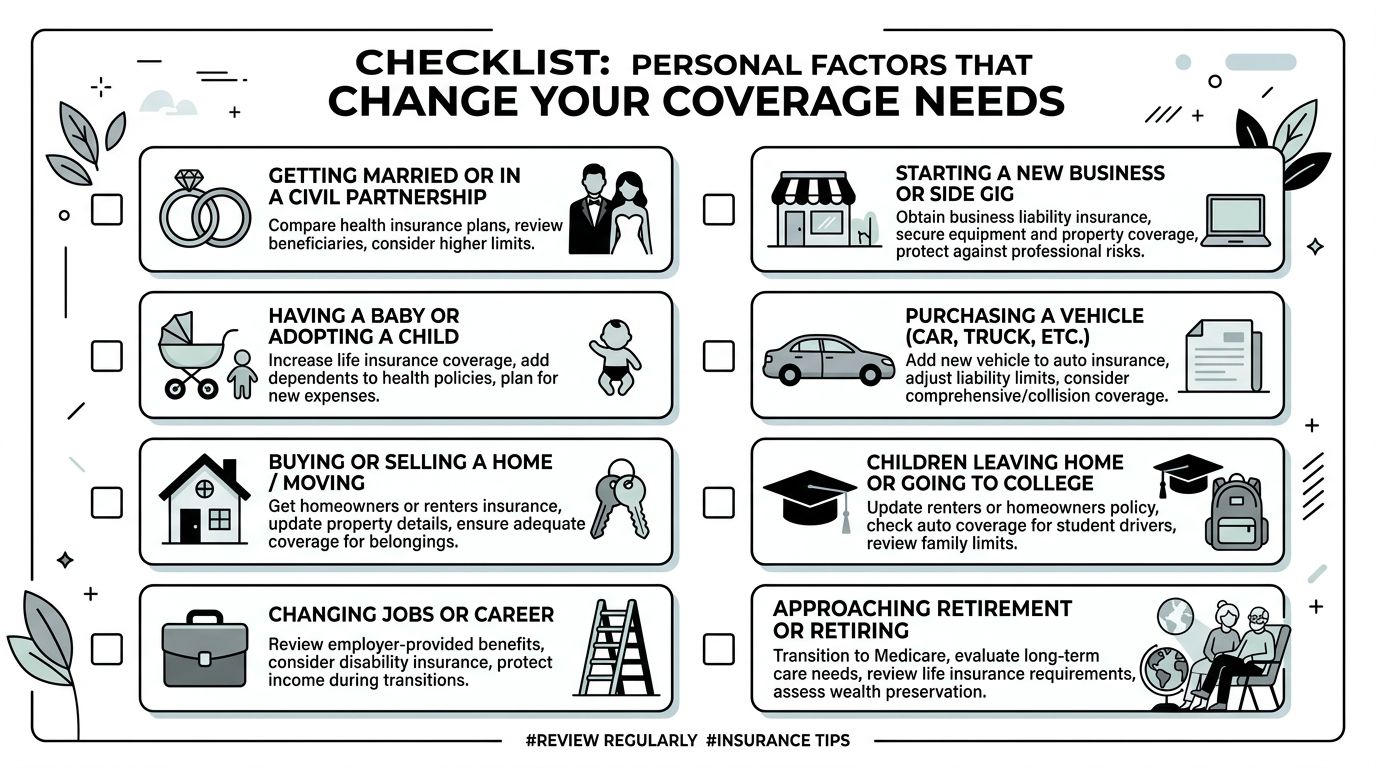
Assets and lawsuits
If you buy a home, build savings, or accumulate investments, your liability exposure grows. That's when minimum auto limits stop making sense. If your financial life gets more complex, your policy should get stronger, and umbrella coverage becomes worth discussing as a layer above auto liability.
Family and driving patterns
More drivers in the household usually means more chances for a claim, more time on the road, and more chances that another driver's bad insurance becomes your problem. If your commute gets longer or your driving shifts toward busier roads, higher liability and UM or UIM coverage become more important than they were when you drove less. The risk isn't abstract, it rises with exposure.
Vehicle value and financing status
A paid-off car with low replacement cost may not justify the same physical damage coverage as a newer car with a loan. A leased or financed car is different because the lender's interest is on the line, so collision and full coverage generally stay in place. That's a simple cutoff, and it's one drivers should respect.
Don't ignore the other lines on the policy
California drivers often focus on auto insurance and forget the rest of the household. Home insurance and renters insurance matter because they define what assets are exposed, and life insurance matters because a family's financial resilience changes the amount of risk they can absorb after a loss. The more protection your household already has, the more honest you can be about how much auto liability you need.
If you review your policy after a move, a marriage, a new job, or a car purchase, you're not being obsessive. You're keeping the policy aligned with reality. That's what smart coverage management looks like.
Getting Personalized Auto Insurance Quotes in California
Start with your current limits, your vehicle information, and a rough picture of your assets and debts. Then compare quotes with the same liability numbers so you're not comparing apples to oranges. Use this quote request page to gather options, and ask for a review that includes auto, home, renters, and life insurance if your household needs those layers too.
Ask two direct questions on every quote. First, “What would this policy pay if I caused a serious injury claim?” Second, “What would happen if my car were totaled or hit by an uninsured driver?” Those two answers tell you more than a cheap monthly price ever will.
If you live in a wildfire-prone or higher-risk part of California, ask about bundling home or renters coverage with auto coverage so the whole household policy picture makes sense. A good agent won't just quote you a number, they'll show you where the gaps are and where the savings are hiding.
Mai & Associates helps Californians compare auto, home, renters, and life coverage with a practical eye on real protection, not just bare minimum pricing. If you want a straight answer on whether your limits are too low, get a quote and review your options with Mai & Associates today.