How Life Insurance Works: 2026 Guide for Californians
If you're like many California families, you probably already think about protection in layers. You pay for car insurance so one accident doesn't wreck your budget. You keep home insurance or renters insurance in place because replacing a house, rebuilding after a fire, or covering stolen belongings would be overwhelming out of pocket. Life insurance belongs in that same conversation.
It matters for a simple reason. If someone in your household brings in income, handles childcare, pays the mortgage, or holds a business together, their loss isn't only emotional. It can also disrupt everything from rent and utility bills to college plans and retirement savings. That's why understanding how life insurance works can bring a surprising amount of calm. Once you see the mechanics, it stops feeling mysterious and starts feeling practical.
For Californians, that practical side is even more important. High housing costs, long commutes, wildfire-related work risks in some occupations, and layered insurance needs often mean families are managing auto insurance, home insurance, renters insurance, and life insurance at the same time. The good news is that life insurance is easier to understand than anticipated.
Understanding the Life Insurance Promise
Think of life insurance as a financial umbrella. You hope your family never has to stand in a storm without you, but if that happens, the policy is there to keep bills from pouring in all at once.
Life insurance is a contract. Guardian explains that every policy revolves around three main parts: the insured person, the beneficiaries, and the death benefit, and the payout can be divided among multiple people or entities by percentage in Guardian's explanation of how life insurance works.

The three moving parts
Here's the plain-English version:
- The insured person is the person whose life the policy covers.
- The beneficiary is the person, people, or organization chosen to receive money if the insured dies.
- The death benefit is the amount the insurance company agrees to pay.
There's one more piece families often ask about, even if it isn't part of the three-part core. That's the premium, which is the payment you make to keep the policy active.
A simple example helps. A parent buys a life insurance policy on their own life. Their spouse is listed as the primary beneficiary, and their two children may also be named in set shares. If the insured parent dies while the policy is active, the insurer pays the agreed death benefit to the listed beneficiary or beneficiaries.
Why people get confused
People often assume life insurance works like a savings account, an investment account, or a health plan. It doesn't. The main promise is protection. The insurer agrees to pay if a covered death happens while the policy is in force.
Simple rule: Life insurance is less about building money quickly and more about preventing financial chaos for the people you love.
That makes it a natural partner to California insurance planning overall. Auto insurance protects your driving risk. Home insurance or renters insurance protects your property risk. Life insurance protects your family's income and long-term stability.
If insurance terms still feel unfamiliar, a plain-language California insurance glossary can help decode the wording you see in policy documents. And if you'd like a useful international comparison of how the basic idea translates across markets, this guide to compare UK life insurance explained is a good companion read.
Choosing Your Policy Type Term vs Permanent
The most important product choice is simple to say and harder to sort out in real life. Do you need coverage for a specific season of responsibility, or do you want a policy built to stay with you for life?
That question matters even more in California. A family in Orange County, Los Angeles, or the Bay Area may be balancing a large mortgage, child care costs, and a budget that already has to stretch across auto, home, and everyday living expenses. A firefighter, contractor, utility worker, or someone whose work puts them near wildfire zones may also want to think carefully about how long protection needs to last and what the monthly cost can realistically be.
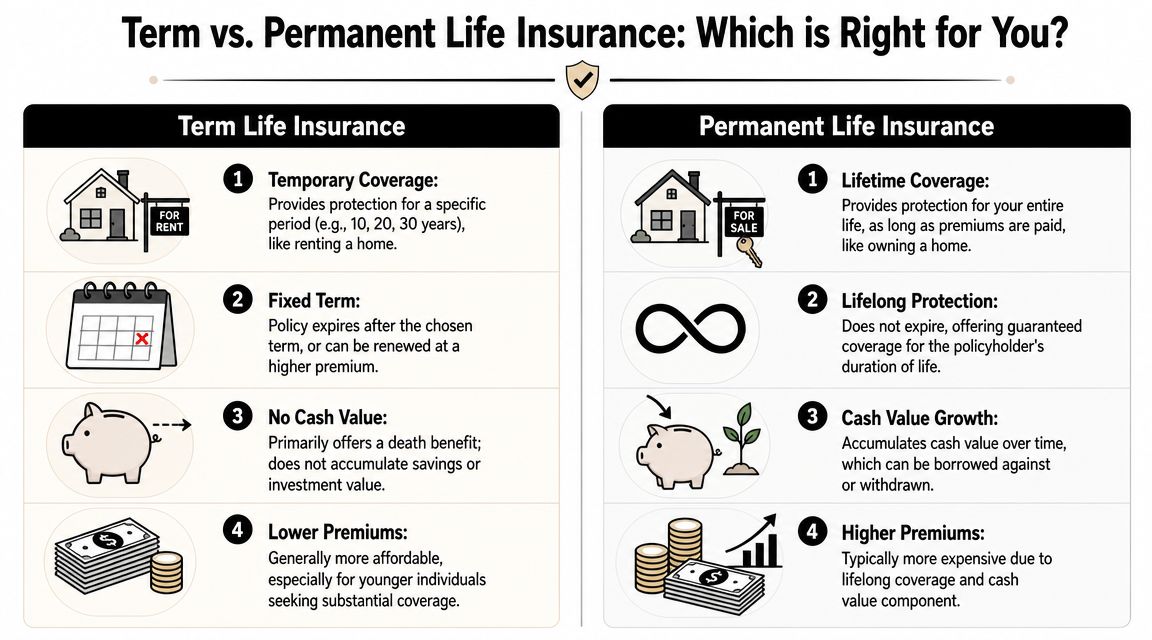
According to State Farm's overview of life insurance types, term life covers a fixed period such as 10, 20, or 30 years, while permanent policies such as whole life and universal life are designed to last for the insured's lifetime as long as required policy payments are made. Permanent coverage often includes cash value, which is one reason it usually costs more.
What term life does best
Term life is built for temporary financial jobs. The policy is active for a set number of years, and the death benefit is paid if the insured dies during that term while the policy is in force.
That makes term a common fit for needs like these:
- Mortgage protection during repayment years
- Income replacement while children are still financially dependent
- Coverage for a business loan or other time-limited debt
- Larger death-benefit goals on a tighter budget
For many California households, this is the starting point because it answers a practical question. "If something happened to me during our most expensive years, would my family have enough money to stay in the home and keep life stable?"
What permanent life does differently
Permanent life is built for longer-range planning. Instead of ending after 10, 20, or 30 years, it is meant to remain in place for life if maintained properly.
People often hear "cash value" and get confused. A simple way to understand it is this. Part of the policy is the lifelong insurance protection, and part may build value inside the contract over time, depending on the policy design. That feature can make permanent insurance useful for people who want coverage that does not expire, have a lifelong dependent, or want another layer in estate or legacy planning.
The broad categories usually look like this:
- Whole life insurance often has fixed premiums and a more predictable structure.
- Universal life insurance often allows more flexibility in premiums and death benefits.
- Both are forms of permanent coverage and usually cost more than term for the same death benefit.
A practical way to choose
A young couple in California with a new mortgage and two small children often leans toward term because the main job is income protection during working and parenting years.
A family caring for a child with lifelong support needs may look more closely at permanent coverage because the protection may need to remain in place no matter when death occurs.
Neither option is automatically better. Each solves a different problem.
Term vs Permanent Life Insurance at a Glance
| Feature | Term Life Insurance | Permanent Life Insurance (Whole/Universal) |
|---|---|---|
| Coverage length | Fixed period | Lifelong, if maintained |
| Typical use | Income replacement during key years | Lifelong protection and cash accumulation priorities |
| Cash value | Generally none | Often included |
| Premium pattern | Often simpler and lower for a given death benefit | Usually higher because of lifelong coverage and cash value features |
| Best fit | Mortgage years, raising children, budget-focused protection | Estate planning, long-term dependents, people who want permanent coverage |
A good policy matches the job you need it to do.
If you are comparing options as part of a broader California insurance plan, including home and auto coverage through one local agency, this guide to life insurance in California can help you review choices with that full picture in mind. Mai & Associates can be especially helpful for families who want to coordinate life insurance with the rest of their household protection, rather than making each decision in isolation.
How Premiums and Coverage Are Determined
Many people worry that life insurance pricing is arbitrary. It isn't. Insurers use a process called underwriting to decide how much risk they're taking on and what premium fits that risk.
The basic logic is simple. Life insurance transfers mortality risk from your family to the insurer. To price that risk, the company looks at the chance it may have to pay a claim while your policy is active.
What underwriting looks at
The USAA Educational Foundation's explanation of life insurance basics says that underwriting is the technical gatekeeper that prices risk, using factors such as age, medical history, lifestyle disclosures, and sometimes medical tests. It also notes that premiums are directly tied to expected claim cost.
That helps explain why two people applying for the same amount of coverage may get different prices.
Common factors include:
- Age: Younger applicants often get better pricing because their near-term mortality risk is generally lower.
- Health history: Past and current medical conditions matter.
- Lifestyle disclosures: Smoking and other habits can affect pricing.
- Medical testing: Some applications require exams or lab work, while others may not.
- Occupation and hobbies: Jobs or activities with greater danger can raise concern for an insurer.
For Californians, occupation can matter in very practical ways. A desk-based software engineer and a worker exposed to active field hazards won't necessarily be viewed the same way during underwriting. The same idea applies to certain physically demanding or high-risk jobs tied to wildfire response or hazardous environments.
What the application feels like
Most applications involve questions first. You may answer detailed items about your medical background, prescriptions, family history, driving record, or work. Some carriers also ask for access to outside records as part of the review.
If a medical exam is required, think of it as a screening step, not a judgment. The insurer is trying to sort applicants into risk categories as accurately as possible.
Honesty matters more than perfection. A manageable health condition doesn't automatically make coverage impossible, but inaccurate answers can create bigger problems later.
Why buying earlier can help
The most important takeaway isn't that insurers are trying to make things difficult. It's that they price what they can measure. If you're younger and healthier today than you might be later, applying earlier can give you more options and may make coverage easier to keep affordable over time.
Beneficiaries Payouts and the Claim Process
A life insurance policy is purchased long before anyone wants to think about a claim. Still, families feel better when they understand what happens next.
The claims process is usually more orderly than people expect. The insurer's job is to confirm the policy, verify the death, identify the beneficiary, and arrange payment according to the contract.
What beneficiaries usually do
A beneficiary typically starts by contacting the insurance company and asking for claim forms. The insurer will explain what paperwork it needs, which often includes a certified death certificate and policy details.
A practical checklist looks like this:
- Locate the policy information. This may be in a paper file, online account, or with the family's advisor.
- Contact the insurer. Ask what forms are required and where to send them.
- Gather documents. Death certificate copies are commonly requested.
- Confirm beneficiary details. Names, addresses, and identification may need to match the policy records.
- Choose a payout method if options are offered. Some families prefer one payment, while others review structured options.
Why beneficiary choices matter so much
People sometimes spend a lot of time comparing companies and very little time reviewing beneficiary designations. That's backward. The beneficiary form is one of the most important pages in the policy.
A few points deserve extra care:
- Primary beneficiaries are first in line to receive the benefit.
- Contingent beneficiaries can step in if the primary beneficiary can't receive it.
- Percentages should be clear if more than one person will receive a share.
- Updates matter after marriage, divorce, births, deaths, or major estate changes.
Keep beneficiary records current. An old designation can send money somewhere you no longer intended.
Families who want a broader, plain-language discussion of the after-death side of coverage may find this article on what happens to life insurance after death useful.
Where people often need reassurance
The most common worries are whether the money will get stuck in probate and whether the process will be too burdensome for grieving family members. Specific legal outcomes can depend on how the policy is owned and how the beneficiaries are named, so it makes sense to ask policy-specific questions in advance.
If you want answers to common consumer questions before a claim ever happens, a good insurance FAQ resource can make the process feel less intimidating.
Customizing Your Policy with Riders and Living Benefits
A base life insurance policy does one central job. Riders let you fine-tune that job.
Think of riders as optional upgrades. They don't change the fact that the policy is life insurance, but they can shape how useful it becomes under specific circumstances.

Common rider ideas families ask about
You may hear about options such as:
- Waiver of premium: This may help keep a policy in force if the insured becomes disabled and can't work.
- Accidental death benefit: This may provide added protection in specific accidental-death situations, depending on the contract.
- Child or spouse riders: Some policies let you add limited coverage for family members.
The key point is that riders are contract features, not automatic rights. Availability and terms vary by insurer and policy type.
The overlooked question about using life insurance while alive
One of the most important questions families ask is, "Can life insurance help before death?" Sometimes, yes.
Aflac explains in its life insurance coverage overview that some policies include living benefits or riders that allow access to part of the death benefit in cases of terminal, chronic, or critical illness. It also notes that this can materially change the policy's value for families facing medical costs or caregiving expenses.
That's a major planning issue, especially in California where one health event can disrupt income, routines, and family caregiving arrangements all at once.
Why this matters in real life
A rider can change the conversation from "This only helps after I'm gone" to "This may also help if life gets hard before then." That's not true for every policy, and the details matter, but it's worth asking the question directly when shopping.
Ask for the contract language in plain English. Ask when a rider applies, how benefits are accessed, and whether using a living benefit reduces the amount left for beneficiaries later.
A rider isn't automatically valuable because it sounds impressive. It's valuable when you understand exactly what problem it solves.
A Californian's Guide to Buying Life Insurance
Buying life insurance in California isn't only about picking a policy type. It's about matching coverage to a real household budget in a state where housing, childcare, transportation, and rebuilding costs can put pressure on every decision.
That makes a practical method more useful than a sales pitch. Start with your obligations. Then match the policy to the time period and purpose.

Use the DIME method as a starting point
A common planning shortcut is DIME:
Debt
Think about personal loans, credit cards, business obligations, or any balances your family couldn't comfortably absorb.Income
Ask how long your household would need income replacement if you were gone. For a California family, this question matters because fixed monthly costs can stay high even when income disappears.Mortgage
If one income supports the home, the policy often needs to reflect the risk of losing that support. This is one reason term life and mortgage timelines are often discussed together.Education
Parents often want room for future school costs, childcare, or other family support needs.
DIME isn't a formula that spits out a perfect answer. It's a way to avoid guessing.
Match the policy to the purpose
A lot of buyers get stuck because they try to choose the "best" life insurance before they decide what they need it to accomplish.
Try asking these questions instead:
Do I need protection for a specific window of time?
If yes, term life often deserves a serious look.Do I want coverage that could remain in force for life?
That may point you toward permanent insurance.Would my family struggle more with lost income, debt payoff, or final expenses?
The answer shapes the coverage amount and design.Do I need only life insurance, or should I review my whole protection plan?
In California, it's common for life insurance decisions to overlap with car insurance, home insurance, renters insurance, and umbrella liability planning.
Account for California-specific realities
California households often face local circumstances that make generic advice feel incomplete.
Consider a few examples:
- High cost of living: A coverage amount that sounds large on paper may not stretch very far when a family is carrying a mortgage, childcare expenses, and long-term savings goals.
- Wildfire-related occupations and field risk: Some jobs bring higher underwriting scrutiny because insurers evaluate work-related exposure and lifestyle risk.
- Community property and family structure questions: Married couples, blended families, and business owners often need extra care when naming beneficiaries and owners.
- Multiple insurance lines at once: Someone buying life insurance may also be updating auto insurance for a teen driver, reviewing home insurance after a move, or shopping renters insurance for an adult child.
These are exactly the moments when clear advice matters. Not because life insurance is impossibly complex, but because small details can shape how well the policy works later.
What to ask before you apply
A short list of questions can prevent a lot of confusion:
- What kind of policy am I considering, and why does it fit my goal?
- Is this coverage meant to protect income, a mortgage, estate plans, or all three?
- Will underwriting likely require medical records or an exam?
- Are there riders worth reviewing, especially living benefits?
- Who should be listed as primary and contingent beneficiaries?
- How does this fit with my existing California insurance plan, including auto, home, or renters coverage?
Why local guidance can help
National articles can explain the basics, but California buyers often need more than a textbook overview. They need help comparing carriers, understanding application differences, and spotting gaps between policies.
That becomes even more useful when one household is juggling several needs at once, such as:
- A home insurance review after wildfire market changes
- A renters insurance policy for a new apartment
- Car insurance updates after adding a vehicle or driver
- Life insurance to protect a spouse, children, or a business partner
A local review can bring all of those pieces into one conversation instead of treating each policy in isolation.
If you're ready to compare your options, this page for a California insurance quote is a practical starting point.
If you'd like personal guidance, Mai & Associates helps Californians compare life insurance along with auto insurance, home insurance, renters insurance, and car insurance needs in one place. The agency offers same-day quotes from multiple carriers, multilingual support, and practical help for families who want clear answers instead of insurance jargon.