How Insurance Rates Are Calculated in CA
You're comparing two California auto insurance quotes for what looks like the same coverage. One premium seems manageable, while the other feels completely disconnected from your driving record, your car, or your budget. The numbers aren't random, but the calculation is more layered than a simple list of discounts.
Insurance pricing starts with shared risk, then adjusts for the characteristics of your policy, property, vehicle, or household. How insurance rates are calculated depends on the expected cost of future claims, the exposure being insured, operating expenses, regulatory requirements, and the rating variables an insurer is permitted to use. California's wildfire conditions and regulatory framework add another layer that national explanations often miss.
The Reality of Risk Pooling in California

Two California drivers can request the same liability limits and still receive different prices. An insurer isn't charging only for the policy document. It's estimating the future cost of covering a particular risk and placing that risk into a larger pool of similar policies.
Why insurers use pools
An insurance company collects premiums from many policyholders and uses that pool to pay covered claims, operating expenses, taxes, and required margins. Actuaries study historical loss data to estimate how often claims may occur and how severe they may be. The resulting price reflects a policyholder's expected contribution to that shared financial system, not a personal savings account reserved exclusively for their own accident or home loss.
That's why a premium can change even when you haven't filed a claim. The insurer may revise its underlying estimates, expenses, approved rates, or assumptions about a group of risks. The National Association of Insurance Commissioners' actuarial discussion describes insurance pricing as a base rate adjusted by rating factors such as age, location, driving history, vehicle type, annual mileage, and coverage choices.
For a California auto policy, the insurer may evaluate driving history, mileage, vehicle characteristics, claims history, and the coverage you selected. For home insurance, the property's construction and location matter. Renters insurance focuses more on the insured belongings, liability exposure, and selected limits. Life insurance uses a different underwriting framework centered on the applicant and the policy design.
Practical rule: A quote is a risk assessment, not a verdict on your character. A higher price usually means the carrier's model sees greater expected cost, higher expenses, or less appetite for that type of policy.
California's regulatory environment also matters. Insurers must work within state rules when they develop and file rates, so a national pricing explanation won't always describe the choices available to California consumers. To compare coverage intelligently, review California insurance guides and ask what changed between quotes, including limits, deductibles, endorsements, and the rating information used.
Actuarial Math and the Base Rate Formula
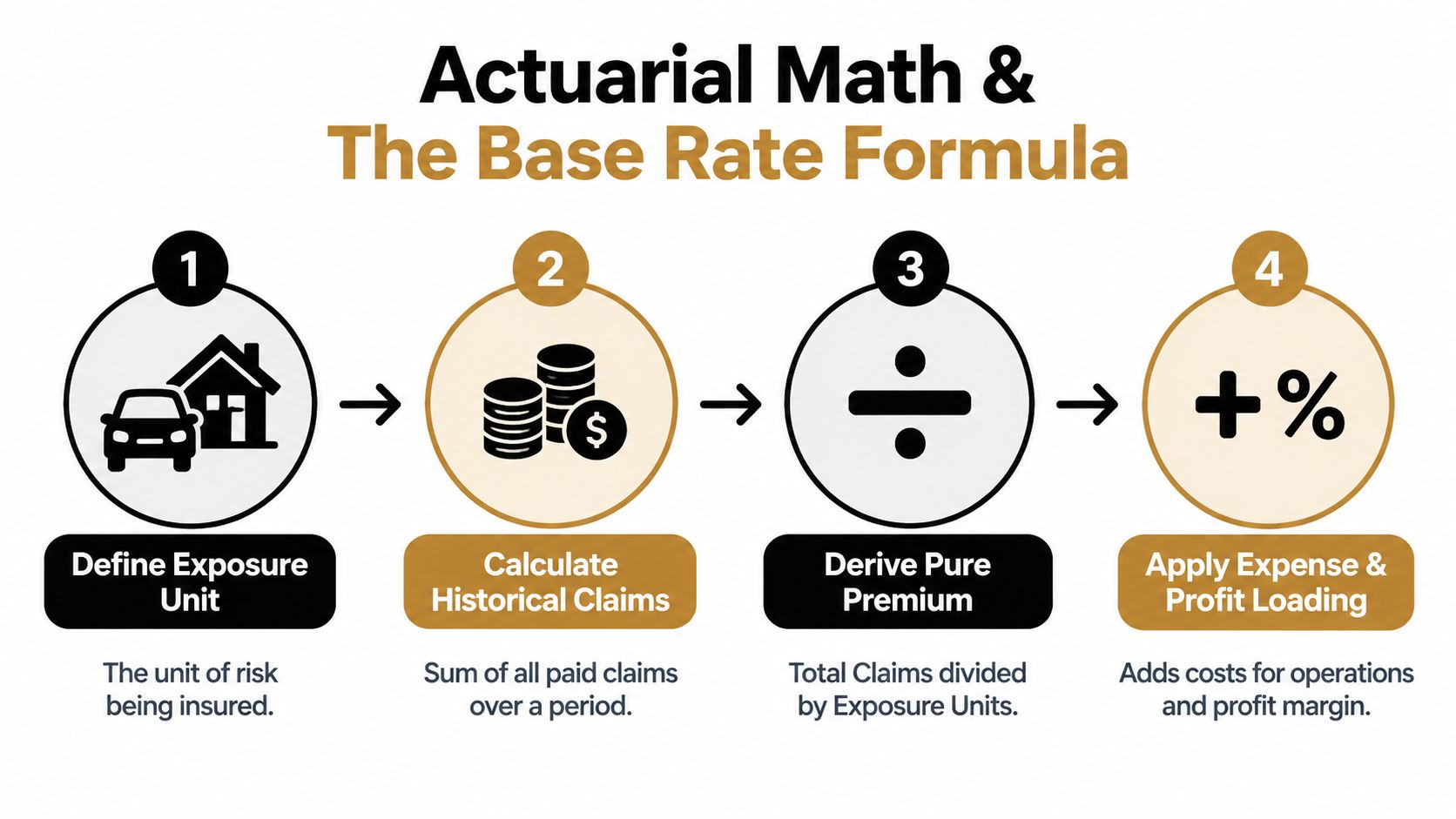
The cleanest way to understand insurance pricing is to separate the calculation into layers. Actuaries first define the exposure unit, meaning the unit of risk being insured. That might be a vehicle, a home, a rental unit, or a life policy. They then analyze historical claims associated with comparable exposure units to estimate the pure premium, the expected claim cost before broader pricing loads are added.
From expected loss to charged premium
The Casualty Actuarial Society explains that a rate can be modeled as a base rate multiplied by classification factors. Its ratemaking guidance also distinguishes expected claim cost from the full premium. The final price can include fixed expenses, variable expenses, taxes, and a profit or contingency load.
A simplified process looks like this:
- Define the exposure. The insurer identifies what it's covering and the period or unit used for pricing.
- Estimate historical losses. Actuaries review claims associated with comparable risks.
- Derive the pure premium. They relate expected claims to the exposure units.
- Apply rating factors and loads. The insurer adjusts for risk characteristics, expenses, taxes, and required margins.
The most useful example comes directly from the NAIC material. Its pricing illustration uses the formula Base Rate × Factor 1 × Factor 2, followed by the calculation $500 × 0.90 × 2.00 = $900. The first factor lowers the base, while the second factor doubles the result. The example demonstrates why two risk characteristics can pull the same starting rate in opposite directions.
That formula doesn't mean every California policy begins with a $500 base rate, or that every insurer uses the same factors. It provides a mental model for understanding how a baseline can become a personalized premium. A factor may reflect a driver's history, a vehicle classification, a location, or another approved rating variable.
Why the final bill exceeds claim cost
An insurer has to pay more than claims. Staff, technology, policy administration, taxes, reinsurance, compliance, and distribution all affect the amount needed to operate the insurance pool. The Casualty Actuarial Society's ratemaking study material describes the importance of exposure units and the use of classification variables after estimating pure premium.
For life insurance shoppers, a separate explanation of what determines your life insurance premium can help clarify how policy design and personal underwriting differ from auto or property pricing. For California home, auto, and renters insurance terminology, the insurance glossary can make declarations pages and quote comparisons easier to read.
Rating Variables Across Auto Home and Life Policies
The same insurer may use completely different information for auto insurance, home insurance, renters insurance, and life insurance. A driver's annual mileage matters to car insurance because it relates to time on the road. A home's construction type matters to property insurance because it can affect expected loss severity and repair requirements. Life insurance focuses on the insured person and the contract's benefits, duration, and underwriting classification.
| Policy Type | Primary Rating Factors | California Specific Nuance |
|---|---|---|
| Auto insurance | Driving history, location, annual mileage, vehicle type, claims history, coverage choices, and prior insurance information | California auto pricing cannot use credit history or an insurance score to set the rate. Driving behavior and approved risk factors remain central. |
| Home insurance | Replacement needs, location, construction type, property characteristics, fire exposure, coverage limits, and deductible | Wildfire exposure and local loss costs can strongly affect availability and price. California regulatory requirements shape how insurers file rates. |
| Renters insurance | Personal property limits, liability limits, location, deductible, claims history, and selected endorsements | The policy covers the renter's belongings and liability rather than the building itself, so coverage selections can change the premium. |
| Life insurance | Age, health classification, medical history, lifestyle information, benefit amount, policy duration, and product structure | Underwriting evaluates the applicant and the contract rather than vehicle or property characteristics. |
Auto insurance in California
The NAIC identifies commonly used auto rating variables such as miles driven, age, gender, marital status, education, occupation, claims history, previous coverage, and vehicle type. California's rules are especially important because credit history and insurance scores can't be used to set California auto insurance rates. That makes an accurate driving record, mileage estimate, vehicle information, and coverage selection particularly important during the quote process.
A speeding ticket or other violation can affect how an insurer evaluates driving risk, although the final impact depends on the carrier's rules and the complete policy profile. Drivers who want a separate state-specific discussion of ticket consequences can review this Florida speeding ticket insurance guide, while remembering that Florida rules don't determine California premiums.
Home, renters, and life insurance
Home insurance pricing considers the structure and its surroundings. Construction type, location, fire response characteristics, roof condition, coverage limits, and replacement needs can all affect the underwriting picture. Renters insurance is narrower in property scope, but the renter still chooses personal property and liability limits that shape the premium.
Life insurance is personal in a different way. The carrier evaluates health and lifestyle information alongside the policy's benefit structure and duration. A quote that looks inexpensive at first may provide less protection, while a broader policy may cost more because it transfers more financial risk to the insurer.
Geographic Loadings and Wildfire Catastrophe Models
A California address tells an insurer more than a ZIP code. It can indicate wildfire exposure, brush proximity, local fire protection resources, construction conditions, coastal weather, crime patterns, repair costs, and the concentration of similar risks in the area. Actuaries use location as part of a broader classification system because geography can correlate with both claim frequency and claim severity.

What a catastrophe loading represents
A catastrophe loading is an amount incorporated into pricing to account for the possibility of severe, concentrated losses. In a wildfire-prone area, the model may evaluate vegetation, terrain, wind conditions, historical fire behavior, access, and the number of nearby properties exposed to the same event. The loading isn't a direct prediction that one particular home will burn. It reflects the financial risk created when many insured properties could suffer losses from one catastrophe.
Repair inflation and local loss costs can also influence filed rates. A home may cost more to insure because rebuilding requires expensive labor, materials, specialized contractors, or updated construction standards. The result is a price shaped by both the property itself and the surrounding risk environment.
A low-risk structure in a high-severity area may still receive a high-risk price. Insurers price the location and the possibility of correlated losses, not just the condition of one house.
Why the FAIR Plan enters the conversation
Some private carriers limit new business or reduce exposure in areas where catastrophe risk is difficult to model or finance. When standard homeowners insurance becomes unavailable, the California FAIR Plan can serve as an insurer of last resort. A FAIR Plan policy may address a basic need, but many homeowners also need to examine limits, exclusions, and supplemental coverage carefully.
That's why a FAIR Plan review shouldn't end with the FAIR Plan document. Consumers may need to consider difference-in-conditions coverage, personal liability, water damage, earthquake options, and wildfire mitigation strategies, depending on their situation. The California home insurance resource can help homeowners organize the questions they should ask before accepting a quote or renewing a high-risk policy.
Geographic pricing also affects renters. A tenant in a wildfire-exposed community may pay for renters insurance based on location and selected limits, even though the building owner carries the property policy. Location doesn't determine the entire premium, but it can establish the risk tier in which the rest of the policy is priced.
The Hidden Weight of Proprietary Pricing Models
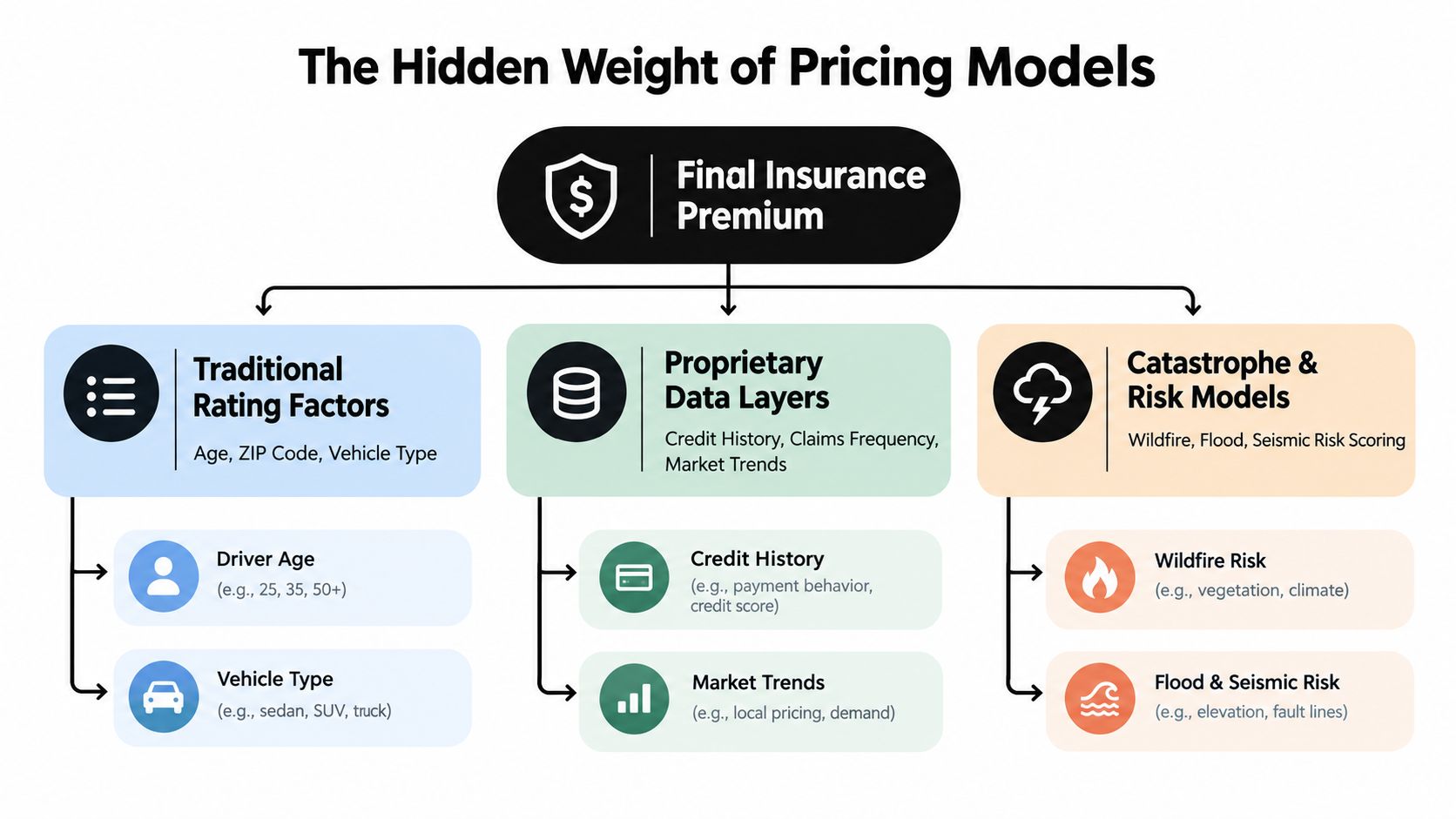
Consumers often hear that age, ZIP code, and vehicle type determine an insurance rate. Those factors matter, but they rarely act like separate switches with equal influence. Insurers combine variables inside proprietary pricing models, and the relative weight of each input can change by carrier, product, market, and underwriting appetite.
Why combinations outperform simple lists
Actuarial classification guidance emphasizes that a rating variable should show meaningful differences in cost, remain reasonably homogeneous within a class, and have enough credible data to support a stable estimate. An insurer therefore doesn't need to ask only, “Is this driver young?” It may evaluate how age interacts with driving history, vehicle type, mileage, location, and prior coverage.
The same principle applies to property. Construction type may interact with wildfire exposure, roof characteristics, local fire response, replacement cost, and policy limits. One factor can look modest by itself but become more important when combined with another risk characteristic.
A model also reflects the carrier's business strategy. One insurer may be comfortable with a particular vehicle type or geographic area, while another may seek fewer policies in that category. Both companies can review the same application and produce very different premiums without either calculation being arbitrary.
What consumers can and can't see
You'll usually see broad rating categories on a quote, not the exact proprietary weighting behind them. That creates a practical information gap. You may know that mileage matters, but not whether mileage or claims history carries greater influence for that carrier and policy.
This is why comparing only the headline premium can mislead. Check whether quotes use identical liability limits, deductibles, collision selections, replacement-cost assumptions, endorsements, and exclusions. A lower price may reflect thinner protection rather than a more efficient risk assessment.
Ask the useful question: “Which part of this quote changed the price?” An agent may not disclose proprietary algorithms, but they can often explain differences in coverage, underwriting eligibility, discounts, and declared risk information.
Shopping around matters because each insurer interprets the same profile through its own approved model. Comparing multiple carriers gives your risk profile more opportunities to land in a favorable pricing tier, without assuming that one company's result represents the entire California market.
Modern Shifts and Usage Based Insurance Telematics
Auto insurance pricing is becoming more behavior-sensitive. Usage-based insurance, or UBI, can use telematics from a smartphone application or a device installed in the vehicle to evaluate actual driving patterns. Potential signals include mileage, hard braking, time of day, acceleration, and other measures defined by the program.
Adoption has moved unevenly. JD Power reported that UBI was offered to 17% of insurance shoppers in 2025, compared with 15% in 2024 and 22% in 2023 in its 2025 U.S. Insurance Shopping Study. Those figures show renewed interest, but they don't prove that every driver will save money.
How to evaluate a telematics program
Start with the program rules, not the advertised discount. Ask what data the insurer collects, how long it retains the data, whether participation can increase the premium, and which behaviors matter most. A low-mileage driver may benefit because the program measures limited vehicle use, while a driver who regularly travels at night or brakes hard in dense traffic may receive a different result.
Use these steps before enrolling:
- Read the scoring rules: Identify whether the program evaluates mileage, braking, acceleration, phone use, time of day, or other signals.
- Check privacy terms: Understand who receives the data and how the insurer handles it.
- Compare the full quote: Keep limits and deductibles consistent so you're comparing pricing rather than coverage changes.
- Review the time horizon: Ask whether the insurer uses a short observation period or ongoing behavior.
- Discuss alternatives: An independent agent can compare a telematics option with traditional underwriting.
Readers who want a technical overview can explore AutoProv's telematics data analysis. Smart-home devices may also support underwriting conversations for home or renters insurance when they help detect water leaks, smoke, or unauthorized entry, but the effect depends on the carrier and approved program.
For California drivers, auto insurance guidance can help frame the decision around privacy, coverage, mileage, and the actual terms of a specific UBI program.
Optimizing Your Coverage with Local Expertise
Knowing the formula helps, but the best savings decisions come from separating price reductions from coverage reductions. Raising a deductible may lower a premium while increasing the amount you must pay after a covered loss. Removing an endorsement may reduce the bill while creating a gap you'll notice only after damage occurs.
Review the controllable parts of your insurance profile first:
- Update mileage accurately: An outdated commute or vehicle-use description can distort an auto quote.
- Verify property details: Make sure the insurer has current information about renovations, roof condition, construction, and safety features.
- Compare equal limits: A cheaper auto, home, or renters quote isn't meaningful if it provides less protection.
- Ask about bundling: Combining eligible policies with one carrier may produce a discount, but compare the total package rather than one policy alone.
- Choose deductibles deliberately: Select an amount you could comfortably fund after a loss.
- Consider defensive driving education: Ask whether an approved course can affect eligibility or discounts.
- Review life insurance design: Compare benefit amount, duration, premiums, exclusions, and policy guarantees before choosing the lowest quote.
California consumers also need an advocate who understands local conditions. A licensed independent agency can compare multiple carriers, explain why one insurer prices your profile differently, and identify whether a FAIR Plan review, earthquake option, wildfire strategy, renters policy, or life insurance adjustment deserves attention. Multilingual assistance can make technical policy language easier to verify, especially when a household is coordinating coverage across several family members.
The central lesson is simple. Insurance rates are calculated from expected risk, exposure, rating variables, expenses, and policy choices, but the final price depends on how each carrier weights that information. The right comparison protects your budget without treating essential coverage as an expense to cut blindly.
Mai & Associates helps California drivers, homeowners, renters, and families compare coverage from multiple carriers, including support for FAIR Plan reviews, wildfire protection strategies, and life insurance needs. Visit Mai & Associates for personalized guidance, multilingual service, and a no-obligation quote comparison.