How Does California Homeowners Insurance Work? A Clear Guide to Coverage
Think of homeowners insurance as a financial safety net for your biggest asset. You pay a regular amount—your premium—to an insurance company. In exchange, they agree to step in and cover the costs if something unexpected, like a fire or a major storm, damages your home. It’s a simple trade-off that protects you from a potentially devastating financial hit, and it works alongside other policies like auto insurance and life insurance to protect your overall financial well-being in California.

The Six Pillars of Your California Homeowners Policy
So, how does it actually work? Instead of getting bogged down in jargon, it helps to see a standard policy as a bundle of six different types of protection. Each one covers a specific angle, from the physical structure of your house to accidents involving visitors.
For us here in California, getting a handle on these basics is critical. It’s the foundation you need before we can even start talking about tailoring your home insurance policy for state-specific risks like wildfires or earthquakes. Understanding how it fits with your car insurance is also key to a complete protection plan.
A Quick Overview of Standard Coverage
Let’s break down what you’ll find in a typical homeowners policy (often called an HO-3). The table below gives a quick snapshot of these six core protections.
The Six Pillars of a Standard Homeowners Policy
| Coverage Type | What It Protects | Simple Analogy |
|---|---|---|
| Dwelling | The physical structure of your house—walls, roof, foundation. | The "shell" of your home. |
| Other Structures | Detached structures like a garage, shed, or fence. | The "extras" on your property. |
| Personal Property | Your belongings inside the home—furniture, electronics, etc. | The "stuff" that makes a house a home. |
| Loss of Use | Extra living expenses if your home becomes uninhabitable. | A "temporary home" fund. |
| Personal Liability | Financial protection if you're responsible for an accident. | Your "oops" coverage. |
| Medical Payments | Minor medical bills for guests injured on your property. | A "goodwill" gesture to prevent lawsuits. |
Let's unpack these a bit more.
- Dwelling Coverage: This is the big one. It's what pays to rebuild or repair the actual structure of your house if it’s damaged by a covered event.
- Other Structures Coverage: Got a detached garage, a tool shed, or a fence? This part of the policy covers those.
- Personal Property Coverage: This protects all the stuff inside your house. From your couch to your laptop, this coverage helps you replace your belongings if they’re stolen or destroyed. It is a key component of both home insurance and renters insurance.
- Loss of Use Coverage: If a fire forces you out of your home, this coverage is a lifesaver. It helps pay for things like a hotel or a rental property while your home is being repaired.
- Personal Liability Coverage: This protects you if someone is injured on your property and you're found legally responsible. It can cover everything from legal fees to settlement costs.
- Medical Payments to Others: This is a smaller, no-fault coverage. If a guest trips and sprains their ankle, this can help cover their initial medical bills, often preventing a small mishap from escalating.
Think of it this way: your policy isn't just one big shield. It's a multi-layered defense system designed to protect your house, your belongings, your financial stability, and ultimately, your peace of mind.
To learn more about how different types of insurance work together, feel free to explore our collection of online guides. Understanding this six-part framework is the first real step toward making sense of the other details, like deductibles and coverage limits.
Decoding Your California Homeowners Insurance Policy
A homeowners policy isn't just a piece of paper; it's a detailed financial agreement. To get the most out of it, you first have to speak its language. Understanding the core terms is the only way to know what you're truly buying, especially when you start comparing different home insurance options for your California home.
Let's break down the key parts of your policy into plain English, starting with the four main ways your property is protected.
The Four Pillars of Property Coverage
Think of your policy's property protection as a set of four distinct shields. Each one is designed to cover a specific part of your life, and together, they form a comprehensive defense for your home and belongings.
- Dwelling (Coverage A): This is the big one. It’s the coverage for the main structure of your house—the foundation, walls, and roof. If a kitchen fire or a fallen tree damages the house itself, this is the part of the policy that pays to repair or rebuild it.
- Other Structures (Coverage B): This covers anything on your property that isn’t attached to the main house. We're talking about a detached garage, a backyard shed, a fence, or even a swimming pool. The coverage amount is usually a percentage of your dwelling coverage, often around 10%.
- Personal Property (Coverage C): This protects all the stuff inside your house. From your sofa and big-screen TV to your clothes and pots and pans, this is the coverage for your personal belongings. A good way to think about it: if you could flip your house upside down and shake it, everything that falls out is probably covered here. This protection is central to both homeowners insurance and renters insurance.
- Loss of Use (Coverage D): This coverage is a lifesaver if a major disaster forces you out of your home. It helps pay for the additional living expenses you rack up while you’re displaced—things like a hotel stay, a temporary rental, and even the extra cost of eating out if you don't have a kitchen.
These four coverages work in tandem, but knowing what is protected is only half the battle. You also need to know how your insurance company will pay you when you file a claim.
Replacement Cost vs. Actual Cash Value: A Critical Difference
When it comes to paying you for damaged property, insurance companies use two different playbooks. The one your policy uses can mean a difference of thousands of dollars right when you need the money most.
Replacement Cost Value (RCV): This is what most people want. It pays to replace your damaged item with a brand-new, similar one at today's market price, with no deduction for age or wear and tear. If your five-year-old laptop gets fried in a power surge, RCV gives you enough money to go buy a new, comparable model.
Actual Cash Value (ACV): This method pays you what your damaged property was worth the moment before it was destroyed. It’s the replacement cost minus depreciation. For that same five-year-old laptop, ACV would only give you what a used laptop of that age is worth—which is a lot less than you'd need for a new one.
For peace of mind, most California homeowners opt for Replacement Cost coverage. It’s the best way to ensure you have the actual funds to rebuild your home and replace your belongings without a huge financial hit.
Your Deductible and Policy Limits
Finally, two more numbers define your policy: the deductible and the limits. They set the boundaries for what you'll pay versus what your insurer will pay.
Your deductible is the amount you agree to pay out-of-pocket on a claim before your insurance kicks in. For instance, if you have a $1,000 deductible and a storm causes $10,000 in roof damage, you pay the first $1,000. Your insurer then covers the remaining $9,000. This concept applies to most forms of California insurance, including auto insurance.
Your policy limits are the absolute maximum amounts your insurer will pay for a covered claim. Each type of coverage (Dwelling, Personal Property, etc.) has its own limit. Getting these limits right is crucial—set them too low, and you could be left underinsured and unable to fully rebuild after a total loss.
Insurance lingo can get a little tricky, but our insurance glossary is always here to help translate. Once you have a firm grip on these building blocks, you're in a much better position to choose a policy that truly protects what matters most.
How Liability Coverage Protects Your Financial Future
When you think about homeowners insurance, you probably picture your house being repaired after a fire or a storm. But one of the most critical jobs your policy has is protecting you. Beyond fixing walls and replacing stuff, your policy includes a powerful financial shield called liability coverage. This is what stands between a simple accident on your property and a potential financial catastrophe for your family, working hand-in-hand with your California car insurance liability limits.
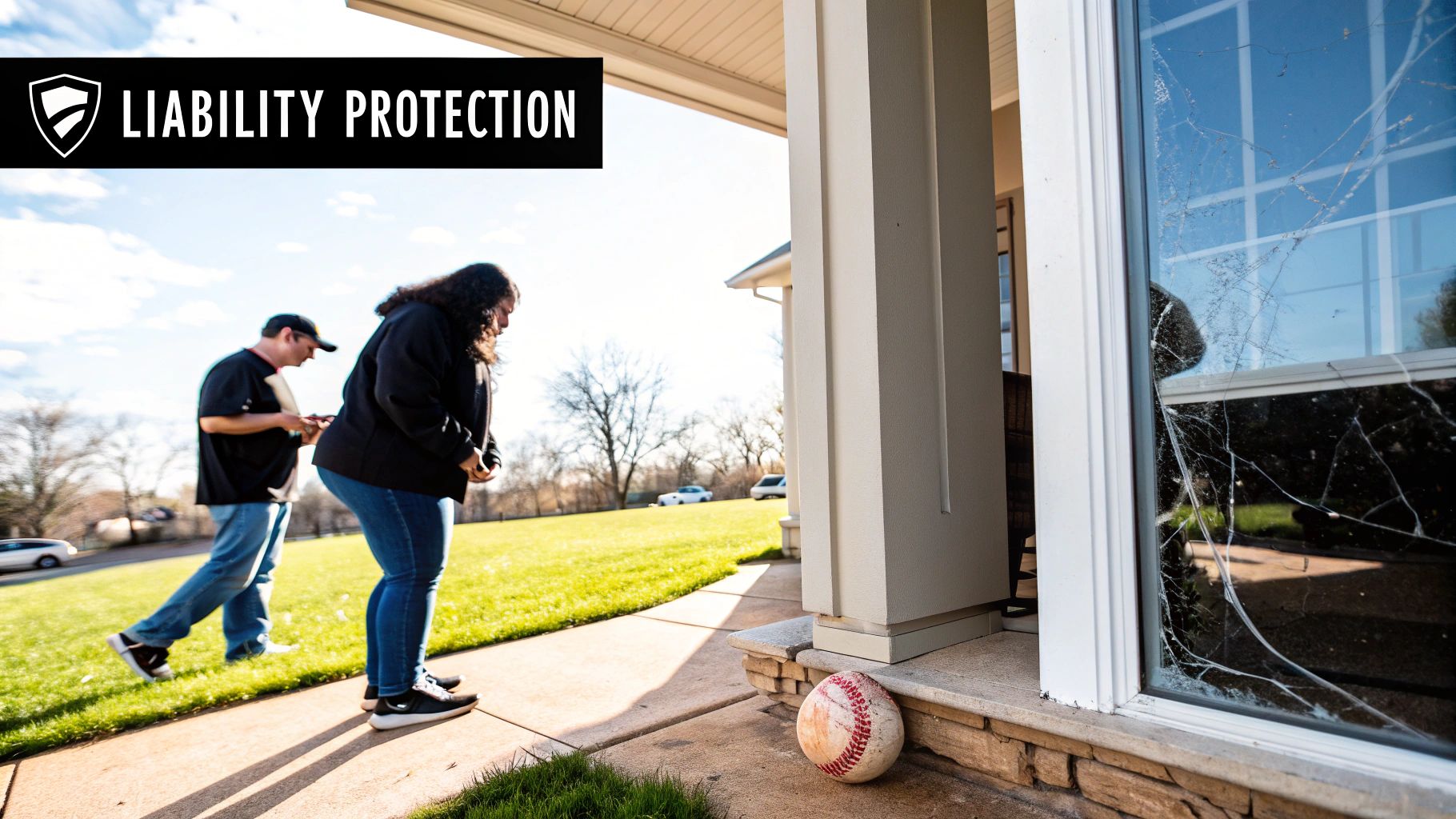
Think about it. A delivery driver slips on your wet porch steps and breaks their wrist. A stray baseball from a backyard game smashes your neighbor's expensive picture window. These everyday mishaps can spiral into huge medical bills and legal claims if you're found responsible. This is exactly where your liability coverage comes into play.
The Two Sides of Liability Protection
Liability coverage is typically split into two distinct parts. Each serves a unique purpose, but they work together to create a safety net for accidents that happen at your home or are caused by you or your family.
Personal Liability (Coverage E): This is the real heavy lifter. If someone gets hurt on your property and decides to sue, this coverage helps pay for your legal defense and any damages you’re ordered to pay, up to your policy limit. It can cover everything from medical bills and lost wages to pain and suffering. Standard policies often start at $100,000, but frankly, most experts recommend at least $300,000 to $500,000.
Medical Payments to Others (Coverage F): You can think of this as "goodwill" coverage. It’s designed to quickly pay for smaller medical bills if a guest is injured on your property, no matter who was at fault. This is great for handling minor incidents quickly and amicably, often stopping them from escalating into bigger lawsuits. Coverage limits here are much lower, usually between $1,000 and $5,000.
So, if a friend twists their ankle on your staircase, your Medical Payments coverage can immediately help with their ER visit. That kind of quick action can prevent hurt feelings and keep them from needing to file a formal claim against you.
Why Your Liability Limit Is So Important in California
Here in California, where property values and the cost of living are sky-high, having enough liability coverage isn't just a good idea—it's essential. A single serious accident could trigger a lawsuit that puts your home, savings, and even future earnings on the line. Understanding how homeowners insurance works means realizing your liability limits need to be high enough to protect your entire net worth. A comprehensive approach involves coordinating the liability on your home insurance with your auto insurance policy.
Liability claims under homeowners policies pay out billions of dollars every single year. This coverage is your first line of defense against a lawsuit that could otherwise wipe out everything you’ve worked so hard to build.
Just imagine the potential costs. A slip-and-fall accident can easily rack up tens of thousands in medical bills and legal fees. If your liability limit is too low, you’re on the hook for the rest. That’s why many California homeowners also get a separate umbrella policy, which adds another layer of liability protection that kicks in once your home insurance or auto policy limits are maxed out.
At the end of the day, liability protection is what turns your homeowners policy from a simple property repair plan into a powerful defense for your family’s financial well-being. It ensures one unexpected accident doesn't derail your life.
Why California Home Insurance Costs Are So High
If you're a California homeowner, you’ve probably felt the sting of rising insurance premiums. Let's be honest, it’s a tough situation, and you're not imagining it. Costs are climbing across the state, driven by a perfect storm of factors that make insuring a home here more challenging than almost anywhere else.
At its heart, California insurance is all about shared risk. But when that risk becomes incredibly high and concentrated in one area, the cost for everyone involved inevitably goes up. Insurers base their prices on two things: how likely you are to file a claim and how much that claim might cost. In California, unfortunately, both of those numbers are headed in the wrong direction.
The Major Drivers of California Premiums
Several powerful forces are making it more expensive for insurance companies to do business in California, and those costs are ultimately passed on to us, the homeowners. The biggest culprits are the escalating threat of natural disasters and the sky-high price of rebuilding.
- Intensifying Wildfire Risk: This is, without a doubt, the number one driver. We're seeing longer and more destructive fire seasons, leading to billions of dollars in insurance claims. A home located anywhere near a high-risk fire zone is now seen as a huge financial liability, which either sends premiums soaring or makes coverage difficult to get in the first place.
- Earthquake Exposure: While a standard policy won't cover earthquake damage, the ever-present seismic risk still plays a role. The sheer potential for a catastrophic event makes the entire state a riskier market for insurers, which subtly affects the cost of all related insurance products, from home insurance to renters insurance.
- Soaring Construction Costs: The cost of everything needed to rebuild a home—lumber, labor, permits, you name it—has exploded. If your home were destroyed today, rebuilding it would cost far more than it would have just a few years ago. Your policy's dwelling coverage has to be high enough to account for these inflated prices, and that directly bumps up your premium.
These California-specific challenges are then stacked on top of all the usual things that determine your rate. Factors like your home's age, your roof's condition, your personal claims history, and even your credit score all get factored into the final price you pay.
Key Factors That Influence Your California Home Insurance Premium
To give you a clearer picture, insurers look at a wide range of details when calculating your premium. Some things you can control, while others are set by your location.
| Factor | How It Impacts Your Premium (Increase/Decrease) | Why It Matters to Insurers |
|---|---|---|
| Location (ZIP Code) | Increase | Proximity to high-risk areas like wildfire zones or coastlines. |
| Reconstruction Cost | Increase | Higher material and labor costs mean a higher premium. |
| Age & Condition of Home | Increase/Decrease | Older homes may have outdated systems (plumbing, electrical), posing higher risks. |
| Roof Age & Material | Increase/Decrease | A newer, fire-resistant roof can earn you a discount. |
| Claims History | Increase | A history of frequent claims suggests you are a higher risk to insure. |
| Protective Devices | Decrease | Smoke detectors, fire alarms, and security systems can lower your premium. |
| Credit Score | Increase/Decrease | Insurers use credit-based scores to predict the likelihood of future claims. |
| Deductible Amount | Decrease | A higher deductible means you pay more out-of-pocket, lowering the insurer's risk. |
Understanding these elements helps demystify why your rate is what it is and shows where you might have some room to make cost-saving adjustments.
The Numbers Tell the Story
This isn't just a feeling; the data absolutely confirms the financial squeeze California homeowners are under. While insurance premiums have risen nationwide, the situation here is particularly tough. The average premium for a new policy has hit $1,966, which is a 9.3% jump from the previous year—and that came after other large increases.
Since 2019, the average home insurance premiums in both California and Florida have shot up by over 31%. That's nearly double the national increase of 17%. For many families, that's a serious hit to the budget. You can see more details on these trends in the 2025 home insurance report.
Your home insurance premium is a direct reflection of risk. In California, the combined risk of wildfires, earthquakes, and high rebuilding costs creates one of the most challenging insurance landscapes in the country.
Knowing what's driving these costs is the first step toward finding a smart solution. It explains why grabbing the cheapest policy isn't always the wisest move and why taking the time to review your coverage is so critical. For a deeper dive into your options, check out our complete guide to home insurance in California.
Navigating the High-Cost Market
Once you understand why costs are so high, you can start taking meaningful action. This means focusing on the things you can actually control, like installing a fire-resistant roof or bundling your home insurance and auto insurance policies to get a discount.
Most importantly, it means partnering with an agent who truly gets the California market. A good agent can help you compare quotes from companies that are still actively insuring homes in your area and, crucially, make sure your coverage is high enough to handle today’s massive rebuilding costs. By understanding the forces at play, you can make smarter, more strategic decisions to protect your home without breaking the bank.
Closing the Gaps: Essential California Insurance Coverage
Think of your standard homeowners insurance policy as a strong foundation. It’s a great start, but here in California, that foundation often has some serious cracks. The reality is, a basic policy doesn't cover everything, leaving you exposed to some of the biggest financial threats in the state. Knowing what’s excluded is just as important as knowing what’s included.
Most policies, for instance, won't cover damage from floods, earthquakes, sinkholes, or pests. For Californians, two of those exclusions should set off alarm bells. Your policy will not pay for damage caused by an earthquake or a flood. Period. You need separate, specialized coverage for those events. This is a crucial distinction in the world of California insurance.
Sometimes you can patch these gaps by adding endorsements—think of them as small, specific add-ons—to your existing policy. But for catastrophic risks like earthquakes, you’ll need an entirely separate policy. Building a truly protective insurance plan in California is all about strategically layering different types of coverage, including home insurance, car insurance, and potentially life insurance.
Protecting Your Home from Earthquakes
Living in California means living with the near-constant threat of earthquakes. It's a fact of life here. Yet, a standard home insurance policy provides zero coverage for earthquake damage. If a tremor cracks your foundation or collapses a wall, you're on your own without a specific earthquake insurance policy.
This standalone policy is designed to cover what your homeowners policy won't, including:
- Dwelling Repair: Pays to rebuild or repair the physical structure of your home.
- Personal Property: Helps you replace belongings that are damaged or destroyed in the quake.
- Loss of Use: Covers your temporary living expenses if your home is uninhabitable during repairs.
Be aware that earthquake insurance deductibles work differently. Instead of a flat dollar amount, they're usually a percentage of your coverage limit—typically between 5% and 25%. So, if your home is insured for $500,000 and you have a 15% deductible, you would be responsible for the first $75,000 of repair costs. It’s a high number, but having this coverage can be the one thing that prevents a total financial wipeout.
Securing Coverage in High-Risk Wildfire Areas
For many Californians, finding affordable home insurance in a high-risk wildfire zone has become a massive headache. If you've been turned down by traditional insurance companies, you are definitely not alone. This is precisely why the state created the California FAIR Plan—to act as an insurer of last resort.
The FAIR Plan provides basic fire insurance when no one else will. It’s important to understand, however, that it is a very limited policy. It only covers damage from fire, lightning, and internal explosions. It does not include crucial protections like liability, theft, or water damage.
To get the comprehensive protection you need, you have to pair the FAIR Plan with a separate "Difference in Conditions" (DIC) policy. This DIC policy essentially "wraps around" the FAIR Plan, adding back all the essential coverages of a standard homeowners plan to create a complete, though more complex, insurance solution.
Navigating this two-policy system is where having an expert in your corner really pays off. An independent agent can make sure your FAIR Plan and DIC policy fit together perfectly, leaving no dangerous gaps.
While market conditions are tough, we are seeing some signs of improvement. The global insurance market is stabilizing. And although Los Angeles wildfires have impacted performance, the U.S. homeowners market is projected to see double-digit growth and a return to profitability. A recent quarter showed a direct incurred loss ratio of 58.9%—a strong result suggesting the industry's financial footing is slowly improving, which could eventually ease the pressure on California homeowners, even as climate risks keep costs elevated.
Navigating the Home Insurance Claims Process
It's one thing to read your policy documents, but it's another thing entirely to use them when your home is damaged and stress levels are high. When disaster strikes, the last thing you need is confusion about what to do next. The process is similar whether you are filing a claim for home insurance or car insurance.
Think of it this way: you walk into your kitchen and discover a burst pipe has turned your floor into a shallow pond. It’s a mess, and it's easy to panic. But knowing the claims process ahead of time can turn that anxiety into a clear, actionable plan.
Your First Steps After a Loss
Before you even pick up the phone to call your agent, a few immediate actions are crucial. Your main goals are to stop the damage from getting worse and to document everything.
- Prevent Further Damage: Your absolute first priority is damage control. For that burst pipe, it means finding and shutting off the main water valve to your house. In a fire, it means getting everyone out safely and calling 911.
- Document Everything: This might be the single most important step you take. Pull out your smartphone and take tons of photos and videos. Get every angle of the damage—the source of the leak, the waterlogged cabinets, the warped floorboards, and any personal items that were ruined. This visual proof is pure gold for your claim.
Once you’ve contained the situation and recorded the evidence, you’re ready to get the ball rolling.
Filing the Claim and Working with an Adjuster
Contact your insurance company or agent right away to report what happened. You'll be given a claim number and assigned a claims adjuster. Think of the adjuster as the insurance company's investigator; their job is to assess the damage and figure out how much the insurer owes you under your policy.
The adjuster will set up a time to visit your home and see the damage for themselves. They'll look at your photos, ask a lot of questions, and write up their own report. This is where your detailed documentation becomes your strongest advocate. Always be honest and provide as much detail as possible, but keep in mind that the adjuster's primary role is to represent the insurance company.
This flowchart shows how a basic policy is just the foundation. In California, you often need to fill in the gaps for specific risks.
As you can see, things like earthquake or wildfire coverage are critical add-ons, not standard features.
After the inspection, the adjuster will estimate the cost of repairs. They'll take that total, subtract your deductible, and that's your settlement amount. So, if the repairs are estimated at $8,000 and your policy has a $1,000 deductible, you'll receive a check for $7,000.
A homeowners policy is a contract. The claims process is simply that contract in action, making sure you get the financial help you’ve paid for to put your home back together.
Payments often come in two parts. You’ll usually get an initial check to help you hire contractors and get the work started. The final payment comes after the job is done, which confirms the money was used for the intended repairs. Knowing these steps helps take the mystery out of the process, empowering you to navigate it confidently and get your life back to normal.
Take Control of Your California Home Insurance
You've done the hard work of understanding how homeowners insurance works. Now it's time to put that knowledge to use and make sure your policy is actually doing its job—protecting your biggest investment. This same proactive approach should be applied to all your California insurance needs, from renters insurance to life insurance.
Think of your policy less like a contract you file away and more like a living shield. It needs to be checked and adjusted, especially here in California where the risks and costs are constantly changing. Getting it right is what brings real peace of mind.
Your Quick-Action Checklist
Use this simple list to run a quick health check on your current policy or as a guide when you're looking at new quotes. It’s all about making sure you’re truly covered.
- Rebuild Cost (Dwelling Coverage): With construction costs soaring, is your Coverage A limit high enough to completely rebuild your home from the ground up today?
- Liability Shield: Do you have at least $300,000 to $500,000 in personal liability coverage? This is your firewall against a lawsuit that could threaten everything you own.
- Deductible Check: Is your deductible a number you could comfortably write a check for tomorrow without causing financial stress?
- California Gaps: Are you covered for the big local risks? Most standard policies don't include earthquakes or floods, so you often need separate coverage.
- Missing Discounts: Are you taking advantage of every possible discount? Bundling with your auto insurance policy or having a security system can make a real difference.
Partner with a California Insurance Pro
Let's be honest: the California insurance market is tough. Between wildfire risks and fewer companies willing to write policies, finding great coverage at a good price can feel overwhelming. This is where an independent agent becomes your biggest ally.
An independent agent isn't tied to one company. They work for you. Their job is to shop the market, comparing options for home insurance, auto insurance, and more from multiple top-rated carriers to find that sweet spot of great coverage and competitive pricing.
At Mai & Associates, we live and breathe California insurance. We know the ins and outs of the FAIR Plan, the best earthquake options, and how to find coverage for homes in high-risk areas. Our entire focus is on finding the perfect fit for your home, your family, and your budget, whether you need home insurance, car insurance, renters insurance, or life insurance.
Don't wait to find out you're underinsured when it's too late. The team here at Mai & Associates is ready to give you a personalized, no-pressure policy review to make sure you're protected. You can get an instant insurance quote right now and see how we can help you build a stronger financial future.