how does car insurance work: A simple guide for California Drivers
So, what exactly is car insurance? At its most basic, it's a deal you make with an insurance company to protect you financially. You pay them a regular fee, called a premium, and they agree to cover the costs if you get into an accident or your car gets damaged.
Think of it like a safety net. Without it, a single bad day on the road could turn into a personal financial disaster. This guide explains how car insurance works, especially for drivers in California.
What Is Car Insurance and Why Do You Need It?
Driving always comes with risks. Accidents happen, and they can lead to astronomical costs for car repairs, medical bills, and even lawsuits. If you didn't have insurance, you'd be on the hook for every single penny of that yourself. For most people, that could mean financial ruin.
A car insurance policy is your shield. It's a formal contract where the insurance company takes on that financial risk for you. It's not just a good idea—it's a legal requirement in California and almost every other state for this very reason. Having the right California insurance is essential.
The Key Players in Your Policy
To really get how it all works, it helps to know who's who in the world of car insurance. There are three main players in any policy:
- The Policyholder: That’s you! You own the policy and pay the premiums to keep your coverage active.
- The Insurer: This is the insurance company, like Mai & Associates. They collect premiums from thousands of drivers into one big pot of money to pay for claims when they happen.
- Third Parties: This is anyone else involved in an incident—the other driver, their passengers, or even a pedestrian. Your liability coverage is there to cover their costs, protecting you from having to pay out of pocket.
This isn't some small local system; it's a massive global industry. The car insurance market is huge and growing, expected to hit around USD 629.45 million by 2025. This just goes to show how essential people believe this protection is. You can read more about the global car insurance market trends to see just how big it is.
To make sense of the language you'll see in your policy, it's good to know a few key terms. They can seem confusing at first, but they're pretty straightforward once you break them down.
Here's a quick reference table to get you started.
Key Car Insurance Terms at a Glance
| Term | Simple Definition |
|---|---|
| Premium | The regular amount (usually monthly or yearly) you pay to keep your insurance active. |
| Deductible | The amount you have to pay out of your own pocket for a claim before the insurance company starts paying. |
| Claim | A formal request you make to your insurer to cover a loss that's included in your policy. |
| Policy Limit | The maximum amount your insurance company will pay for a single claim or accident. |
| Liability | Your legal and financial responsibility for causing injury or damage to someone else. |
Knowing these terms is the first step to feeling confident when you're shopping for a policy or, if the time comes, filing a claim. They're the building blocks of your entire auto insurance coverage.
By paying a relatively small, predictable premium, you are protecting yourself from large, unpredictable financial losses. It’s a fundamental tool for managing the everyday risks of being on the road.
At the end of the day, car insurance is more than just a piece of paper to satisfy the law. It’s about protecting your financial future. Whether you’re stuck in traffic on the 405 in Los Angeles or cruising down a quiet road in Northern California, the right policy gives you peace of mind, knowing that one accident won't derail your life.
Decoding the Main Types of Car Insurance Coverage
Think of car insurance less like a single product and more like a custom-built toolkit. You wouldn't use a hammer for every job, right? Similarly, an auto insurance policy is really a bundle of different coverages, each designed to protect you from specific financial risks on the road.
For us here in California, picking the right combination is crucial. It's not just about staying legal; it's about making sure a bad day on the road doesn't turn into a financial catastrophe. Some pieces are required by law, but others, while optional, are what I'd consider essential for real peace of mind. Let’s break down the main tools in that kit.
This diagram gives a great visual of how the moving parts work together—your policy is the financial bridge between you, your insurer, and anyone else involved in an accident.
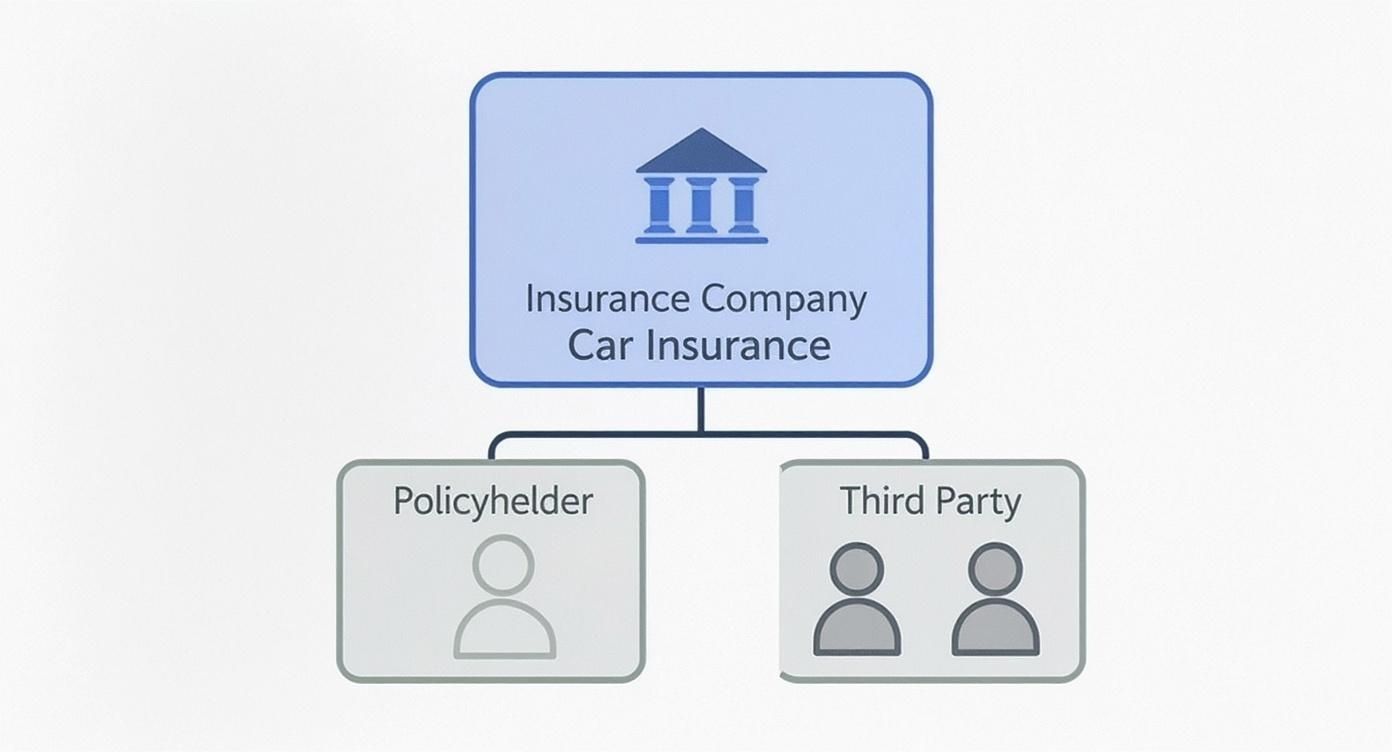
As you can see, your insurance company acts as a safety net, stepping in to cover costs for you and others, all based on the specific coverages you've chosen.
Liability Coverage: The Foundation of Your Policy
If you remember one thing, make it this: liability coverage is the one part of your car insurance that’s legally required in California. It's not for you—it's for them. This coverage pays for the damage you cause to other people and their property when an accident is your fault.
It’s broken down into two key parts:
- Bodily Injury Liability (BI): If you injure someone in a crash, this covers their medical bills, lost income, and even their pain and suffering. While California has minimum requirements, I can tell you from experience they are often nowhere near enough to cover the costs of a serious accident.
- Property Damage Liability (PD): This pays to repair or replace what you hit. Most of the time, that's the other driver's car. But it could just as easily be someone’s fence, a mailbox, or the front of a storefront.
Without enough liability insurance, one mistake behind the wheel could force you to pay out of pocket, putting your home, savings, and future earnings on the line.
Key Takeaway: Liability insurance is your financial shield. It protects your assets by covering the costs you're responsible for when you cause an accident.
Protecting Your Own Vehicle
Okay, so liability takes care of everyone else. But what about your car? That’s where these next two coverages come in. They’re usually optional, unless you have a car loan or lease—in which case your lender will almost certainly require them.
Collision Coverage This one is pretty straightforward. Collision coverage pays to fix or replace your car if you hit something, whether it's another vehicle, a pole, a guardrail, or even if your car rolls over.
Comprehensive Coverage I like to call this the "everything else" coverage. Comprehensive coverage protects your car from damage caused by things other than a crash. It’s for all the weird, unexpected stuff life throws at you.
Here are a few classic examples where comprehensive has your back:
- Your car gets stolen or vandalized.
- A heavy branch falls on your roof during a storm.
- You hit a deer on a back road.
- A rock flies up on the freeway and cracks your windshield.
- Your car is damaged by hail, a fire, or a flood.
Put them together, and collision and comprehensive are the one-two punch that protects the value of your vehicle.
Filling the Gaps with Additional Protection
Beyond the big three, a few other coverages address some very real—and very common—risks we face on California roads. Understanding how these work can be the difference between a minor inconvenience and a major financial headache.
Uninsured/Underinsured Motorist (UM/UIM) So, what happens if the person who hits you has no insurance or just the bare-bones minimum? That's exactly what UM/UIM is for. This vital coverage steps in to pay for medical bills for you and your passengers when the at-fault driver can’t. Trust me, in a state with millions of drivers, this is a lifesaver.
Medical Payments (MedPay) This coverage helps pay for medical or funeral expenses for you and anyone in your car after an accident, no matter who was at fault. MedPay is great because it can immediately cover things your health insurance might not, like ambulance fees or annoying co-pays and deductibles. It gets you the help you need, right away.
Building the right policy is about more than just checking a legal box. It's about crafting a personalized safety net for your car, your health, and your financial future. To see how these pieces fit into the bigger picture of California insurance, feel free to explore our other California Insurance Guides.
How Insurance Companies Calculate Your Premiums
Ever wonder why your car insurance rate is completely different from your friend’s, even if you drive similar cars? It's not random. When you apply for insurance in California, the company is doing a deep dive to predict one thing: how likely are you to file a claim? Your premium is the price they put on that prediction.
Think of it like putting together a puzzle of you as a driver. Insurers collect all sorts of pieces—your driving habits, your car, where you live—to build a complete picture of your unique risk profile. This is the core of how auto insurance pricing works; it's not a one-size-fits-all sticker price but a highly personalized cost figured out from a mountain of data.

This risk-based model is the bedrock of the entire insurance industry, from auto insurance policies to home insurance and renters insurance. It’s all about making sure the money collected from everyone's premiums is enough to pay out for the claims that will inevitably happen.
Key Factors That Shape Your Car Insurance Rate
In California, insurers zero in on a specific set of factors to figure out what you'll pay. While every company has its own "secret sauce" for weighing these details, the main ingredients are pretty much the same everywhere. Knowing what they are gives you the power to find ways to lower your costs.
Here are the heavy hitters that have the biggest impact on your premium:
- Your Driving Record: This is the big one. A history of at-fault accidents, a stack of speeding tickets, or a DUI on your record sends a clear signal to insurers that you're a higher risk, and your rates will reflect that.
- Your Vehicle: The car you drive is a huge piece of the puzzle. A shiny new sports car with expensive parts will always cost more to insure than an older, reliable sedan. Insurers look at everything from typical repair costs and theft rates to the safety ratings for your exact make and model.
- Your Location (ZIP Code): Where you park your car at night matters. In California, living in a dense urban area with more traffic and higher rates of theft and vandalism almost always means you'll pay more than someone in a quiet, rural town.
- How Much You Drive: Your annual mileage is a straightforward measure of your exposure to risk. The more you're on the road, a greater your chances of getting into an accident. It's that simple.
Insurers are constantly crunching numbers and analyzing data from millions of drivers to fine-tune these predictions, setting prices that match the level of risk they’re taking on with each policy.
Other Influential Premium Factors
Beyond those major factors, a few other details get mixed into the calculation to determine your final cost. Some you can control, while others are just part of who you are.
Personal and Policy Details Details like your age, gender, and marital status also play a role. Statistically, younger, less experienced drivers are involved in more accidents, which leads to higher premiums. Of course, the coverages, limits, and deductibles you choose have a direct impact on your price—opting for higher limits and lower deductibles means you're paying for more robust protection.
In California, insurers are prohibited from using your credit score to calculate auto insurance or home insurance premiums. This is a key consumer protection in the state that doesn't exist everywhere else.
The insurance market itself is also a factor. After a period of steep price hikes, the U.S. auto insurance market in 2025 has become more competitive. Insurers are now shifting their focus from simply raising prices to actively winning over and retaining customers, which is great news for shoppers. You can read the full analysis of 2025 auto insurance trends to get a deeper look.
Understanding these factors is the first step toward taking control and managing your insurance costs effectively.
Understanding California's Car Insurance Rules
Driving in the Golden State comes with its own unique set of rules for car insurance. These aren't just suggestions; they're laws designed to protect every driver on the road. Before you can choose the right policy, you need to understand the ground rules here in California.
The most important thing to know is that every California driver must show proof of financial responsibility. For nearly everyone, that means having an active auto insurance policy. The entire system is built on a simple concept: California is an "at-fault" state.
What Does "At-Fault" Really Mean?
It's actually pretty straightforward. In California, the person who causes an accident is responsible for paying for the damage. If you're deemed at fault for a collision, your liability insurance steps in to cover the other person's car repairs and medical expenses.
This is a key difference from "no-fault" states, where each driver's own insurance typically covers their own injuries, no matter who caused the crash. Here, figuring out who's at fault is the critical first step after an accident. That’s why having enough liability coverage isn't just about following the law—it's about protecting your financial future.
The Famous 15/30/5 Rule: California's Minimum Coverage
You'll often hear people mention the "15/30/5" rule. This isn't just industry slang; it's the absolute bare minimum liability coverage you must carry to legally drive in California.
Let's break down what those numbers actually represent. Think of them as the maximum amount your insurance company will pay out if you cause an accident.
California Minimum Liability Coverage Explained
The table below gives a clear picture of what California's minimum requirements cover.
| Coverage Type | Minimum Required Amount | What It Covers |
|---|---|---|
| Bodily Injury Liability | $15,000 per person | Covers medical expenses for a single person injured in an accident you cause. |
| Bodily Injury Liability | $30,000 per accident | Covers the total medical expenses for all people injured in a single accident you cause. |
| Property Damage Liability | $5,000 per accident | Covers damage to other people's property, most commonly their vehicle. |
It’s crucial to look at these numbers with a critical eye. A $5,000 limit for property damage barely covers a fender bender on a modern car, let alone the cost of replacing a totaled vehicle. If the damages exceed these limits, you could be on the hook for the rest, putting your personal assets at risk.
Expert Tip: The state minimums are a starting point, not a destination. To be truly protected, most insurance professionals strongly advise carrying much higher liability limits to shield your savings, home, and other assets from a costly lawsuit.
Special Programs for California Drivers
California understands that insurance can be a financial challenge for some, so the state offers programs to help.
The most well-known is California's Low Cost Auto Insurance (CLCA) program. This is a state-run initiative that provides affordable, basic liability coverage for income-eligible drivers who maintain a good driving record. The program's goal is to get more drivers insured, which makes the roads safer for everyone.
To see if you qualify for the CLCA program or other discounts, your best bet is to talk with an experienced agent. Getting a solid handle on your options for auto insurance in California is the first step toward finding the right protection and peace of mind on the road.
Your Step-by-Step Guide to the Claims Process
An accident can leave anyone feeling rattled and unsure of what to do next. But knowing the steps to take can bring a sense of control back into a chaotic situation. This is where your insurance policy stops being a document and starts being the practical support system you paid for.
Think of the claims process as a structured conversation with an insurance company. The goal? To get the damages you're covered for paid. Whether you're working with your own insurer or the other driver's, having a clear roadmap makes all the difference. Let's walk through it, from the moment of impact to getting your check.
Step 1: Immediately After an Accident
Your top priorities right after a crash are safety and information. What you do in these first few minutes can seriously affect how smoothly your claim goes.
First things first: check if everyone is okay. If you can, move your car out of traffic to a safer spot. Once the immediate danger has passed, it’s time to switch into fact-gathering mode.
- Exchange Information: You'll need the other driver's name, phone number, driver's license number, and license plate. Crucially, get their insurance company name and policy number. Snap a picture of their insurance card and driver's license if they'll let you.
- Document Everything: Your phone is your best tool here. Take photos and videos from every possible angle, capturing the damage to all vehicles involved. Don't forget the wider scene—get shots of skid marks, street signs, traffic lights, and the final positions of the cars.
- Contact the Authorities: It’s almost always a good idea to call the police. An official police report is an impartial, third-party account of the incident that can be incredibly valuable for your claim, especially if there are injuries or major damage.
Step 2: Filing the Official Claim
Once you're safe and have a moment to breathe, it's time to get the ball rolling. You should contact your insurance company as soon as you can, even if you weren't at fault. Your agent is there to guide you through the next steps.
When you call, you'll provide all the details you collected at the scene. This first call is what officially opens your claim and sets the insurer's internal process in motion.
California is an "at-fault" state, which means the person responsible for the accident is responsible for the damages. You can file with your own insurer (a first-party claim) or the other driver's (a third-party claim). Going through your own company is often faster since you have a direct relationship with them.
Step 3: The Investigation and Appraisal
After you file, your claim gets assigned to a claims adjuster. This person will be your main point of contact throughout the process. Their job is to investigate what happened, determine who was at fault, and figure out the extent of the damages.
The adjuster will look at everything—the police report, photos, witness statements, and the stories from both drivers. Next comes the appraisal, where they'll need to inspect your car. You can usually take it to an approved body shop, or in some cases, an appraiser might come to you.
The appraiser creates a detailed repair estimate, which becomes the foundation for the settlement offer. If the cost to fix your car is more than its actual cash value (ACV), the insurance company will likely declare it a total loss.
Step 4: Negotiation and Settlement
With the investigation wrapped up, the insurance company will make you a settlement offer. This amount will cover the cost of repairs (minus your deductible, if it applies) or pay out the ACV if your car was totaled.
Don't just accept the first number they give you. Review the offer carefully. If you think the repair estimate is too low or they've undervalued your totaled car, you absolutely have the right to negotiate. You can support your case by getting your own estimates from mechanics you trust.
Once you and the insurer agree on a final amount, they'll issue a payment. The check might come directly to you or be sent straight to the auto shop, finally getting you back on the road.
How an Independent Agent Simplifies Your Insurance Needs
Getting your head around how car insurance works is one thing. But actually diving into the crowded marketplace to find the right policy? That’s a whole different beast. This is precisely where having an independent insurance agent in your corner can turn a confusing chore into a straightforward, guided experience.
Think of it this way: going straight to a single insurance company is like visiting just one car dealership. You’re limited to their models and their prices, period. Working with an independent agent, like our team at Mai & Associates, is like having a personal car shopper who hits every lot in town, compares all the options, and finds you the absolute best deal.
Your Advocate in a Complex Market
An independent agent doesn't work for an insurance company; we work for you. Our loyalty is to our clients, not a single carrier. This freedom allows us to shop the entire market on your behalf, pulling quotes from dozens of top-rated providers to find the perfect fit. We lay out the best options for your specific needs, whether that’s auto insurance, home insurance, renters insurance, or even life insurance, bundling them together for maximum savings.
This kind of personalized help is crucial right now. The U.S. auto insurance market saw staggering underwriting losses of USD 53 billion between 2022 and 2023, which forced an average rate hike of 14.3% across the board. With rates constantly shifting, having an expert who can navigate these changes for you is more valuable than ever. Discover more insights about the motor insurance market to see why expert guidance makes all the difference.
But our job isn’t just to sell you one policy. We look at your whole picture here in California to build a complete protection plan that makes sense for your life.
We specialize in finding every available discount, from multi-policy bundles that combine your car insurance and renters insurance to good driver rewards, ensuring you never overpay for the coverage you need.
Ultimately, we save you the two things you can’t get back: time and peace of mind. We do the legwork, cut through the jargon, and give you honest advice so you can make a smart choice. You can feel confident knowing your car, home, and family’s future are properly protected. Ready to see how easy it can be? You can get a personalized insurance quote from our experts and let us do the heavy lifting for you.
Frequently Asked Questions About Car Insurance
Let's face it, diving into the details of auto insurance can bring up a lot of questions. Getting a handle on how it all works is a process, and it’s completely normal to have specific scenarios you’re not sure about. To give you some clarity, we’ve put together plain-English answers to the questions we hear most often from California drivers.
Think of this as your quick-reference guide to clearing up the confusion so you can feel more confident about the policy you choose.
How Does My Deductible Really Work?
Your deductible is basically your part of the deal. It's the amount you agree to pay out of your own pocket for a claim before your insurance company steps in to pay the rest.
Here’s a simple example: Let's say you have a $500 deductible and your car needs $3,000 worth of repairs after a covered accident. You’ll pay the first $500, and your insurance provider will cover the remaining $2,500.
Picking a higher deductible is a common way to lower your monthly premium, but just remember that it means you’ll have a bigger bill to pay upfront if something happens.
Does Car Insurance Follow the Car or the Driver?
This is a classic, and the answer isn't quite black and white. For the most part, car insurance follows the vehicle. If you let a friend borrow your car and they get into an accident, your policy is generally the primary one on the hook for the damages.
That said, your friend's insurance might come into play as secondary coverage if the costs go beyond your policy's limits. The big takeaway? Be mindful of who you hand your keys to, because their driving can have a direct impact on your insurance record and future rates.
What Happens to My Rates After I File a Claim?
Filing a claim, particularly for an accident where you were at fault, will probably lead to a rate increase when it's time to renew your policy. From an insurer's perspective, a claim signals a higher risk. The size of that increase really depends on a few things:
- Who was at fault: At-fault accidents almost always trigger bigger rate hikes than claims where you weren't to blame.
- The cost of the claim: A minor parking lot scrape will affect your premium far less than a major collision that totals a vehicle or causes injuries.
- Your driving history: A single claim after years of a clean record is viewed differently than a pattern of frequent accidents.
Some insurers offer an "accident forgiveness" feature, which can be a lifesaver. It essentially gives you a pass on a rate hike after your first at-fault accident.
Key Insight: The fear of a rate increase is real, but don't let it stop you from reporting a legitimate accident. Not reporting a crash can create much bigger headaches down the road, from being dropped by your insurer to facing a personal lawsuit with no coverage.
Getting a grip on these details is key to understanding how your policy works in the real world. If you've got more questions, you can dive deeper on our car insurance FAQ page for more straightforward answers on everything from policy jargon to filing claims.
Trying to find the right coverage without overpaying can feel like a full-time job, but you don't have to figure it all out on your own. The licensed experts at Mai & Associates are here to give you clear, personalized advice for all your California insurance needs—whether it's for your car, home, apartment, or family. We do the shopping for you, comparing top carriers to find you great protection at a competitive price.
Get your free, no-obligation quote online or call us today!
Article created using Outrank