House Settling Noises: A California Homeowner's Guide

You hear it after midnight. A sharp pop from the ceiling. Then a creak in the hallway. Maybe another click near the wall by the bedroom door.
Most California homeowners have had that moment where they stop breathing for a second and wonder if the house is shifting in some dangerous way. In many cases, it isn't. A home isn't a rigid box. It moves a little, responds to heat and cool air, and settles into the ground over time. That's normal.
The part that gets expensive is confusion. People often mistake normal house settling noises for major structural failure, or they assume any unsettling sound should be covered by home insurance. That's where trouble starts. The sound itself may be harmless, but the wrong response can lead to missed maintenance, delayed repairs, pest damage, or a denied claim.
If you also shop for California home insurance, renters insurance, auto insurance, car insurance, or life insurance, this matters more than it seems. A noisy house can raise questions about maintenance, documentation, and whether damage came from gradual wear or a sudden covered event. In California, where earthquake risk, wildfire exposure, and aging housing stock all affect coverage decisions, that distinction matters.
Decoding Your Home's Clicks Pops and Groans
A house can sound alive. At night, when everything else goes quiet, even a small snap in the attic can sound dramatic.
I've walked through homes where owners were convinced a beam had cracked, only to find a routine temperature change had made framing shift slightly against fasteners. I've also seen the opposite. Someone ignored repeated noises for months because they assumed “houses just do that,” and the underlying cause turned out to be a water problem or movement around an entry door.
Why homes make noise
Think of a house like a pair of leather shoes you wear every day. They flex, dry out, warm up, cool down, and adjust to pressure. Your home does the same thing, just with wood framing, drywall, metal, concrete, ductwork, and plumbing.
A few examples homeowners commonly describe:
- A single loud pop after sunset when the roof or wall assembly cools down
- Creaks underfoot in one hallway, especially in the morning
- Ticking sounds near ducts or pipes when heating or cooling cycles change
- Short bursts of noise after a hot afternoon when building materials release stress
Most house settling noises are the sound of materials adjusting, not failing.
That doesn't mean you should ignore every sound. It means you should listen with context. Timing, location, repeat pattern, and visible changes matter more than how scary the sound feels in the moment.
If insurance terms like wear and tear, peril, exclusion, and settlement feel fuzzy, it helps to review a plain-English California insurance glossary before you start reading your policy language.
The Normal Noises Every House Makes
Most ordinary house settling noises come from movement so small you'd never see it, but you can definitely hear it.
The main driver is simple. The primary mechanism behind house settling noises is thermal expansion and contraction of building materials, where fluctuating temperatures and humidity cause wood and other components to expand and contract, generating flexing that produces popping sounds. Homeowners can mitigate these noises by maintaining consistent indoor temperatures, as explained in this home sounds reference from Mounds View.
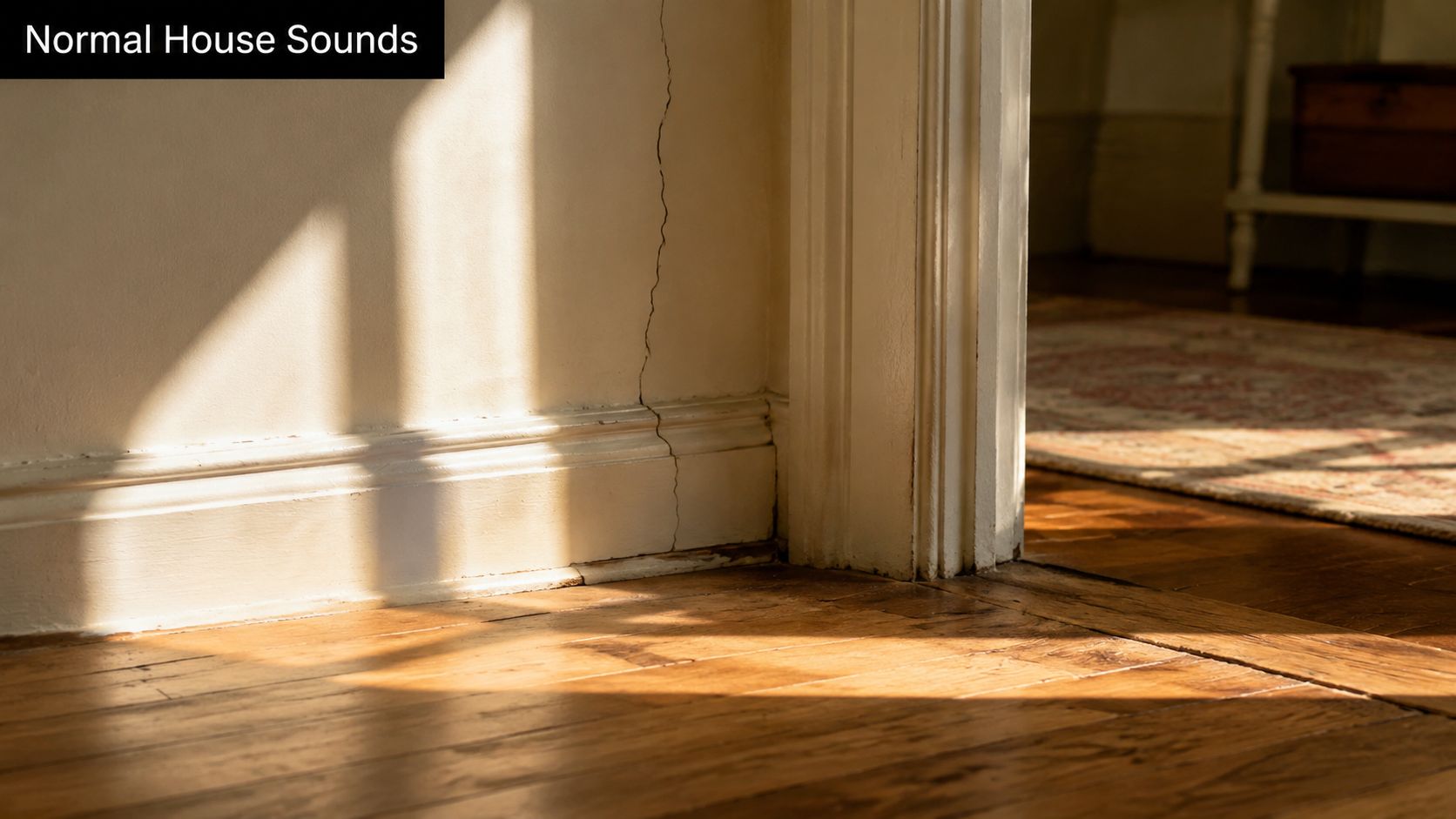
Your house stretches during the day
On a hot California afternoon, roof materials, framing, metal connectors, and even drywall warm up. As they warm, they expand. Later, when temperatures drop, they contract.
That's why some homes seem noisiest during big day-to-night swings. The building is “stretching” and then relaxing. Wood may rub slightly at a fastener. A truss connection may shift. Metal components may click as tension changes.
This is especially common in:
- Attics and ceilings where heat builds up
- Exterior walls that get direct sun
- Floor systems above crawl spaces or garages
- Homes with metal roofing or metal duct runs
Soil movement is also part of normal life
A home also settles because the ground beneath it compresses under load. That happens in every house to some extent. In a newer home, those adjustments may be more noticeable because materials are still finding their long-term positions under everyday weight and seasonal changes.
That's why owners often hear popping in the first year or two and assume the builder missed something major. Often, what they're hearing is ordinary redistribution of stress across joists, joints, and trusses.
Practical rule: A sound by itself usually matters less than a sound paired with visible change.
Humidity changes affect wood more than people expect
Wood isn't dead, even after it's been milled and installed. It still responds to moisture in the air. When indoor air gets very dry or very damp, framing, trim, and subfloors can shrink or swell enough to create noise.
That's one reason the same hallway floor can be quiet one month and vocal the next. It isn't necessarily getting worse. It may just be reacting to different indoor conditions.
A few harmless examples:
Floorboard creak in one spot
Often caused by slight movement between subfloor and framing.Ticking in a wall in late afternoon
Often tied to sun-heated materials cooling or shifting.Ceiling pop after the HVAC cycles off
Often tied to changing temperature around framing or ductwork.
If the sounds are occasional, predictable, and not paired with other symptoms, they usually fall in the normal category.
When Noises Signal a Deeper Problem
Not every house noise deserves a shrug. Some sounds are warning signs, especially when they arrive with physical changes you can see or feel.
The most common homeowner mistake is treating all noises as structural. The second most common mistake is treating all noises as harmless. The right approach is comparison.
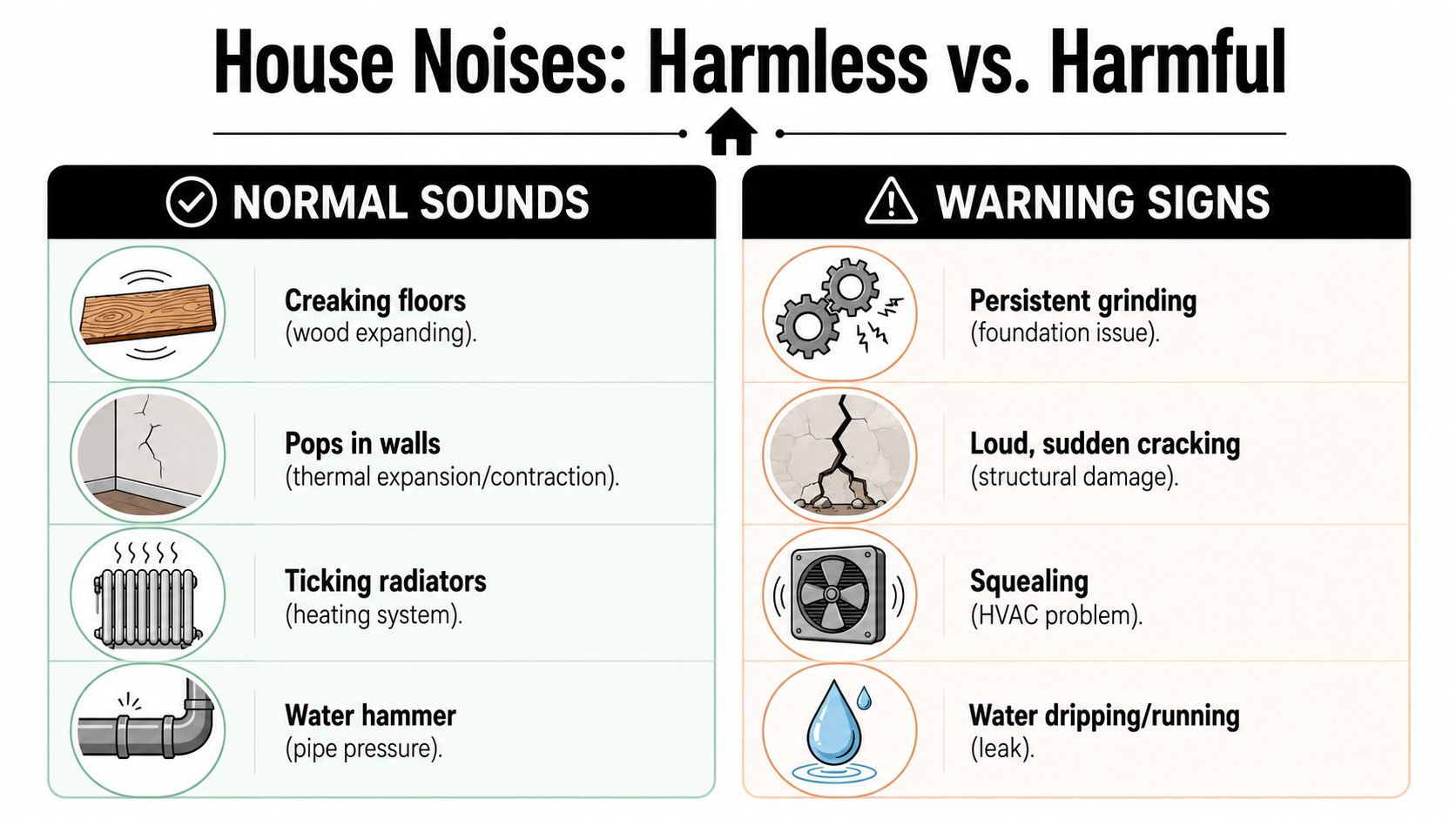
Sounds that deserve closer attention
Some noises point away from ordinary settling and toward a specific system or hazard.
- Scratching or scurrying inside walls or ceilings can suggest pests rather than framing movement.
- Banging near plumbing lines may come from pipe movement or pressure-related issues.
- Repeated squealing or grinding near vents or equipment can point to HVAC components.
- Loud cracking paired with visible wall or door changes deserves prompt evaluation.
One California-specific blind spot is pests. In Southern California, a 2025 UC study found that 38% of “settling noise” complaints were identified as mouse or rat infestations. A key diagnostic is timing: if noises peak at 3–5 AM, it's likely biological; if they peak at 2–4 PM, it's likely thermal expansion, as noted in this house settling noises checklist.
That timing clue is more useful than commonly understood. If you hear activity in the quiet hours before dawn, think creatures first, structure second.
Compare the pattern, not just the volume
A harmless noise can be loud. A serious issue can start with little sound. That's why pattern beats intensity.
| Sound Characteristics | Likely Benign Cause (Monitor) | Potential Concerning Cause (Investigate) |
|---|---|---|
| Single pop during heat-up or cool-down | Thermal movement in framing or drywall | Structural shift if paired with growing cracks or movement |
| Light creak in one floor area | Normal subfloor movement | Framing or support issue if floor feels sloped or bouncy |
| Ticking near ducts | Duct expansion and contraction | Mechanical issue if airflow drops or noise becomes constant |
| Tapping in walls at night | Minor material movement | Pest activity if timing is concentrated overnight |
| Bang after water use | Pipe movement | Plumbing issue if it repeats often or leaks appear |
| Sharp crack with door misalignment | Minor adjustment only if isolated | Foundation or load-path problem if changes continue |
If a noise starts showing up with sticking doors, sloping floors, or widening wall cracks, stop calling it “just settling.”
Physical clues matter more than fear
A house with ordinary settling noises usually still works normally. Doors latch. Floors feel level. Cracks stay small or unchanged. Windows open without sudden resistance.
A house with a deeper problem often starts telling on itself in other ways. You may notice a door rubbing at the top corner, a gap opening at trim, or a wall crack that looks longer each month.
Those are the moments to investigate, not guess.
Your Step-by-Step Home Inspection Checklist
You don't need to climb on the roof or crawl into dangerous spaces to learn a lot. A calm, repeatable inspection tells you whether the sound is random, seasonal, or tied to a developing issue.
Start with observation. Document first, diagnose second.
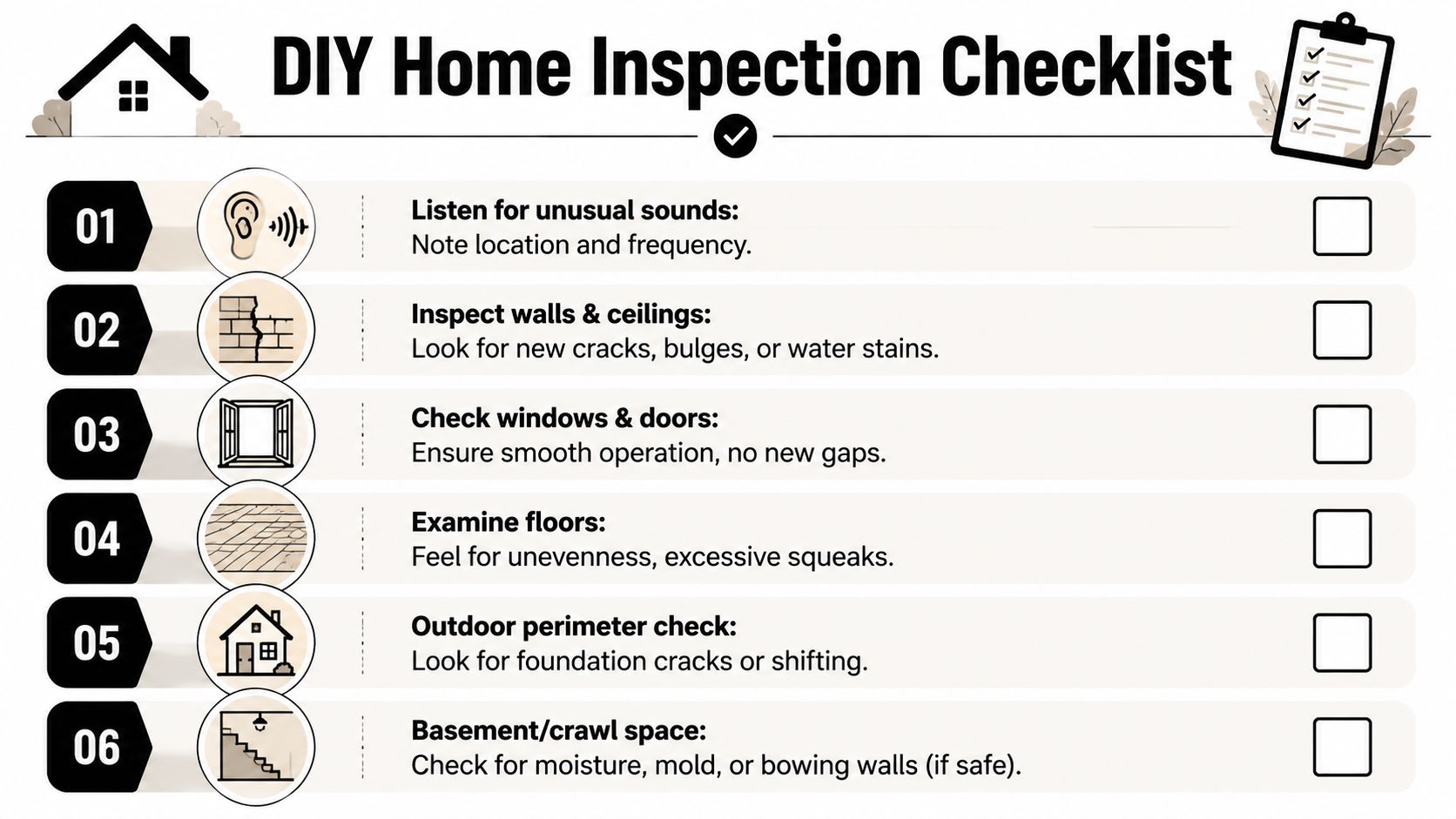
What to check inside the house
Keep a notepad or phone in hand and move room by room.
Listen for repeat locations
Stand still when the noise happens. Note the room, wall, ceiling, or floor area. Write down time of day and weather conditions if you can.Check walls and ceilings
Look for new cracks, stains, bulges, or nail pops. A crack that hasn't changed may be cosmetic. One that lengthens or returns after patching deserves more attention.Test doors and windows
Open and close them slowly. If a door that used to swing freely now sticks or won't latch, that's useful evidence. Don't force it.Walk the floors
Feel for sudden unevenness, bounce, or a new dip. One squeaky board is common. A floor plane that feels noticeably off is different.
What to check outside
The exterior often explains what the interior only hints at.
- Foundation line: Look for visible cracking, separation, or displacement.
- Soil and drainage: Notice whether water tends to collect near the house after irrigation or rain.
- Trim and siding lines: Watch for gaps where materials no longer meet cleanly.
- Porch and step connections: Separation around attached structures can signal movement.
One benchmark helps keep this grounded. A settlement displacement of up to one-sixth of an inch is often considered an acceptable measurement for new homes, and noises are rarely a concern unless they exceed this benchmark or accompany cracks longer than 12 inches, according to the .
That doesn't mean every crack under that limit is harmless. It means small movement exists in the normal range, especially in newer construction.
How to document it well
Good records help whether you call a contractor, an engineer, or your insurer.
- Take dated photos: Use the same angle each time.
- Measure the crack or gap: Even a simple ruler gives you a baseline.
- Check again on a schedule: A recurring log is more useful than memory.
- Save everything in one folder: Photos, notes, repair receipts, and inspection findings belong together.
For more practical homeowner checklists and plain-language insurance education, browse these California insurance guides.
House Noises and Your California Home Insurance
Many claims often face complications. Homeowners hear a noise, see a crack, and assume insurance should step in because the damage feels sudden. The policy may see it differently.
Most standard home insurance policies treat gradual settling, wear and tear, maintenance issues, and ordinary soil movement very differently from sudden and accidental loss. That distinction controls whether a claim has a chance.

The insurance settlement blind spot
In California, this matters even more because homeowners often live with overlapping risks. Earthquake exposure, wildfire history, hillside lots, older foundations, and FAIR Plan arrangements all complicate the question of what caused the damage.
The key point is simple. A settling noise alone usually isn't an insured event. In California, recent data shows a 22% rise in denied home claims where “gradual settling” was misattributed by the homeowner as “sudden structural failure.” Settling noises alone rarely qualify for a claim unless directly linked to a covered peril like an earthquake-induced soil shift, according to this analysis of when house settling is normal.
That means the story of the loss matters as much as the damage itself.
Covered cause versus excluded condition
Here's the easiest way to think about it.
A policy may respond when a covered peril causes sudden damage that produces structural symptoms. It often won't respond when the house ages, compresses, dries out, expands, contracts, or slowly shifts over time.
A few examples make this clearer:
Likely excluded scenario
You notice popping sounds for months, then find an old drywall crack has slowly gotten worse. That often reads like gradual settling or wear.Potentially covered scenario
A sudden plumbing failure saturates part of the structure and leads to abrupt movement or damage. The water loss may be the insurable trigger, depending on the policy language.Earthquake-related scenario
If earth movement stems from an earthquake, the answer may depend on whether you carry separate earthquake coverage. Standard home insurance often handles that differently from ordinary homeowners coverage.
Insurance cares about causation. “What happened first?” is often the most important claim question.
Documentation can make or break the claim
If there's any chance you'll need to involve insurance, start documenting immediately.
Use a simple evidence trail:
- Photograph the area with dates visible in your device record
- Measure cracks and note whether they change over time
- Write down when the noise started and what else happened nearby
- Keep records of inspections, repair recommendations, and invoices
- Avoid making broad statements like “the foundation is failing” unless a professional has said so
That last point matters. Homeowners often weaken their own claims by guessing at the cause. Report the facts you observed. Let the adjuster, contractor, or engineer classify the mechanism.
Why this matters beyond home insurance
A claim problem in one policy can affect broader protection decisions. Households often review California home insurance at the same time they compare auto insurance, car insurance, renters insurance, or life insurance, especially when budgeting after a repair scare. If you're trying to understand policy options, endorsements, and coverage gaps, this California home insurance resource is a useful place to start.
For California drivers, bundling can matter too. Bundling home and auto insurance in California can save drivers 5% to 25%, based on current carrier filing information summarized by Rate Authority's California auto market update. Savings won't fix an excluded claim, but policy reviews often uncover missing protections before the next problem hits.
Simple Fixes and Proactive Home Maintenance
If the noise turns out to be normal movement, that's good news. You may not need a major repair. You may just need to reduce friction, stabilize indoor conditions, or quiet a noisy contact point.
Small fixes that often work
A lot of routine noise comes from materials touching where they shouldn't, or moving more than necessary.
For pipes and ducts, a practical fix is cushioning the contact point. Installing foam insulation or pipe sleeves around water pipes and ductwork where they contact wood framing can absorb movement. For squeaky floors, driving screws through the subfloor into joists can eliminate friction-based noise, as described in this guide to house settling sounds.
Other homeowner-friendly habits can help too:
- Keep indoor temperature steadier: Big swings tend to create bigger expansion and contraction cycles.
- Watch indoor humidity: Wood behaves better when indoor conditions stay more consistent.
- Manage drainage around the house: Water near the foundation can add stress over time.
- Pay attention to repeat trouble spots: The same corner, door, or hallway usually tells a story.
Know when to stop DIY work
Cosmetic patching is one thing. Structural guessing is another.
Call for professional help when noises come with visible movement, recurring door misalignment, slope changes, moisture, or signs of pests. If conditions look more serious, a structural engineer inspection may be appropriate. The verified guidance available for this topic notes a structural engineer inspection can cost $300–$500 when deeper concerns are present, as summarized in this earlier-cited source context from Why It Sounds. I'm not linking it again here because one clean source citation is enough. The point is qualitative too. A targeted inspection is often cheaper than waiting and being wrong.
Quieting a house is good. Understanding why it got noisy is better.
For more homeowner tips and California coverage education, you can explore the Mai & Associates blog.
If house settling noises have you wondering whether you're hearing something normal, dealing with damage that needs repair, or facing a possible claim issue, talk with Mai & Associates. Their licensed California team helps homeowners, renters, and drivers review coverage for home, renters, auto, car, and life insurance, including FAIR Plan questions, earthquake options, and wildfire-related coverage gaps, so you can make decisions with more clarity and less guesswork.