Homeowners Insurance Policy Comparison Guide for California

Your renewal notice arrives, and the premium is higher than last year. Another carrier offers a cheaper quote, so switching seems obvious. Then you read the details: the new policy pays actual cash value for your roof and belongings, carries a larger deductible, and leaves water backup or earthquake damage outside the coverage. The lower price wasn't a bargain. It was a smaller promise.
A useful homeowners insurance policy comparison is really a comparison of potential claim payouts. Premium matters, but so do rebuilding limits, settlement terms, exclusions, sub-limits, deductibles, and endorsements. California homeowners face especially important questions about wildfire, earthquakes, water losses, and whether the policy limit can keep pace with rebuilding costs.
Introduction to Smarter Homeowners Insurance Shopping in California
Your renewal notice shows a higher premium, and a competing quote looks cheaper. Before switching, compare the claim terms. The new policy may settle a roof or personal belongings at actual cash value instead of replacement cost, apply a larger deductible, or leave earthquake and wildfire-related losses outside the protection you expected.
California homeowners are shopping more often after rate increases. The average shopping rate among U.S. home insurance customers reached 6.8% in the second quarter of 2024, up from 5.9% two years earlier, while only 2.2% switched policies (MoneySuperMarket home insurance comparison guidance). The gap shows why price comparisons alone miss the payout differences that appear on declarations pages.
Among customers who received an insurer-initiated rate increase, 37% were likely to shop for a new policy. Premium pressure also followed an 11.2% increase in the average homeowners insurance premium in 2022 compared with 2021, as reported in a National Association of Insurance Commissioners study cited by the Insurance Information Institute (Which? home insurance review).
A cheaper quote can hide several payout gaps. Check whether personal property uses replacement cost or actual cash value, then inspect sub-limits for jewelry, electronics, water damage, and other high-value losses. Confirm endorsements for risks the base policy excludes. In California, that review must include wildfire terms and the separate treatment of earthquake damage.
The practical rule: compare the money you could recover after a loss, not merely the money you pay before one.
Use a fillable side-by-side worksheet with each carrier's dwelling, other structures, personal property, loss of use, liability, and medical payments limits. Add columns for settlement basis, deductible structure, exclusions, sub-limits, endorsements, and charges. Gather your declarations page, renewal notice, mortgage requirements, prior endorsements, and a realistic rebuilding-cost estimate before requesting matching quotes.
The California insurance resource center can help organize questions about home, auto, renters, and life insurance. Recheck the worksheet when your property, rebuilding costs, risk zone, or household finances change.
Understanding What Every Homeowners Policy Actually Covers
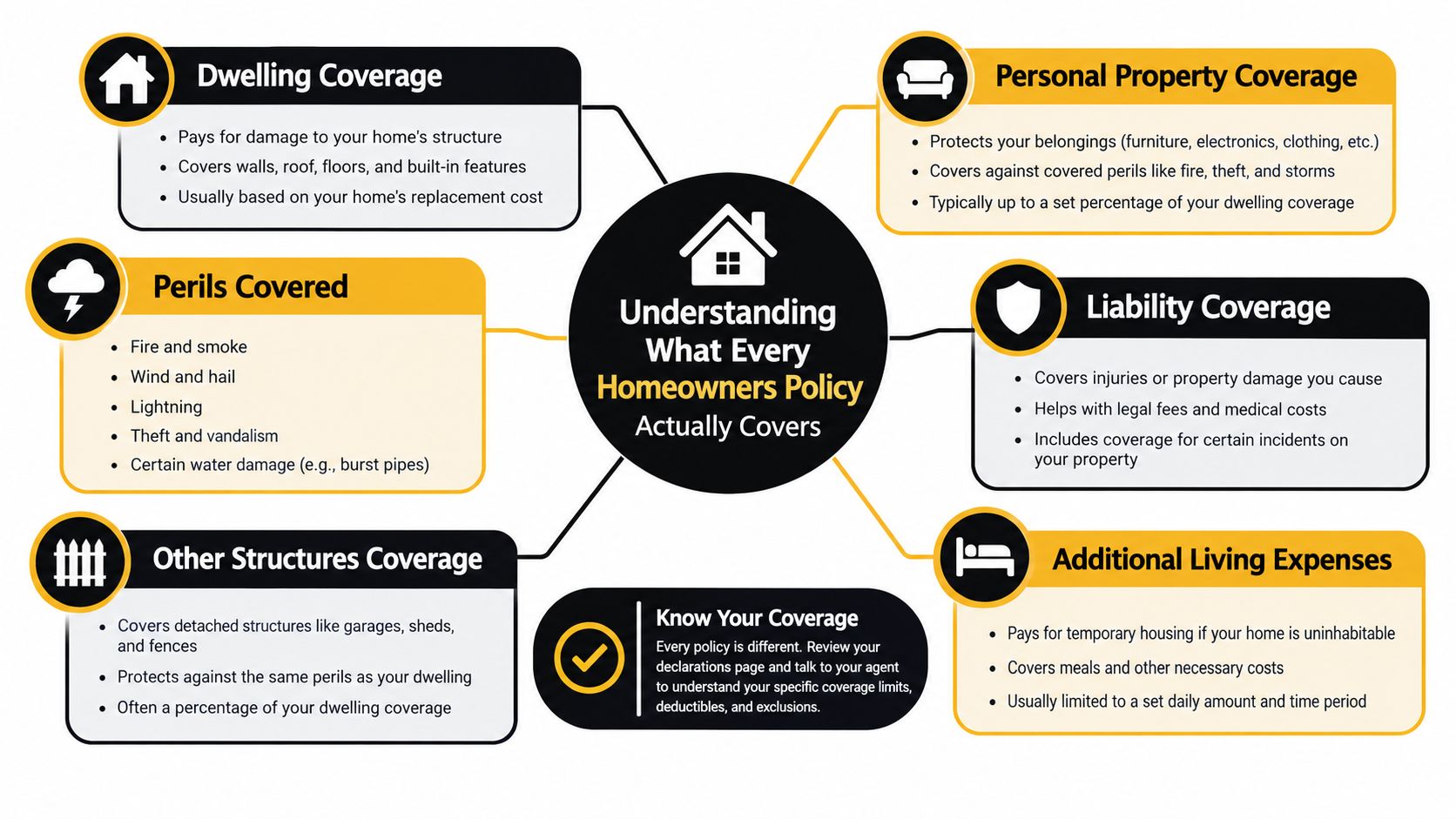
A declarations page is the quickest way to expose an incomplete comparison. Read it line by line, and separate the six core coverage areas instead of treating “home insurance” as one large promise.
Start with the six coverage buckets
Dwelling coverage applies to the primary residence, including covered structural components. This limit should reflect the cost to rebuild, not the property's market value, which also includes land.
Other structures covers eligible detached features such as a garage, shed, fence, or similar structure. If a detached garage appears important to your property, confirm that the limit is sufficient rather than assuming it automatically tracks the dwelling amount.
Personal property covers belongings such as furniture, clothing, appliances, electronics, and other contents, subject to the policy's settlement basis and item-specific caps.
Loss of use can help with additional living expenses when a covered loss makes the home uninhabitable. Review the limit and the conditions, because a headline dwelling limit doesn't tell you how temporary housing expenses are handled.
Personal liability responds to covered claims alleging that you caused bodily injury or property damage to someone else. Check both the limit and exclusions, particularly if you operate a business from home, rent part of the property, or own unusual hazards.
Medical payments to others is designed for certain smaller injury-related expenses, subject to policy terms. It isn't a substitute for liability coverage.
Read settlement terms before premium
The declarations page should identify whether dwelling and personal property are settled on a replacement cost value, or RCV, basis, or an actual cash value, or ACV, basis. RCV generally pays the cost to repair or replace covered property at current prices without depreciation, while ACV subtracts depreciation. The difference can be significant for an older roof, aging appliance, furniture, or electronics.
Dwelling coverage is often replacement cost by default, while personal property is frequently actual cash value unless upgraded. Check those categories separately. For a plain-language explanation of how the distinction affects roof claims, review Audit Genius on ACV and RCV.
Next, scan the exclusions and sub-limits. Jewelry, firearms, collectibles, business property, computers, water losses, and service lines may have special restrictions. A policy can appear broad while limiting a particular category to an amount far below its real value.
Use the home insurance glossary when a declarations page uses unfamiliar terms. Don't compare premiums until you know which coverage bucket each figure belongs to and whether the policy requires an endorsement for the protection you expect.
How to Compare Coverages Limits Deductibles and Endorsements Side by Side
A quote looks cheaper because the dwelling limit is lower, personal property is settled at ACV, or a water-loss endorsement is missing. Compare identical inputs before comparing premiums. Require each carrier to quote the same dwelling limit, other structures limit, personal property limit, loss of use provision, liability limit, and medical payments limit. If an agent changes a limit to reduce the price, label the quote noncomparable.
The NAIC homeowners insurance consumer worksheet identifies these fields as shopping points. The NAIC comparison shopping tool also recommends lining up dwelling limits, ACV or RCV status, deductibles, and add-on protections.
Use this fillable matrix
| Comparison Criteria | Quote A | Quote B | Quote C |
|---|---|---|---|
| Annual premium | |||
| Dwelling limit | |||
| Dwelling settlement, ACV or RCV | |||
| Extended or guaranteed replacement cost | |||
| Other structures limit | |||
| Personal property limit | |||
| Personal property settlement, ACV or RCV | |||
| Loss of use limit or formula | |||
| Personal liability limit | |||
| Medical payments limit | |||
| All-peril deductible | |||
| Wind or wildfire deductible structure | |||
| Water backup endorsement and limit | |||
| Service line endorsement and limit | |||
| Scheduled jewelry or valuables | |||
| Earthquake option | |||
| Major exclusions and sub-limits |
Compare settlement, not labels
Check ACV and RCV separately for the dwelling and personal property. ACV reduces a claim payment for depreciation. RCV generally pays the cost to repair or replace covered property at current prices, subject to policy conditions. A lower premium may reflect ACV personal property, while another quote includes an RCV upgrade. The NAIC comparison guidance indicates that personal property RCV upgrades are commonly priced about $25 to $50 per year, and extended or guaranteed dwelling replacement options about $50 to $100 per year. Treat those figures as comparison points, not automatic recommendations. Ask exactly what the endorsement changes, which conditions apply, and whether it covers the entire category or only specified property.
Deductibles need the same scrutiny. Record the dollar amount, whether it applies per occurrence or per covered peril, and whether wildfire, wind, or another risk follows a separate deductible structure. A premium you can afford does not help if the deductible exceeds your available emergency funds.
Compare the recovery path: If the dwelling burns, what pays first, what depreciation is withheld, which receipts are required, and what limit remains for temporary living costs?
Price endorsements one by one. Confirm whether water backup, service line, identity fraud, ordinance or law, equipment breakdown, scheduled valuables, and earthquake coverage are included, excluded, or available separately. Then read the major exclusions and sub-limits. A quote that omits protection you need is a different product, not a better deal.
California Specific Risks That Change Your Comparison
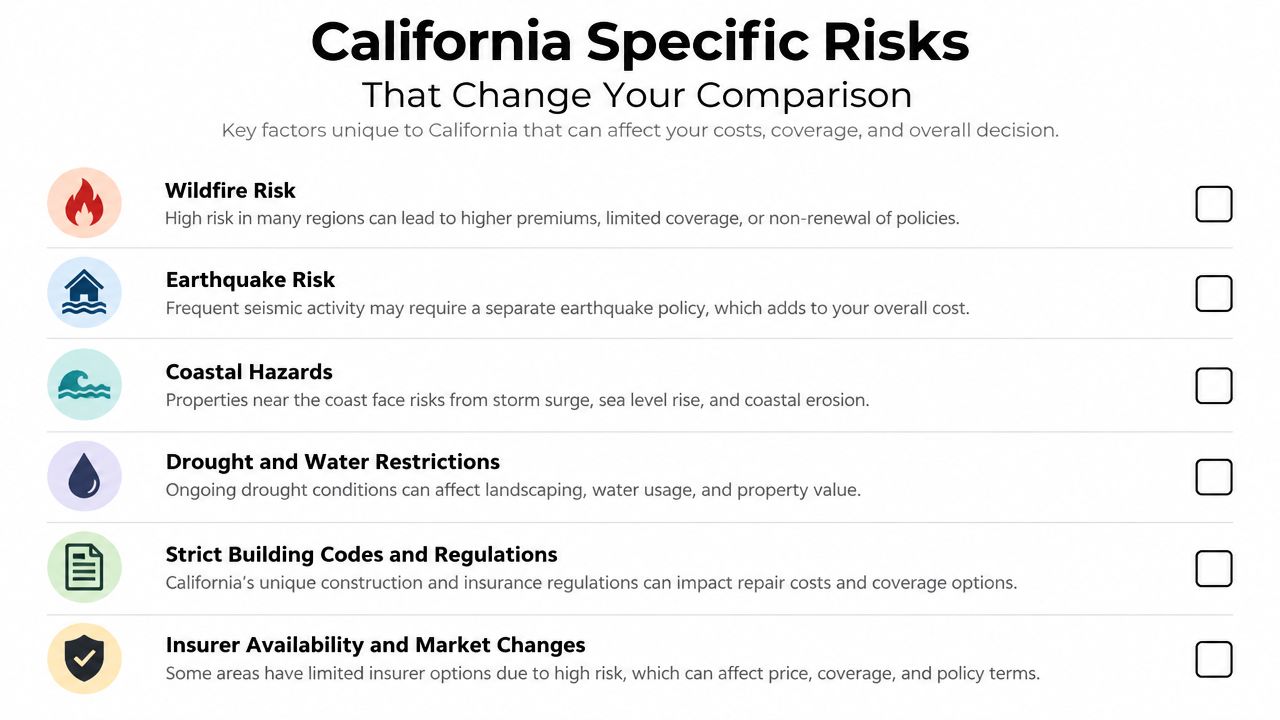
A California quote can look affordable until wildfire, earthquake, or water damage exposes a coverage gap. Compare the risk structure first, then compare premiums. Check ACV versus RCV, sub-limits, endorsements, and exclusions in the same side-by-side worksheet.
Wildfire and the FAIR Plan
The California FAIR Plan is a last-resort property insurance pool for homes that have difficulty obtaining coverage in the voluntary market. Residential policies provide up to $3 million total coverage and generally settle fire-related perils, including fire, lightning, internal explosion, and smoke, on an actual cash value basis (California FAIR Plan explanation).
Do not compare a FAIR Plan quote with a standard homeowners policy as if they were identical products. Record whether the FAIR Plan covers only the structure, where personal property and liability coverage comes from, which endorsements are available, and whether a separate wrap policy fills the remaining gaps. Confirm the wildfire deductible and ask how defensible-space or mitigation information affects eligibility and terms.
Earthquake and water exposures
Standard homeowners insurance commonly excludes earthquake damage. Request separate earthquake coverage and compare its deductible, exclusions, structural limit, contents limit, and loss-of-use treatment. Fire damage after an earthquake may be covered while the earthquake damage itself remains excluded.
Water coverage also requires line-by-line review. Ask about water backup, service line damage, seepage, plumbing failures, and flood exposure. Each event may receive different treatment, and a broad-looking quote can still leave a major payout gap.
Use this California home insurance guide to review state-specific coverage considerations. Then complete a side-by-side worksheet:
- Dwelling: replacement limit, ACV or RCV basis, and ordinance-or-law protection.
- Wildfire: deductible, exclusions, mitigation requirements, and FAIR Plan or wrap structure.
- Earthquake: separate policy or endorsement, deductible, contents, and loss of use.
- Water: backup, service line, seepage, plumbing, and flood treatment.
- Property: sub-limits and scheduled coverage for valuables.
California pricing varies by location and risk profile. Ask the agent to explain what drives each premium, rather than choosing the lowest figure without checking the payout terms. A lower price can reflect narrower coverage, higher deductibles, ACV settlement, or missing endorsements.
Common Pitfalls That Make Cheap Policies Expensive at Claim Time
A homeowner can pay every premium on time and still face a major shortfall after a fire, roof loss, or theft. The usual cause is a declarations page built around an outdated dwelling limit, ACV settlement, restrictive sub-limits, or missing endorsements. Market value does not determine rebuilding cost, and a low quote can hide each of those gaps.
Research summarized by the Rocky Mountain Institute found that 71% of California homeowners with fire claims were underinsured across 2018 through 2023. It also found that half of U.S. households had less than 70% of rebuilding costs covered, while one-fifth had less than 50% covered (Resources for the Future issue brief).
Run this claim-gap check
Use the same worksheet for every quote. Have the agent complete each blank before you compare premiums.
- Dwelling limit: Record the rebuilding estimate, valuation method, and whether extended replacement cost applies.
- Personal property: Mark ACV or RCV settlement, then list belongings that need documentation or scheduling.
- Sub-limits: Record caps for jewelry, electronics, collectibles, firearms, business property, and cash.
- Water protections: Confirm water backup and service line coverage. Do not assume a plumbing loss receives broad coverage.
- Identity fraud: Note whether protection is included or requires an endorsement.
- Roof settlement: Ask how age, material, condition, and depreciation affect payment.
- Excluded perils: Mark wildfire, earthquake, flood, mold, wear and tear, and maintenance exclusions.
A 2026 consumer survey found that 90% of homeowners were concerned about protecting their homes and personal property, yet many had not checked identity fraud protection, service line coverage, water backup coverage, or personal property replacement cost. The respective shares were 46%, 41%, 38%, and 24% (Insurance Journal consumer survey coverage).
The same survey found that 74% said they'd choose broader coverage even at a higher price. That choice matters as claim severity rises. Home insurance claim severity reached a record high in 2025, increasing 25.9% from 2024 and 93.2% since 2019. Fire and lightning loss costs rose 76.8% year over year, driven largely by the January 2025 Los Angeles wildfires (Resources for the Future issue brief).
Which Policy Fits Your Situation Real World Use Cases
A first-time buyer in a suburban tract usually needs a clean baseline comparison. Match the dwelling limit to rebuilding cost, confirm replacement cost for the structure, inspect personal property settlement, and price water backup, service line, and scheduled valuables where appropriate. Don't let a bundled home and auto quote distract you from the declarations page.
First-time buyer priority: Choose a policy you can understand and fund after a loss, not one that only looks inexpensive at closing.
A foothill homeowner who can only access the FAIR Plan needs a different arrangement. Compare the FAIR Plan's actual cash value structure and fire-related scope with a supplementary wrap policy. The wrap may address liability, personal property, loss of use, or other gaps, but the exact division of responsibility must be written down.
Owners of high-value homes should focus on rebuilding complexity, custom materials, code upgrades, landscaping, valuables, and extended or guaranteed replacement cost. A standard dwelling limit may not reflect the cost of reproducing specialized features. Personal property should be inventoried, and high-value items may require scheduling rather than relying on general contents limits.
Budget-conscious owners have one safe lever and one dangerous lever. Adjusting the deductible can reduce premium if you can comfortably pay it, but cutting dwelling limits or removing critical endorsements creates a claim problem. Compare the total annual cost with the out-of-pocket amount, then test whether the household could handle that deductible after a wildfire, water loss, or other covered event.

California renters and drivers also need coordinated protection. California renters insurance is commonly priced around $228 per year, or $19 per month, for a typical policy (California renters insurance pricing summary). California auto insurance minimum liability limits for policies renewing on or after January 1, 2025, are 30/60/15, meaning $30,000 bodily injury or death per person, $60,000 per accident, and $15,000 property damage per accident (California Department of Insurance auto limits). Those auto, renters, home, car, and life insurance decisions should be reviewed together when household assets and liability exposure are substantial.
Next Steps to Get and Compare Quotes With Confidence
Use a disciplined workflow. It prevents an agent or online form from changing the assumptions between quotes.
Prepare the same information
Collect your current declarations page, property details, roof information, prior claims history, mortgage requirements, security features, wildfire mitigation details, and a contents inventory. Ask for a dwelling-limit explanation, not just a number. If the estimate looks low, request a second review based on local construction features and code requirements.
Request matched quotes
Give every carrier the same limits and deductible instructions. Require written answers for ACV versus RCV, roof settlement, personal property settlement, water backup, service line, identity fraud, earthquake, wildfire, ordinance or law, and extended replacement cost. Ask agents to identify every material exclusion and sub-limit before you compare the premium.
Review the final documents
Don't bind coverage from a proposal alone. Compare the issued declarations page and endorsements with the quote, confirm effective dates, and make sure the mortgagee information is correct. Save the policy, inventory, receipts, photos, and agent correspondence in a location you can access after a loss.
An independent agency can make the process faster by requesting multiple carrier options and reviewing policies side by side. Mai & Associates provides same-day quotes, a 24-hour response, multilingual service, and specialized California FAIR Plan and earthquake reviews through offices in Glendale, Westlake Village, Escondido, and Costa Mesa. Its broader insurance work also includes auto insurance, car insurance, renters insurance, and life insurance, which can help households review related coverage together.
Revisit the comparison before renewal and after renovations, major purchases, roof work, household changes, or changes in wildfire risk. Use the California insurance quote request to submit the information needed for a coverage-focused review rather than a price-only estimate.
Mai & Associates can compare California homeowners insurance options, review FAIR Plan and earthquake arrangements, and identify hidden payout gaps in ACV, RCV, sub-limits, deductibles, and endorsements. Visit Mai & Associates to request a no-obligation quote and have your current declarations page reviewed by a licensed California agent.