Homeowners Insurance in California: Your Expert Guide

You open your mailbox, see a non-renewal notice, and your stomach drops. Or your renewal offer arrives and the price jumped so hard you read it twice. Or you’re buying your first place and finding out that homeowners insurance in california isn’t a simple box to check. It’s a real part of the budget, and in some ZIP codes it decides whether a deal still makes sense.
That stress is valid. California homeowners are dealing with a market that is more difficult to manage than it used to be. Carriers are tightening guidelines, wildfire maps are affecting eligibility, and too many people are learning the difference between “having insurance” and “having enough insurance” only after a loss.
You still have options. The key is to stop shopping by headline price alone and start making decisions like a homeowner who plans to keep the property protected for years. That means understanding what a standard policy does, where California risk changes the conversation, when the FAIR Plan makes sense, and how to work your way back into the private market when possible.
Navigating the Shifting California Insurance Market
You get a non-renewal notice, your escrow clock is ticking, and every carrier you call asks a different set of questions about brush, roof age, wiring, and prior claims. That is the California market right now. For a first-time homeowner, it feels chaotic fast.

Private carriers have pulled back in many parts of the state, especially where wildfire exposure, older roofs, deferred maintenance, or past claims make a home harder to insure. The mistake I see over and over is waiting for a cheap standard policy to appear. Start with insurability. Then work on price.
If you were non-renewed or you cannot get a reasonable private quote, treat this like a process, not a panic.
What this means for you
Three rules matter right away:
- Get eligible first: Ask who will write the home before you spend time comparing minor price differences.
- Bring proof, not guesses: Have the roof age, update history, photos, and any mitigation work ready before you ask for quotes.
- Use temporary coverage if you must: FAIR Plan coverage plus a companion policy can keep you insured while you improve the home’s profile and shop the private market again.
Practical rule: Start shopping as soon as you hear about a purchase, renewal problem, or non-renewal. Waiting until the lender deadline costs you options.
What to do now
Use a clean five-step plan.
- Verify the property details. Confirm year built, square footage, roof age, plumbing and electrical updates, prior losses, and any detached structures. Bad or incomplete application data gets quotes declined.
- Ask the hard underwriting question early. Have the agent tell you exactly what is blocking eligibility. Is it wildfire score, brush near the structure, roof condition, claims history, or something else?
- Fix what you can fix fast. Clear defensible space, trim overhanging branches, document roof repairs, and gather inspection photos. Keep records of the work. If a future claim happens, this guide to critical claim documentation for contractors is also useful for understanding what evidence matters.
- Set up a fallback if private coverage is not available. FAIR Plan is often the bridge, not the finish line. Pair it with the additional coverage your lender and your risk profile require, then calendar a remarket date after you complete property improvements.
- Stay organized while you shop back into the private market. Keep one file with quotes, inspection notes, photos, and upgrade receipts. A practical California home insurance guides library can help you sort through terms without wasting time.
One more blunt recommendation. If an insurer offers a policy with weak protection just to get you through closing, do not accept it blindly. Coverage gaps are expensive, and they usually show up at the worst possible moment.
The homeowners who handle this well do two things. They secure coverage now, even if the first solution is temporary. Then they make the property easier to insure and revisit private options on a schedule. That is how you keep the house protected without getting stuck in the wrong setup for years.
What a Standard California Homeowners Policy Covers
A standard California homeowners policy follows a two-part structure. Section I handles property. Section II handles liability. California law also requires insurers to offer earthquake coverage as an optional endorsement, either directly or through a separate option such as the California Earthquake Authority, as outlined in this explanation of California homeowners policy structure and earthquake offer requirements.
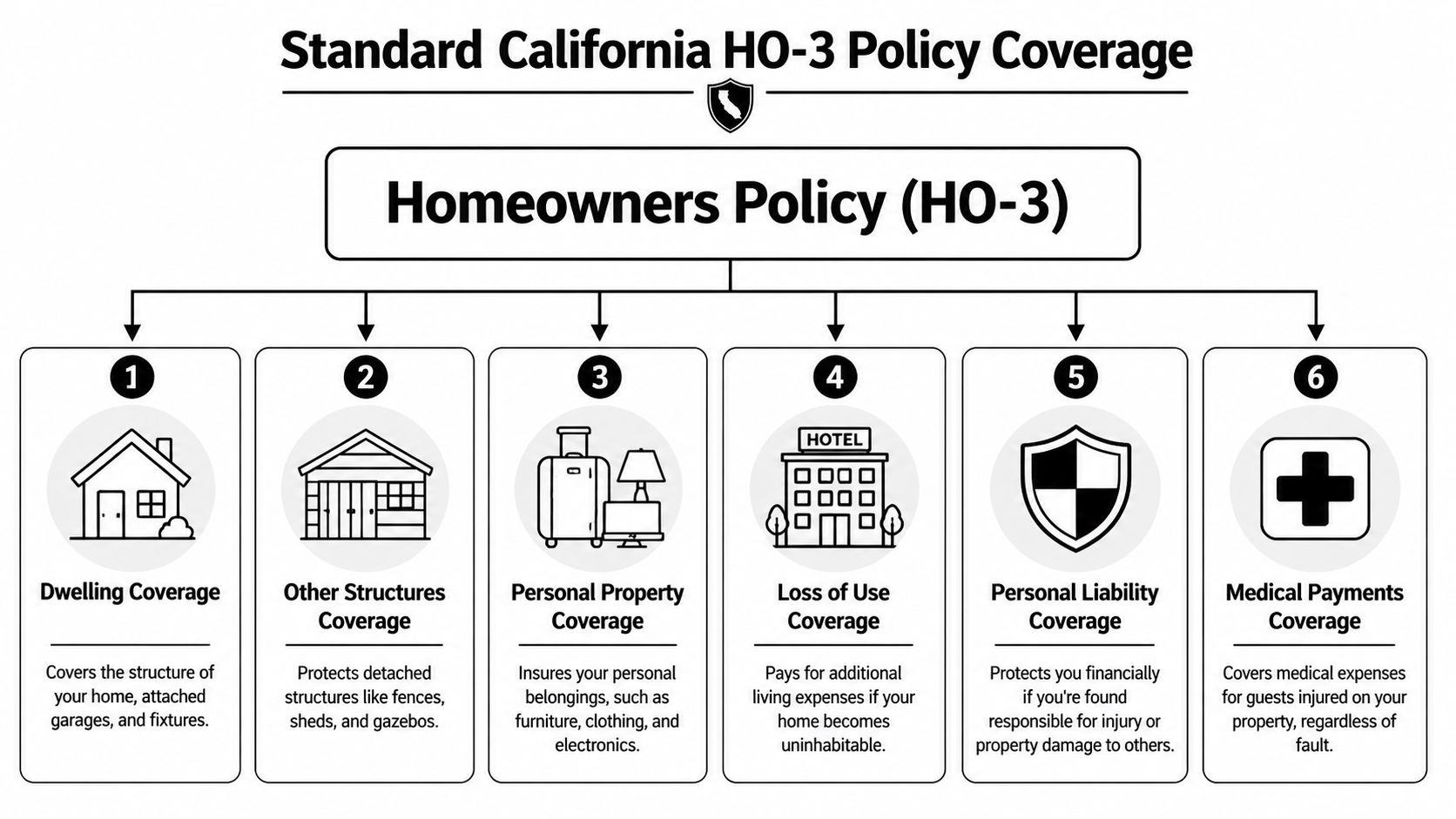
Think of your home like a castle. The building is the castle itself. Your belongings are what’s inside. Liability is the moat around it, protecting you when someone else says you caused injury or damage.
Section I property protection
These are the coverages most homeowners care about first:
- Coverage A, Dwelling: This is the house itself. Walls, roof, attached garage, built-in fixtures.
- Coverage B, Other Structures: This usually applies to detached items like a fence, shed, or separate garage.
- Coverage C, Personal Property: Furniture, clothing, electronics, kitchenware, and the rest of what makes the house livable.
- Coverage D, Loss of Use: If a covered loss makes the home unlivable, this helps with extra living costs while repairs happen.
A lot of claims get messy because people know they “have home insurance” but don’t know which bucket a loss falls into. That matters. A damaged detached garage isn’t the same coverage as a damaged main house. Temporary housing isn’t the same coverage as rebuilding the dwelling.
Section II liability protection
Liability is where many first-time owners underestimate risk.
- Coverage E, Personal Liability: This helps if someone claims you caused bodily injury or property damage and you’re legally responsible.
- Coverage F, Medical Payments to Others: This addresses smaller guest injury expenses regardless of fault, subject to the policy terms.
Your policy doesn’t just protect lumber and drywall. It also protects your finances if a guest gets hurt and the situation turns into a claim.
What to review before you say yes
Don’t just ask for a quote. Ask what’s inside it.
- Match the limit to rebuilding, not resale: Market value and rebuild cost are not the same thing.
- Check special limits: Jewelry, electronics, collectibles, and business property often need a closer look.
- Review the deductible carefully: A lower premium can hide a deductible that hurts when you need the policy.
- Prepare for the claim stage: Good records matter. If repairs involve roofing or structural work, this checklist for critical claim documentation for contractors shows the level of detail that helps support a claim file.
- Learn the language: A plain-English insurance glossary for California policyholders can save you from signing something you don’t fully understand.
A standard policy is the baseline. In California, baseline isn’t the same as complete.
Confronting California's Unique Insurance Risks
You buy the house, line up the mortgage, and then the insurance quote comes back ugly. Or worse, your carrier sends a non-renewal notice and you have 45 days to fix it. That is the California reality for many homeowners right now. Wildfire changes whether you can keep private coverage. Earthquake changes what your policy will pay for after a major loss.

Wildfire risk can block private coverage
In many parts of California, wildfire is not just a claim concern. It is an underwriting problem. A home can be well maintained, claim-free, and still get declined or non-renewed because of brush, access, roof condition, slope, or the carrier's exposure in that ZIP code.
Take that seriously and act fast. If you get a warning, inspection request, or non-renewal notice, do not wait until the last two weeks. Start shopping immediately, ask exactly what the underwriter objected to, and fix the items you can document. Clear defensible space. Remove debris. Trim trees away from the roof. Replace broken vents or damaged roofing. Take timestamped photos when the work is done. That paper trail can help you get reconsidered by a private carrier later.
If you are already getting rejected, stop asking only, "Who is cheapest?" Ask, "What gets this home written again?" That question leads to better decisions.
Earthquake is a separate decision
A standard homeowners policy does not include earthquake coverage. In California, that gap is one of the costliest mistakes first-time owners make because they assume the house is covered for any major structural loss. It is not.
You need to choose this on purpose. Review the deductible, the age and type of construction, whether the home is bolted or retrofitted, and how much damage you could absorb out of pocket. If the premium feels high, that does not mean the answer is automatically no. It means you should compare the premium against your actual financial exposure. Homeowners who want plain-English help on these choices should review these California home insurance FAQ answers.
What to do right now if your risk profile is hurting your options
Start with the fixes that improve both insurability and day-to-day resilience.
- Harden the home for wildfire: Focus on roof condition, vents, gutters, siding, and vegetation clearance.
- Document every improvement: Keep invoices, before-and-after photos, inspection reports, and contractor notes in one file.
- Prepare for outages and temporary displacement: If blackouts are common where you live, reviewing residential off-grid power options can help you plan for backup power and livability.
- Ask your agent for a marketability review: You want to know what will make the home acceptable to private carriers again, not just whether one quote exists today.
- Treat the FAIR Plan as a bridge if needed: If private coverage is unavailable, get protected first, then work on the property and your documentation so you can return to the standard market when conditions improve.
The biggest mistake I see is waiting for the market to get easier. Act before the next renewal deadline, before the next inspection, and before fire season. In California, the homeowners who prepare early usually have more choices and better pricing.
Understanding the California FAIR Plan
The FAIR Plan is the option many homeowners end up hearing about only after a private carrier says no. It’s not a magic replacement for a standard homeowners policy, and it shouldn’t be treated like one.
The FAIR Plan is a last-resort market for property owners who can’t secure traditional private coverage. Right now, it’s carrying a massive load. Its total exposure reached $724 billion by December 2025, up 230% since September 2022, with 21,859 new policies added in Q4 2025 alone, according to FAIR Plan exposure and policy growth data.
What the FAIR Plan does well
It gives people a path to basic property protection when private insurers won’t write the home. That matters. Without it, many transactions would stall and many existing homeowners would be left scrambling.
For a buyer facing a closing deadline or an owner dealing with non-renewal, the FAIR Plan can be the tool that keeps coverage in force while you work on longer-term options.
Where people get burned
The FAIR Plan is limited. Homeowners often assume they’re fully covered because they finally obtained a policy. They aren’t.
A FAIR Plan policy is generally centered on basic property coverage and does not function like a full standard HO-3 homeowners policy. That’s why many homeowners need a Difference in Conditions policy, often called a DIC policy, to add important protections that the FAIR Plan alone doesn’t provide.
Here’s the practical takeaway:
- FAIR Plan only: Better than going uninsured, but incomplete.
- FAIR Plan plus DIC: Closer to the protection structure people expect from standard homeowners insurance.
- Private-market HO-3: Still the cleaner setup when available and appropriately priced.
Treat it as a bridge, not a destination
If you’re on the FAIR Plan now, your job is not finished. Your next job is to make the home easier to place back into the private market.
That usually means:
- Reviewing roof and exterior condition
- Cleaning up underwriting red flags
- Checking whether updates to plumbing, electrical, or heating help eligibility
- Confirming the home’s coverage limits still make sense
- Requesting periodic remarketing instead of assuming you’re stuck
A lot of homeowners stay on the FAIR Plan longer than necessary because nobody tells them to re-shop. That’s a mistake. Private-market appetite can change. Property condition can change. Your file can improve.
If you need definitions while sorting through the moving parts, a focused California insurance FAQ page can help decode common terms before you sign anything.
What Drives Home Insurance Costs in California
You open a renewal and the premium jumped again. Or worse, the carrier won’t renew at all. At that point, the question is not “Why is California so expensive?” The useful question is, “Which part of my risk profile is driving this price, and what can I fix now?”
California’s average home insurance premium is $1,724 annually, and 60% of California homeowners have struggled to find affordable coverage over the last three years, while premiums rose 25% between 2021 and 2024 and are projected to rise 16% for 2026, according to this California home insurance affordability survey. Those numbers explain the pressure. They do not tell you what to do next.
Start with the factors insurers price most aggressively.
- Location and wildfire exposure: ZIP code matters, but insurers usually look deeper than that. They may price for brush proximity, slope, road access, distance to fire services, and whether the area has a history of severe losses.
- Condition of the home: Older roofs, deferred maintenance, aging plumbing, outdated electrical panels, and wood shake roofing can push a home out of preferred pricing or out of eligibility entirely.
- Rebuild cost: Insurance covers the cost to repair or rebuild, not your mortgage balance or purchase price. Higher local labor and material costs raise premiums even if the home’s market value has not changed much.
- Claims history: Recent water, fire, or liability claims can narrow your options and raise the price.
- Coverage structure: A standard private-market homeowners policy, a FAIR Plan policy, and a FAIR Plan paired with a DIC policy all price differently.
- Deductible and endorsements: Lower deductibles and broader add-ons cost more. Sometimes that extra cost is worth it. Sometimes it is wasted money.
One issue gets missed all the time. Insurers are not just pricing the house. They are pricing how difficult the house is to insure.
That is why two similar homes on the same street can get very different results.
California also changed how insurers can set rates. The state finalized major ratemaking reforms in December 2024. The Catastrophe Modeling and Ratemaking regulation allows insurers to use catastrophe models for rates if they expand coverage in higher-risk areas. The Net Cost of Reinsurance and Ratemaking regulation allows reinsurance costs to be reflected in premiums under the same condition, as explained in Milliman’s review of the 2024 California homeowners insurance reforms. The practical effect is simple. Premiums can reflect wildfire and reinsurance pressure more directly, but the state is trying to get more carriers willing to write business where options have dried up.
So what should a homeowner do?
If you are still in the private market, protect that position. Ask what underwriting issues could trigger a future non-renewal. Get the roof age documented. Show updates to plumbing, electrical, and heating. Clear obvious exterior hazards before inspection.
If you have already been non-renewed or the quotes are far outside your budget, stop chasing random online quotes. Get a real placement strategy. That may mean using the FAIR Plan as a short-term fallback while you fix the property issues that blocked private coverage in the first place. Then re-shop on a schedule instead of assuming you are stuck there.
Cost control that works
- Choose a deductible you can afford without panic: A higher deductible can help, but only if you could write that check after a real loss.
- Fix underwriting problems before shopping: Roof replacement, brush clearance, plumbing updates, and exterior repairs can improve both price and eligibility.
- Bundle only when the total household cost improves: Do the math across all policies. A bundle is useful only if it lowers the full bill or improves coverage.
- Re-shop after documented improvements: Receipts, photos, and inspection reports help. Underwriters respond better to proof than promises.
- Use an agent who can check multiple markets quickly: A focused California home insurance quote comparison saves time and gives you a better shot at finding a workable private option before settling for a backup plan.
My advice is straightforward. Do not shop by premium alone, and do not sit still after a non-renewal. Price follows risk, condition, and eligibility. Improve those three, and your options usually improve with them.
How to Compare Policies and Choose the Right Coverage
The cheapest quote is often the most expensive mistake. That’s not sales talk. That’s what happens when a homeowner saves money upfront and discovers after a major loss that the policy limit was too low, the exclusions were broader than expected, or the deductible structure was harsher than it looked.
California’s underinsurance problem is serious. Nearly two-thirds of homeowners who lost homes in recent California disasters were underinsured, often by more than a third of true rebuilding cost, according to this analysis of the California underinsurance crisis. That gap is often tied to outdated property data and valuation methods, not just homeowner neglect.
Compare the structure before the premium
When you review quotes, compare these first:
Dwelling limit
This is the number that has to rebuild the home. Don’t compare it to your purchase price. Compare it to actual reconstruction exposure.Deductibles
A policy that looks cheaper may shift more pain to you at claim time.Loss of use protection
If your home is unlivable, this part becomes very real, very fast.Exclusions and special limitations
The phrase “I thought I had coverage” usually starts here.Whether you’re looking at one policy or two
FAIR Plan setups require extra attention because you may be combining policies to build full protection.
California Home Coverage Options at a Glance
| Coverage Type | Standard HO-3 Policy | FAIR Plan Only | FAIR Plan + DIC Policy |
|---|---|---|---|
| Property structure coverage | Broad core homeowners protection for the home | Basic property protection centered on fire-related risk | FAIR Plan handles basic property risk, DIC fills added gaps |
| Personal property | Typically included | Limited compared with standard homeowners expectations | Often strengthened through the DIC structure |
| Liability | Included | Not the same as a standard homeowners liability setup | Commonly added through the companion policy |
| Loss of use | Typically included | Not equivalent to standard HO-3 protection | Often addressed through the companion policy |
| Simplicity | One primary policy | Incomplete for most homeowners | More complex because it combines policies |
| Best fit | Homeowners eligible for private market coverage | Temporary last-resort placement | Homeowners who need FAIR Plan access but want broader protection |
Questions you should ask every agent
- What is the dwelling amount based on?
- What major exclusions should I know before I bind this?
- If this is a FAIR Plan solution, what does the companion policy add?
- How often should I review this to move back to the private market?
- What part of this quote is most likely to create trouble during a claim?
Buy coverage for the bad day, not for the invoice. The invoice is annoying. The bad day is life-changing.
If you own in California, policy comparison is not a one-line exercise. It’s a risk review.
How Mai & Associates Simplifies California Insurance
A good agency should reduce confusion, not add to it. That means quoting across multiple carriers, explaining where a standard homeowners policy ends and where California-specific risk begins, and telling you plainly when the FAIR Plan is a bridge instead of a permanent answer.
That also means looking beyond a single line of coverage. Household insurance decisions connect. If you’re insuring a home, that’s the right time to review auto insurance, car insurance for other drivers in the household, renters insurance on an additional residence, and life insurance if someone depends on your income. Bundling doesn’t fix every pricing problem, but it often improves the total picture.
What practical help should look like
You want an advisor who can do a few things well:
- Compare carriers instead of pushing one option
- Review FAIR Plan placements for possible private-market alternatives
- Check for underinsurance, not just whether a policy exists
- Explain earthquake options clearly
- Communicate in the language you’re most comfortable using
For California households, multilingual support matters. Insurance terms are hard enough in plain English. They get more dangerous when the buyer nods along without fully understanding what’s covered, excluded, or optional.
The right standard for service
Don’t settle for an agent who only gives you a price. You need someone who can answer direct questions with direct answers.
Ask them:
- Why did this home get declined?
- What would improve eligibility?
- Is this dwelling limit realistic?
- Is the FAIR Plan temporary or likely long-term?
- What happens if I bundle my home and auto coverage?
- Should I add earthquake coverage now?
If the answers are vague, keep shopping. A homeowner’s biggest insurance mistake usually happens before the first claim. It happens when they accept a policy they don’t fully understand because they’re tired of the process.
If you want a no-obligation review of your homeowners insurance in california, including private-market quotes, FAIR Plan options, bundling with auto, renters, car, or life insurance, and guidance in English, Spanish, Armenian, Russian, or Vietnamese, contact Mai & Associates.