Homeowners Insurance Discounts: Top Tips for 2026

The cheapest discount may start with a policy review, not a new alarm or roof. Homeowners insurance discounts vary by carrier, property risk, policy combination, claims history, state rules, and documented improvements. A credit that looks attractive on paper may apply only to part of the premium, require an inspection, or come with higher deductibles or narrower coverage.
California policyholders should separate three types of opportunities. Some discounts reward behavior you already have, such as bundling or maintaining a claims-free record. Others require upgrades, including water shutoff devices, monitored alarms, roof improvements, defensible space, or broader wildfire mitigation. The third category is California-specific: replacing a California FAIR Plan policy with coverage from a standard carrier can change the entire policy structure, not merely reduce the price.
Compare bundled and standalone quotes before moving coverage. Verify eligibility before spending money on an improvement, and ask an agent to itemize every credit, requirement, deductible, exclusion, and coverage limit. Mai & Associates is a California agency that compares multiple carriers and handles auto insurance, home insurance, renters insurance, car insurance, life insurance, California FAIR Plan reviews, earthquake options, and wildfire protection strategies.
A lower percentage discount isn't necessarily the lowest total premium if the policy changes your coverage, deductible, exclusions, or limits.
1. Multi-Policy Bundling Discount for Auto, Home, Renters, and Life
Bundling is the first quote to request because it connects several insurance needs without requiring a property upgrade. A California household can ask an agent to compare auto insurance, homeowners insurance, renters insurance, and life insurance under one carrier or coordinated package. The available savings depend on the carrier and the policies included, so don't assume that adding another policy automatically improves the total price.
Industry summaries identify home and auto bundling as a common major savings lever, with average savings of about 15% to 18%. Some households may qualify for five or more discount categories, but carriers usually cap total stackable homeowners insurance discounts at about 30% to 40% of premium, even when several credits apply. See the industry overview of homeowners insurance discounts for the supplied market context.
Compare the package, not just the percentage
Request two quote sets: each policy separately, then the complete package. Include the same dwelling limit, personal property limit, liability limit, replacement-cost terms, deductibles, vehicle coverage, and life insurance amount in both comparisons. A cheaper bundle can be a poor trade if it reduces protection or adds an unsuitable deductible.
Use this script with an agent:
“Please itemize the standalone and bundled premiums for my auto, home, renters, and life insurance, and show every discount, coverage limit, deductible, and eligibility condition.”
Mai & Associates can compare combinations across carriers, including future bundle expansion when you buy a home, add a vehicle, rent out property, or need life insurance. Review the package annually because a carrier that is competitive today may not remain competitive after a renewal, claim, move, or household change.
2. Home Safety and Security System Discount
Security and fire-protection equipment can earn a homeowners insurance credit, but the system must meet the carrier's requirements. Monitored security systems often save only 2% to 15%, according to industry guidance, so calculate the insurance credit against equipment, installation, maintenance, and monitoring costs before buying. The home insurance discount guidance also places monitored security systems in this limited savings range.
A homeowner in Glendale might be considering a monitored alarm, while a property in Escondido may already have cameras, motion sensors, or a smart doorbell. Those devices aren't interchangeable for underwriting purposes. An insurer may distinguish between self-monitoring, professional monitoring, central-station monitoring, fire detection, burglary detection, and automatic emergency notification.
Get approval before installation
Ask the carrier for its approved-device list and documentation standard first. Then request a written estimate of the credit, if any.
- Confirm monitoring requirements: Ask whether self-monitoring qualifies or whether active professional monitoring is required.
- Separate security from fire protection: A burglar alarm may earn a different credit from monitored smoke or fire detection.
- Price the full system: Include installation, monthly monitoring, testing, battery replacement, and service fees.
- Document activation: Keep invoices, certificates, contracts, photographs, and proof that the system remains active.
Use this script:
“Which security, fire, smoke, alarm, camera, and water-protection devices qualify for my policy, and what proof must I submit before the credit applies?”
For installation planning, homeowners can also review smart home security system considerations from DLG Electrical. Contact Mai & Associates before purchasing so the proposed equipment matches a carrier's actual eligibility rules.

3. California FAIR Plan Policy Conversion
A California FAIR Plan review isn't just another discount comparison. The FAIR Plan is a named-peril fire policy, not a standard homeowners policy. Wildfire damage is handled under the fire peril in the base policy, smoke is separately listed as covered, and earthquake insurance must be purchased separately through the California Earthquake Authority, as explained in this California FAIR Plan coverage guide.
That distinction matters. A homeowner who moves from the FAIR Plan to a standard carrier may gain broader policy protection while changing the premium, underwriting requirements, deductibles, and available endorsements. Conversion depends on the property's risk, construction, roof, vegetation, claims history, location, and carrier appetite. Don't treat an advertised conversion price as guaranteed.
Prepare for underwriting
Before applying, gather the documents that explain why the home may qualify for standard coverage:
- Property records: Provide the year built, roof age, electrical and plumbing details, permits, photographs, and prior inspection reports.
- Wildfire evidence: Document defensible space, access, vegetation clearance, home-hardening work, and roof materials.
- Claims history: Prepare accurate loss information and explain completed repairs.
- Coverage comparisons: Match dwelling, liability, personal property, additional living expense, and deductible terms across offers.
Ask:
“Can you review my FAIR Plan and identify standard-market options, coverage gaps, required improvements, deductible changes, and the total premium for each alternative?”
Start with Mai & Associates' California home insurance resources and request a multi-carrier review. If standard coverage isn't available, ask whether a FAIR Plan plus a difference-in-conditions policy, earthquake coverage, or other supplemental protection is appropriate.
4. Wildfire Mitigation and Defensible Space
Wildfire mitigation discounts reward documented risk reduction, but the work must satisfy the specific carrier's checklist. California policyholders may need to address vegetation, access, roof materials, vents, siding, windows, decks, gutters, and other home-hardening features. A carrier can require photographs, inspection results, contractor records, or a defensible-space verification before applying a credit.
California insurance filings show that savings can differ sharply by policy type and filing. One filing lists a wildfire or fire-related discount of up to 20% for home policies and up to 10% for renters and condo policies. Another discount column lists up to 13% for home, up to 28% for renters, and up to 27% for condo coverage, demonstrating why a generic wildfire percentage isn't a reliable quote. Review the California Department of Insurance discount filing for the cited filing details.
Treat maintenance as part of eligibility
Defensible space isn't a one-time project. Vegetation grows back, roof conditions change, and carriers may reassess risk at renewal.
Ask:
“Which wildfire mitigation measures qualify for my policy, which must be inspected, and what photographs, permits, receipts, or certificates will keep the credit active?”
Request the checklist before hiring a contractor. Keep dated photographs, invoices, inspection reports, and records of annual maintenance. Also ask whether the credit applies to the full homeowners insurance premium or only a defined coverage component.
5. Auto Insurance Bundle When Adding Homeowners Insurance
If you already have auto insurance, ask that carrier to quote homeowners insurance before renewing elsewhere. The home policy may provide a multi-policy credit, but the correct comparison includes the auto premium too. A carrier could offer a strong homeowners discount while charging more for car insurance, reducing or eliminating the household's total savings.
The 2026 consumer survey from Kin found that 61% of American homeowners bundle home and auto insurance with the same carrier, while 36% don't and 4% are unsure. That makes bundling the dominant strategy in the cited survey, but it doesn't prove that every bundled quote is the cheapest. Review the 2026 home and auto bundling survey for those figures.
Use a complete comparison
Ask for current auto coverage and proposed homeowners coverage side by side. Keep liability limits, uninsured-motorist protection, collision terms, dwelling coverage, personal property coverage, and deductibles consistent.
Your agent-request script:
“Show me my current auto premium, the proposed home premium, the bundle credit, and the combined annual cost compared with separate policies from other carriers.”
This is also the right time to ask about claims-free status, security devices, roof age, wildfire mitigation, and mileage-based auto programs. California auto filings explicitly state that some programs are rated on mileage driven, making annual miles a concrete rating factor rather than a vague underwriting detail. Review the California auto discount filing and report realistic mileage.
A bundled quote should preserve adequate coverage. Don't accept a lower price by reducing liability limits or selecting a deductible you couldn't comfortably pay after a loss.
6. Renters Insurance Bundle with Auto Coverage
Renters should ask for a bundle even when the renters policy is relatively small. Renters insurance protects personal property, personal liability, and potentially additional living expenses after a covered loss. It also gives an auto insurer another policy relationship to evaluate, although the carrier's credit and eligibility rules vary.
For a renter in Los Angeles, San Diego, or the Bay Area, the useful comparison is not “How cheap is renters insurance?” Ask how the renters policy changes the combined auto and renters premium, then compare that total with separate policies. Don't reduce personal property limits just to make the monthly price look lower.
Match the limit to your belongings
Create a room-by-room inventory before requesting quotes. Include furniture, electronics, clothing, tools, bicycles, jewelry, and other high-value items. Ask whether personal property is settled at replacement cost or actual cash value, and confirm sublimits for categories such as jewelry or business equipment.
Use this script:
“Please quote my auto and renters insurance separately and together, then explain the bundle credit, liability limits, personal property settlement, deductible, exclusions, and any required documentation.”
You can begin with Mai & Associates' California renters insurance information. If you later buy a home, revisit the package rather than automatically transferring the renters policy into homeowners coverage. The new home introduces dwelling, other structures, loss-of-use, and property-risk questions that require a fresh comparison.
7. Life Insurance Added to a Home and Auto Package
Life insurance belongs in the household review because its purpose differs from property coverage. Homeowners insurance protects the structure and liability exposure. Auto insurance protects vehicles and driving liability. Renters insurance protects belongings and tenant liability. Life insurance supports dependents, mortgage obligations, income replacement, and final financial responsibilities.
Don't buy life insurance solely for a homeowners insurance discount. Start with the need for coverage, then compare the proposed policy's insurer, term, benefit, exclusions, underwriting, conversion options, and premium against standalone life insurance quotes. A package isn't valuable if it pushes you into an unsuitable policy or leaves your family underinsured.
Ask for a separate life insurance comparison
Request an itemized quote that shows the life policy on its own and within the broader relationship. Confirm whether any savings are contractual, promotional, or dependent on keeping the auto and home policies active.
Ask:
“Please evaluate my life insurance need separately, then show whether adding it to my auto and home relationship changes the total cost without reducing the death benefit or policy quality.”
Review California life insurance options while comparing term and permanent coverage. Families with a mortgage, children, or other dependents should prioritize an appropriate death benefit and reliable policy terms over a headline bundle credit. A licensed agent can also identify gaps when household income, marital status, debts, or dependents change.
8. Claims-Free Discount for Auto and Home
A claims-free history can reduce premiums, but the qualification period and credit differ by carrier. Industry summaries report that homeowners commonly need three to five years without a claim to earn about 5% to 10% off premiums. Read the claims and discount overview for that supplied range and eligibility context.
The practical decision is whether a small loss should become an insurance claim. Don't make that decision from the discount alone. Compare the estimated repair cost with the policy deductible, the potential loss of claims-free status, the damage's severity, and your obligation to report certain incidents.
Keep a defensible record
Preventive maintenance can reduce the chance of a claim and help explain property condition during underwriting. Keep roof inspection records, plumbing invoices, electrical permits, appliance service records, photographs, and receipts for completed repairs.
Use this script:
“How many claim-free years do I have, what credit is currently applied to auto and home, and how would a claim affect the credit, renewal, deductible, and future eligibility?”
A claims-free credit shouldn't discourage prompt reporting of serious damage. Water intrusion, fire, liability incidents, and other losses can worsen when delayed. Ask the agent about reporting requirements before deciding how to handle a minor repair, and preserve documentation either way.
9. Home Improvement and Upgrade Discount
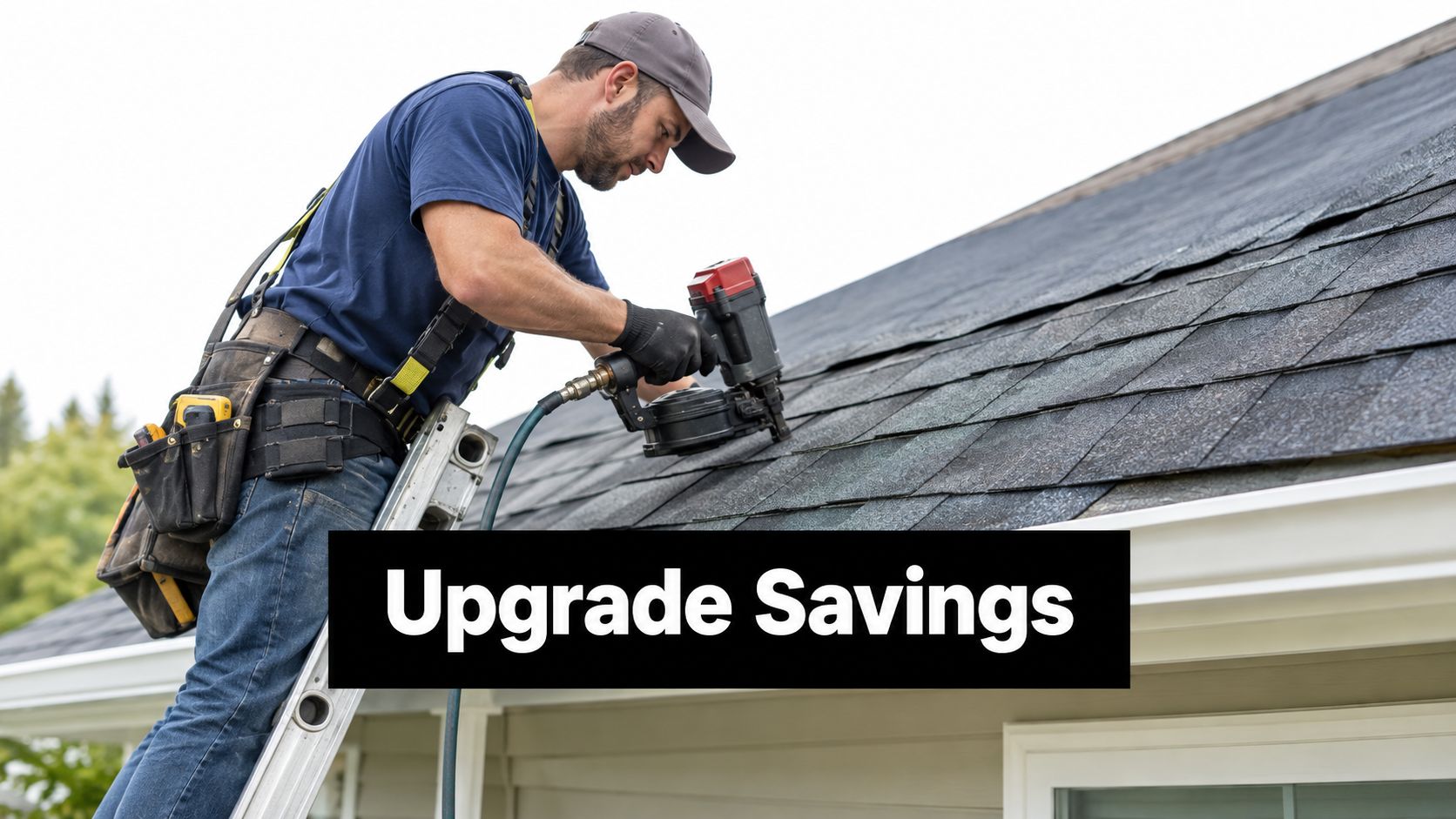
Roof, electrical, plumbing, and other system upgrades can affect both insurability and discount eligibility. The carrier may want a permitted improvement, a contractor invoice, photographs, a roof certification, inspection documentation, or proof that the work meets a defined standard. A project that improves safety may not qualify for a premium credit if the insurer doesn't recognize the material, age, installation method, or documentation.
Start with the upgrade you need for safety or property condition, not the discount. A roof replacement can be sensible in a wildfire-prone area even when the insurance savings won't repay the project cost quickly. Ask the carrier to confirm eligibility before signing a contract.
Build the paper trail
Keep:
- Permits and final approvals: Save records for electrical, plumbing, structural, and roof work.
- Material specifications: Record fire ratings, product names, installation details, and warranties.
- Contractor credentials: Retain licenses, certifications, invoices, and completion dates.
- Before-and-after evidence: Photograph the work and preserve inspection reports.
Ask:
“Will this roof, electrical, plumbing, foundation, or home-hardening improvement qualify for a credit, and what exact documents and inspection results do you require?”
Also ask when the discount becomes active and whether the carrier will reevaluate it at renewal. Combine eligible upgrades with wildfire mitigation or water-protection measures only after confirming that credits can stack and that the total remains within the carrier's cap.
10. Good Driver Discount for California Auto Insurance
California's Good Driver Discount depends on defined eligibility rules, not a carrier's general “safe driver” marketing. Qualifying personal auto drivers receive a measurable rating credit, so review the California good-driver insurance guidance and require the carrier to display the credit on your quote.
Compare mileage as carefully as your record. Some California auto programs are rated on mileage driven, so report accurate annual mileage and ask whether a lower-mileage program fits your actual use. Do not guess. An incorrect estimate can create underwriting problems and make the quote unreliable. Compare your total auto premium with California auto insurance options from Mai & Associates, not only the discount label.
Verify every household driver
Request the driving-record details used for every listed driver. Confirm each license, accident, violation, vehicle use, garaging address, and annual mileage. If one household driver has a violation, ask how it changes the Good Driver Discount and whether another carrier rates the same record differently.
Use this script:
“Please show the California Good Driver Discount for each qualifying driver, identify the record information used, and compare the total auto premium with and without the homeowners insurance bundle.”
A clean driving record can improve a home and auto comparison, but do not reduce liability limits or uninsured-motorist coverage to chase a smaller premium. Ask the agent to compare matching limits, deductibles, and vehicle use. Recheck the policy after adding a vehicle or driver, changing your commute, moving, or changing annual mileage.
Comparison of 10 Homeowners Insurance Discounts
| Item | Implementation Complexity 🔄 | Resource Requirements ⚡ | Expected Outcomes ⭐📊 | Ideal Use Cases 💡 | Key Advantages ⭐ |
|---|---|---|---|---|---|
| Multi-Policy Bundling Discount (Auto + Home + Renters + Life) | Moderate 🔄 (policy coordination, possible carrier switch) | Low–Medium ⚡ (time to compare; possible small switching costs) | ⭐⭐⭐⭐, 15–25% avg savings; streamlined renewals 📊 | Families/households with multiple policies | Consolidated billing, coordinated coverage, stronger agent relationship |
| Home Safety and Security System Discount | Low–Medium 🔄 (install/setup & carrier approval) | Medium ⚡ (equipment $300–2,000; $15–40/mo monitoring) | ⭐⭐–⭐⭐⭐, 5–15% savings; reduced theft/fire risk 📊 | Homeowners in higher-crime or high-value properties | Lower premiums + improved home security; stacks with other discounts |
| California Fair Plan Policy Conversion Discount | High 🔄 (underwriting, inspections, conversion process) | Medium ⚡ (home improvements, documentation) | ⭐⭐⭐⭐–⭐⭐⭐⭐⭐, 25–50% potential reduction vs Fair Plan 📊 | Fair Plan policyholders in wildfire/high-risk zones | Large premium reductions; access to standard carriers & broader coverage |
| Wildfire Mitigation and Defensible Space Discount | High 🔄 (property work, verification) | High ⚡ (one-time $2k–10k+; ongoing maintenance) | ⭐⭐⭐⭐, 5–20% savings; materially lowers wildfire risk 📊 | Homes in SRAs and fire-prone California regions | Direct risk reduction; may qualify for grants/rebates; stacks with other discounts |
| Auto Insurance Bundle Discount When Adding Homeowners | Low 🔄 (add homeowners to existing auto account) | Low ⚡ (simple paperwork, immediate effect) | ⭐⭐⭐, 10–25% homeowners discount; instant at policy start 📊 | Drivers with existing auto policies buying home coverage | Immediate premium reduction; single agent & billing; gateway to larger bundles |
| Renters Insurance Bundle Discount with Auto Coverage | Low 🔄 (quick addition to auto policy) | Low ⚡ (minimal cost; no inspection) | ⭐⭐, 10–18% savings; renters $12–22/mo typical when bundled 📊 | Renters, students, young professionals with auto policies | Affordable protection, fast activation, entry to broader bundling |
| Life Insurance Discount When Adding to Home and Auto Bundle | Medium 🔄 (bundle coordination; possible underwriting) | Medium ⚡ (health underwriting for large limits) | ⭐⭐⭐, 15–30% off term life when bundled 📊 | Families with dependents, mortgage holders | Lower term premiums; simplified billing and unified protection |
| Claims-Free Discount (Auto and Home Combined) | Low 🔄 (behavioral; maintain no-claim history) | Low ⚡ (avoid filing claims; maintain property/driver care) | ⭐⭐⭐⭐, 10–30% (grows with years claims-free) 📊 | Long-term safe drivers/homeowners with few/no claims | Automatic reward; compounds with other discounts for large savings |
| Home Improvement and Upgrade Discount (Roof, Electrical, Plumbing) | Medium–High 🔄 (permits, contractor work, documentation) | High ⚡ (upgrades $5k–30k; inspections) | ⭐⭐⭐, 5–15% savings; reduced specific hazard claims 📊 | Homeowners renovating older systems or in fire-prone areas | Improves safety/resale value; reduces specific claim exposures |
| Good Driver/Safe Driver Discount (3–5+ Years Without Violations) | Low 🔄 (maintain clean driving record) | Low ⚡ (behavioral; driving discipline) | ⭐⭐⭐⭐, 10–25% auto discount; 35–40% when bundled with home 📊 | Drivers with 3–10+ years clean record | Significant auto savings that grow over time; combines well with bundles |
Turn Discount Opportunities Into an Annual Coverage Review
Treat homeowners insurance discounts as one part of a coverage review, not as the entire shopping strategy. The most important comparison is the protection you receive for the total household cost. A discount can be meaningful, but it can also be offset by a higher deductible, lower limits, exclusions, a separate policy, or a carrier's narrower definition of covered loss.
Start by listing every current policy: auto insurance, car insurance, home insurance, renters insurance, and life insurance. Record the carrier, renewal date, premium, deductible, liability limits, dwelling limit, personal property limit, vehicle coverage, life insurance benefit, and any endorsements. Mark which policies are already bundled and identify how long each policy and household driver has remained claims-free.
Next, document the property details that affect eligibility. Gather security-system invoices, active monitoring certificates, water shutoff and leak-detection records, roof age and material, electrical and plumbing permits, contractor receipts, inspection reports, defensible-space photographs, wildfire home-hardening records, and any FAIR Plan documents. If you have a California FAIR Plan policy, include the declarations page, named perils, supplemental policies, earthquake arrangements, deductibles, and any recent inspection or mitigation information.
Then request itemized quotes in three formats:
- Standalone pricing: Quote each policy separately with matching limits and deductibles.
- Bundled pricing: Show auto, home, renters, and life combinations, including every applied credit.
- Converted-policy pricing: If you use the FAIR Plan, show standard-market alternatives and explain coverage differences, underwriting conditions, and supplemental protection.
Ask the agent to confirm carrier-specific eligibility, required inspections, active monitoring, permits, receipts, policy limits, deductibles, and the exact premium component affected by each discount. Also ask whether the credit can be removed after a missed monitoring payment, an expired certificate, a changed roof condition, a new claim, or a carrier inspection.
The 2026 satisfaction data deserves attention. Satisfaction with discounts fell from 68% in 2024 to 63% in 2025, a five-point decline, as customers became less convinced that discounts offset premium increases. Review the home insurance satisfaction trend report for that supplied finding. The question isn't only whether you qualify. It's whether the final coverage remains affordable and suitable.
Higher deductibles can also reduce the practical value of a discount. Market data shows that policies with deductibles under $2,500 fell from 73.52% in 2018 to 59.67% in 2025, while another trend report found average deductibles rose 24.5% from 2024 to 2025. See the 2026 home insurance consumer trends report for those figures. Compare the amount you save with the amount you may need to pay after a loss.
Review the package annually, especially after renovations, a move, a new vehicle, a claim, a new driver, a change in mileage, marriage, divorce, a new child, a mortgage change, or a change in financial dependents. Mai & Associates can compare California options and provide no-obligation guidance across auto, home, renters, and life insurance, including FAIR Plan reviews, earthquake options, and wildfire protection strategies.
Mai & Associates can compare standalone and bundled California insurance quotes, review FAIR Plan alternatives, and check whether documented safety or wildfire improvements may qualify for available credits. Visit Mai & Associates to request no-obligation guidance for your auto, home, renters, and life insurance needs.