California Insurance Companies: Your Guide to Home, Auto & Life Plans for 2026

Let's be honest—finding great insurance in California feels tougher than it's ever been. Between skyrocketing costs for home insurance, major insurers pulling out of high-risk areas, and the ever-present threat of wildfires, just protecting your property has turned into a major headache. Choosing the right homeowners insurance companies is no longer a simple task; it’s one of the most important financial decisions you’ll make, and it often goes hand-in-hand with finding the right auto insurance and life insurance to protect your family completely.
The New Reality of California Home Insurance
If you're a homeowner in California, you've probably noticed that the insurance landscape in 2026 is a whole new ballgame. The days of getting a simple, affordable policy and forgetting about it are long gone. What used to be a routine renewal has become a stressful, time-consuming search for any coverage at all, let alone something affordable. This guide is here to help you cut through the noise and find a clear path forward for all your California insurance needs.
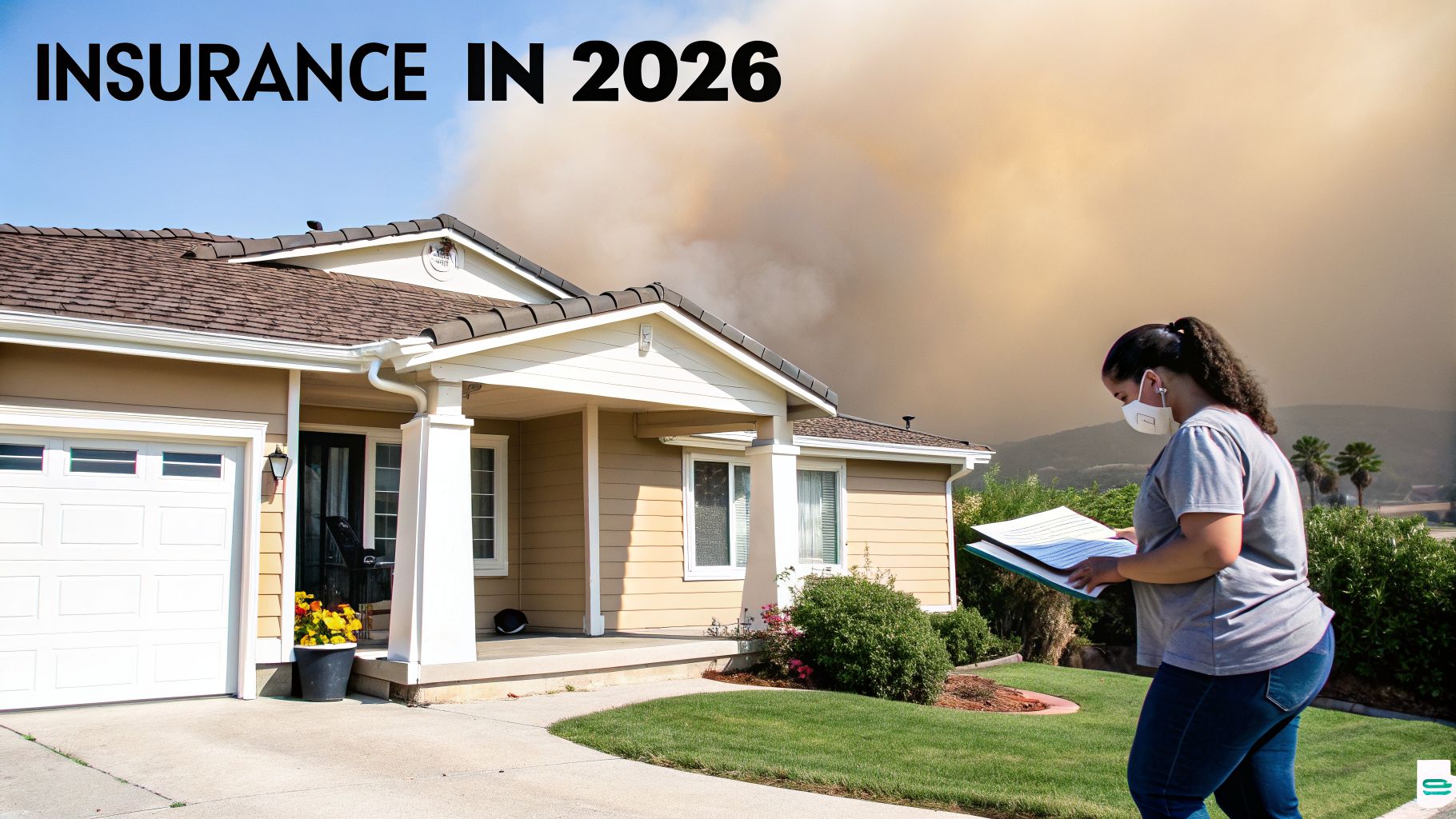
This isn’t just a California problem, either. The global homeowners insurance market hit an incredible USD 234.6 billion in 2024 and is only getting bigger. That growth is fueled by rising property values and a heightened awareness of risk, especially in places like the U.S. where natural disasters are a constant concern.
Why Is It So Difficult Now?
So, what exactly created this perfect storm for California homeowners? It boils down to a few key factors:
- Insurers Are Backing Away: Many of the big-name insurance carriers have either stopped writing new policies or have completely pulled out of areas they deem too risky, especially those prone to wildfires.
- Premiums Are Through the Roof: The companies that are still offering coverage have hiked their rates dramatically to offset the potential for massive losses from a single catastrophic event.
- Underwriting is Incredibly Strict: Insurers are now scrutinizing every little detail of your property. They're looking at everything from the age and condition of your roof to the specific types of plants in your yard.
It helps to think of it this way: insurers no longer see your property as just a home. They see it as a complex risk profile, and they’re calculating that risk down to the last shingle and shrub.
With these challenges in mind, it's worth looking at how proactive homeowners are adapting. Making smart hardscape choices for fire season, for example, is one of the many ways you can actively lower your property's risk profile. Taking these steps can make a real difference in whether you can even get coverage in the first place.
Think of Mai & Associates as your expert guide through this complicated market. We take the frustration out of the process. With our network of carriers and ability to provide instant quotes, we can find the right fit for your home insurance, auto insurance, and life insurance needs without the runaround.
Making Sense of Your Homeowners Policy
Let’s be honest—an insurance policy can read like a legal document written in another language. It's dense, packed with jargon, and it's all too easy to just sign on the dotted line without really knowing what you’re paying for. My goal here is to translate it for you. We’re going to break down the key parts of a standard California homeowners policy so you can feel confident you have the right protection.

This knowledge is your best defense. If you want to dig deeper, learning how to read your insurance policy is a fundamental skill that helps you spot crucial details and potential gaps. It’s what empowers you to ask the right questions and make sure you’re not left exposed when you need your coverage the most.
Let's start by looking at the six standard coverage parts you'll find in most policies.
Key Homeowners Insurance Coverage Types Explained
| Coverage Part | What It Protects | Example Scenario |
|---|---|---|
| Coverage A: Dwelling | The physical structure of your house and anything attached to it (walls, roof, foundation). | A kitchen fire causes extensive smoke and structural damage, requiring a full rebuild of that section of your home. |
| Coverage B: Other Structures | Structures on your property not attached to your house (detached garage, fence, shed). | A powerful windstorm knocks down your backyard fence and damages the roof of your standalone shed. |
| Coverage C: Personal Property | Your belongings inside the home (furniture, electronics, clothing, etc.). | A burglar breaks in and steals your laptops, television, and jewelry. |
| Coverage D: Loss of Use | Additional living expenses if your home becomes uninhabitable due to a covered event. | A wildfire forces you to evacuate, and this covers your hotel bills and restaurant meals while you're displaced. |
| Coverage E: Personal Liability | Financial protection if you're found legally responsible for injuring someone or damaging their property. | A delivery person slips on your icy walkway, breaks their arm, and sues you for medical costs. |
| Coverage F: Medical Payments | Pays for minor medical bills for a guest injured on your property, regardless of who is at fault. | A neighbor's child trips while playing in your yard and needs stitches for a small cut. |
Now that we have the overview, let's dive into the three parts where I see California homeowners make the most common—and costly—mistakes.
Dwelling Coverage: The Foundation of Your Policy
This is, without a doubt, the most critical part of your policy. Dwelling Coverage, or Coverage A, protects the actual structure of your house. This is where a lot of homeowners get into trouble.
They often insure their home based on its market value. But your dwelling coverage needs to be set to the replacement cost—what it would actually cost to rebuild your home from scratch today, at current labor and material prices. With construction costs in California skyrocketing, a home you bought for $700,000 could easily cost over $1 million to rebuild after a disaster.
I see it all the time: a homeowner hasn't reviewed their policy in five years, and their dwelling coverage is $200,000 short of today’s rebuilding costs. That’s a gap they would have to cover out-of-pocket. An expert here at Mai & Associates can run a detailed replacement cost estimate to make sure that number is solid.
Protecting What’s Inside Your Home
Your house is more than just walls and a roof; it's filled with your belongings. That's where these next two coverages are so important.
- Personal Property (Coverage C): This covers everything you own—furniture, clothes, electronics, you name it. Most policies automatically set this limit as a percentage of your dwelling coverage, usually between 50% and 70%.
- Loss of Use (Coverage D): This is a lifesaver. If a covered disaster, like a wildfire, forces you out of your home, this coverage pays for your extra living expenses. Think hotel bills, rent for a temporary apartment, and even the added cost of eating out.
A quick tip: create a home inventory. You don't need anything fancy. Just walk through your house with your smartphone, recording a video of your belongings. It can make a huge difference if you ever have to file a major claim. For more advice on this, check out the resources in our guides section.
Your Financial Shield: Personal Liability
Personal Liability (Coverage E) is the part of your policy that protects your assets if someone gets hurt on your property and holds you responsible. It also steps in if you or a family member accidentally damage someone else's property.
Imagine a guest slips on your wet patio, breaks their leg, and decides to sue you for their medical bills and lost income. Your liability coverage is what would handle the legal defense costs and any potential settlement, up to your policy limit.
Standard policies often start with just $100,000 in liability coverage. In a state as litigious as California, that's often dangerously inadequate. We almost always recommend our clients carry at least $300,000 or $500,000, and many benefit from an additional umbrella policy for even greater protection.
A Look at California's Top Homeowners Insurance Companies
Choosing who to trust with your biggest asset can feel overwhelming, especially in California's tricky insurance market. It's so easy to just focus on the price tag, but the real test of an insurance policy comes when you actually have to use it. That’s when you find out what it's really worth.
We need to look beyond the premium and dig into what makes a company truly reliable for California homeowners. We're talking about financial stability, how they treat their customers, and their track record for handling claims when things go wrong. This isn't just about a list of names; it's about figuring out who is the right fit for you and your unique needs, whether for home insurance, car insurance, or life insurance.
How to Evaluate Homeowners Insurance Companies
When you start comparing options, you'll be buried in marketing promises. My advice? Ignore the fluff and focus on the hard data that shows how a company actually performs.
There are three pillars I always tell my clients to look at:
- Financial Strength: Will they be able to pay your claim, even after a massive event like a widespread wildfire? Ratings from agencies like AM Best are the gold standard here. Look for an "A" rating or higher—that tells you they have a strong ability to meet their promises.
- Customer Satisfaction: How do they actually treat people? J.D. Power scores are a great benchmark for this. They measure satisfaction across the board, from billing and policy questions to the claims process itself.
- Claims Handling Reputation: This is the big one. What do real customers say happened after a loss? This is where an agent's inside knowledge is crucial. We hear the good, the bad, and the ugly about which companies are fair and which ones make a tough situation even worse.
The "best" company isn't a one-size-fits-all answer. A national giant might offer a fantastic discount for bundling your home and auto insurance, but a smaller regional carrier might have a better grasp on local fire risks and offer more flexible underwriting.
The Big Players and Regional Specialists
Across the country, a handful of massive homeowners insurance companies dominate the landscape. You know the names: State Farm, Allstate, and Liberty Mutual. It’s a surprisingly concentrated industry. In fact, data from the NAIC shows the top 10 property and casualty insurers write over 51% of all the policies out there. You can dig into the numbers in the 2025 market share report.
But bigger isn't always better, especially in California. We also have excellent regional insurers who live and breathe this market. They're often more nimble, with a more personal touch that can make a real difference.
The key is to compare them on the metrics that matter. A company with a slightly higher premium but a stellar claims satisfaction score could be a much smarter investment in the long run. To get a full picture, you really need to explore your options to find the right home insurance in California for your specific home and family.
How an Independent Agent Simplifies Your Search
This is where working with an independent agency like Mai & Associates completely changes the game. Think of us as your personal insurance shopper. Instead of you spending hours calling five different companies and repeating the same information over and over, we do all that for you.
We have relationships with a whole host of top-tier carriers, both the national giants and the regional specialists. This lets us compare rates and coverage options for you, side-by-side, in minutes. Our team also knows the little details—the underwriting quirks of each company—so we can match your property with the insurer most likely to give you the best terms.
For example, we know that one company might flat-out decline a home in a high brush area, while another will gladly write the policy if you've done specific fire mitigation work. That's the kind of knowledge that saves you time and money. Our job is to navigate this complex world to find that perfect balance of price and protection, so you never overpay or, worse, find out you're underinsured when disaster strikes. We handle home insurance, auto insurance, renters insurance, and life insurance, making it easy to protect everything that matters to you.
Solving California's Unique Insurance Puzzles
Owning a home in California means dealing with challenges that homeowners in other states rarely think about. From the constant threat of wildfires to the ground shaking beneath our feet, protecting your biggest asset here requires a specific playbook.
Frankly, many of the standard homeowners insurance companies are struggling to keep up, creating some serious puzzles for residents to solve. The good news? With the right knowledge and a proactive approach, you can absolutely find solid coverage. This isn't about finding loopholes; it's about understanding the unique risks we face and knowing which tools are actually available to protect your home and family. In this market, local expertise is everything.
Facing the Wildfire Threat Head-On
For a growing number of Californians, wildfire risk has become the single biggest hurdle to securing affordable home insurance. Insurers are understandably cautious, but you have more power than you think to improve your situation. It all comes down to making your property a less risky bet for them.
Two key concepts are non-negotiable here:
- Defensible Space: This is the buffer you create between your home and the surrounding brush, trees, and wildland. It’s designed to slow or stop a wildfire in its tracks. Think of it as clearing a safety perimeter of at least 30 feet around your house (and up to 100 feet in some areas) by removing dead vegetation, trimming trees, and choosing fire-resistant landscaping.
- Home Hardening: This is all about using building materials and construction techniques that make your home more resistant to catching fire from flying embers, which can travel for miles. This means installing double-paned windows, using non-combustible siding, and covering attic vents with fine metal mesh to keep those dangerous embers out.
Taking these steps isn't just a smart safety measure; it's a direct signal to insurers that you are a responsible homeowner actively managing your risk. Many companies will be far more willing to offer coverage—and sometimes at a better rate—for homes with proper defensible space and hardening.
When Standard Insurance Is Not an Option: The FAIR Plan
So what happens when you’ve done everything right, but you still can't find a standard policy because of your location? For many, the answer is the California FAIR Plan. It’s crucial to understand exactly what it is—and, more importantly, what it isn't.
The FAIR Plan is not a replacement for a normal homeowners policy. It’s a last-resort, state-mandated insurance pool that provides basic fire, lightning, and internal explosion coverage for your home's structure. It was created to ensure that even those in the highest-risk areas can get fundamental fire protection.
Here's the catch: the FAIR Plan is a "bare-bones" policy. It does not cover crucial risks like theft, water damage, or personal liability. If a guest slips and falls on your property, the FAIR Plan won't help you one bit.
This is where a critical second step comes in. To get complete protection, you have to pair the FAIR Plan with a separate policy called a Difference in Conditions (DIC) policy. This "wraparound" policy fills in all the gaps, providing the liability, theft, and other coverages that the FAIR Plan lacks.
Building this two-policy solution can be tricky, which is why working with an expert agency like Mai & Associates is so important. We specialize in finding the right DIC policy to combine with the FAIR Plan, creating a protective shield that functions much like a standard home insurance policy.
This decision tree gives you a simplified look at the key factors to consider when choosing between homeowners insurance companies, whether you're looking for a standard policy or a more complex solution.
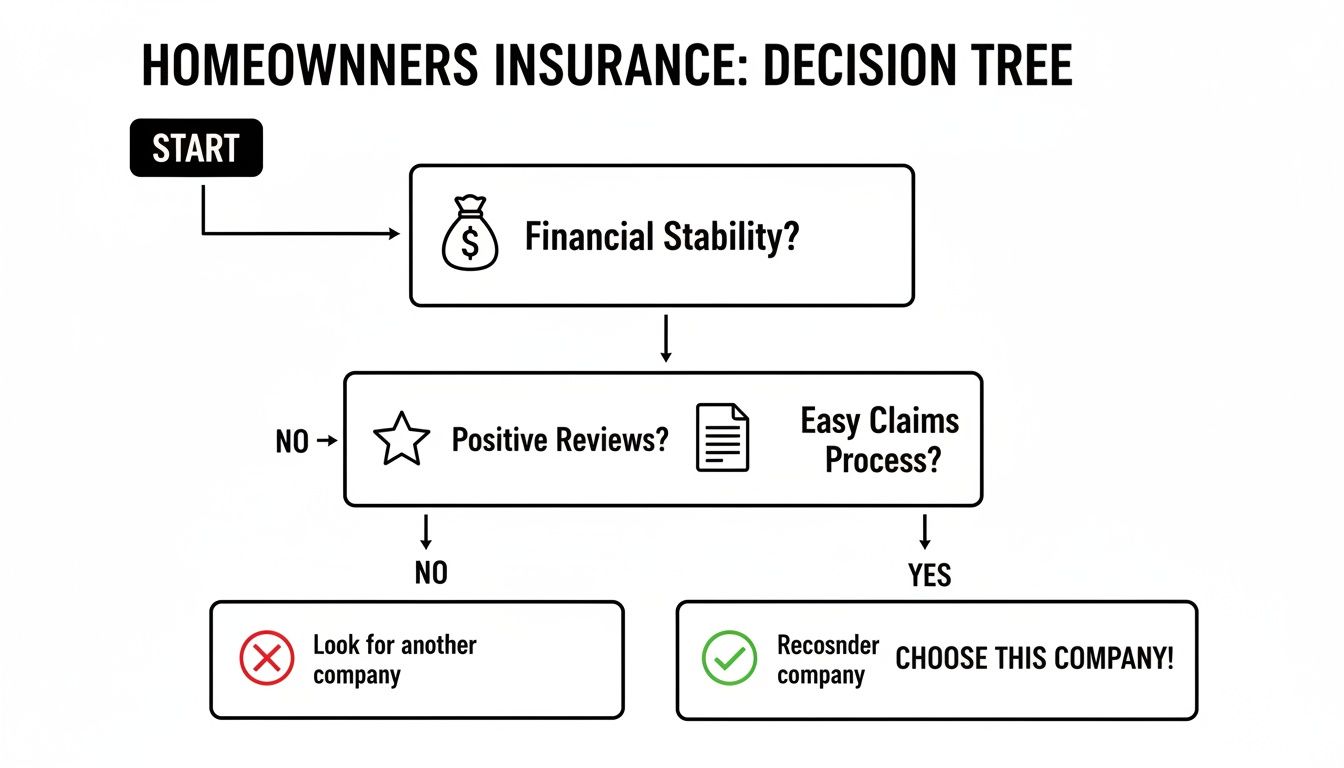
The visual highlights that your evaluation should always balance a company's financial health, customer reviews, and claims-paying reputation to make a well-rounded decision.
The Ground-Shaking Reality: Earthquake Insurance
Another major California risk that standard home insurance policies explicitly exclude is damage from an earthquake. It’s a common and costly mistake for homeowners to assume they have some level of coverage for "earth movement," but that is simply not the case. If you want protection from an earthquake, you must purchase a separate, dedicated policy.
Your main option for this is the California Earthquake Authority (CEA). The CEA is a publicly managed, privately funded organization that offers earthquake coverage through participating insurance companies. When you buy a CEA policy, you'll still work with your regular insurance agent, but the coverage itself is backed by the CEA.
CEA policies are highly customizable. You can choose different deductible amounts, typically ranging from 5% to 25% of your home's dwelling coverage. A higher deductible will mean a lower premium, but it also means you'll pay more out-of-pocket before your coverage kicks in after a quake. You can also decide whether to include coverage for your personal belongings and for loss of use (which covers temporary living expenses).
Navigating these unique California challenges—from wildfires to earthquakes—is precisely where Mai & Associates shines. We help our clients understand their options every day, guiding them through the FAIR Plan process, finding the right DIC policy, and structuring a CEA plan that fits their budget and risk tolerance. Our local expertise makes all the difference in solving these complex insurance puzzles.
Smart Ways to Lower Your Home Insurance Costs
Every California homeowner wants to save money on their insurance, but it's a balancing act. The goal is to lower your premium without gutting the coverage that actually protects you. This is more critical than ever, especially with the way costs have been climbing lately.
The market is definitely feeling the pressure from increased climate risks, and those costs are being passed down. We've seen a staggering 45% jump in average U.S. home insurance premiums since 2022. What's worse, that increase has dwarfed the less than 12% rise in actual dwelling coverage, according to recent industry reports. If you want to dig into the data, you can read more about these home insurance trends on matic.com.
This new reality means you have to be proactive. Let's get beyond the obvious and talk about some real, actionable strategies you can use to bring those costs down.
The Power of Bundling Your Policies
Probably the quickest and most effective way to see an immediate discount is by bundling your policies. Insurance companies love when you bring them more business, and they reward that loyalty. It's a win-win.
The classic bundle is pairing your home insurance with your auto insurance. Doing this can often knock 15-25% off both policies, which really adds up. But you don't have to stop there. Many carriers will give you a break for adding other policies, such as:
- Life Insurance: It’s a bit of a hidden gem, but adding a life insurance policy can sometimes trim your other premiums.
- Umbrella Policy: This adds a crucial extra layer of liability protection and almost always qualifies you for a bundling discount.
- Renters Insurance: If you own a rental property, insuring it with the same company can unlock savings.
This is something we specialize in at Mai & Associates. We can run the numbers across different carriers to see which combination of home, auto, and life insurance policies gives you the absolute best bang for your buck.
Choosing the Right Deductible
Think of your deductible as your share of the risk. It's the amount you agree to pay out-of-pocket on a claim before the insurance company steps in. By agreeing to take on a slightly larger share, you directly lower your annual premium.
It's a straightforward trade-off. For example, bumping your deductible up from $1,000 to $2,500 could easily save you hundreds of dollars over the year. The insurer has less skin in the game on smaller claims, so they charge you less.
A Word of Caution: This strategy only works if you choose a deductible you can actually afford to pay at a moment's notice. The last thing you want after a disaster is a financial scramble just to get your claim started.
Hunt Down Every Available Discount
So many homeowners miss out on savings simply because they don't know what to ask for. Insurance companies offer a whole menu of discounts for homeowners who are proactive about reducing risk.
You might be eligible for a credit if you have:
- Protective Devices: A monitored security system, smart smoke detectors, or a fire alarm can all earn you a discount.
- A Newer Roof: If your roof is less than 10 years old, it's a huge plus in an insurer's eyes. It signals lower risk of leaks and weather damage.
- Modern Utilities: Upgrading your home’s electrical, plumbing, or heating systems makes your home safer and can result in a nice little premium reduction.
- A Good Claims History: Haven't filed a claim in three to five years? Most companies will reward that with a "claims-free" discount.
The only way to know for sure is to have an expert review your policy. We can help you spot these opportunities and make sure you're getting credit for every single safety feature you've invested in. If you're curious what you could be saving, you can get an instant insurance quote right now and see how your rate stacks up.
Answering Your California Home Insurance Questions
Let's be honest: navigating home insurance in California can feel like a maze. The rules seem to change constantly, and what you thought you knew a few years ago might not apply today. I get it. Below, I’ve answered some of the most common and pressing questions I hear from homeowners just like you.
My goal here is simple: to cut through the industry jargon and give you clear, straightforward advice. We'll tackle some of the tough topics—like what to do when you can't get coverage, how often to check your policy, and how your personal details can impact what you pay.
What Happens If Standard Insurance Companies Won't Cover My Home?
This is a tough spot to be in, and it's happening to more Californians every year, especially in areas with high wildfire risk. If you've been turned down by traditional homeowners insurance companies, your next step is usually the California FAIR Plan. Think of it as a last-resort, state-mandated program that provides the most basic fire coverage for your home's structure.
But here’s the critical part: the FAIR Plan is not a complete policy. It’s a safety net for fire damage only. It does not cover incredibly important risks like personal liability (if someone gets hurt on your property), theft, or most common types of water damage.
To get the kind of protection you'd expect from a standard policy, you have to pair it with a second, separate policy called a Difference in Conditions (DIC) policy. This "wraparound" coverage is designed to fill in the gaps. Building this two-policy solution correctly is tricky, and it’s where working with an experienced agent who specializes in this is essential to make sure you're truly protected.
How Often Should I Review My Homeowners Insurance Policy?
You should have a conversation with your agent to review your homeowners policy at least once a year. Your life doesn’t stand still, and neither should your insurance. A major renovation, a new backyard pool, or simply buying a new piece of expensive jewelry can leave you dangerously underinsured if your policy isn't updated.
An annual review makes sure your coverage limits actually match the current cost to rebuild your home—a number that has been climbing fast. It's also the perfect time to see if you qualify for new discounts. Did you install a new roof or a monitored alarm system? That could save you money. A good, proactive agent will reach out to you for this yearly check-in to ensure your coverage is keeping pace with your life.
Think of your policy as a living document. An annual review isn't just about saving money; it's about making sure the single most important safety net you have for your largest asset is still strong enough to hold.
Will Filing a Small Claim Make My Premium Go Up?
Yes, it absolutely can. Filing a claim—even a small one—can trigger a premium increase when your policy renews. Insurers track your claims history closely, and they see it as a predictor of future risk. A pattern of frequent claims, regardless of size, signals to them that you're more likely to file again.
Before you ever pick up the phone to file, do a quick cost-benefit analysis. Compare the repair estimate to your deductible. If the repair only costs a few hundred dollars more than what you'd have to pay out-of-pocket anyway, it's often smarter to handle it yourself. This is why we always tell our clients to call us first. We can talk through the specifics and help you decide if filing is the right financial move for your situation.
Does My Credit Score Affect My Home Insurance Rates in California?
It does. In California, insurance companies are legally allowed to use a credit-based insurance score when setting your rates. Over the years, industry data has shown a correlation between credit history and the likelihood of filing a claim. As a result, a stronger credit profile can often lead to lower premiums.
However, it's just one piece of a much bigger puzzle. Many other factors carry just as much, if not more, weight. These include:
- Your home's exact location and its proximity to risks like wildfire zones.
- The age of your home and its construction materials (e.g., wood frame vs. masonry).
- Your personal claims history from the past five years.
Every carrier weighs these factors differently, which is why you can get wildly different quotes from different companies. This is a huge reason why it pays to shop around. We compare quotes from dozens of carriers to find the most competitive options for our clients, no matter where they fall on the credit spectrum. For more answers, you can dig deeper on our detailed home insurance FAQ page.
Navigating California’s complex insurance market requires a knowledgeable partner. The team at Mai & Associates is dedicated to helping you find the right auto insurance, home insurance, and life insurance coverage to protect what matters most. We simplify the process by comparing rates from top carriers to find you the best value.