Homeowners Insurance California High Fire Area: Tips

You open the mailbox and find a non-renewal notice with your policy expiration approaching. Your home hasn't changed, your claims history is clean, and you've already spent money clearing brush. Yet the insurer says the property no longer fits its wildfire appetite. That is the truth behind homeowners insurance in a California high fire area.
The answer isn't "buy a FAIR Plan policy." The FAIR Plan can keep a property insured when private carriers decline it, but it has hard ceilings and important exclusions. The stronger strategy is to treat it as a coverage floor, then add private-market protection, document mitigation, and keep shopping before the next renewal crisis.
Why Homeowners Insurance Is Harder to Find in California High Fire Areas
The notice usually feels personal. A homeowner in a Cal Fire Tier 2 or Tier 3 location may have paid premiums for years without filing a claim, then receive a letter saying the policy won't continue. The insurer may point to brush, roof condition, access, or wildfire exposure. Sometimes the deciding factor is simpler: the carrier is reducing business in the ZIP code.
That shift has been building since the major Wine Country fires of 2017. Catastrophic losses changed how insurers view concentration risk, reinsurance, and the possibility that a single wind event could damage many nearby homes at once. California's admitted-market residential policies in high-risk ZIP codes declined by over 40% between 2009 and 2024, according to analysis cited by Insurance for Good's review of California's two insurance markets.
Why location now dominates the conversation
Three pressures shape underwriting decisions:
- Reinsurance costs: After the Camp Fire in 2018, the cost of transferring catastrophe risk became a larger part of carrier pricing. Insurers can't treat wildfire as an occasional claim when one event can affect an entire portfolio.
- Rate approval limits: California's rate-filing system can make it difficult for admitted carriers to adjust prices quickly enough to reflect changing wildfire exposure. The result is often tighter underwriting instead of a price that fully reflects the risk.
- Moratorium uncertainty: Temporary non-renewal protections can delay when a carrier acts, but they don't eliminate the underlying exposure. Once the protection ends, the insurer still has to decide whether the property fits its book.
Your ZIP code may now matter more than your personal claims history because insurers evaluate fuel loads, slope, access, ember exposure, and the concentration of nearby policies. That doesn't mean property condition is irrelevant. It means a clean record won't overcome an underwriting decision aimed at an entire geography.
Practical rule: Treat a non-renewal as a renewal problem that starts today, not as a letter to address during the final weeks before expiration.
The decisions ahead are straightforward, even when the market isn't. You need to choose the right market tier, build the right coverage structure, complete mitigation that underwriters recognize, and work with an advisor who can compare admitted carriers, surplus lines options, and the FAIR Plan. A useful starting point is this California home insurance resource, especially if you need to compare coverage before a deadline.
The Private Market and the California FAIR Plan
California homeowners in fire-prone locations move through three practical insurance tiers. The admitted market includes standard carriers regulated by the California Department of Insurance. These policies generally offer the broadest homeowners protection, including more complete liability, personal property, loss of use, and water-related coverage. They're also the first quotes an experienced agent should pursue.
The problem is availability. Admitted carriers may inspect the roof, evaluate vegetation, review emergency access, and ask for evidence of mitigation before binding or renewing. A property with a Class A roof and documented ember protection can receive a different underwriting response from an otherwise similar property surrounded by receptive fuels.
Surplus lines fill the middle
Surplus lines carriers serve risks that standard insurers won't accept. They may consider higher-value homes, unusual construction, steep lots, remote access, or wildfire exposure that falls outside admitted underwriting guidelines. Their flexibility can make them useful, but you should understand the trade-offs.
A surplus lines insurer isn't backed by the California Insurance Guarantee Association in the same way an admitted carrier is. The policy may also carry a higher premium, larger deductible, narrower wording, or more conditions around inspections and repairs. Read the financial strength information, exclusions, and claims process before choosing this tier.
FAIR Plan is the floor, not the finished structure
The California FAIR Plan is a state-mandated association of insurers that provides basic fire coverage when the private market won't. Its growth shows that this isn't a temporary inconvenience. As of June 2026, the FAIR Plan reported 696,562 policies in force, an increase of 8% from September 2025 and 157% from September 2022. Total exposure reached $768 billion, up 11% from September 2025 and 250% from September 2022. The figures are published in the California FAIR Plan key statistics.
The growth rate has slowed, but the volume remains enormous. State regulators said the plan added about 16,000 residential policies in the first quarter of 2026, roughly 2.4% growth from the prior quarter, compared with quarterly increases of 35,000 to 50,000 policies during 2024 through September 2025. That slowdown doesn't mean the market has recovered. It means the migration into the residual market has become more gradual.
An agent should pull multiple admitted quotes first, approach surplus lines when appropriate, and use the FAIR Plan as the baseline floor. Buying the first FAIR Plan quote without pricing a supplemental policy is incomplete insurance planning.
What FAIR Plan Covers and Where the Gaps Begin
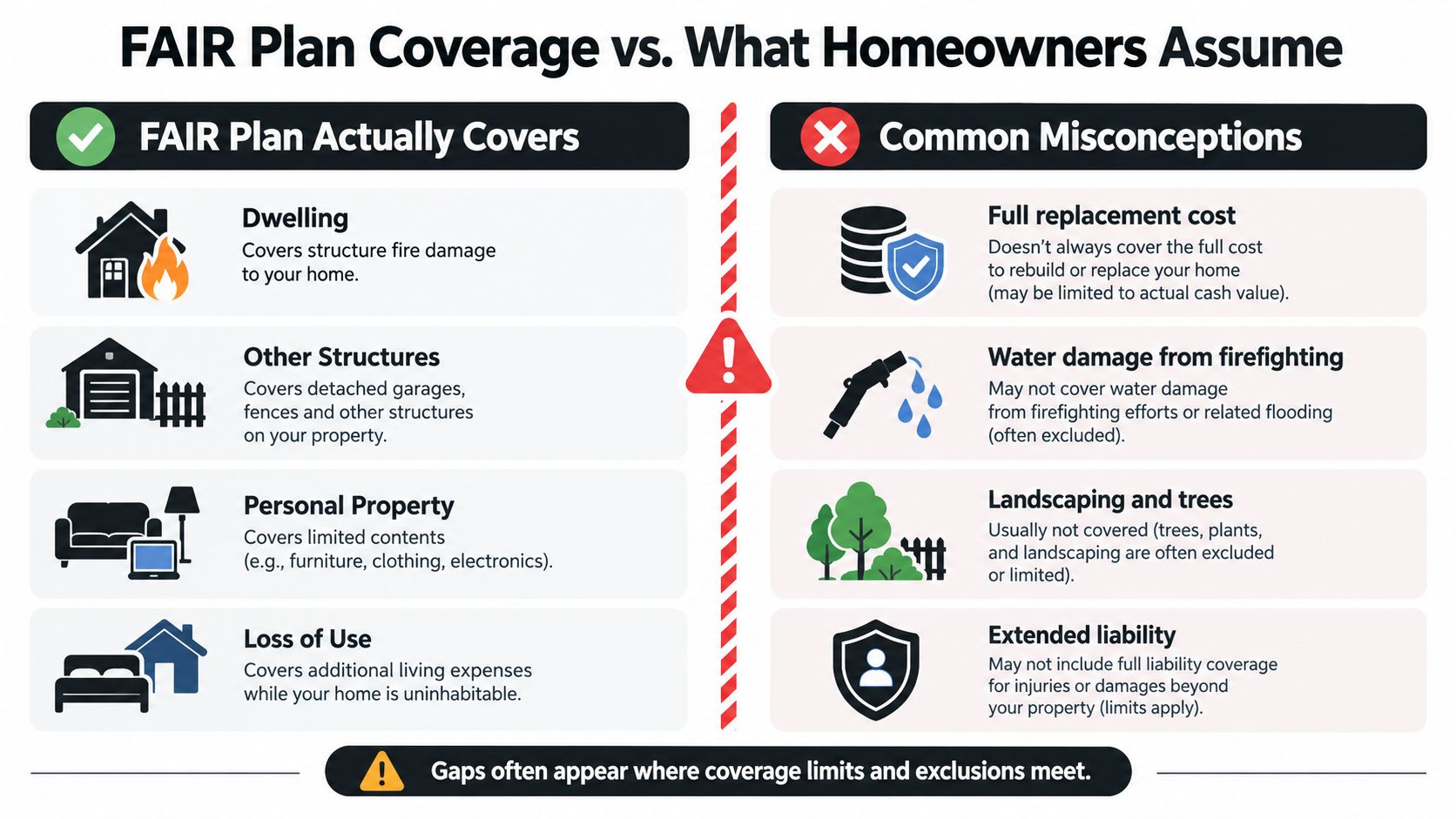
A bare FAIR Plan dwelling fire policy isn't equivalent to a conventional homeowners policy. It can cover the dwelling, other structures, personal property, and loss of use for named perils such as fire, smoke, internal explosion, and vandalism. It doesn't automatically give you the broad protection most homeowners assume they purchased.
The most dangerous misunderstanding involves the dwelling limit. A FAIR Plan limit may not equal the actual cost to rebuild your home under current labor, material, debris-removal, and building-code conditions. It also doesn't provide liability coverage, and personal-property protection can be sharply limited. The policy wording, endorsements, and available limits must be reviewed line by line.
The DIC wrapper changes the structure
A Difference in Conditions policy, commonly called a DIC wrapper, sits over the FAIR Plan. It can add protection for perils and losses the FAIR Plan doesn't address, including water damage, theft, liability, and broader personal-property coverage. Depending on the form, it can also coordinate with the dwelling limit and provide Ordinance or Law protection.
That combination matters after a total loss. The FAIR Plan handles the named fire coverage, while the DIC policy supplies the missing structure around it. Without that second layer, you could have fire insurance but still face unpaid liability claims, inadequate contents protection, or a rebuild shortfall.
Audit these five questions
- Dwelling limit: Does the combined structure provide enough for a code-compliant rebuild, not merely the home's market value?
- Other structures: Are detached garages, fences, retaining walls, and similar items treated separately?
- Personal property: Does the limit reflect your actual belongings, and are high-value items scheduled?
- Loss of use: Would the coverage sustain temporary housing if rebuilding takes an extended period?
- Liability: Is personal liability included through the DIC or another policy?
The terminology can be confusing, particularly when a DIC policy and a separate dwelling-fire policy use different definitions. Use a reliable insurance glossary when reviewing unfamiliar terms, but don't rely on definitions alone. Ask the agent to show which policy responds first, what each excludes, and whether the limits coordinate.
Wildfire and Earthquake Endorsements That Complete Your Coverage
Endorsements should solve specific gaps, not decorate a policy with duplicate benefits. Start with the wildfire layer. Ask whether it increases dwelling protection beyond the FAIR Plan limit, pays debris-removal costs, includes Ordinance or Law coverage for upgraded building codes, and extends temporary housing after a total loss.
A DIC wrapper is usually the structural companion to a FAIR fire policy. It can provide liability, broader personal-property protection, loss of use, and non-fire perils. Confirm whether the DIC treats water damage from firefighting, smoke, theft, and vandalism differently from the FAIR policy. You want a coordinated claim, not two insurers arguing over which one responds.
For a plain-language explanation of fire claims and policy questions, review this fire damage FAQ from Restore Heroes. Use it as general education, then compare the explanation with your own policy forms and endorsements.
Earthquake coverage deserves its own decision
Standard homeowners insurance doesn't cover earthquake damage. The California Earthquake Authority and private stand-alone carriers offer separate earthquake policies, and the CEA presents deductible choices of 5%, 10%, 15%, 20%, and 25%, as described in its policy options. CEA coverage may also offer premium discounts for eligible retrofits, including cripple-wall reinforcement and foundation anchor bolts.
The deductible is usually a percentage of the insured dwelling limit, so don't choose it without calculating the amount you could fund after a loss. Earthquake protection also needs a separate review of personal property, temporary living expenses, and masonry or older construction limitations.
| Endorsement | What It Covers | Typical Limit / Deductible | Overlaps With |
|---|---|---|---|
| Wildfire extension | Higher dwelling limits, debris removal, code upgrades, and temporary housing | Policy-specific limits and deductibles | FAIR Plan dwelling coverage and DIC |
| DIC wrapper | Liability, water, theft, broader contents, and loss of use | Policy-specific limits and deductibles | Homeowners policy and FAIR Plan |
| Earthquake policy | Earth movement damage and selected living-expense protection | CEA deductible options of 5%, 10%, 15%, 20%, or 25% | Structural coverage, rarely fire coverage |
| Sewer-backup rider | Drain or sump overflow damage | Policy-specific limit and deductible | Water damage coverage |
| Equipment breakdown | Sudden mechanical or electrical failure | Policy-specific limit and deductible | Manufacturer warranties |
| Ordinance or Law coverage | Required code upgrades after covered damage | Policy-specific limit | Wildfire extension and dwelling coverage |
Homes near military bases may need an Ordinance or Law review for unusual rebuilding requirements. Water-damage, sewer-backup, and equipment-breakdown endorsements can fill ordinary household risks that a FAIR Plan leaves open. The cleanest program has one clearly identified response for each peril, with no assumption that a fire policy covers every consequence of a fire.
Wildfire Mitigation Discounts and the Safer From Wildfires Framework
Mitigation only helps your insurance position when you can prove what you did. California's wildfire rating rules require insurers to offer premium relief for qualifying measures, including a Class A fire-rated roof, enclosed eaves, fire-resistant vents, multi-pane windows, and defensible space. The rules also recognize community-scale designations such as Firewise USA and Fire Risk Reduction Community status as rating factors, according to Milliman's explanation of California wildfire rating requirements.
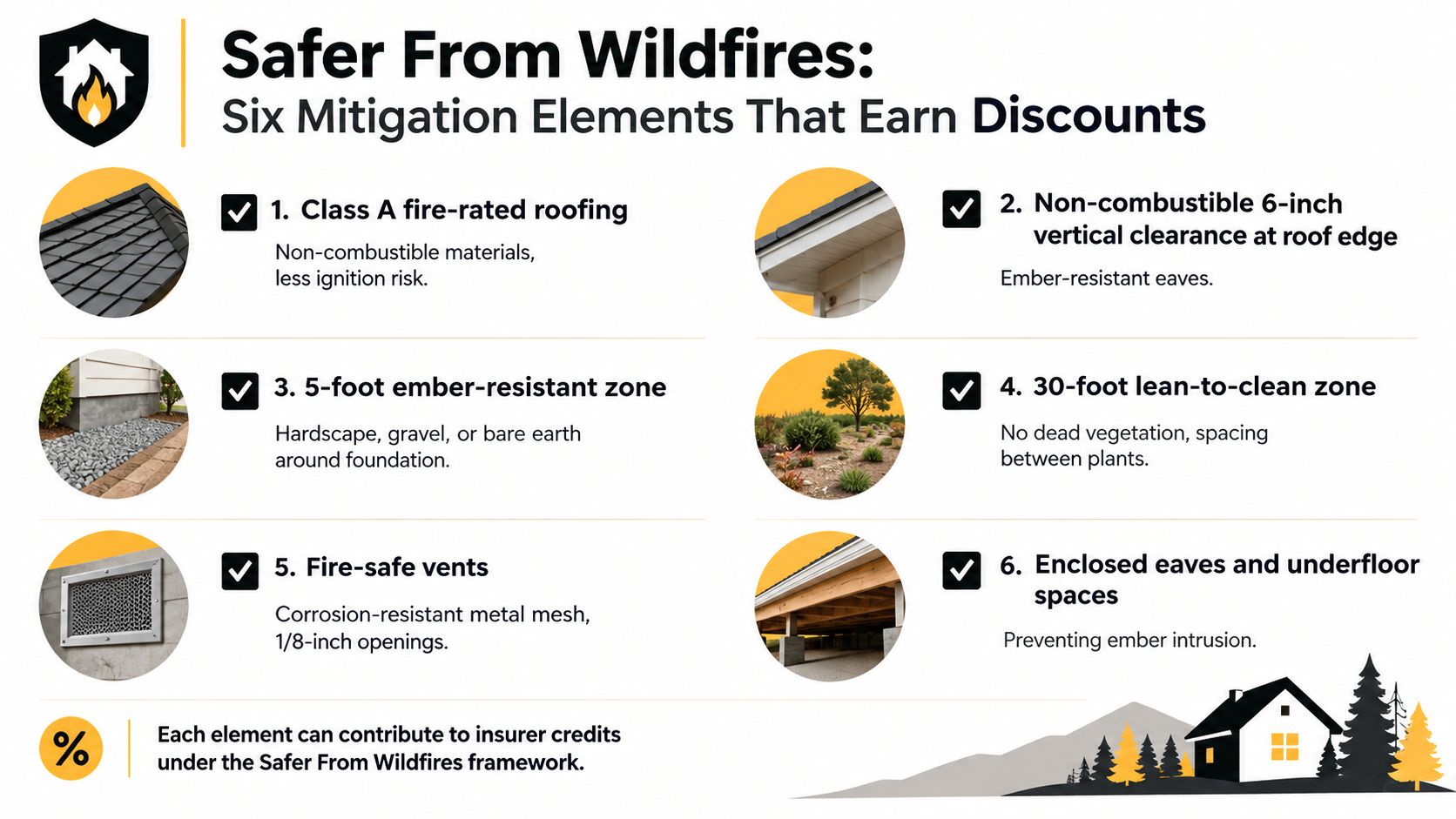
The California Department of Insurance's Safer from Wildfires guidance focuses heavily on ember exposure. It identifies a 5-foot ember-resistant zone around the structure, noncombustible materials near the home, and ember-resistant vents with 1/16- to 1/8-inch noncombustible screens as practical defenses against ember intrusion. The official guidance is available through the California Department of Insurance Safer from Wildfires framework.
Build an underwriting file, not just a safer house
The six practical elements deserve documentation:
- Class A roofing: Keep the installation record, product information, and photographs.
- Ember-resistant vents: Photograph the screens and retain the installer's invoice.
- Zone 0: Remove combustible mulch, storage, and vegetation immediately around the structure.
- Enclosed eaves: Document the construction detail and any completed retrofit.
- Multi-pane or tempered windows: Save product records and wide-angle photographs.
- Cleared gutters: Photograph the completed work and retain maintenance records.
Carriers may apply credits differently, and a mitigation feature doesn't guarantee acceptance. Still, this work gives an underwriter something concrete to evaluate instead of relying only on the ZIP code. For broader fire-protection planning, homeowners can also consult this fire protection guide from Overton Security.
Community action can strengthen the file. A Firewise USA designation may help demonstrate that risk reduction extends beyond your parcel, while insurer-specific Cal Fire parcel-level scores can influence how the carrier evaluates the property. Use the practical California insurance guides to organize documents before requesting a review.
The key is to prioritize ember pathways first. Roof edges, vents, eaves, gutters, decks, and the immediate area around the structure often provide more underwriting value than cosmetic landscaping changes. Mitigation is the controllable lever. You can't move the ZIP code, but you can change the building's vulnerability and show the carrier exactly how.
California's Non-Renewal Moratorium and What It Really Protects
A wildfire moratorium isn't a permanent right to keep your existing policy. California's one-year protection applies to residential policies in ZIP codes within or adjacent to a fire perimeter after a declared emergency, and it addresses wildfire-related cancellation or non-renewal. The California Department of Insurance moratorium guidance explains the eligibility framework and the timing homeowners need to verify.
That distinction matters. A homeowner outside the eligible ZIP code may receive no protection, and a new applicant generally can't assume a moratorium guarantees access to coverage. The protection also doesn't freeze premiums, prevent every underwriting restriction, or eliminate the need to find a replacement policy once the protected renewal period ends.
Read the notice and check the dates
Start with four questions:
- Was there a gubernatorial emergency declaration?
- Is the property inside or adjacent to the affected fire perimeter?
- Was the policy active when the protection became effective?
- Does the notice concern wildfire-related non-renewal, rather than unpaid premium, misrepresentation, or another permitted reason?
A moratorium can protect an existing policy for the applicable period, but it doesn't repair a roof, raise a dwelling limit, or add liability coverage. It also doesn't make the FAIR Plan equivalent to an admitted homeowners policy.
A moratorium buys time. It doesn't buy a complete insurance program.
Use that time aggressively. Request the insurer's inspection findings, correct documented hazards, gather mitigation proof, and ask an independent broker to shop the property before the protection expires. Waiting until the final renewal cycle leaves you with fewer options and less time to coordinate a FAIR Plan policy with a DIC wrapper.
A Practical Playbook to Get Covered in a High Fire Area
The best insurance strategy is sequenced. Shopping, mitigation, and documentation should support one another rather than happen as disconnected tasks.
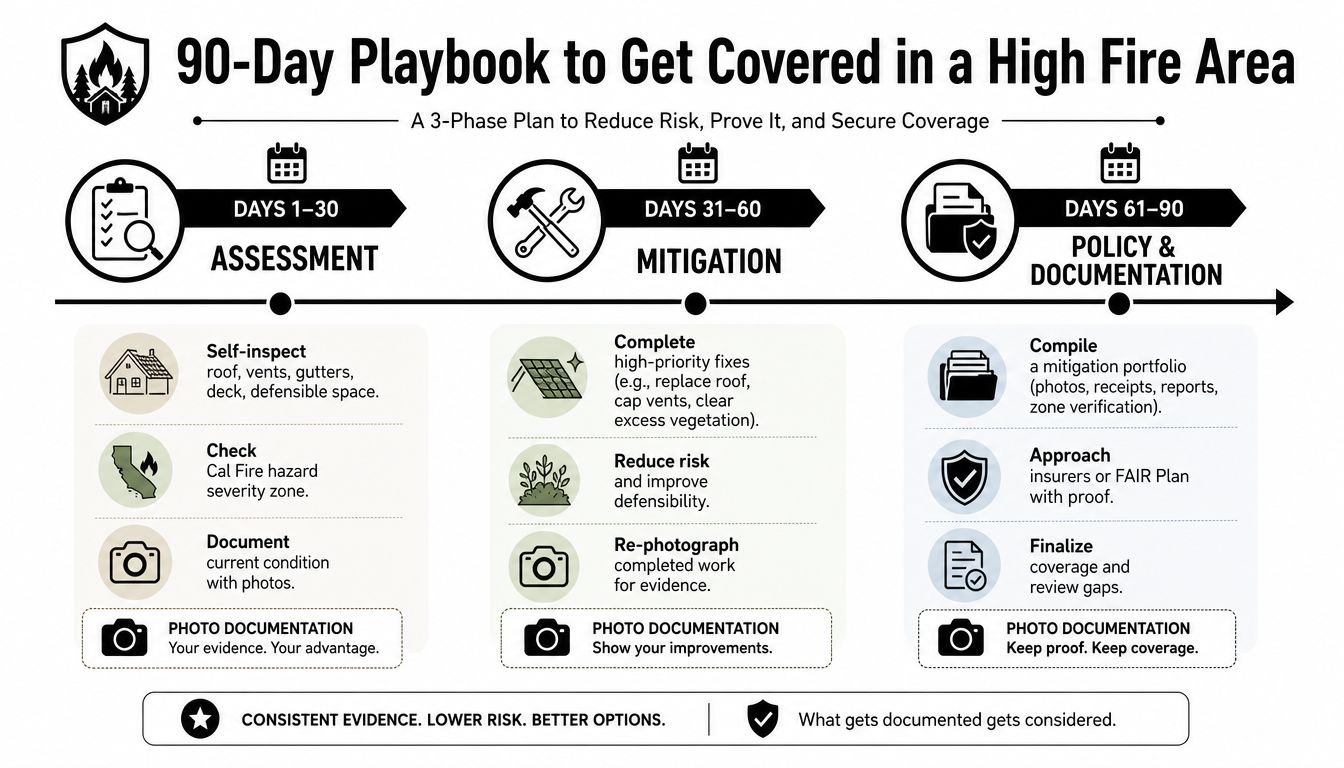
Days 1 through 30 for assessment
Walk the property as an underwriter would. Inspect the roof covering, vents, eaves, gutters, decks, fences, siding, access road, and vegetation immediately surrounding the structure. Confirm the property's wildfire hazard classification through the appropriate Cal Fire mapping resources, then photograph both the current condition and any existing protective features.
Create one digital folder with the address, current declarations page, inspection reports, roof records, receipts, permits, photos, and an inventory of major personal property. Ask your mortgage servicer what evidence it requires if the current policy is non-renewed, because a lapse can create separate financing problems.
Days 31 through 60 for market and mitigation work
Shop two admitted carriers and one surplus lines broker at the same time. Request a FAIR Plan quote as the baseline, then price a DIC wrapper through a broker who understands layered placements. This comparison tells you whether private coverage is available and what the fallback structure will cost.
At the same time, complete repairs with the clearest underwriting value. Replace or document vulnerable vent screens, clear the five-foot ember-resistant zone, remove combustible materials near the home, clean gutters, and address roof or eave deficiencies. Keep before-and-after photos, invoices, and contractor details. Guidance about roof condition and maintenance can also be found in this Roof Cleaning Homeowners Insurance resource from Ventura County Roof Cleaners.
Days 61 through 90 for binding and review
Compile the mitigation portfolio and submit it before the binding date. Confirm the dwelling limit, Ordinance or Law coverage, debris removal, loss of use, liability, contents, deductibles, and any extended replacement cost option. Don't cancel an existing policy until replacement coverage is active and confirmed in writing.
Schedule the next review well before renewal, ideally 120 days ahead. Update the carrier whenever you complete a meaningful improvement, and re-shop annually rather than assuming last year's placement will survive the next underwriting cycle. For location-specific planning, compare options through this Santa Rosa home insurance resource.
Key Takeaways for Homeowners in High Fire ZIP Codes
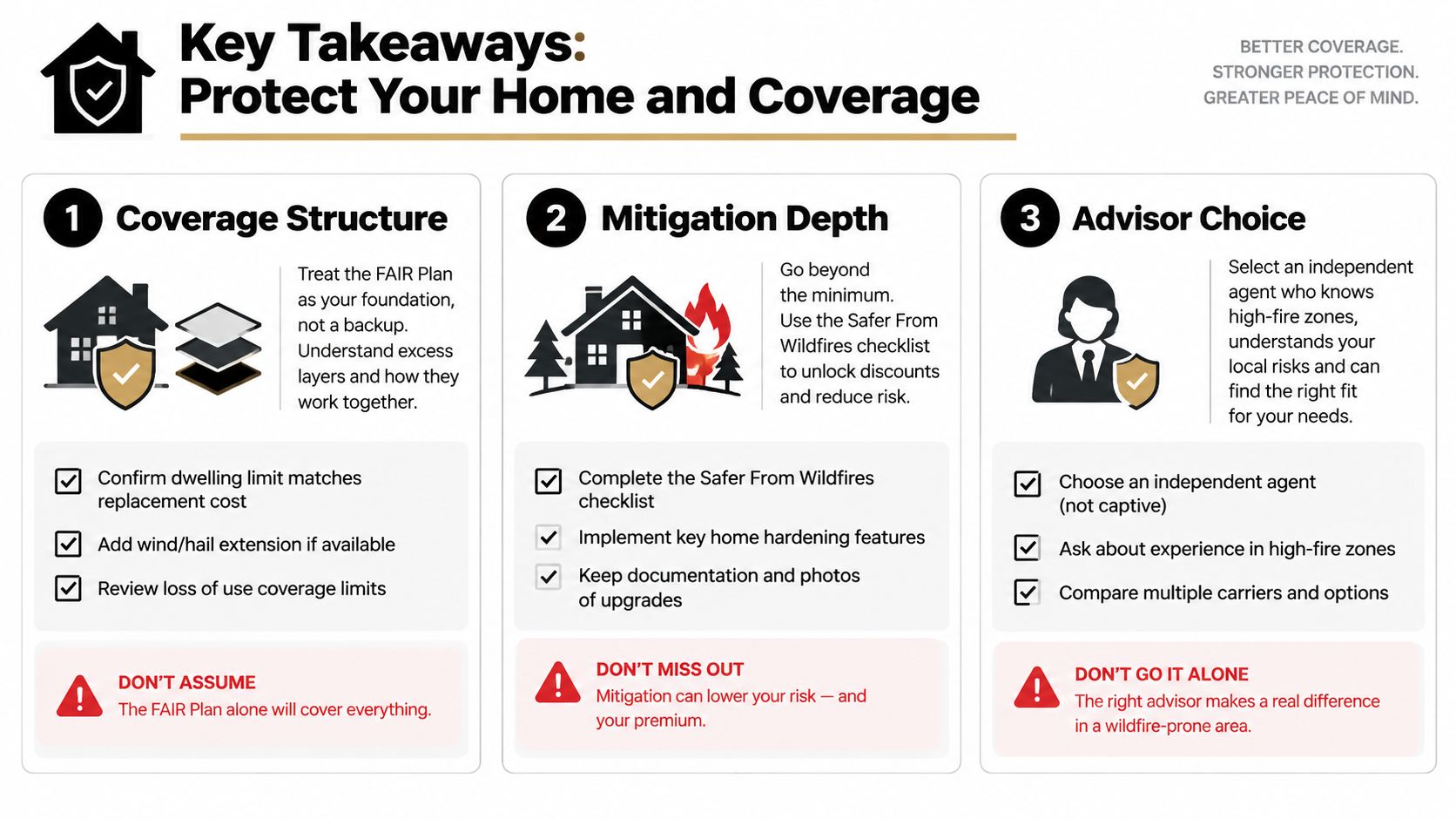
Three decisions matter most: coverage structure, mitigation depth, and advisor choice. If you get the structure wrong, a FAIR Plan can leave serious gaps. If you stop mitigation at cosmetic cleanup, an underwriter may still see the same ember pathways. If your advisor only knows one market, you may never see the full range of admitted, surplus lines, and residual-market options.
Treat the FAIR Plan as a foundation when you need it, not as a complete replacement for homeowners insurance. Pair its fire protection with a DIC policy or other private-market layers that address liability, water, theft, personal property, loss of use, and rebuilding requirements. Confirm that the combined dwelling protection reflects realistic replacement cost rather than the purchase price or tax assessment.
Mitigation should be documented, measurable, and aligned with the Safer from Wildfires framework. A Class A roof, ember-resistant vents, enclosed eaves, multi-pane windows, cleared gutters, and verified Zone 0 work give an insurer evidence to evaluate. Firewise USA recognition can add community context, but no designation replaces property-level maintenance.
The checklist to complete this week
- Confirm replacement cost: Ask how the dwelling limit was calculated and whether code upgrades are covered.
- Audit Ordinance or Law: Check whether the limit can handle required rebuilding changes.
- Document mitigation: Photograph roofs, vents, eaves, gutters, windows, and the five-foot zone.
- Shop early: Start the next review 120 days before expiration.
- Coordinate layers: Verify how the FAIR Plan, DIC, earthquake policy, and endorsements respond.
- Protect continuity: Never allow the existing policy to lapse before replacement coverage is bound.
Mai & Associates can review a California FAIR Plan, compare private home insurance and supplemental options, and help coordinate wildfire, earthquake, auto, renters, and life insurance around your household's needs. Visit Mai & Associates to request a policy review and compare coverage before your next renewal deadline.