Homeowners Insurance California Average 2026 Cost Guide

California homeowners paid an average annual premium of $1,413 in 2026, which is 41% below the national average of $2,395 according to Insurance Journal's coverage of LendingTree's 2026 State of Home Insurance report. That sounds affordable until you try to insure a house in a wildfire-heavy ZIP code, where the statewide average stops being useful fast.
That's the story behind the homeowners insurance California average. On paper, California looks cheaper than much of the country. In practice, your price depends on where your house sits, how much it would cost to rebuild, whether a standard carrier wants your risk, and whether you need backup options like the FAIR Plan.
If you're shopping for California insurance, this matters beyond one policy. Home insurance decisions often connect to your broader protection strategy, including auto insurance, car insurance, renters insurance, and life insurance. Smart households don't buy these in isolation. They line them up so coverage works together and discounts don't get left on the table.
Why California Home Insurance Is Both Cheaper and More Expensive Than You Think
California confuses homeowners because both sides of the argument are true. The state is cheaper than the national average overall, yet many owners feel squeezed, frustrated, or flat-out shocked by their renewal. They aren't imagining it.
The average is low because a lot of California homes still sit in areas where insurers view risk as manageable. But averages flatten reality. They blend safer suburbs, dense urban neighborhoods, and high-risk foothill communities into one number. That's why the same state can look affordable in a headline and punishing at the kitchen table.
The average hides the real fight
If your home sits far from brush, has newer construction, and fits a carrier's underwriting rules, you may still find a normal policy at a reasonable price. If your property sits in a wildfire corridor or has features insurers dislike, you're playing a different game.
Practical rule: Never shop for home insurance based on the statewide average alone. Shop based on your address, your rebuild cost, and your fallback options.
Most homeowners also make a second mistake. They focus only on premium and ignore coverage structure. That's how people save a little up front and get hit with ugly surprises later, especially on exclusions, endorsements, and replacement cost assumptions.
Why this matters for every California household
The market is more technical than it used to be. Insurers care about location details, roof condition, vegetation management, prior losses, and how much home they're being asked to insure. That same reality spills into related California insurance decisions too. If you bundle home insurance with auto insurance or life insurance, or if you're a landlord also thinking about renters insurance requirements for tenants, every policy choice can affect cost and convenience.
For a broader look at California coverage issues beyond home insurance, review these California insurance guides. They help if you're trying to see the whole picture instead of chasing one quote at a time.
Decoding the Real California Home Insurance Average
California's statewide average can lull homeowners into a bad decision.
LendingTree's California homeowners insurance analysis shows how wide the spread gets inside one state. Tarzana posted an average annual premium of $2,415, and homes with $800,000 to $900,000 in dwelling coverage averaged $3,091 a year. Homes with $200,000 to $299,999 in dwelling coverage averaged $1,679. That gap is the point. The average is only a starting marker, not a shopping target.
Here's how to use that number correctly. Treat the statewide average as a rough reference for broad affordability, then ignore it and judge your own quote by three things: your address, your rebuild cost, and whether a standard admitted carrier will write the risk. If one of those breaks against you, the average stops being useful.
That matters most in California because two homeowners with similar home values can land in completely different insurance situations. One gets a standard HO-3 policy through a major carrier. The other gets declined, ends up piecing together coverage, and pays more for less protection. Same state. Very different outcome.
What the statewide average actually helps you do
It helps you spot quotes that are obviously out of line.
If your home is newer, outside a severe wildfire zone, and built with features carriers like, a quote far above common California ranges deserves scrutiny. Check the dwelling amount first. Carriers often raise coverage limits based on rebuilding formulas, and sometimes those estimates need a closer review. You should verify them, not accept them blindly.
If your home sits in a brush-heavy area or an insurer flags the location, stop comparing your quote to a statewide average. Compare your options by coverage quality, exclusions, and fallback paths. That is where California homeowners get trapped. They chase a lower premium and miss the bigger issue: whether the policy will protect the home they own.
| Sample California pricing signals from LendingTree data | What it usually points to |
|---|---|
| Higher premium in a city like Tarzana | Greater local risk pressure and tighter underwriting |
| Much higher premium at $800,000 to $900,000 dwelling coverage | Higher rebuild exposure, not just a pricier home |
| Lower premium at $200,000 to $299,999 dwelling coverage | Lower insured rebuild amount, assuming standard eligibility |
The smart read on California averages is simple. They tell you where the market starts. They do not tell you how hard your address will be to insure, whether the FAIR Plan may enter the picture, or how much supplemental coverage you may need to close gaps.
If you want plain-English answers on deductibles, replacement cost, and policy structure before you compare offers, review these California homeowners insurance FAQs. If you also want a broader consumer baseline, this home insurance guide for homebuyers is a useful companion read.
The 5 Key Factors That Determine Your Premium
California home insurance pricing is underwriting math, not a mystery. Carriers start with one blunt question: how likely is this house to produce a large claim? Your premium reflects that answer.
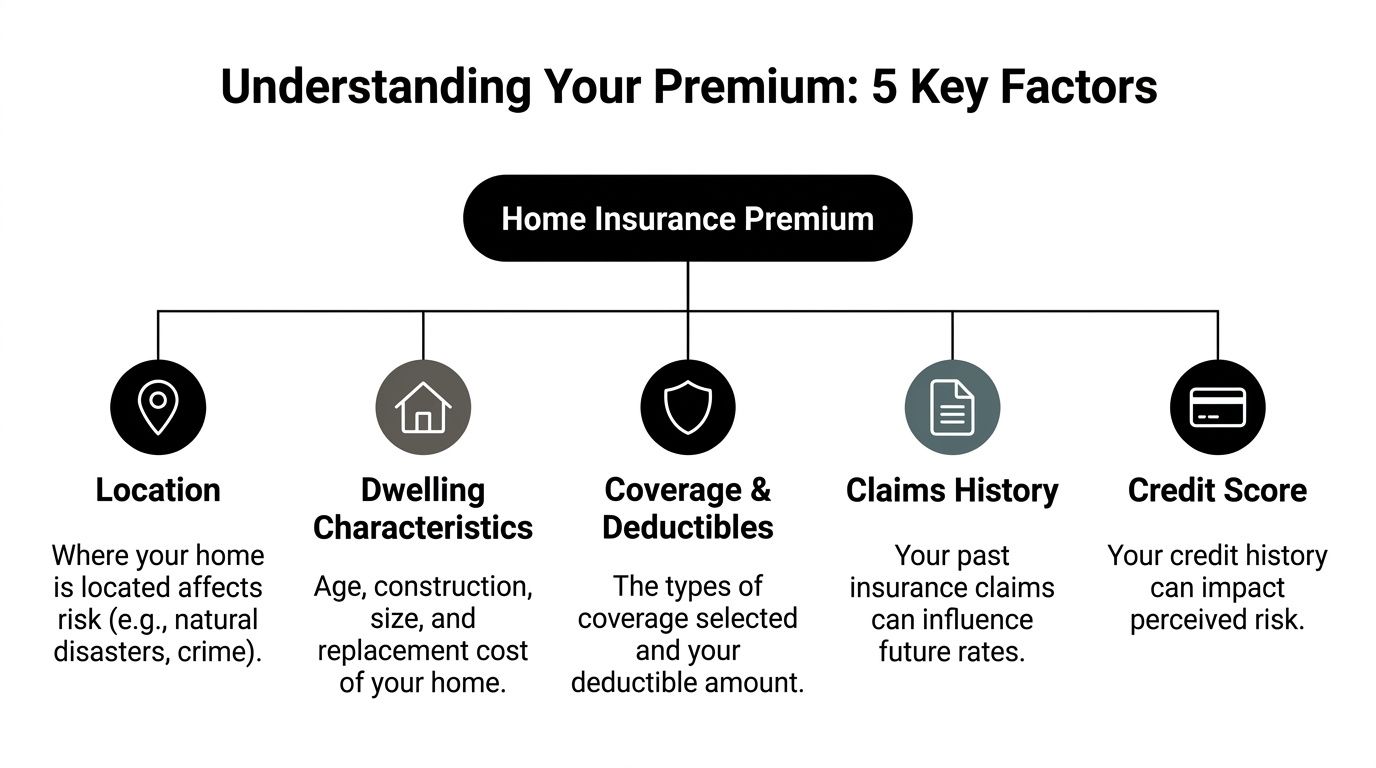
1. Location and site conditions
Your address does more than place you on a map. It signals wildfire exposure, fire department access, response times, slope, surrounding vegetation, and local claim patterns. A home at the edge of brush or up a narrow hill road will usually cost more to insure than a similar home in a lower-risk tract neighborhood.
Some parts of this are outside your control. The part that is in your control still matters. Clear defensible space, trim limbs away from the roof, remove debris, and keep records of the work. If your siding is old or highly combustible, replacing it can help both insurability and long-term durability. Homeowners comparing exterior upgrades can review vinyl and fiber cement siding for Fresno to see how material choices affect maintenance and fire resistance.
2. Rebuild cost, not sale price
Insurers price the cost to rebuild the house after a loss. They do not care what your neighbor sold for unless that sale indirectly reflects construction costs. Older homes, custom finishes, plaster walls, ornate trim, outdated wiring, and specialty materials all push reconstruction costs higher.
Homeowners often get tripped up. They insure based on market value or loan balance, then find out the rebuild estimate is much higher. In California, labor and material costs can move fast. If your Coverage A limit is too low, the cheap premium you liked at purchase becomes expensive the day you file a claim.
3. Roof age and overall condition
Roof condition is one of the fastest ways to change a quote. An aging roof raises the chance of water damage claims, and many carriers have strict roof rules now. The same goes for old plumbing, knob-and-tube wiring, or deferred maintenance that signals trouble.
Underwriters pay attention to what the home tells them. A newer roof, updated electrical, and documented repairs can improve your options. A house with visible wear usually gets higher pricing, tighter terms, or a flat decline.
4. Coverage choices and deductible level
Higher limits cost more. That part is simple. More dwelling coverage, higher personal property limits, and added endorsements increase what the insurer may have to pay.
Your deductible changes the balance. A higher deductible lowers the premium because you keep more of the smaller-loss risk. Set it at a level you can afford from savings. A policy is not a bargain if the deductible would force you onto a credit card after a claim.
5. Claims history and carrier appetite
Your prior claims matter. So does the home's history, and sometimes the neighborhood's. Frequent water losses, liability claims, or repeated weather-related claims can narrow your choices quickly.
Carrier appetite is the factor homeowners miss most often. One insurer may still want a well-maintained suburban home. Another may avoid that ZIP code entirely. Another may accept the risk only with tighter terms. That is why shopping by price alone is a mistake. You need to compare who is willing to insure the property on usable terms, for a realistic rebuild amount, with deductibles you can handle.
If you want a plain-English explanation of replacement cost, deductibles, and policy terms before you compare quotes, use these California homeowners insurance FAQs.
Navigating High-Risk Areas Wildfire Earthquake and The FAIR Plan
If you own in a high-risk area, stop chasing the perfect standard policy. Start building a workable insurance structure. That's the mindset shift that saves time and prevents dangerous gaps.
The FAIR Plan is often misunderstood. People hear the name and assume it's a complete homeowners policy. It usually isn't. It's a backstop for people who can't get traditional coverage, and it's commonly used as a last-resort fire solution when admitted carriers won't write the risk.
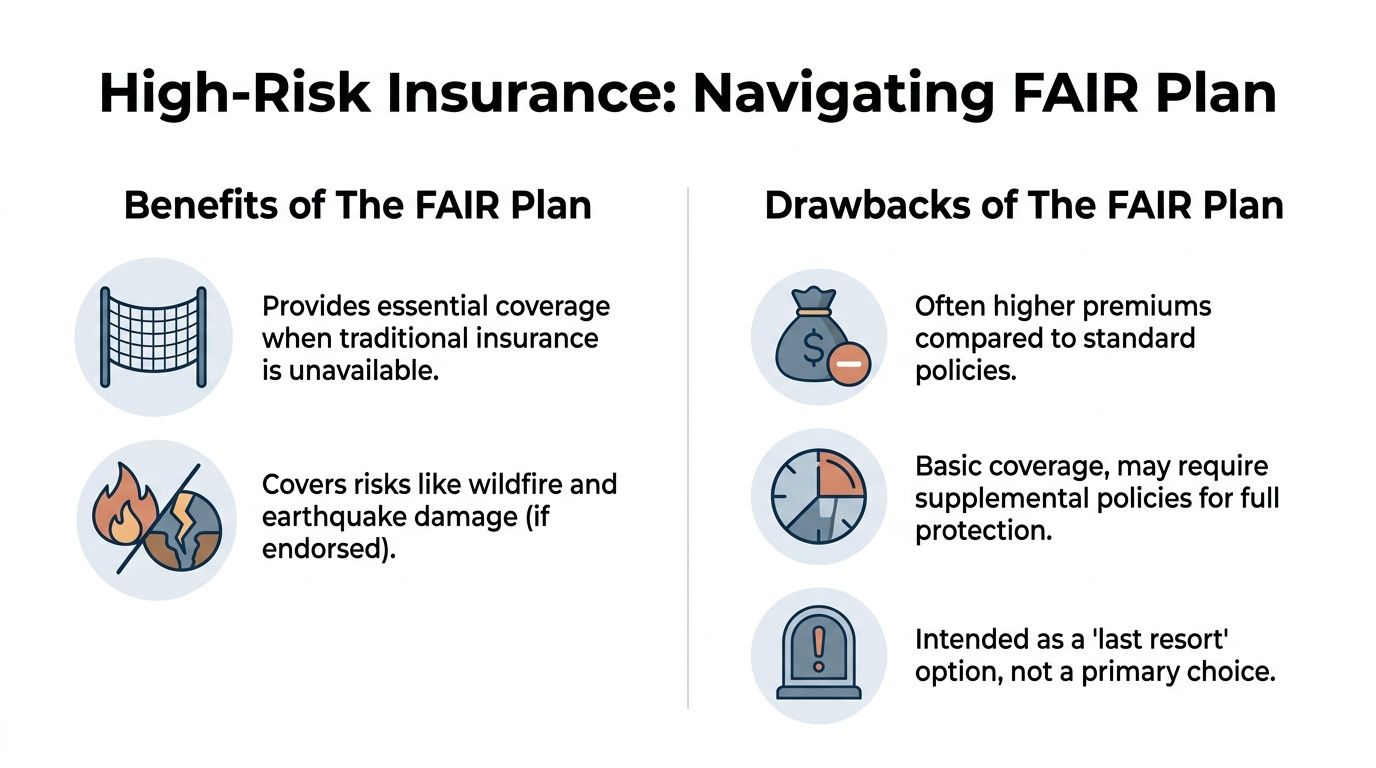
The FAIR Plan is not a complete answer
A FAIR Plan policy typically needs to be paired with a Difference in Conditions policy if you want broader protection for things like liability and other common exposures. Skip that second piece, and you may think you're insured when you're really exposed.
That's the trap. Homeowners focus on getting something issued, then never step back to ask whether the full package protects the house and the household.
If you're on the FAIR Plan, don't ask only, “Do I have coverage?” Ask, “What exactly is missing?”
Wildfire hardening still matters
Even when you're already in a difficult market, property improvements can help. Roof condition, vents, siding, vegetation clearance, and ember-resistant upgrades all matter in underwriting conversations and in real-world loss prevention.
For homeowners evaluating exterior upgrades in fire-exposed parts of the Central Valley, this guide to vinyl and fiber cement siding for Fresno is worth reviewing because siding choice affects durability, maintenance, and how a house handles heat exposure.
Earthquake coverage is a separate decision
Earthquake damage is a different conversation from wildfire. Standard homeowners policies usually don't handle that risk the way many owners assume. In California, earthquake protection is often purchased separately, commonly through the California Earthquake Authority structure offered through participating carriers.
You don't need earthquake coverage just because California sits on faults. But you should make a deliberate decision, not an accidental one. If your home has a steep rebuild cost, limited savings, or structural vulnerabilities, ignoring earthquake coverage may be a costly gamble.
A simple decision framework works:
- If standard carriers are available, compare them first and review exclusions carefully.
- If standard coverage is unavailable, use FAIR Plan plus a DIC policy and inspect the package line by line.
- If earthquake loss would wreck your finances, evaluate a separate earthquake option instead of assuming your homeowners policy covers it.
- If wildfire mitigation upgrades are possible, complete them and keep records. Underwriters respond better to documented improvements than verbal assurances.
7 Practical Ways to Lower Your Home Insurance Costs
Premium matters because it lands on the same household budget as the mortgage, utilities, groceries, and everything else. In California, home insurance took about 1% of annual income for the typical homeowner in 2023, but households in the lowest income quartile, below $66,000 annually, spent about 3% of income on average, according to the Terner Center's California home insurance charts. That gap is why every smart savings move counts.
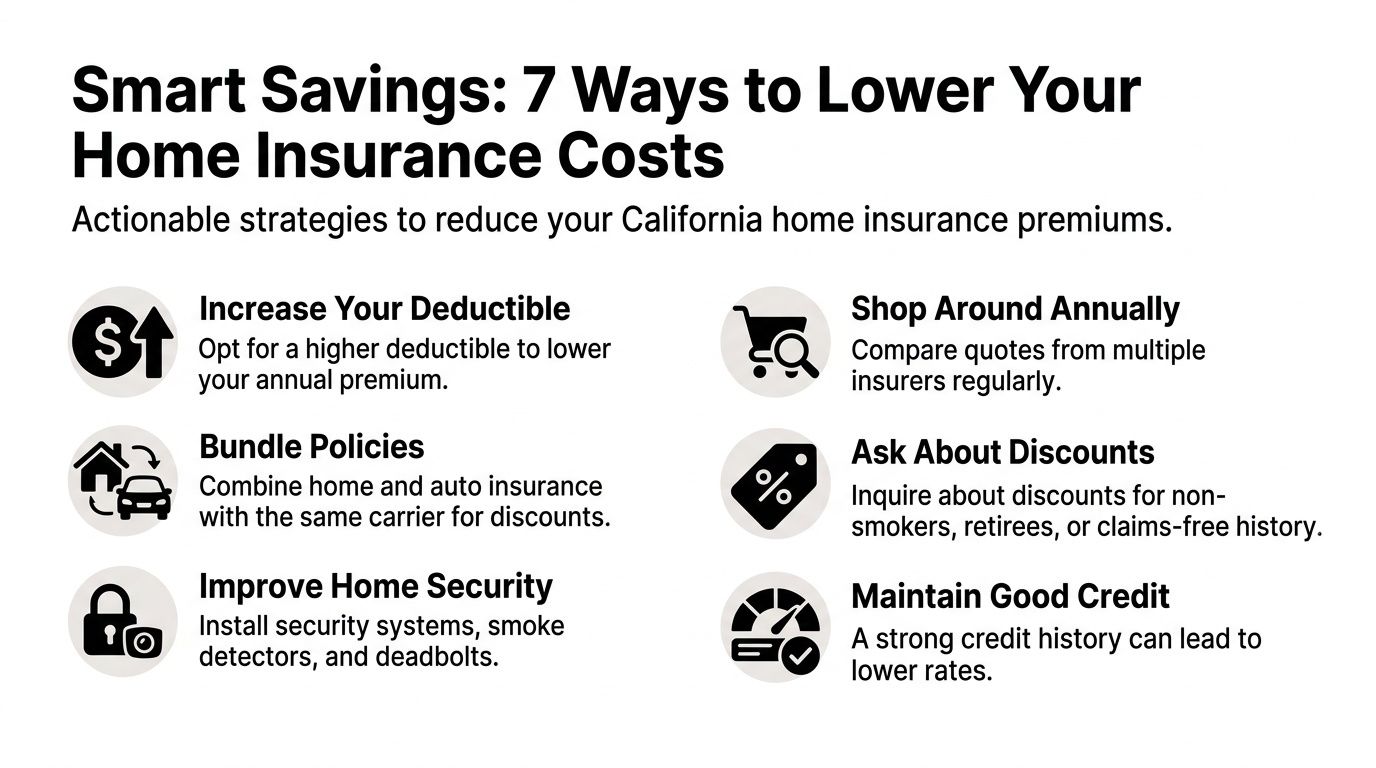
Start with the easiest wins
Bundle your policies
If you also need auto insurance, car insurance, or life insurance, ask for a bundled quote. Multi-policy pricing is one of the simplest ways to cut friction and often lower cost.Raise your deductible carefully
This is the fastest lever you control. Just make sure the deductible still fits your emergency fund. If paying it would force you onto a credit card, it's too high.Install or update protective devices
Smoke detectors, monitored alarms, water leak detection, deadbolts, and fire mitigation features can all help. Some discounts are modest, but risk reduction helps with insurability too.
Move to higher-impact changes
Upgrade the house where underwriters care most
Roofs, wiring, plumbing, and wildfire-resistance features matter more than cosmetic remodeling. Don't expect a kitchen renovation to impress an insurer. A safer roof might.Review the policy every year
Too many owners renew on autopilot. Rebuild costs shift, endorsements change, and your eligibility for discounts may improve. Review the dwelling amount, deductible, liability limit, and exclusions each year.Keep your financial profile clean
Carriers look at risk signals in different ways. Better overall financial habits can help you qualify for stronger offers, especially when combined with claims-free history and stable ownership.Shop the market through an independent agent
This is the most effective move when the market is tight. One captive quote tells you what one company thinks. A real market comparison tells you what the market thinks.
Good shopping isn't collecting random quotes online. It's comparing equivalent coverage forms, deductibles, endorsements, and exclusions.
If you rent out part of the property or want to reduce claim conflicts, align the whole household insurance setup. That can include requiring tenants to carry renters insurance and reviewing whether your home insurance, auto insurance, and life insurance still fit your current finances.
Putting It All Together Sample Premium Scenarios
Abstract advice only goes so far. Real homeowners need to see how these moving parts combine on an actual property.
Three homeowners, three very different outcomes
Scenario one: low-risk suburban owner
A family in a newer tract home, outside a severe wildfire footprint, bundles home and auto, chooses a sensible deductible, and has no recent claims. Their premium likely lands closer to the lower end of the market than the stories you hear on the news. They still need to verify replacement cost, but they usually have standard-carrier options.
Scenario two: foothill homeowner in a wildfire zone
This owner gets non-renewed, moves to a FAIR Plan structure, then adds a DIC policy to fill major gaps. Their insurance arrangement is more complicated and usually more expensive than the statewide average suggests. But the right question isn't whether it beats the average. It's whether the combination effectively protects the house.
Scenario three: first-time condo buyer in a major metro
The HOA covers part of the building structure, so the buyer focuses on interior coverage, personal property, liability, and loss assessment exposure. Then comes the earthquake question. For many condo owners, that separate decision matters more than shaving a little premium off the base homeowners package.
For owners in Southern California trying to benchmark local conditions, this page on Los Angeles home insurance options can help ground the conversation in a real regional market.
Find Your Best California Home Insurance Policy Today
The homeowners insurance California average is a starting point. It's not your price, and it's definitely not your protection plan. The homeowners who do best in this market are the ones who stop shopping by headline and start shopping by fit.
That means asking better questions. Is the dwelling amount realistic? Are wildfire exposures addressed? Is the policy from a standard carrier, a FAIR Plan structure, or a surplus option? If it's cheaper, what was removed? If it's expensive, is that because of genuine risk, inflated coverage, or a carrier that doesn't want the address?
What smart buyers do next
Use the average as context, then get specific. Compare quotes only when coverage terms are lined up. Review deductibles, liability, exclusions, endorsements, and whether earthquake coverage deserves a separate decision.
If you're also reviewing California insurance more broadly, this is a good time to revisit your car insurance, auto insurance, renters insurance, and life insurance together. Households save money and avoid coverage gaps when the whole protection plan is reviewed as one system.
A no-obligation California insurance quote is the fastest way to see what your real options look like at your address, not in a statewide average.
If you want a straight answer instead of another generic quote form, talk to Mai & Associates. They help Californians compare coverage for home, auto, renters, car, and life insurance, and they're especially useful when you need help with high-risk properties, FAIR Plan reviews, earthquake options, or wildfire-related coverage questions. You can reach out online or by phone for a no-obligation quote and get guidance from licensed agents who know how California policies work.