Home Insurance for First Time Buyers: A Complete Guide

You've found the house, negotiated the price, survived the inspection, and started counting the days until closing. Then your lender asks for proof of insurance, and you're suddenly comparing policy pages filled with terms like replacement cost, liability limits, endorsements, and percentage deductibles.
For a California first-time buyer, choosing the cheapest policy is a risky shortcut. Home insurance protects the structure, your belongings, and your financial exposure, but standard coverage leaves important gaps for flooding, earthquakes, renovation work, and some wildfire losses. The right policy is the one that matches the home's rebuilding cost, location, lender requirements, and your ability to absorb a serious out-of-pocket loss.
Why First-Time Buyers Need to Understand Home Insurance Before Closing
You are reviewing loan documents, preparing closing funds, and watching the deadline approach when the lender asks for a homeowners insurance binder. The fastest response is often to accept the lowest quote. In California, that can leave a serious coverage gap before you even receive the keys.
A policy may satisfy the lender while protecting too little of your actual financial exposure. The lender needs insurance because the property secures the mortgage. You need it to protect the structure, belongings, savings, and income from covered damage and liability claims. Standard policies also exclude risks that deserve separate attention, including earthquakes and flooding. Wildfire terms, availability, and deductibles require an even closer review.
Treat insurance as part of the purchase decision, not closing paperwork. Roof age, electrical and plumbing systems, construction, location, wildfire exposure, and the home's rebuilding cost can affect whether a carrier offers coverage and how the policy responds after a claim.

Insurance belongs in your housing budget
First-time buyers often have limited cash for an unexpected loss. In 2023, about 800,000 Americans used private mortgage insurance to purchase a home, and 64% were first-time buyers, according to U.S. Mortgage Insurers' homebuyer data. The same data reports that in November 2024, 63.2% of GSE borrowers with PMI were first-time homebuyers, compared with 36.5% of GSE borrowers without PMI.
Budget for the premium and the deductible. The release found that 74% of first-time buyers considered homeowners insurance a significant part of their housing budget, while 47% said a premium increase could make mortgage payments difficult to afford. Their expected average premium for 2025 was $2,692, compared with an actual average of $2,887.
Practical rule: Approve a policy only after you know the premium and the largest realistic deductible you would pay after a covered loss.
Start shopping as soon as you are under contract. Request the declarations page, deductible schedule, exclusions, and replacement-cost basis before sending insurance information to the lender. If you are moving from an apartment, reviewing California renters insurance options can help identify your personal property and liability needs. Ask directly whether wildfire coverage is available, whether earthquake insurance is separate, and what the policy excludes.
How Homeowners Insurance Coverage Is Structured
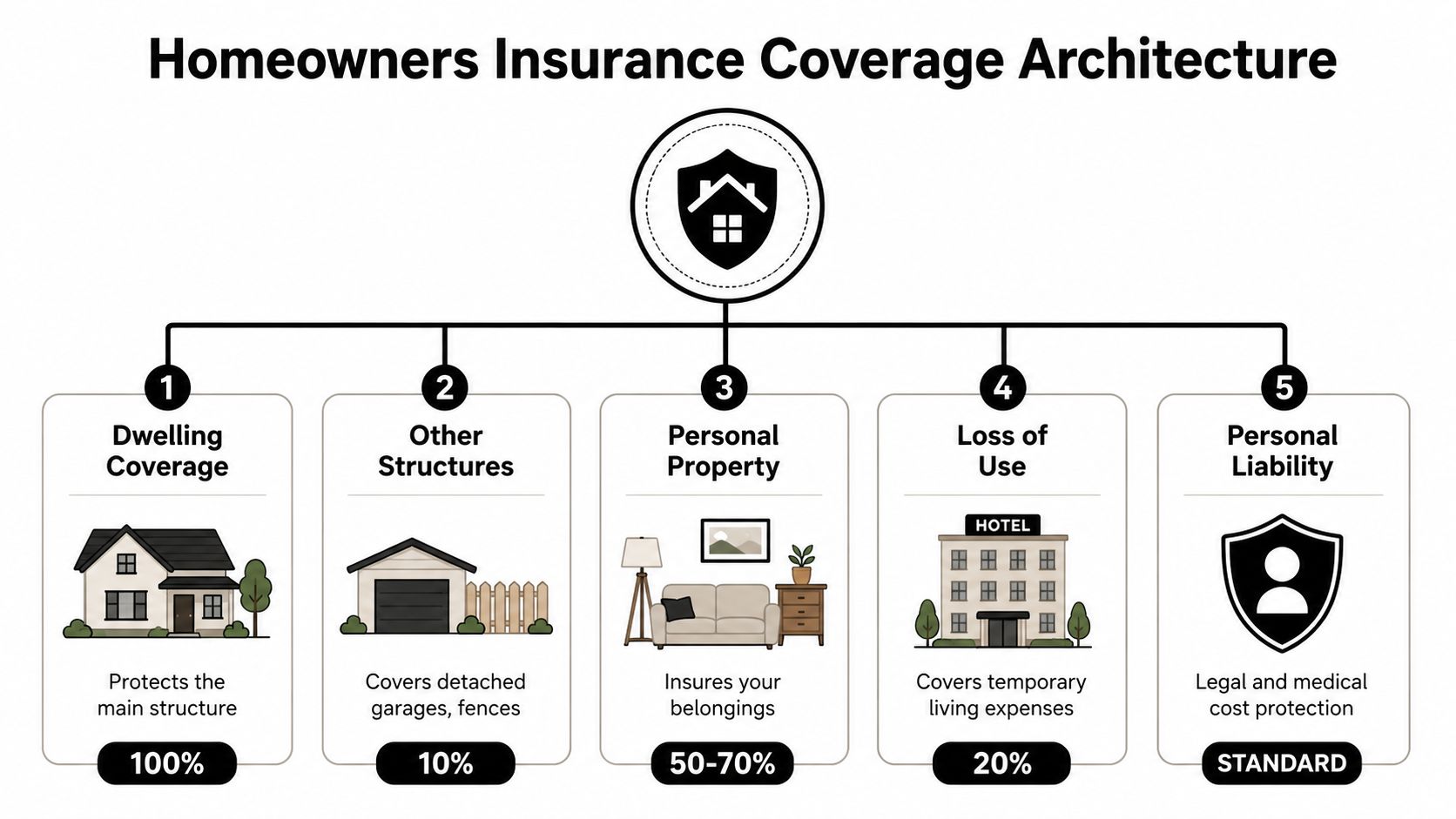
A standard homeowners policy consists of separate protections, each with its own limit, purpose, and conditions. Read it as a set of coverages, not a single promise to pay for every problem affecting the property.
Start with the rebuilding number
Coverage A, dwelling coverage, should reflect the home's replacement cost. Replacement cost answers what contractors may need to rebuild the insured structure after a covered loss, using comparable materials and labor. It does not equal the purchase price, appraised market value, or value of the land.
Market value includes location and land. Dwelling coverage addresses the structure itself. California consumer guidance says the dwelling limit should equal the cost to replace the home. California's residential insurance guide also explains a federal mortgage constraint for one- to four-unit properties. The maximum allowable deductible for required property perils is 5% of the property insurance coverage amount, including separate windstorm or wildfire deductibles.
A carrier's replacement-cost estimate gives you a starting point. Correct it with the agent if the property has additions, an upgraded kitchen, custom finishes, detached structures, solar equipment, or unusual construction features. Underinsurance can leave you responsible for a large portion of rebuilding costs after a major California loss.
Know what the remaining coverages do
| Coverage | Common benchmark or purpose | What it protects |
|---|---|---|
| Other structures | Around 10% of Coverage A, as described in this first-time buyer coverage guide | Detached garages, sheds, fences, and similar structures |
| Personal property | Around 50% of Coverage A as a common benchmark | Furniture, clothing, electronics, appliances, and other belongings |
| Loss of use | Roughly 20% to 30% of Coverage A | Additional living costs when a covered loss makes the home uninhabitable |
| Personal liability | At least $300,000 as a common benchmark | Legal defense, settlements, and covered injury or property-damage claims |
| Medical payments | A smaller limit for certain guest injuries | Eligible medical expenses under the policy's terms |
Coverage B generally applies to detached structures. Coverage C protects personal property, but jewelry, art, collectibles, firearms, and specialty equipment may have sublimits or need scheduled coverage. Create a home inventory before moving in, with photographs, videos, receipts, and serial numbers.
Coverage D can pay eligible additional living expenses after a covered event makes the home uninhabitable. Coverage E addresses liability if a guest falls, your dog injures someone, or a household member causes covered damage to another person's property. Coverage F, medical payments to others, can handle certain smaller injury claims under the policy's terms.
Use the Mai & Associates insurance glossary to decode unfamiliar terms, then confirm the actual limits and exclusions on your declarations page and policy forms. Those documents control how a claim is evaluated.
What Standard Home Insurance Does Not Cover
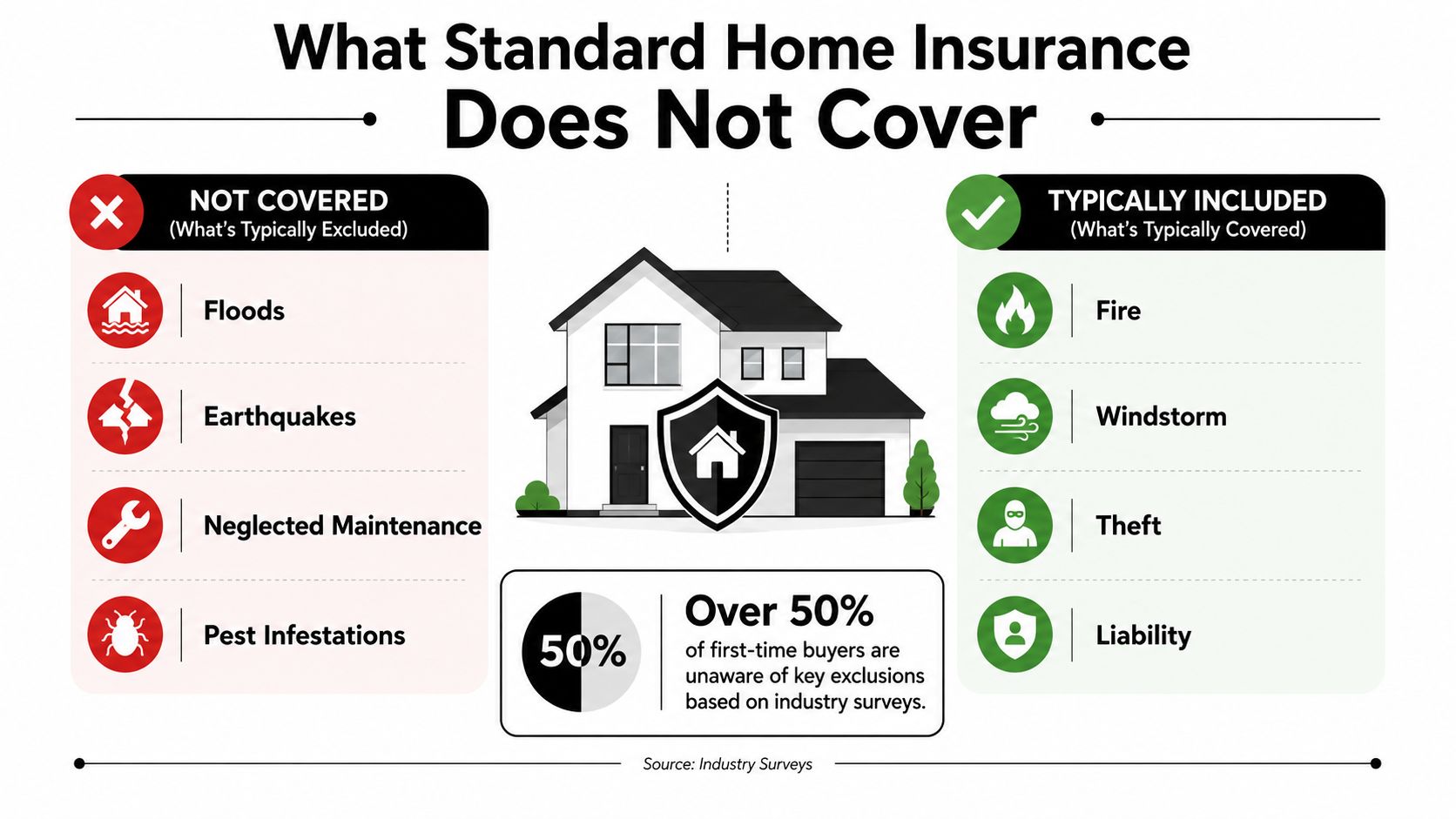
You can sign closing papers, receive a homeowners policy, and still have no protection for some of the costliest damage a California property can face. Standard insurance responds to covered perils listed in the policy. It does not insure every cause of loss.
A 2026 survey summarized by The Zebra found that over half of respondents didn't realize standard homeowners insurance excludes flooding, while seven in 10 believed the policy would cover materials for a voluntary renovation project. The findings appear in The Zebra's discussion of mortgage costs and insurance premiums. Read the exclusions before you compare premiums. The right question is, “What does this policy exclude, and what protection fills that gap?”
Flood and earthquake require separate attention
Flood damage generally isn't included in a standard homeowners policy. Rising water, storm runoff, drainage overflow, and other water conditions may fall under flood definitions in the policy or an applicable flood program. If the property is near a flood-prone area, arrange separate flood coverage before closing. A lender may not require it, but that does not remove your financial exposure.
Earthquake damage also typically requires separate coverage or an endorsement. Ask about protection for the dwelling, personal property, and additional living expenses, then examine the deductible structure. Earthquake coverage may be expensive or limited. Leaving the risk unaddressed is a serious California coverage gap.
Renovations aren't automatically insured
A voluntary renovation raises two separate concerns. The standard policy may not cover project materials as expected, and construction can change the home's replacement cost, occupancy, wiring, plumbing, roof, and liability profile.
Call the agent before work starts. Confirm the contractor's insurance, the policy's notice requirements, and whether completed improvements will change Coverage A. An unreported kitchen upgrade can leave the policy limit below the cost to rebuild the home you now own.
Maintenance problems are different from sudden losses
Insurance responds to sudden, accidental damage from a covered peril. It generally does not pay to replace an old roof, remove a pest infestation, repair gradual deterioration, or correct neglected plumbing. Sewer backup may require a specific endorsement, even when the resulting indoor water damage appears claim-worthy.
Ask these questions in writing:
- Flood: Is rising water excluded, and should I buy separate flood coverage?
- Earthquake: Which policy or endorsement options are available, and how is the deductible calculated?
- Water backup: Is sewer or drain backup included, limited, or excluded?
- Renovation: What must I report before construction begins?
- Maintenance: Which existing conditions could lead to a claim denial?
California-Specific Risks and Coverage Considerations
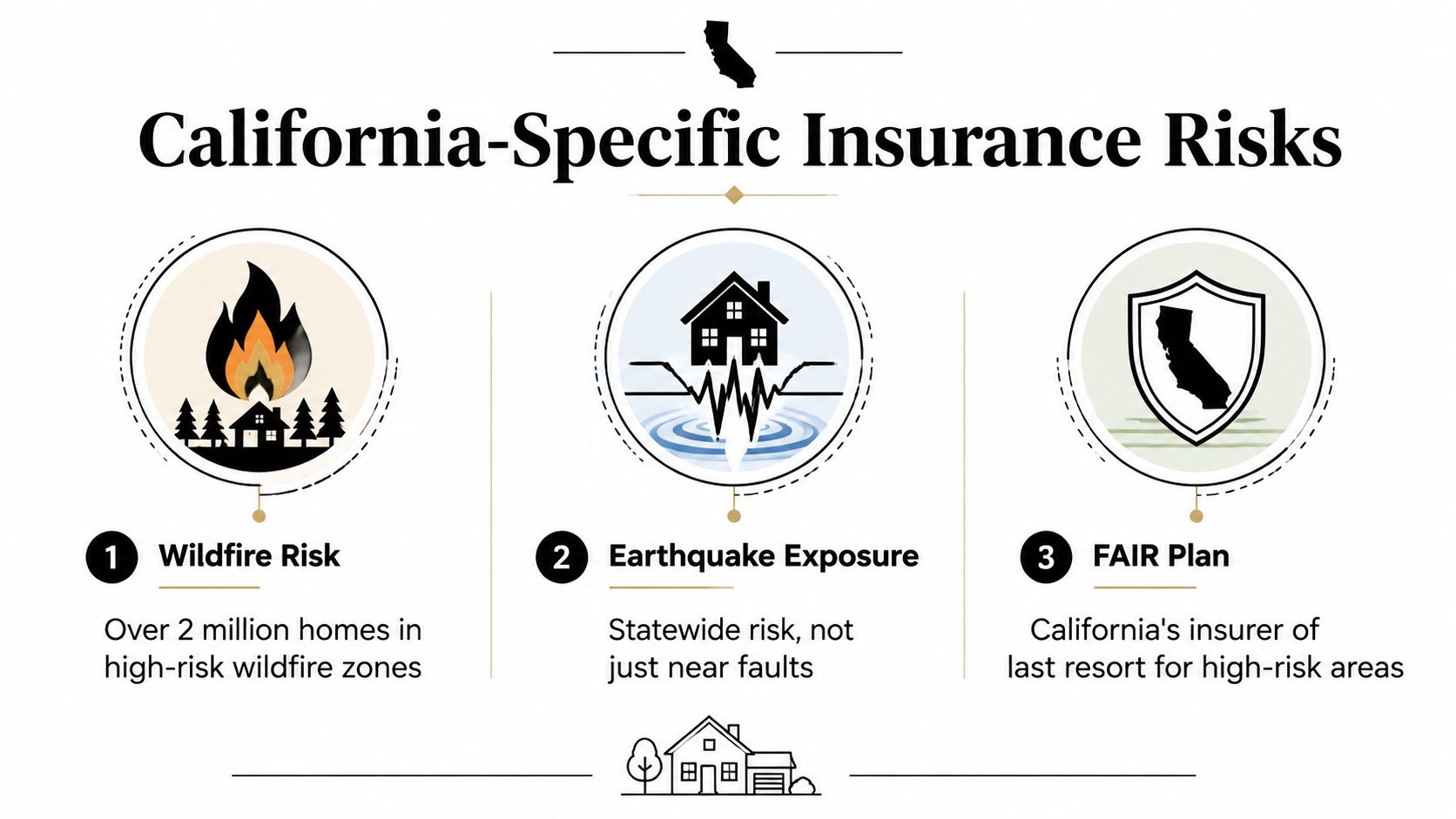
A home can look affordable and still be difficult to insure after closing. In California, wildfire exposure, brush, limited road access, roof age, and carrier underwriting rules can determine whether standard coverage is available and what you will pay.
Wildfire requires a close review. Ask whether the policy has a separate wildfire deductible, then confirm whether it is a fixed dollar amount or a percentage of the dwelling limit. A percentage deductible can create a substantial cash obligation because Coverage A reflects rebuilding cost, not the home's sale price. Before making an offer, confirm that the address is insurable and ask what property improvements could qualify for a Safer from Wildfires discount. The California Department of Insurance FAQ on Safer from Wildfires explains qualifying wildfire-hardening measures and related discounts.
Understanding the FAIR Plan
The California FAIR Plan is a last-resort property insurance option for eligible homes that cannot obtain coverage in the voluntary market. It may satisfy a lender's basic insurance requirement, but it does not automatically provide the protection of a broad homeowners policy. Review the available limits for property perils, personal belongings, liability, water damage, and additional living expenses. A companion policy may be needed to fill those gaps.
The FAIR Plan's reinsurance structure shows how large wildfire losses can become. A FAIR Plan update says it can access the first $350 million in available reinsurance above its $900 million deductible. It also says the plan is responsible for about $3.5 billion to access all reinsurance layers, including the deductible and copays. Treat those figures as a warning to examine limits, exclusions, and supplemental coverage before relying on the plan.
Earthquake is a separate decision
Earthquake risk exists throughout California, including areas far from a visible fault. Standard home insurance generally excludes earthquake damage. Get a separate quote and compare the deductible, dwelling limit, personal property limit, and loss-of-use protection.
Before choosing a property, ask whether carriers are writing the address, whether inspections or mitigation records are required, and whether a FAIR Plan arrangement needs supplemental coverage. A California home insurance review can help examine those details before you finalize the purchase.
How to Compare Quotes and Choose the Right Policy
A lower premium may hide structural differences worth comparing. One quote may carry a higher deductible, actual cash value settlement, narrower endorsements, lower personal property limits, or wildfire terms that increase your out-of-pocket cost after a claim.
Request the same dwelling limit, personal property basis, liability limit, and deductible structure from every carrier. Read each declarations page, then request the policy forms that explain exclusions, special deductibles, and claim settlement rules. Without that comparison, you are comparing prices rather than protection.
| Factor | What to Look For | Why It Matters |
|---|---|---|
| Dwelling limit | Replacement-cost estimate tied to the actual structure | A market-value figure can understate rebuilding needs |
| Claim settlement | Replacement cost versus actual cash value | Actual cash value applies depreciation, which can reduce payment |
| Wildfire deductible | Dollar amount or percentage, and which losses trigger it | A percentage deductible can create a large cash requirement |
| Water protection | Sewer backup, service line, and related endorsements | Standard coverage may not address every water source |
| Earthquake | Separate policy or endorsement, limits, and deductible | Earthquake damage is generally outside standard home coverage |
| Liability | At least $300,000 as a common benchmark | Liability claims can reach beyond the damaged property |
| Insurer quality | Financial strength and claims-handling reputation | Premium savings do not help if the policy is difficult to use |
| Discounts | Bundling, protective devices, and wildfire hardening | Discounts can reduce cost without removing core protection |
Use a worst-case test
Ask four questions about every quote:
- Could I pay the stated deductible without using emergency debt?
- Would the dwelling limit rebuild the house with today's labor and materials?
- Would replacement-cost personal property coverage replace what I own?
- Could the liability limit protect my income and assets after a serious claim?
Replacement cost is generally the stronger choice for personal property and dwelling claims because actual cash value subtracts depreciation. Do not accept a higher deductible solely to lower the premium unless that deductible is already included in your emergency budget.
Bundling home and auto insurance can simplify billing and may provide a multipolicy discount. Compare the combined protection instead of assuming the package costs less. Your car insurance liability limits, uninsured motorist options, and vehicle coverage still need their own review.
Ask whether water backup, service line damage, and wildfire-related deductibles are included or require endorsements. These details often matter more after a California loss than a small premium difference.
When ready, request comparable California home insurance quotes through Mai & Associates' insurance quote process. Use the result as a starting point for reviewing limits, exclusions, deductibles, and claim settlement terms, not as a reason to choose the first number you see.
Common Mistakes First-Time Buyers Make With Home Insurance
A buyer can close on a California home and still discover that the policy cannot pay for the loss they feared most. The common mistakes are not limited to missed paperwork. They involve incorrect limits, unaffordable deductibles, and exclusions that become obvious only after wildfire, earthquake, or water damage.
Insuring the house for its purchase price is the first error. Market value includes the land and local demand. The dwelling limit should reflect the cost to rebuild the structure. Ask how the carrier calculated Coverage A, and report additions, upgraded materials, detached structures, and unusual features.
A low deductible on the quote may hide a percentage wildfire deductible. After a severe loss, that obligation can exceed the cash you have available. Compare the premium savings with the amount you would need immediately after a claim. A deductible belongs in your emergency budget before you accept the policy.
Shortcuts that create expensive gaps
- Buying the cheapest quote: A low price may mean weaker limits, actual cash value settlement, or missing endorsements. Compare matching coverage before comparing premiums.
- Assuming flood and earthquake are included: Standard policies usually exclude both. Arrange separate coverage or an endorsement, and get the answer in writing before closing.
- Ignoring personal property limits: Jewelry, art, collectibles, and specialized equipment may need higher limits or scheduled coverage.
- Skipping a home inventory: Photographs, receipts, and serial numbers make ownership and value easier to prove after a loss.
- Failing to report renovations: Remodeling can change rebuilding costs and underwriting requirements. Tell the agent before work begins.
- Letting coverage lapse: A missed payment can leave you uninsured and breach the mortgage agreement. Keep the lender and agent updated during escrow changes or refinancing.
- Never reviewing renewal documents: Premiums, deductibles, exclusions, and underwriting conditions can change. Read every renewal.
Liability deserves its own review. Buyers with substantial savings, investments, or growing income should ask whether an umbrella policy fits their risk. The home and auto liability limits must satisfy the umbrella carrier's requirements.
Mortgage errors can disrupt insurance timing, escrow, and closing. Review those details with avoid mortgage errors with David J Greiner before signing documents or changing financial arrangements late in the process.
Your First-Time Homebuyer Insurance Checklist and FAQ
A policy can look affordable and still leave a new homeowner exposed. Before closing, confirm what pays to rebuild the house, which California risks are excluded, and how much cash you would need for each deductible. Use this checklist before closing and at every renewal:
- Confirm the rebuild estimate: Set dwelling coverage from replacement cost, not market value. Ask whether local labor, debris removal, and building-code upgrades are included.
- Review each deductible: Check standard, wildfire, windstorm, and earthquake deductibles separately. A lower premium can create a large claim bill.
- Ask about exclusions: Get written answers on flood, earthquake, sewer backup, renovations, and maintenance-related damage.
- Inventory belongings: Photograph rooms, save receipts, and record serial numbers for major items. Jewelry, art, collectibles, and specialized equipment may need scheduled coverage.
- Check liability: Use at least $300,000 as a common benchmark, then discuss your assets, household risks, and whether umbrella coverage fits.
- Verify lender details: Confirm the mortgagee information and make sure coverage begins before closing.
- Review California risks: Ask about wildfire hardening, FAIR Plan eligibility, and separate earthquake coverage. A FAIR Plan policy may address basic fire protection, but it does not replace the broader coverage of a standard homeowners policy.
- Revisit the policy: Update limits after renovations, major purchases, additions, or changes in occupancy.
Frequently asked questions
Do I need insurance before closing?
If you're financing the purchase, your lender will generally require proof of active coverage before funding. Start shopping once you're under contract so underwriting issues do not delay closing.
How can I lower my premium?
Compare carriers, ask about bundling home and auto insurance, improve qualifying safety features, and review wildfire-hardening discounts where available. Keep necessary limits and choose a deductible you can pay.
What happens after I file a claim?
Report the loss, document damage, and protect the property from further harm when safe. Your payment depends on the covered cause, limits, deductible, exclusions, and whether the policy uses replacement cost or actual cash value.
Should I bundle auto and home insurance?
Bundling can simplify administration and may qualify for a discount. Compare total cost and coverage, including your California auto insurance liability protection.
Mai & Associates provides California home, auto, renters, and life insurance quotes, plus policy reviews for wildfire-prone properties and California FAIR Plan situations. Visit Mai & Associates to compare options with licensed agents before closing.