Your Guide to Home Insurance Deductibles in California

If you’ve ever looked at an insurance policy—whether for your home, car, or apartment—you’ve probably seen the term “deductible.” But what does it actually mean? In simple terms, it's the amount you agree to pay out-of-pocket on a claim before your insurance company steps in and pays the rest.
Think of it as your share of the repair cost. This one number is a crucial part of your policy, directly affecting both your monthly budget and your financial safety net if something goes wrong. Understanding how deductibles work for home insurance is a great foundation for managing all your California insurance policies, from auto insurance to renters insurance.
Decoding Your Home Insurance Deductible

Getting a handle on your deductible is one of the smartest things you can do as a homeowner in California. It’s not just a random number; it's a core lever that controls what you pay for your coverage and how much help you get when you need it most.
A good analogy is your health insurance co-pay. When you go to the doctor, you pay a small, fixed amount first, and your insurance handles the rest. Your home insurance deductible works the exact same way for things like a burst pipe or storm damage. The same principle also applies to your car insurance when you file a claim for an accident.
The Give-and-Take of Deductibles and Premiums
The most important concept to understand is the balancing act between your deductible and your premium. They have an inverse relationship—as one goes up, the other comes down. It’s a classic trade-off seen across all types of California insurance, including auto, home, and renters insurance.
- Go for a Higher Deductible: If you're willing to cover a larger chunk of the initial repair cost, your insurer sees you as less of a financial risk. Your reward? A noticeably lower annual premium.
- Opt for a Lower Deductible: If you’d rather pay less out of pocket when disaster strikes, your insurance company takes on more of the potential cost. This means you'll pay a higher annual premium.
This choice is all about finding what works for your personal finances. Are you more comfortable with a lower bill every year, knowing you'll have a bigger one-time expense if you file a claim? Or do you prefer paying a bit more annually for the peace of mind that comes with a smaller out-of-pocket cost during an emergency?
Juggling these insurance terms can feel confusing, but our straightforward insurance glossary is always here to help clear things up.
The Core Idea: Your deductible is a measure of the financial risk you're willing to take on yourself. The more risk you assume with a higher deductible, the less risk the insurance company has, which is why they give you a better price on your policy.
Deductible Basics at a Glance
For anyone living in California, this isn't just theory—it's critical. Between wildfire threats and earthquake risks, picking the right home insurance deductible can be a make-or-break decision. To make it easier, I've put together a quick cheat sheet.
Here’s a simple table to keep the key terms straight.
| Concept | Simple Explanation |
|---|---|
| Deductible | Your pre-agreed share of the cost for a covered insurance claim. You pay this first. |
| Premium | The regular payment (monthly or annually) you make to keep your insurance policy active. |
| Claim | A formal request you submit to your insurance company for payment after a covered loss. |
| Inverse Relationship | When your deductible amount increases, your premium payment generally decreases, and vice-versa. |
Think of this as the foundation. Once you have these basics down, you can start making strategic decisions that truly protect your property and your wallet, whether you're managing home, renters, or car insurance in California.
How Your Deductible Plays Out in a Real Claim
It's one thing to talk about deductibles in theory, but seeing how they work in the real world is what really makes it click. Your deductible is the first part of the bill you have to cover yourself. Think of it as your share of the repair cost before your insurance company steps in to pay the rest.
Let's walk through a couple of all-too-common scenarios for California homeowners—a surprise plumbing leak and a serious kitchen fire—to see exactly how the math works and what it means for your wallet.
Scenario 1: The Classic Under-the-Sink Pipe Burst
Picture this: you come home from work to find a puddle in your kitchen. A pipe under the sink has burst, soaking your cabinets, ruining the hardwood floors, and damaging the drywall. A restoration expert comes out and gives you a quote for the total repair: $12,000.
Now, let's see how your claim payout would differ with two common deductible choices.
Example A: You Chose a $1,500 Deductible
With a fairly low deductible, the calculation is pretty simple.
- Total Covered Damage: $12,000
- Your Deductible (What you pay): -$1,500
- The Insurance Check: $10,500
You're on the hook for the first $1,500. Once you've covered that, your insurer cuts a check for the remaining $10,500. Having a lower out-of-pocket cost like this makes it much easier to handle the immediate financial shock, especially if your emergency fund is a bit lean.
Example B: You Chose a $5,000 Deductible
Maybe you opted for a higher deductible to get a lower monthly premium on your home insurance. If so, your initial financial responsibility is a lot bigger.
- Total Covered Damage: $12,000
- Your Deductible (What you pay): -$5,000
- The Insurance Check: $7,000
In this situation, you need to come up with a significant $5,000 to get the repairs started. While you’ve been saving money on your premium all along, you have to make sure you have that cash ready to go when a disaster strikes.
The bottom line is simple: your insurance payout is always the total approved repair cost minus your deductible. This is precisely why financial advisors always recommend having an emergency fund that can, at a bare minimum, cover your highest insurance deductible, whether it's for your home or your car insurance.
Scenario 2: A Much More Serious Kitchen Fire
Let's escalate things. A grease fire on the stovetop gets out of hand, causing serious damage. The fire, smoke, and soot destroy your countertops and appliances and damage the surrounding walls. The total estimate to rebuild your kitchen comes in at $45,000.
This is a major disaster, and it's the exact reason you have home insurance. Let's run the numbers with the same two deductibles.
Payout with a $1,500 Deductible
In a truly stressful time like this, your lower deductible offers a huge amount of financial relief.
- Total Covered Damage: $45,000
- Your Deductible (What you pay): -$1,500
- The Insurance Check: $43,500
Your out-of-pocket hit is still a manageable $1,500. The $43,500 check from your insurer covers the overwhelming majority of the restoration. This is where you really see the value of a lower deductible for a catastrophic claim.
Payout with a $5,000 Deductible
Even with the higher deductible, your policy is still doing the heavy lifting to protect you from financial ruin.
- Total Covered Damage: $45,000
- Your Deductible (What you pay): -$5,000
- The Insurance Check: $40,000
You'll need to contribute $5,000, and your insurance company will handle the other $40,000. It's a bigger upfront cost, for sure, but your policy still shields you from the full, devastating impact of a $45,000 bill.
As you can see, that deductible on your policy isn't just some random number. It's a critical part of your financial plan that determines exactly what you'll pay out of pocket when you need your coverage the most.
Choosing Between a High and Low Deductible
When it comes to your home insurance deductible, you're at a classic crossroads. This isn't just about picking a number; it's a strategic decision that pits immediate savings against your long-term financial safety net. The right choice for you has everything to do with your personal budget, how much you have tucked away in savings, and frankly, how much risk you're comfortable with.
Think of it this way: opting for a higher deductible means you're agreeing to take on a bigger piece of the financial pie if something goes wrong and you need to file a claim. Your insurance company rewards you for taking on that risk with a lower annual premium. On the flip side, a lower deductible means your out-of-pocket costs will be minimal after a disaster, but you'll pay more for that peace of mind throughout the year.
This simple infographic breaks down exactly how the math works when you file a claim.
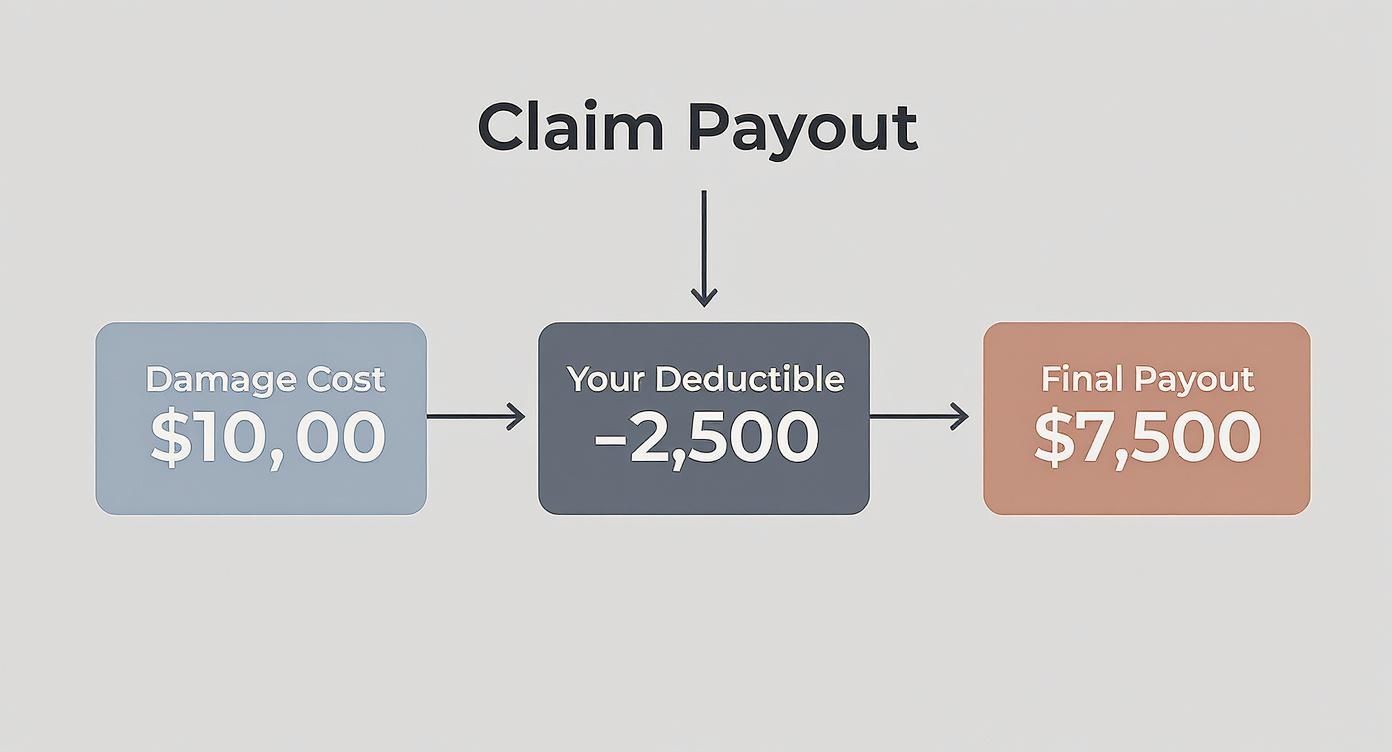
As you can see, the check you get from your insurer is always the total cost of the damage, minus the deductible you chose.
The Case for a High Deductible
Going with a high deductible is a bit like making a bet on yourself. You're betting that you won't need to file a claim anytime soon, and if you do, you've got the cash to handle your share of the cost. For homeowners who are diligent savers and have a healthy emergency fund, this can be a very savvy financial move for both home and auto insurance.
If you could comfortably write a check for a $5,000 deductible without breaking a sweat, you could unlock some serious savings on your yearly premium. Those savings could then be put to work, perhaps by beefing up your emergency fund even more or funding a life insurance policy.
But this strategy demands financial discipline. If a surprise $5,000 bill would send your finances into a tailspin, the lower premium simply isn't worth the risk. It's all about being brutally honest with yourself about what you can truly afford on a moment's notice.
The Case for a Low Deductible
On the other hand, a low deductible is all about buying peace of mind. It's a stronger safety net, designed to ensure that a covered disaster won’t completely wipe out your savings. This is a fantastic option for homeowners who value predictable expenses and want to avoid any nasty financial surprises.
Sure, you'll pay more for your policy each year. But if you have to make a claim, you'll face a much smaller, more manageable bill. For many California families, especially those with tighter monthly budgets or less in emergency savings, that predictability is worth its weight in gold. It turns a potential financial catastrophe into a mere inconvenience, whether we're talking about home, renters, or car insurance.
For many, a low deductible is a form of "sleep-at-night" insurance. You pay a bit more for the premium to guarantee that a major repair won't derail your entire financial plan when you're most vulnerable.
High Deductible vs Low Deductible: Which Is Right for You?
To make this decision a little easier, it helps to see the two approaches side-by-side. Here’s a direct comparison to help you figure out which strategy best aligns with your financial reality as a California homeowner.
| Feature | High Deductible Plan | Low Deductible Plan |
|---|---|---|
| Annual Premium | Lower Cost - You pay less each year for your policy. | Higher Cost - You pay more annually for greater protection. |
| Out-of-Pocket Claim Cost | Higher Cost - You are responsible for a larger portion of the repair bill. | Lower Cost - Your personal financial hit during a claim is minimal. |
| Emergency Fund Needs | Larger - You must have enough saved to cover the full deductible at any time. | Smaller - A more modest emergency fund is sufficient to cover your share. |
| Best For | Homeowners with substantial savings and a higher tolerance for financial risk. | Homeowners who prioritize budget predictability and have less cash on hand. |
At the end of the day, there is no single "correct" home insurance deductible. The right choice is the one that fits your personal financial health and your stomach for risk, a principle that applies across your entire California insurance portfolio, including life insurance planning.
Navigating California's Unique Deductible Rules

While a standard deductible for something like a burst pipe is pretty straightforward, California's insurance landscape has some unique twists. Our state's exposure to major events like earthquakes and wildfires means you'll often run into special home insurance deductible rules that can have a massive impact on your wallet.
Getting a handle on these rules isn't just a good idea—it's absolutely essential for protecting your finances. You might have a simple $2,500 deductible for a common claim, but the one for earthquake damage could easily be tens of thousands of dollars. It's a critical distinction every California homeowner needs to understand.
The Rise of Percentage-Based Deductibles
For those big, high-risk events, California insurers often use something called a percentage-based deductible. This is where things get tricky. Instead of a flat dollar amount, this deductible is calculated as a percentage of your home's total insured value, which you'll see listed as "Dwelling Coverage" or "Coverage A" on your policy.
Let's walk through an example to see why this detail matters so much.
Say your home is insured for $700,000. Your policy has a standard $2,500 deductible for most things, but a separate 5% deductible for earthquake damage. If a quake hits and causes $80,000 in damage, what do you actually pay?
It's a common mistake to think you'd pay 5% of the damage. You don't.
You pay 5% of your home's total insured value.
The math looks like this: $700,000 (Dwelling Coverage) x 0.05 (5%) = $35,000.
That’s a staggering $35,000 you have to come up with out-of-pocket before your insurance kicks in to cover the remaining $45,000. This is exactly why you have to read the fine print on any California insurance policy.
Why Wildfire and Earthquake Deductibles Are Different
So why the different structure? Insurers use these percentage-based deductibles for catastrophic events because the potential for widespread, devastating losses is just so high. By having homeowners shoulder a larger piece of the initial risk for these specific perils, insurance companies can better manage their own financial exposure and, in theory, continue offering coverage in our high-risk state.
You'll almost always see these special deductibles for:
- Earthquake Coverage: This is usually sold as a separate policy or add-on, and it nearly always comes with a percentage deductible, typically ranging from 5% to 25%.
- Wildfire Damage: In areas flagged as high-risk, some insurers are now applying a separate, higher deductible just for wildfire claims. This could be a high flat-dollar amount or a percentage.
- Hurricane or Windstorm Damage: While not as big of a concern for most of the state, policies in certain coastal zones might have specific wind or hurricane deductibles that work the same way.
Navigating the complexities of home insurance in California means paying close attention to these details to avoid a nasty financial shock when you can least afford one.
Understanding the California FAIR Plan Deductible
For homeowners in high-risk wildfire areas who have been dropped by their traditional insurer, the California FAIR Plan has become a crucial, last-resort option. It provides a basic fire insurance policy when no one else will.
It's important to know that the FAIR Plan is a safety net, not a comprehensive policy. It usually only covers damage from fire, lightning, and internal explosions. To cover everything else, like theft or liability, you need to buy a separate "Difference in Conditions" (DIC) policy to wrap around it. This is somewhat similar to how renters insurance works, covering your belongings and liability rather than the structure itself.
Because it operates in this unique space, the FAIR Plan’s deductible options and overall cost can be very different from what you're used to. Working with an agent who understands how to piece these policies together is key to making sure you're actually covered without any dangerous gaps.
Choosing the right deductible in California is about more than just picking a number on your main policy page. You have to dig deeper and understand how separate deductibles for perils like earthquakes and wildfires are calculated to know what you’re really on the hook for. That knowledge is what allows you to build a financial plan that can weather any storm—literal or otherwise.
If you feel like your home or auto insurance bill gets bigger every year, you're not wrong. Policyholders all over California are seeing their premiums climb, and it’s happening for a few big reasons that are shaking up the entire insurance world. Knowing what's driving these changes is the first step to making smart choices about your own policy, especially when it comes to your home insurance deductible.
At the end of the day, it's simple math: insurance companies are paying out more money on claims, and they're doing it more often. When their expenses go up, they have to pass those costs along to customers to stay in business. This also makes them favor policies with higher deductibles, which helps limit their payout on smaller, more frequent claims.
More Frequent—And More Intense—Natural Disasters
A huge piece of the puzzle is the undeniable increase in severe weather. California homeowners know the threat of wildfires all too well, but this isn't just a local problem. We're seeing more hurricanes battering the Gulf Coast and more destructive tornadoes tearing through the Midwest. These catastrophic events are causing record-breaking levels of damage, year after year.
This new reality has forced insurance carriers to completely rethink how they calculate risk, particularly in high-risk states like ours. The data is clear: claims are getting bigger and more frequent, making it much more expensive for insurers to offer the protection homeowners need.
When insurance companies pay out billions to cover widespread damage, they have to raise their rates to stay financially solvent. That means higher premiums for everyone—even for those who have never had to file a claim for their home or car insurance.
The Soaring Cost to Rebuild
Beyond the weather, basic economics is hitting hard. The cost to repair or rebuild a house has skyrocketed compared to just a few years ago. Inflation has sent the price of lumber, roofing, copper wiring, and other essential materials through the roof.
On top of that, there’s a major shortage of skilled construction workers, which means labor costs have also jumped significantly. When you file a claim, your insurance company has to cover these inflated prices for both the materials and the crew needed to fix your home. This rising "replacement cost" is a major ingredient in how your premium is calculated.
These trends aren't slowing down. Right now, the average yearly premium for a $350,000 home with a $1,000 deductible is around $2,927. Over the last three years alone, American homeowners have watched their premiums jump by a shocking 24%, fueled directly by claims from wildfires, hurricanes, and other disasters.
How This Affects Your Policy
So, what does this tough new California insurance market mean for you? It puts your policy choices front and center. With premiums on the rise, homeowners are understandably looking for ways to keep their costs in check. One of the most powerful tools you have is adjusting your home insurance deductible.
Choosing a higher deductible is a trade-off. It can definitely lower your annual premium, sometimes by a lot. But you have to be comfortable paying that higher amount out of pocket if something happens and you need to file a claim.
Finding that sweet spot between cost and coverage is more critical than ever. For more tips on managing your insurance in this changing market, check out the other articles on the Mai & Associates blog. Working with an expert who can navigate these challenges with you is the best way to ensure you have the right protection at the right price.
Finding Your Ideal California Home Insurance Deductible
Choosing the right home insurance deductible really comes down to a personal financial decision. It’s all about striking a balance between what you can afford for your premium today and what you could comfortably pay out-of-pocket if something went wrong tomorrow. There’s no magic number here; the best choice is different for every California homeowner.
The real key is to be honest with yourself about your finances. For instance, someone with a healthy emergency fund might feel totally fine with a $5,000 deductible. They know they can handle that one-time hit in exchange for paying less every year.
On the other hand, if you're a first-time homebuyer with a tighter budget, a $1,000 deductible might be the smarter play. Knowing you won't face a massive, unexpected bill can bring some much-needed peace of mind. The same logic applies when choosing a deductible for your auto or renters insurance.
Tailoring Your Deductible to Your Profile
Think about your own financial situation and where you fit. The right deductible should feel comfortable, aligning with both your savings and your tolerance for risk.
- For the Budget-Conscious Homeowner: If a surprise $2,500 bill would send you scrambling, a lower deductible is your friend. Paying a little more on your premium is a planned expense that protects you from a much larger, unplanned one.
- For the Established Homeowner with Equity: If you've built up savings and can easily cover a higher out-of-pocket cost, raising your deductible can be a savvy financial move. The money you save on premiums can be put to better use, whether that's investing it or padding your emergency fund even more.
Your deductible should never be higher than what you can comfortably pay on short notice. A low premium is no bargain if a claim would put you in debt.
Your Next Step to Perfect Coverage
Feeling good about your deductible is important, but you don't have to figure it all out on your own. The California insurance market is tricky, with unique challenges like wildfire risk and those separate earthquake deductibles. This is where having an expert guide you can make a huge difference.
An independent agent can help you run the numbers for different scenarios, making sure the deductible you choose fits your entire financial picture.
The team here at Mai & Associates specializes in helping California homeowners find that perfect balance. Our licensed agents can take a look at your current auto, home, renters, or life insurance policies to spot any hidden gaps, find ways to save, and make sure your protection truly meets your needs.
If you’re ready to stop guessing, you can get a personalized insurance quote and expert advice today. We deliver same-day comparisons from multiple top-rated carriers, making it simple to lock in the right coverage at a great price.
Answering Your Top Questions About Home Insurance Deductibles
Even with all this information, you might still have a few questions floating around. That’s perfectly normal. Let's tackle some of the most common questions California homeowners ask about their deductibles so you can feel completely confident about your policy.
Can I Change My Home Insurance Deductible at Any Time?
The short answer is: it depends. Most of the time, you can ask to change your deductible, but the new amount will usually kick in when your policy renews. Some insurance companies might let you make a change mid-term, but it's not a given and could change your premium for the rest of the policy period.
The best thing to do is simply talk to your agent. Someone on our team at Mai & Associates can look at the specifics of your home, auto, or renters insurance policy and figure out the best time to make a switch that fits your budget.
Do I Pay My Deductible Directly to the Insurance Company?
Nope, you don't actually send a check for your deductible to the insurance company. Think of it as your share of the repair bill. The insurer simply subtracts your deductible amount from the total claim settlement they send you.
For example, let's say a small kitchen fire causes $15,000 in damage. If your policy has a $2,000 home insurance deductible, the insurance company will cut you a check for $13,000. You're then responsible for covering the first $2,000 of the repair costs, which you'll typically pay directly to your contractor.
What Is a Percentage-Based Deductible?
This is a big one, especially here in California where we deal with risks like earthquakes and wildfires. Unlike the simple flat-dollar amount we've been discussing, a percentage-based deductible is calculated from your home's total insured value (your Dwelling Coverage), not the amount of damage from a specific claim.
This is a critical distinction that can have a huge financial impact. Here’s a quick breakdown:
- Your Home's Insured Value: $600,000
- Earthquake Deductible: 5%
- Your Out-of-Pocket Cost: $30,000 (which is 5% of $600,000)
That $30,000 is the amount you’d have to cover before your insurance kicks in to pay for any earthquake damage. For California homeowners, really understanding how this works is essential to avoid a nasty financial surprise after a disaster.
Trying to figure out the fine print on a home, auto, renters, or life insurance policy can feel overwhelming, but you don't have to go it alone. The licensed agents at Mai & Associates are here to give you clear answers and personalized advice. Reach out today for a no-obligation policy review and same-day quotes. Find out more at https://cahomeauto.com.