A Guide to the California Home Insurance Claims Process for 2026

Navigating a home insurance claim can feel overwhelming, but it's a process you can manage effectively. It all starts the moment you discover damage and doesn't truly end until you have the funds to make things right again. Knowing what to do—and when—is the key to a fair and successful outcome, whether you're dealing with a standard policy or specialized California insurance.
Your First Steps After Home Damage in California
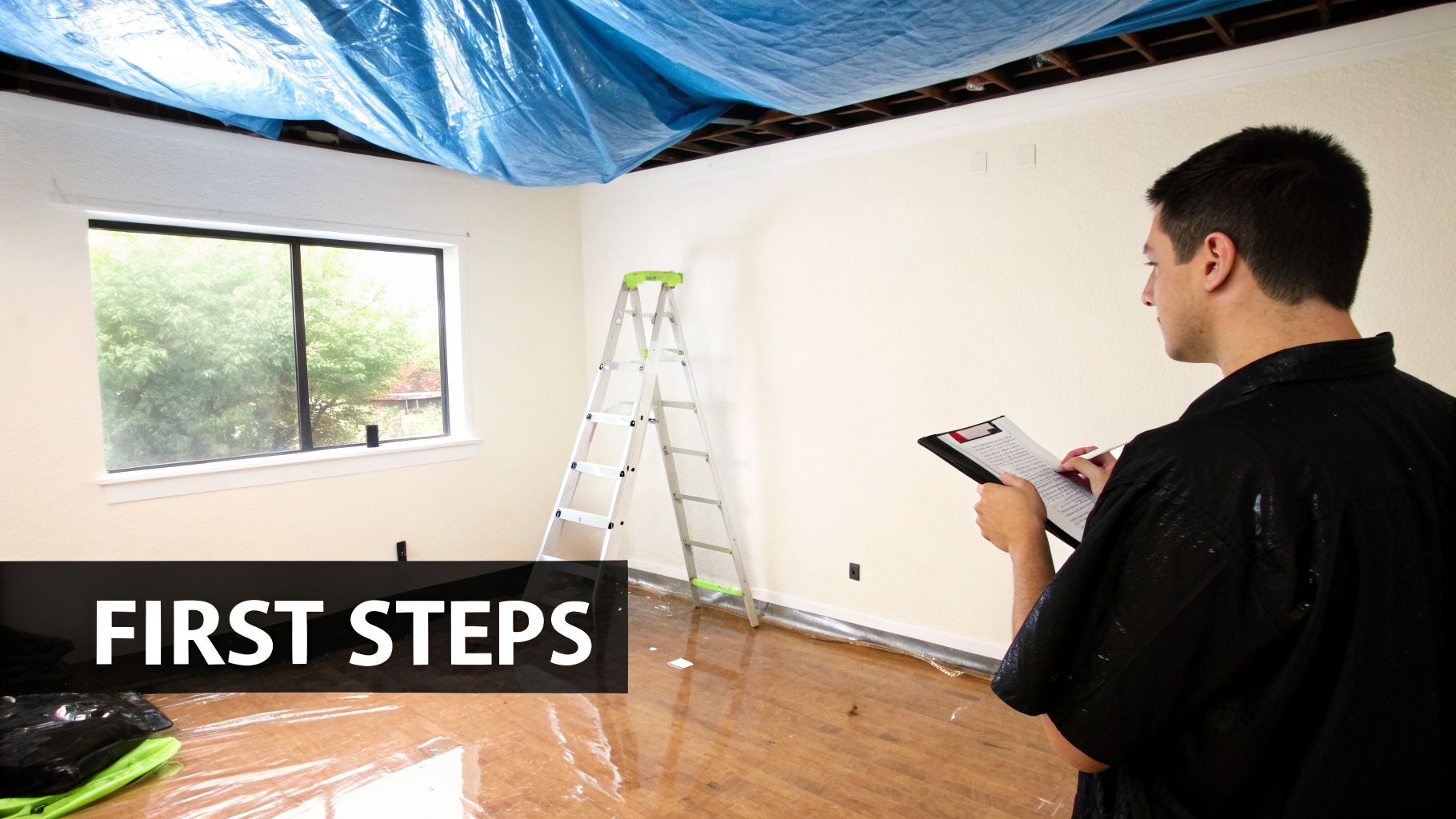
The first 24 hours after a fire, a burst pipe, or a major storm are chaotic. Amid the stress and confusion, the actions you take right away are absolutely crucial. They not only protect your family and property from further harm but also set the stage for your entire insurance claim. Your priorities are simple: stay safe, stop the damage from getting worse, and get the claims process started.
Secure the Scene and Prevent More Damage
Before you even think about insurance, your first job is to make sure everyone is safe. If your home's structure feels unstable or you suspect a gas leak or fire risk, get out immediately and call 911.
Once you know the area is secure, your policy actually requires you to take reasonable steps to mitigate further damage. This doesn't mean you should hire a contractor and start rebuilding. It's about taking temporary, protective measures to prevent a bad situation from becoming a catastrophe.
- Tarp a damaged roof. If a storm tears off shingles, a tarp is your best defense against the rain that will inevitably follow, preventing serious interior water damage.
- Board up broken windows. This protects your home from the weather, but it also secures it against theft after a break-in or storm.
- Shut off the main water valve. For a burst pipe, this is the single most important thing you can do. It stops the source of the flooding and limits the scope of the damage.
Crucial Tip: Hold on to every receipt for materials you buy for these quick fixes, like tarps, plywood, or locks. These costs are almost always reimbursable and are considered part of your claim.
To help you stay focused during a stressful time, here's a quick checklist of what to do in those first critical hours.
Immediate Action Checklist After Home Damage
This table is your quick reference guide for what to prioritize within the first 24 hours of discovering damage to your home.
| Action Step | Why It's Important | Pro Tip |
|---|---|---|
| Confirm Everyone's Safety | Your family's well-being is the absolute top priority. Property can be replaced; people can't. | If you have to evacuate, have a pre-planned meeting spot so you can account for everyone quickly. |
| Mitigate Further Damage | Your policy requires it, and it prevents a small problem from escalating into a much larger, more expensive one. | Take photos before and after you make temporary repairs. This proves the initial damage and shows you acted responsibly. |
| Notify Your Insurer | This officially starts the clock on your claim and gets the process moving. | Have your policy number handy when you call to speed things up. It's usually on your policy declarations page. |
| Start a Claim Journal | This creates a reliable record of every conversation, deadline, and detail, which is invaluable later. | Use a simple notebook or a note-taking app. Log the date, time, who you spoke with, and what was said. |
Following these steps methodically will help you maintain control and build a strong foundation for the rest of your claim.
Making the First Call to Your Insurer
With the immediate emergency under control, it's time to officially notify your insurance company. This first phone call is what kicks the whole claims process into gear.
Unfortunately, you need to be prepared for a potentially long road ahead. The 2025 J.D. Power U.S. Property Claims Satisfaction Study revealed that claim cycle times have stretched to record lengths, now averaging over 44 days from the first notice to the final payment. You can see the full research from J.D. Power to understand how these delays are affecting homeowners across the country.
To make that first call as productive as possible, have this information ready:
- Your Policy Number: This is the key to your account.
- A Brief Description of the Damage: Be clear and factual. "A pipe burst under the bathroom sink, flooding the first floor" is much better than "There's water everywhere."
- The Date and Time of the Incident: Be as specific as you can.
Start a Claim Journal Immediately
From the moment you hang up after that first call, grab a notebook or open a new digital document and start your claim journal. This is non-negotiable.
Document every single interaction: the date, the time, the name and title of the person you spoke with, and a summary of what was discussed. This journal will become your bible for the claim, helping you track promises, follow up on deadlines, and hold your insurer accountable.
Bringing in an expert public adjuster like Mai & Associates from day one can also give you immediate guidance and advocacy, ensuring you start the process on the strongest possible footing. Before disaster strikes, it's also wise to read through our comprehensive guide on California home insurance to get a better handle on what your policy actually covers.
Building an Unshakable Claim with Strong Evidence
Once the immediate crisis has passed, your focus has to shift. This is the moment that truly defines the outcome of your claim: gathering proof. A successful claim isn’t built on what you say happened, but on the undeniable evidence you can present. A few quick phone pictures won't cut it—you need to build a rock-solid case for your recovery.
Think of yourself as the lead investigator of your own loss. Every receipt, photo, and invoice you can find helps your adjuster understand the true scope of what you’ve lost and justifies the settlement you deserve.
Create a Master Inventory of Damaged Items
The absolute cornerstone of your claim is a detailed list of everything—and I mean everything—that was damaged or destroyed. Don't be vague. “Sofa” and “television” are just words; they don't communicate value. The more specific you are, the stronger your position becomes. This diligence applies whether you're filing a home insurance claim or a renters insurance claim.
For every single item, try to nail down these details:
- Item Description: Get specific with the brand, model number, and any unique features.
- Purchase Date: When did you acquire it? An estimate is fine if you don't know the exact date.
- Original Cost: What did you pay? Find receipts or old statements if you can.
- Condition Before Loss: Be honest. Was it brand new, in good shape, or well-loved?
- Estimated Replacement Cost: Research what it would cost to buy a new, similar item today.
The difference this makes is enormous. Listing "laptop" might get you a check for a basic Chromebook. Documenting a "16-inch MacBook Pro, M3 Max Chip, purchased in 2024 for $3,499" ensures you’re compensated for what you actually owned.
A meticulous inventory is your most powerful negotiating tool. It transforms your claim from a vague request into a specific, itemized, and justifiable demand for reimbursement.
This applies to all your belongings, not just the big-ticket electronics. The combined value of smaller things like books, kitchen tools, and clothing can easily run into the tens of thousands of dollars during a major event. Don't leave that money on the table. For more tips on organizing your insurance documents, you might be interested in checking out our other guides.
Backing It Up with Proof
With your detailed inventory complete, it's time to play detective and find the proof to back it all up. Thankfully, most of us leave a digital trail that can be incredibly useful here. Hunt down any records that prove ownership and value.
Real-World Scenario: A Kitchen Fire in San Diego
Let's say a grease fire torches your kitchen. The custom cabinets are charred, the granite countertops are cracked from the intense heat, and your high-end appliances are a total loss.
Your evidence package should include:
- The Contractor's Invoice: The paperwork from your 2022 kitchen remodel showing you invested $45,000 in custom work and premium materials.
- Digital Receipts: That email confirmation from Best Buy for the $3,200 smart refrigerator you were so proud of.
- Credit Card Statements: The Visa bill that clearly lists the $1,500 charge for your Bosch dishwasher.
This collection of documents proves you didn't just have a kitchen; you had a high-quality, recently updated one. It justifies a replacement cost far beyond what an adjuster might assume for a "standard" builder-grade kitchen.
Documenting the Invisible Damage from Wildfires
Gathering evidence gets more complex when the damage isn't immediately obvious. Take, for example, a home in Sonoma County that escaped a wildfire's flames but was saturated in thick, acrid smoke for days on end.
The damage is real and expensive, even if you can’t see a single burn mark.
- Professional Cleaning Quotes: Contact remediation companies that specialize in smoke and ash cleanup. Their detailed estimates become proof of the cost to professionally clean your HVAC system, ductwork, carpets, and furniture.
- Photos of Ash and Soot: Get up close. Take pictures of the fine layer of soot on windowsills, inside cabinets, and on any surfaces. This shows the smoke wasn't just outside—it got in.
- Inventory of Soft Goods: Make a list of everything that has absorbed that persistent smoke odor, like curtains, clothes, rugs, and upholstered furniture. These items are often impossible to fully clean and will need to be replaced.
Without this kind of specific evidence, an adjuster might only approve a basic surface cleaning. By proving how deeply the smoke penetrated your home, you build an undeniable case for the extensive and costly work required to make your home safe and livable again. This is what it takes to navigate the home insurance claims process successfully in California.
Working With the Adjuster and Managing Your Claim Timeline
Once you’ve done the hard work of documenting your loss, you’ll enter what is arguably the most critical part of the process: dealing with the insurance adjuster. This is the person your insurance company sends to inspect the damage, and their report is the foundation of your settlement offer.
Your insurer will send either a company adjuster (their own employee) or an independent adjuster (a third-party contractor). It doesn't matter which one shows up; their job is the same. And here's the crucial thing to remember: they work for the insurance company, not for you. Their goal is to evaluate the damage based on the fine print of your policy and close the file.
Gearing Up for the Adjuster's Visit
Think of the adjuster’s inspection as your chance to make your case. You absolutely must be there for it—never let an adjuster walk your property alone. This is your opportunity to control the narrative and point out every single detail.
Preparation is everything. You need to have your evidence lined up and ready to go.
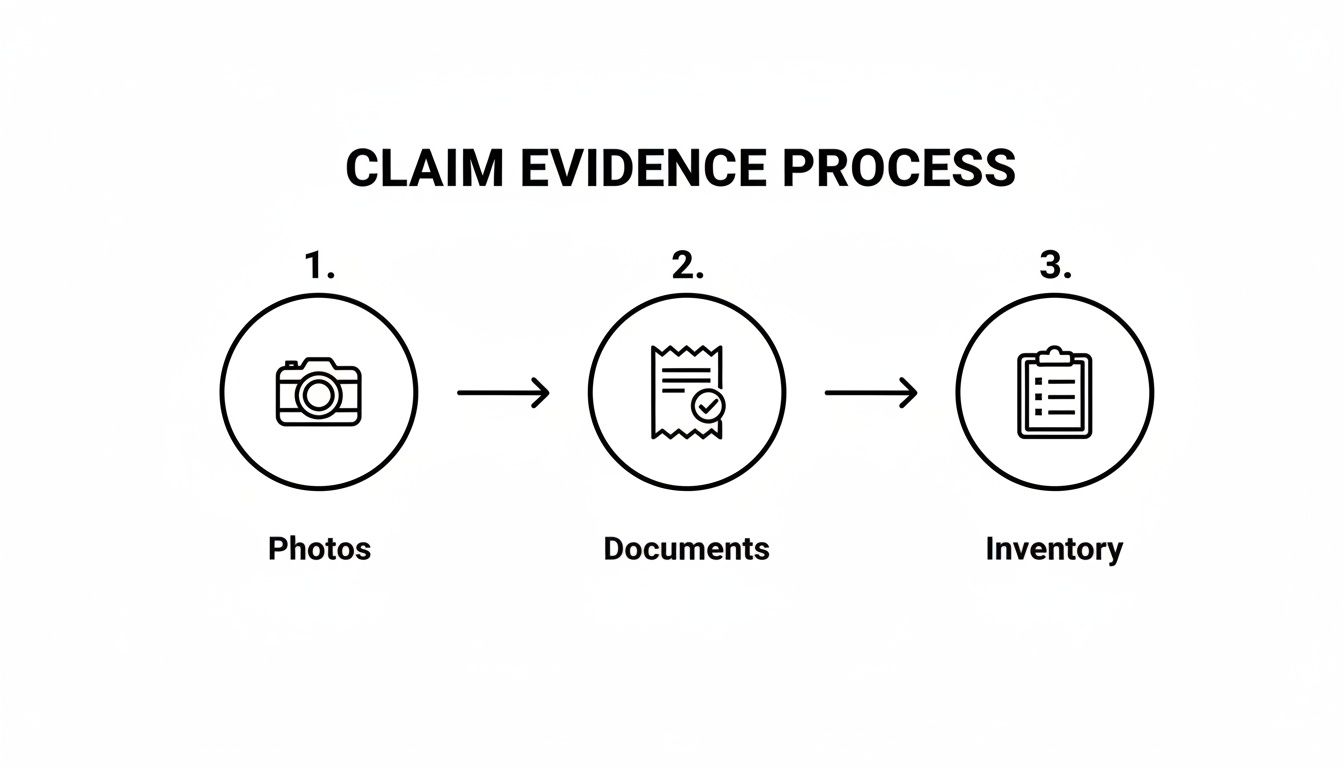
As you walk the property with them, be their guide. Point out the cracked foundation hidden behind a bush, the smoke smell that has permeated the drywall, or the water damage on the underside of the subfloor. Hand them a physical copy of your detailed inventory and repair estimates. When you present a well-organized, professional case, it sends a clear signal that you're on top of things.
Key Questions to Ask the Adjuster
This meeting is a two-way street. Don't be afraid to ask direct questions to get a clear picture of what comes next.
- From what you can see right now, what's your initial take on the damage?
- When can I expect to receive your full report and the settlement offer?
- Is it possible to get an advance payment for immediate expenses like temporary housing?
- What are the next steps, and is there anything else you need from me?
- What’s the best way to send you additional receipts or repair bids I get?
Your ability to manage the conversation and present your evidence lays the groundwork for successful Adjuster Negotiation. It's not about being confrontational; it's about being prepared.
How to Handle Inevitable Delays and Timelines
In a perfect world, claims would move quickly. But we don't live in a perfect world. While California has laws about how quickly insurers must act, delays are common—especially after a widespread disaster like a wildfire that floods the system with thousands of claims at once.
The numbers don't lie. In 2024, the home insurance industry saw all-peril claim severity jump by 9% over the prior year, driven by 27 separate billion-dollar climate disasters. Since 2019, the cost of claims has skyrocketed by 49.7% thanks to soaring prices for labor and building materials. These pressures inevitably slow things down.
Our Advice: Be the squeaky wheel, but be a polite one. Consistent, professional follow-up is the only way to ensure your file doesn't end up at the bottom of a very tall stack. Keep a detailed log of every call, email, and conversation in your claim journal.
Understanding potential roadblocks can help you manage expectations and take proactive steps.
Common Claim Delays and How to Respond
| Common Delay | Potential Cause | Your Proactive Strategy |
|---|---|---|
| Initial Contact Lag | High claim volume (especially after a major event like a wildfire or storm); staffing shortages. | Follow up with a polite email and phone call 24-48 hours after your initial filing if you haven't heard back. |
| Adjuster No-Show/Reschedule | The adjuster is overbooked with multiple inspections in your area. | Immediately call the claims department to report the no-show and get a firm date for the rescheduled visit. Confirm via email. |
| Slow Report Processing | Complex damage assessment; need for specialist reports (e.g., engineer, roofer); backlogs with the adjuster's supervisor. | After the inspection, get a timeline from the adjuster for their report. If that date passes, follow up with them and their supervisor in a single email. |
| "Under Review" Limbo | The claim may be close to a policy limit, involve complex coverage questions, or have been flagged for potential issues. | Send a formal, written request (email is fine) for a specific explanation of what is being reviewed and a timeline for when the review will be complete. |
If you feel your claim has completely stalled, it's time to escalate. A formal email to both the adjuster and their direct supervisor, calmly recapping the timeline and asking for an immediate update, can work wonders. It creates a paper trail and often gets your file the attention it deserves.
Handling California-Specific Wildfire and FAIR Plan Claims
Living in California comes with a trade-off. We get the stunning landscapes and incredible lifestyle, but we also live with the ever-present risk of wildfire. When disaster strikes, navigating an insurance claim is already stressful, but a wildfire claim is a whole different beast. It's even more complicated for the growing number of us who rely on the California FAIR Plan.
Let's walk through what you need to know for these unique and often frustrating situations, from tracking down hidden smoke damage to understanding the critical gaps in last-resort insurance.
Mastering the Wildfire Claim Beyond the Flames
Even if your home is still standing after a fire, the fight isn't over. The damage from smoke, ash, and intense heat can be devastating and sneaky, causing thousands in damage that you might not spot right away. Your insurance company might not be looking for it, so it's up to you to be your own best advocate.
Your proof of loss needs to go far beyond just what burned. I always tell my clients to focus on these often-missed details:
- Smoke and Ash Infiltration: Get photos of the thin film of soot on everything. I'm talking about window sills, the inside of your kitchen cabinets, and especially your HVAC system. This shows the contamination isn't just surface-level; it's invaded your entire home.
- Exterior Heat Damage: The intense radiant heat from a nearby fire can melt vinyl siding, crack stucco, and destroy the seals on your windows, setting you up for major moisture problems down the road. Get close-up shots of any bubbling, warping, or discoloration.
- Odor in Soft Goods: Smoke odor gets deep into the fibers of clothes, curtains, rugs, and furniture. A simple cleaning often won't cut it, meaning these items must be replaced. Create a detailed inventory.
One of the most important parts of your wildfire claim is maximizing your Additional Living Expenses (ALE) coverage. If you've been evacuated, this is your lifeline. Keep every single receipt for hotels, meals, and anything else you have to buy while you're displaced. The burden of proof is on you.
If you live in a high-risk area, understanding your local insurance landscape is half the battle. Our guide to home insurance in Santa Rosa is a good place to start for more regional insights.
Understanding the California FAIR Plan
With traditional insurance carriers pulling out of high-fire-risk zones, hundreds of thousands of Californians now have policies through the California FAIR Plan. You absolutely have to understand what this plan is—and more importantly, what it isn't.
Think of the FAIR Plan as a safety net, not a full policy. It's a last-resort insurer that provides basic, fire-only coverage for your home's structure when no one else in the private market will. While it's certainly better than having no protection at all, relying on the FAIR Plan by itself is a huge financial gamble.
The Critical Need for a DIC Policy
Here's the catch: a standard FAIR Plan policy only covers damage from fire, lightning, and internal explosion. That's it. It offers zero coverage for some of the most common and costly homeowner claims.
This is where a Difference in Conditions (DIC) policy comes in. A DIC policy is a completely separate policy you purchase from a private insurer that essentially "wraps around" your FAIR Plan coverage to fill in the most dangerous gaps.
I saw this happen to a client in Malibu. He had a FAIR Plan policy for fire protection. When a winter storm caused a pipe to burst and flood his entire ground floor, the FAIR Plan paid $0 because water damage wasn't a covered peril. Without a DIC policy, he would have been on the hook for tens of thousands in repairs out of his own pocket.
A good DIC policy is designed to cover the things the FAIR Plan ignores:
- Water damage from burst pipes or leaky appliances
- Theft and vandalism
- Personal liability (if someone gets hurt on your property)
- Medical payments to others
Pairing the FAIR Plan with a solid DIC policy is the only way to get protection that resembles a traditional homeowners policy. It’s a two-part solution that can be tricky to get right. An experienced agent at Mai & Associates can help you piece this puzzle together, ensuring you have the right DIC policy or even helping you find a private market option you might have missed.
Contesting a Low Settlement and Maximizing Your Payout
Getting that first settlement offer from your insurance company can be a moment of relief, but all too often, it’s a moment of sticker shock. What do you do when the number on the page doesn't even come close to what you know it will cost to fix your home?
This isn't the end of the road. It’s actually a very common point in the claims journey. The initial offer is just that—an offer. Now, it's time to negotiate, and the key is to be prepared.
Responding to a Lowball Offer
When you get an offer that seems unfairly low, take a breath. Your immediate reaction might be frustration, but the best response is a calm, organized, and written one. You need to formally reject the offer and state your intention to provide more information that justifies a fair settlement. This simple letter protects your rights and officially opens the door for negotiation.
Your power in this conversation comes from the evidence you’ve been gathering all along. This is where all that hard work documenting your loss with photos, videos, a detailed home inventory, and contractor estimates really pays off.
Your written response needs to surgically break down the differences between the insurer's estimate and your real-world costs. For example, if the adjuster's estimate for replacing your roof is $15,000, but you have three detailed bids from local roofers averaging $22,000, you need to present those bids as concrete evidence.
Pinpoint the exact line items where their numbers fall short. You could create a simple table comparing their figures to yours, or just state it clearly in your letter. For instance:
"Your estimate for drywall repair does not account for the necessary smoke remediation, which is detailed in the attached quote from XYZ Restoration."
It's important to understand the bigger picture. Claims are getting more expensive for insurance companies. In fact, wind and hail damage alone accounted for 42% of all insured home losses from 2018 to 2022. By 2024, the cost of these events ballooned to a staggering $58 billion, with roof claim costs approaching $31 billion. This has led to average deductibles jumping by 24.5% for 2025. You can learn more about these trends in the 2025 home insurance report. This context helps explain why insurers are scrutinizing claims, but it doesn’t excuse an unfair settlement.
Invoking the Appraisal Clause in Your Policy
What if you've sent your evidence and are still at a complete standstill? If you and your insurer are just too far apart on the cost of the damage, your policy has a built-in dispute resolution tool: the appraisal clause.
This isn't for arguing about whether something is covered—it’s strictly for settling disagreements on the price tag of covered damages.
The process is fairly straightforward. You’ll hire your own independent appraiser, and the insurance company will hire theirs. These two experts review all the evidence and try to come to an agreement on the amount of your loss. If they can’t agree, they select a neutral "umpire" who will listen to both sides and make a final, binding decision on the value.
Invoking appraisal is a serious step and can be incredibly effective. It signals to the insurer that you won't be pushed around. Just be aware that it comes with costs—you’ll pay for your appraiser and half of the umpire’s fee.
The Role of a Public Adjuster
At any point in this process, especially when you feel outgunned or overwhelmed by a low offer, you have the right to bring in your own expert: a public adjuster.
Unlike the adjuster sent by your insurance company (who works for them), a public adjuster works for you. Their entire job is to manage your claim, document the loss, and negotiate with the insurer on your behalf to get you the maximum possible payout. Just as you want an expert helping with your car insurance or life insurance, having a pro for your home insurance claim can be a game-changer.
Public adjusters typically work on a contingency fee, meaning they are paid a percentage of the final settlement. While this means sharing a piece of the pie, their expertise often results in a significantly higher settlement that more than covers their fee. Having a dedicated advocate like the team at Mai & Associates can provide the professional leverage you need to level the playing field.
As you navigate these discussions, you'll encounter a lot of specific terminology. You can find clear definitions for these terms in our detailed insurance glossary.
Answering Your Lingering Questions About California Home Insurance Claims
Even after you’ve taken all the right steps, the claims process can feel like a maze. It’s natural to have questions pop up along the way. Let's walk through some of the most common concerns I hear from California homeowners.
Should I Bother Filing a Claim for Minor Damage?
This is a tough one, and honestly, the answer is usually no. It all comes down to your deductible.
Think of it this way: if your deductible is $2,500 and a windstorm does $2,800 of damage to your fence, you’d only get $300 from the insurance company. That small payout just isn't worth the potential headache. Filing that claim could cause your premium to jump at renewal, quickly wiping out that $300 and then some.
My advice? Save your insurance for the big stuff. Multiple small claims in a short time can get you flagged as high-risk, leading to higher rates or even getting your policy dropped. It’s better to handle the small repairs out-of-pocket, which is sound advice for both home and auto insurance.
Can My Insurer Really Cancel My Policy After I File a Claim?
It's a huge worry for homeowners, but California law offers some solid protection. Your insurance company generally can't non-renew your policy just because of a single claim, especially if it was tied to a declared disaster like a wildfire.
However, a pattern of claims—say, two claims in three years—is a different story. That can make an insurer see you as a higher risk and decide not to renew your policy. If they do make that call, they are required by law to give you 75 days' notice before your policy expires. This is another great reason to be strategic about when you file.
How Long Does an Insurer Have to Settle My Claim in California?
The state sets some pretty firm deadlines to prevent things from dragging on forever. Once you report a loss, your insurer has 15 calendar days just to acknowledge they received it and send you the right forms.
After you submit your completed proof-of-loss paperwork, the clock starts again: they have 40 days to investigate and either approve or deny your claim. If they approve it, they must issue payment within 30 days. Keep in mind, these are the minimums. In the chaos following a major wildfire or earthquake, expect delays.
What Exactly Is Covered by Additional Living Expenses (ALE)?
Additional Living Expenses (ALE), sometimes called 'Loss of Use,' is one of the most important parts of your policy. If a covered loss forces you out of your house, ALE is what pays for the increase in your normal living costs.
This isn't a blank check, but it covers essentials like:
- Rent for a temporary apartment or long-term hotel stays.
- The cost of restaurant meals if you don't have a kitchen.
- Rental furniture for your temporary place.
- Extra gas for a longer commute.
- Even laundromat costs if you lack a washer and dryer.
You have to be a fanatic about saving every single receipt to get reimbursed. This coverage is also capped, either by a dollar amount (often 30% of your dwelling coverage) or a time limit (like 24 months). In California’s tough rebuilding market, knowing your ALE limits is absolutely critical.
Different types of damage can also trigger this coverage. For instance, people often want to know what their homeowners insurance covers for Big Bear plumbing disasters, because a major pipe burst can easily make a home unlivable while repairs are underway.
Navigating the claims process is complex, but you don’t have to do it by yourself. Whether you’re fighting a denied claim, struggling with the California FAIR Plan, or simply want an expert to review your policy before something happens, professional guidance makes all the difference. The team at Mai & Associates is here to help Californians find insurance solutions that truly protect them, from home and auto insurance to renters and life insurance.