Your Guide to the California HO 2 Policy
When you're looking into homeowners insurance, you'll quickly find there isn't just one type. One policy you might come across is the HO-2, and it works a little differently than the others. It's what we in the industry call a "named perils" policy, meaning it protects your home and belongings only from a specific list of 16 potential disasters.
If an event is on that list, you're covered. If it’s not, you’re not. This makes it a very black-and-white, and often more affordable, type of home insurance.
What Is a California HO 2 Policy?
Let's use an analogy. Think of some home insurance policies as an all-you-can-eat buffet—they cover almost everything unless it's explicitly excluded. An HO-2 policy, on the other hand, is like ordering from a set menu. You get coverage for 16 specific events, or "perils," that are spelled out in your policy documents.
This "named peril" approach is the core of an HO-2, also known as a "broad form" policy. The major trade-off is that if something damages your home and it's not on that predefined list, your policy won't pay for the repairs. The upside? This clear-cut structure often leads to lower premiums, which can be a welcome relief for California homeowners dealing with a high cost of living.
Understanding the 16 Named Perils
The HO-2 isn't a new concept. It actually played a big role in shaping modern home insurance after being tested in markets like California back in the early 1950s. It was created to expand on more basic plans by establishing a standard list of covered events, which helps explain why it's still around as a solid middle-ground option for property owners. For a deeper dive into how these insurance forms evolved, you can check out this guide on HO-2 policies.
One of the biggest strengths of an HO-2 is its clarity. There’s no guessing involved; you know precisely what you’re protected against from day one. Here’s a breakdown of the 16 perils that a standard HO-2 policy covers.
The 16 Named Perils Covered by an HO 2 Policy
This table lists every event that your broad form policy will cover. If it’s not on this menu, it’s not included.
| Covered Peril | Description |
|---|---|
| Fire or Lightning | Damage caused by fire, smoke, or a lightning strike. |
| Windstorm or Hail | Damage to your home's exterior or interior from high winds or hail. |
| Explosion | Damage from both internal (e.g., furnace) and external explosions. |
| Riot or Civil Commotion | Coverage for damage that occurs during public unrest. |
| Aircraft | Protection if an aircraft or its parts crash into your property. |
| Vehicles | Damage from a car or other non-owned vehicle hitting your property. |
| Smoke | Damage from sudden and accidental smoke (e.g., from a faulty appliance). |
| Vandalism or Malicious Mischief | Covers intentional damage or destruction of your property. |
| Theft | Protects your personal belongings if they are stolen from your home. |
| Falling Objects | Damage caused by objects falling from above, such as tree limbs or satellites. |
| Weight of Ice, Snow, or Sleet | Structural damage from the heavy accumulation of ice or snow. |
| Accidental Water/Steam Discharge | Damage from accidental overflow of water or steam from plumbing, HVAC, or appliances. |
| Sudden & Accidental Tearing Apart | Damage from a system like a water heater suddenly cracking, burning, or bulging. |
| Freezing | Covers damage from the freezing of plumbing, heating, or AC systems. |
| Sudden & Accidental Electrical Damage | Damage from artificially generated electrical currents (e.g., power surges). |
| Volcanic Eruption | Covers damage from lava flow, ash, dust, or shockwaves from a volcano. |
Because this list is so specific, an HO-2 can be a great starting point for first-time homebuyers or anyone transitioning from renters insurance to homeowners coverage. The money you save on premiums could even be redirected to other crucial financial protections, like a solid car insurance policy or a life insurance plan.
To get more comfortable with these and other insurance terms, our California insurance glossary is a fantastic resource to explore.
How an HO 2 Policy Protects Your Home
Knowing that an HO 2 policy only covers a specific list of 16 named perils is one thing, but what does that actually look like when disaster strikes? Let's move beyond the definitions and see how this policy springs into action to get you back on your feet.
Think of your policy not as a single document, but as a toolkit with different parts, each designed for a specific job. When a covered event happens, these coverages work together to handle the financial side of recovery, from rebuilding the walls to covering your hotel bill.
The Core Components of Your HO 2 Coverage
Every HO 2 policy is built around a few key areas of protection. When you file a claim for a named peril—like a fire or a sudden pipe burst—these components coordinate to make you whole again.
Here’s a breakdown of the moving parts inside a typical HO 2 plan:
Coverage A (Dwelling): This is the big one. It covers the physical structure of your house itself—the roof, walls, foundation, and even built-in systems like your plumbing and electrical.
Coverage B (Other Structures): This handles structures on your property that aren't attached to the house. We're talking about your detached garage, that tool shed in the back, or the fence around your yard.
Coverage C (Personal Property): This is for all your stuff inside the house. It helps you replace everything from furniture and electronics to your clothes and kitchenware.
Coverage D (Loss of Use): If a covered disaster forces you out of your home during repairs, this coverage is a lifesaver. It pays for necessary additional living expenses, like a hotel stay, restaurant meals, and other costs you wouldn't normally have.
A Real-World Scenario: A Kitchen Fire
Let’s put this into practice. Imagine a grease fire breaks out in your kitchen—a scary but all-too-common scenario for California homeowners. The fire department puts it out, but your kitchen is a wreck.
Here’s how your HO 2 policy would step in:
First, Dwelling Coverage (A) would pay to repair the structural damage. This includes replacing charred kitchen cabinets, fixing the smoke-damaged drywall, and repainting soot-stained ceilings.
Next, Personal Property Coverage (C) helps you replace your ruined belongings. That melted microwave, the destroyed cookware, and any other items damaged by the fire and smoke would be covered.
Finally, since the smoke and ongoing repairs make your home unlivable, Loss of Use Coverage (D) kicks in. It would cover the cost of a temporary rental or hotel, so your family has a safe place to stay while your home is being restored.
This is why having the right California insurance is so crucial. It’s a coordinated system designed to support you. Of course, being prepared yourself makes a huge difference. For example, knowing what to do immediately to minimize damage from a burst pipe can dramatically reduce the final repair bill and streamline your claim.
Replacement Cost vs. Actual Cash Value: A Crucial Detail
When it comes to your belongings under Coverage C, there’s a critical detail you need to understand in how your policy pays out.
An HO-2 policy typically covers your personal property on an Actual Cash Value (ACV) basis. This means the insurance company pays you what the item was worth the moment before it was destroyed, factoring in depreciation from age and use.
So, that laptop you bought for $1,200 five years ago? Its ACV might only be $300 today. In contrast, Replacement Cost Value (RCV) coverage would give you enough money to buy a brand-new, similar laptop. While RCV is often standard on more comprehensive policies, you can usually add it to an HO-2 as an endorsement for much better protection.
To dig deeper into finding the right level of protection for your needs, you can explore our complete guide to home insurance in California.
Comparing HO-2 vs. HO-3 and HO-5 Policies
Picking the right homeowners policy can feel like you're trying to read a foreign language. But once you understand the basic DNA of the most common options—the HO-2, HO-3, and HO-5—it all starts to click. For California homeowners, knowing these differences is key to making a smart choice.
Think of it like ordering from a menu. The HO-2 policy is your "named special." You get a clear, specific list of 16 covered disasters. If a problem isn't on that list, it's not covered. It’s a no-frills, what-you-see-is-what-you-get kind of deal.
The Hybrid and All-Inclusive Options
Moving up the ladder, you'll find the HO-3 policy. This is, by far, the most common policy homeowners choose. It works like a hybrid: think of it as an "all-you-can-eat" buffet for your house's structure, but a "named special" menu for your personal belongings. It covers your home against everything except for what the policy specifically excludes.
Then there's the HO-5 policy. This is the top-tier, all-inclusive package. It provides the broadest protection by covering both your home’s structure and your personal property for "open perils"—meaning everything is covered unless it's explicitly on the exclusion list.
This diagram breaks down the fundamental protections you'll find in a standard HO-2 policy.
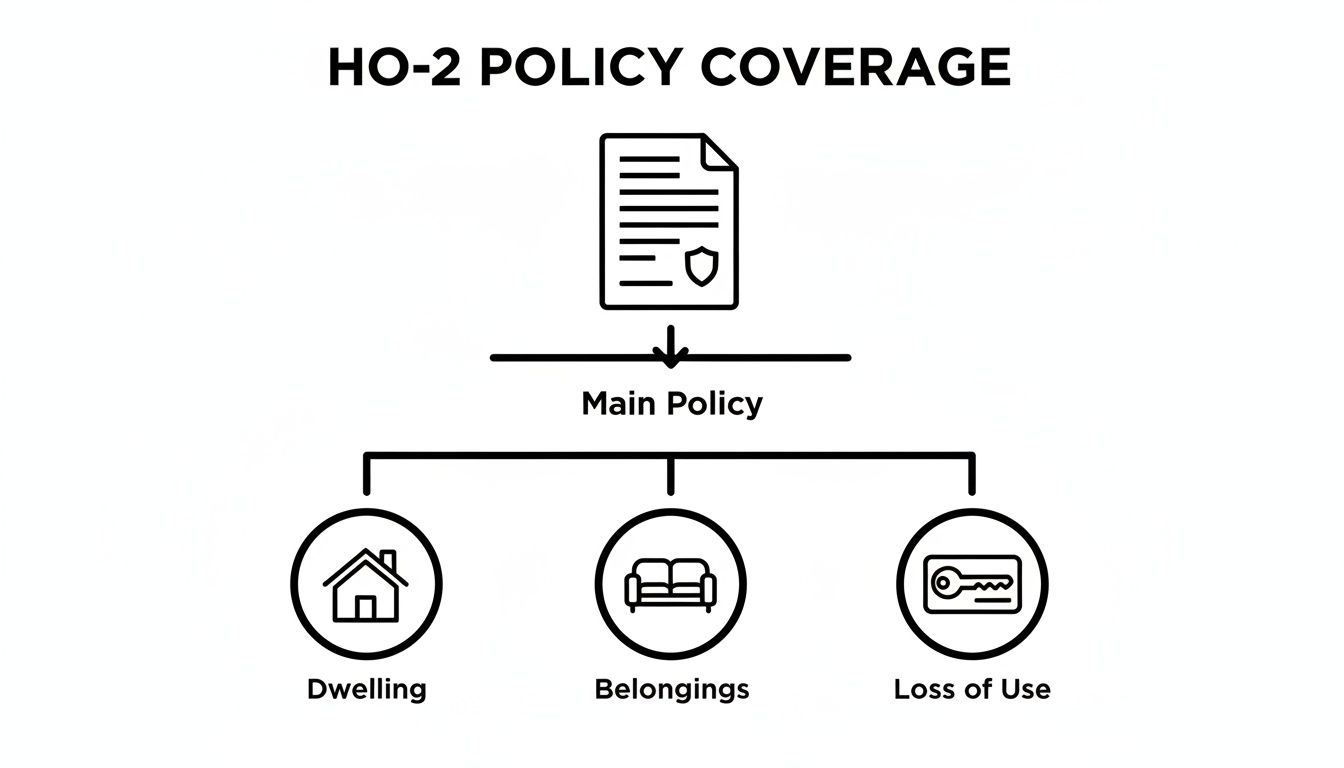
As you can see, it provides a solid foundation, covering your dwelling, your stuff, and the extra costs if you're forced to live elsewhere after a disaster.
To really get a feel for how these policies stack up, let's put them side-by-side. The table below highlights the crucial differences in how they protect your home and your belongings.
HO-2 vs. HO-3 vs. HO-5 At a Glance
| Feature | HO-2 (Broad Form) | HO-3 (Special Form) | HO-5 (Comprehensive Form) |
|---|---|---|---|
| Dwelling Coverage | Named Perils | Open Perils | Open Perils |
| Personal Property | Named Perils | Named Perils | Open Perils |
| Best For | Budget-conscious homeowners | The average homeowner | High-value homes and assets |
| Typical Cost | Lower | Moderate | Higher |
The main takeaway here is the shift from "named perils" (you're only covered for what's listed) to "open perils" (you're covered for everything unless it's explicitly excluded). This is the single biggest factor affecting both your protection and your premium.
Why an HO-2 Policy Stands Out for Budget-Conscious Californians
In the current market, HO-2 policies are gaining traction for one simple reason: they are incredibly cost-effective. Data from 2026 confirms that an HO-2 offers solid protection against 16 common disasters at a noticeably lower price point than an HO-3.
This is a big deal in California, where skyrocketing premiums for home insurance have become the norm. While the HO-2 makes up just 6.71% of policies compared to the HO-3's massive 78.16% market share, it's carving out a vital niche for homeowners who need reliable coverage without the hefty price tag.
That cost advantage isn't just about saving a few dollars. It's a strategic move. By opting for an affordable but dependable HO-2 policy, you can protect your biggest investment while freeing up cash.
The savings from an HO-2 can be redirected to beef up other critical parts of your financial safety net. It could mean finally getting the right auto insurance policy or securing a proper life insurance plan for your family's future.
This balanced approach helps you build a comprehensive protection strategy that fits your budget. It’s a practical way to manage risk, especially if you're a first-time homebuyer or just looking to be smarter with your money. To get more ideas on building out your California insurance plan, feel free to browse our other insurance guides.
When you're looking at California insurance, every policy is a balancing act between how much coverage you get and how much you pay for it. The HO-2 policy is a classic example of this trade-off.
Deciding if it's right for you means getting honest about its strengths and weaknesses, and seeing how they line up with your budget and how much risk you're willing to take on.
The Major Pro: It's Easier on Your Wallet
Let's start with the biggest plus: an HO-2 policy is almost always cheaper than its cousins, the HO-3 and HO-5. In a state like California where every dollar counts, those savings on your premium can make a real difference.
For first-time buyers, young families, or anyone keeping a close eye on their monthly bills, the lower cost of an HO-2 policy is a huge relief. That extra money isn't just gone—it's freed up.
Think of it this way: the savings on your home insurance policy could be the key to affording a better car insurance plan or finally setting up the life insurance your family needs. You're strategically building a broader financial safety net.
This makes the HO-2 a sensible option for people who need solid, no-frills protection for their home without paying top dollar for bells and whistles. It's about getting the essentials covered while keeping your expenses in check.
The Major Con: The "Named-Peril" Catch
So, what's the catch? It all comes down to how an HO-2 policy works. It's a "named-peril" policy, which is exactly what it sounds like. You're only covered for damage caused by one of the 16 specific perils named in the policy document.
If a disaster strikes and it's not on that exclusive list, you're on your own. The cost of repairs comes straight out of your pocket. This creates potential blind spots in your coverage that you just don't have with more comprehensive "open-peril" policies.
What kind of things might not be covered?
- Pest Problems: Damage from termites, rodents, or other critters is a common exclusion.
- Grid-Related Power Surges: A surge from a lightning strike is covered, but one that comes from the utility company's equipment generally isn't.
- A Settling Foundation: Cracks and damage from your house settling over time are considered maintenance issues, not a sudden disaster.
- Most Mold Issues: Unless the mold is the direct result of a covered problem, like a burst pipe that was immediately fixed, you'll likely have to pay for remediation yourself.
This is the fundamental trade-off of an HO-2 policy. You're accepting a very specific, limited list of protections in exchange for a lower premium. It's vital to look at that list of 16 perils and ask yourself honestly, "Is this enough to let me sleep at night?"
When an HO 2 Policy Makes Sense in California
Let's be honest: finding affordable home insurance in California can feel like an impossible task. Between wildfire risks and ever-rising premiums, it’s easy to feel stuck. This is where a little-known but powerful option, the HO-2 policy, comes into the picture as a genuinely smart choice for certain homeowners.
Sure, an HO-2 doesn’t have the all-encompassing "open-peril" coverage of a premium HO-3 or HO-5 plan. But its strength lies in its affordability. It gives you a rock-solid safety net against the 16 most common disasters—think fire, theft, and windstorms—at a price point that makes sense.
This is a huge deal in our state's tough California insurance market. In some high-risk ZIP codes, homeowners are paying 80% more for coverage than their counterparts in safer areas. The financial breathing room an HO-2 provides can be a game-changer. It’s no surprise that HO-2 policies now cover 6.71% of owner-occupied homes in the U.S., a testament to their value for budget-conscious homeowners. You can explore the data on homeowners policy trends to see how these policies fit into the broader market.
Pairing an HO 2 with a California FAIR Plan
One of the most brilliant uses for an HO-2 policy in California is for homeowners using the California FAIR Plan. If you're in a high-risk wildfire area, you might have been forced onto the FAIR Plan as a last resort. The problem? A FAIR Plan policy is dangerously limited on its own.
A California FAIR Plan policy only covers losses from fire, lightning, and internal explosions. It does not include crucial protections like personal liability, theft coverage, or water damage from a burst pipe.
That leaves a massive, frightening gap in your protection. This is where an HO-2 becomes the perfect partner. It effectively "wraps around" the bare-bones FAIR Plan, adding liability coverage and protection for all the other named perils. It transforms a limited policy into a much more comprehensive safety net.
Bridging California's Biggest Coverage Gaps
Even with its advantages, it’s critical to go in with your eyes open about what an HO-2 doesn’t cover. By default, a standard HO-2 policy does NOT include coverage for earthquakes or floods—two of California’s most infamous and destructive risks. These always require separate, specialized policies.
- Earthquake Insurance: This is a must-buy add-on policy to cover the cracked foundations, structural damage, and other devastating losses that a quake can cause.
- Flood Insurance: Typically purchased through the National Flood Insurance Program (NFIP) or a private carrier, this is essential for any home in or near a designated flood zone.
Here’s the strategic upside: the money you save with an affordable HO-2 can make it much easier to budget for these other essential policies. Instead of stretching for one expensive policy, you can build a custom-fit, resilient protection plan that truly covers the risks your property faces.
Final Considerations for California Homeowners
An HO-2 policy can also be a fantastic fit for rental properties or second homes. In those cases, your main goal is often to protect the physical structure against common disasters at a reasonable cost, and an HO-2 does that perfectly. It can even be a more robust alternative to standard renters insurance for those who own investment properties.
The trick is to see the HO-2 not as a lesser product, but as a flexible building block.
Whether you're looking to supplement a FAIR Plan, free up funds for earthquake coverage, or insure a secondary property, the HO-2 provides a path to smart, essential protection. Here at Mai & Associates, our deep expertise in California home and auto insurance means we can help you figure out if this strategy is the right move for you, ensuring your coverage fits both your life and your budget.
Let's Find the Right California Insurance for You
Figuring out California insurance can feel like a full-time job. Between unique risks like wildfires and earthquakes, and a constantly shifting market, going it alone is overwhelming. You don't have to tackle everything from a basic HO-2 policy to a complex protection plan by yourself.
Having an experienced guide in your corner makes all the difference. At Mai & Associates, we take the confusion out of the equation. Forget spending your nights and weekends calling dozens of companies for quotes—we do all the legwork for you. Because we partner with a huge network of top-rated carriers, we can instantly shop the market to find the best coverage at the right price.
Your One-Stop Insurance Partner
Your home is a major part of your financial life, but it’s just one piece of the puzzle. We specialize in looking at the big picture to build a protection plan that covers every part of your world here in California.
Our expertise includes:
- Home Insurance: We can help you find everything from an affordable HO-2 policy to a comprehensive plan for a home in a high-risk area.
- Auto Insurance: We'll track down competitive rates for your car insurance and find all the multi-policy discounts you qualify for.
- Life Insurance: Let us help you put a plan in place to secure your family’s financial future.
- Renters Insurance: We make sure your personal belongings and liability are covered when you're a tenant.
We have years of on-the-ground experience with California’s biggest insurance headaches. This includes navigating the FAIR Plan and finding solid earthquake and wildfire policies. Our job is to build you a real safety net, with no weak spots or dangerous gaps.
Our team is here to give you fast, friendly service and straight answers to your questions. We want to help you build a complete California insurance plan that protects your home, your car, and your family's future.
By looking at your coverage as a whole, we can often find better solutions. For example, bundling your home insurance and auto insurance with one carrier doesn't just simplify your life—it can lead to some serious savings.
Ready to see how straightforward getting the right protection can be? You can get a no-obligation California insurance quote from our team today and take the first step toward feeling confident in your coverage.
Your HO-2 Policy Questions, Answered
When you're digging into the fine print of home insurance, it's natural for questions to pop up. Here are some straightforward answers to the things California homeowners most often ask us about the HO-2 policy.
Does an HO-2 Policy Cover Water Damage from Rain?
This is a great question, and the answer often surprises people. An HO-2 policy does not cover water damage that comes from the outside in, like rain seeping through your roof or floodwaters.
Its water damage coverage is strictly for "sudden and accidental" issues inside your home. Think of a washing machine hose that suddenly bursts or a pipe that lets go under the sink. For protection against rain-driven damage or floods, you'll need to look into specialized coverage, like a separate flood insurance policy.
Can I Bundle an HO-2 Policy with My Auto Insurance?
You bet. In fact, bundling your HO-2 home insurance with your auto insurance policy is one of the easiest ways to save money. Insurance companies reward clients who bring them more business, and those savings usually come in the form of a multi-policy discount.
We partner with a wide range of carriers, so we can shop around to find you the most competitive bundle. It’s a win-win: you get solid protection for your home and car, and you simplify your finances with one provider at a better price.
Bundling isn't just about the discount—it’s about making your life easier. Managing your home insurance and car insurance with a single company means fewer bills to track and one point of contact when you need help.
Is an HO-2 Policy Enough for a Wildfire-Prone Area?
For many Californians, this is the most important question of all. While a standard HO-2 policy includes fire as one of its 16 named perils, it might not be the best fit for a high-risk wildfire zone. The real issue isn't whether fire is covered, but for how much.
Rebuilding costs are incredibly high, and an HO-2's coverage limits might not be enough to make you whole after a total loss. In wildfire-prone areas, we often find that a California FAIR Plan policy combined with a more comprehensive plan provides much more realistic and robust protection. It's crucial to get this right.
Why Is an HO-2 Policy Cheaper Than an HO-3?
It all comes down to how much risk the insurance company is taking on. An HO-2 policy is what’s called a "named-peril" policy. That’s just a fancy way of saying if the cause of damage isn't explicitly on that list of 16 perils, it's not covered. This predictability limits the insurer's exposure.
An HO-3 policy, on the other hand, is an "open-peril" policy for your home's structure. It covers damage from everything except the few specific exclusions listed in the policy. Because the insurance company is on the hook for a much broader range of potential disasters, the premium is higher. Many of our clients find the savings from an HO-2 frees up room in their budget for other important things, like life insurance.
Figuring out California home insurance, auto insurance, and life insurance can feel overwhelming, but you don’t have to go it alone. The team at Mai & Associates is here to help you find the right coverage at the best possible price.
Ready for a simpler insurance experience? Get your personalized quote today from Mai & Associates.