Hit and Run California: Laws and Penalties
California's hit-and-run problem is not a fringe issue. One study summarized in 2022 found 490 fatal hit-and-run crashes in a single year, the most in the country, and those cases made up about 10.1% of all fatal crashes in the state. A later report covering 2019 to 2023 found 2,237 hit-and-run deaths across 2,178 fatal crashes, which averages 447 deaths a year and works out to 5.7 deaths per 100,000 residents CalBizJournal summary of California hit-and-run death totals.
That's the backdrop for hit and run California claims. This isn't just a criminal law issue, it's a coverage issue, a claims issue, and an underwriting issue. If you drive in California, you need to know what the law requires, what insurers pay, and where victims get stuck when the other driver disappears.
Why Hit and Run Is a Massive Problem in California
California's hit-and-run problem is large because too many drivers leave and too many victims never get a clean recovery path. One collision analysis reported 5,719,064 traffic collisions statewide, with 1,083,614 hit-and-run collisions, or 18.9% of the total California hit-and-run collision analysis. In the same analysis, hit-and-run collisions reached 105,117 incidents in a single year, which was 20.2% of 519,203 total traffic collisions.
Why that scale matters for every driver
The takeaway is plain, nearly 1 in 5 reported collisions in California involved a fleeing driver in that dataset. That is not a rare nightmare. It shapes how you should handle auto insurance, claims documentation, and the odds of ever identifying the other driver.
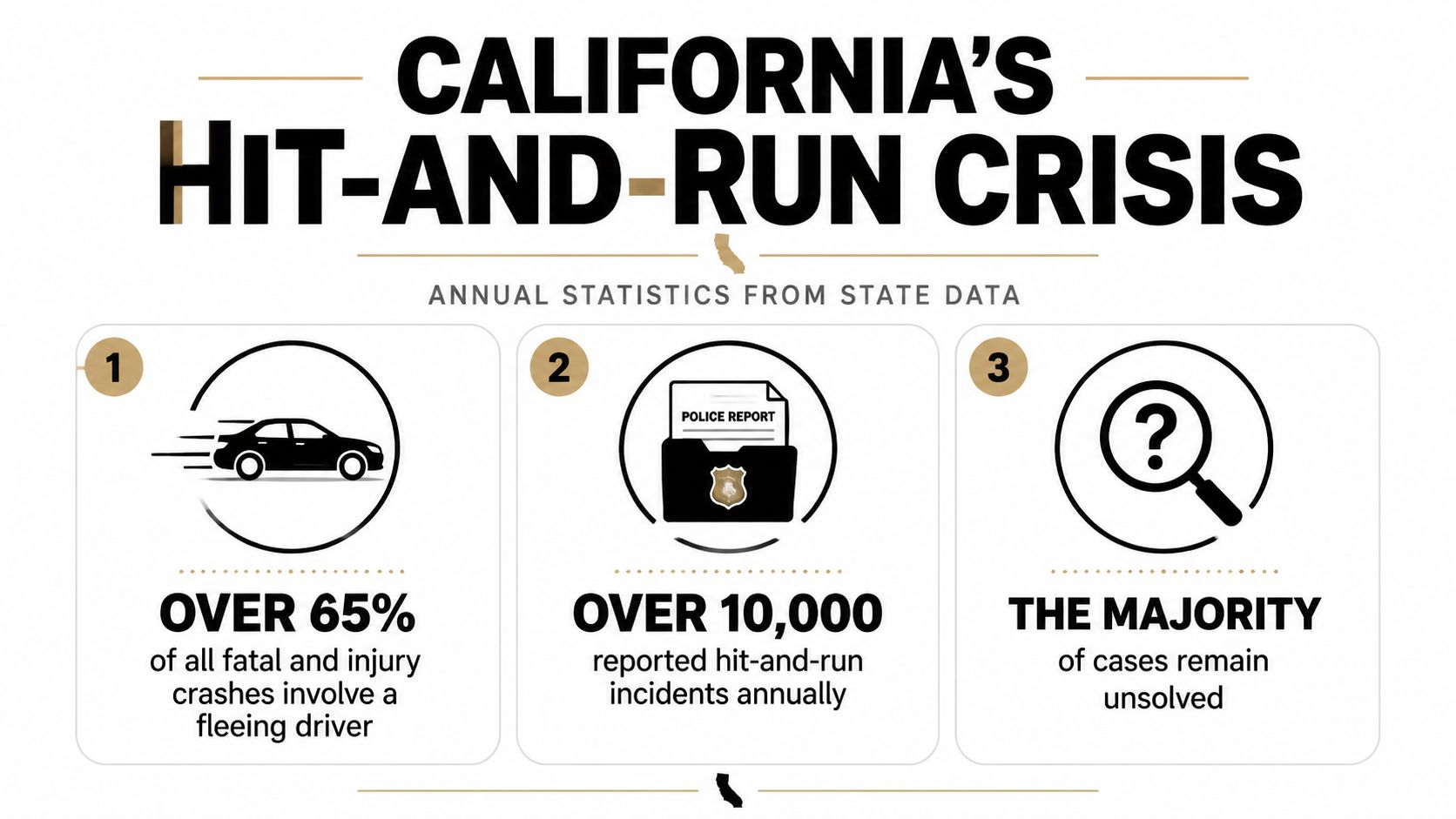
The practical problem is simple. Hit-and-run is common, expensive, and slow to resolve. The cited analysis put the estimated economic cost at $368.9 billion. That shows up in medical bills, body shop invoices, missed work, and fights with insurers over what counts as a valid claim.
Practical rule: If you drive in California, treat hit-and-run coverage as part of the policy you actually need, not a niche feature you will sort out later.
The fatal side is severe too. California had 490 fatal hit-and-run crashes in one year, and later data showed hit-and-run deaths averaging 447 per year over 2019 to 2023 CalBizJournal summary of California hit-and-run death totals. That is why the problem belongs in any serious discussion of California auto insurance, home insurance, renters insurance, and life insurance planning for families who need a financial backstop when a driver flees.
California Hit and Run Laws and Criminal Penalties
California draws a hard line between a driver who leaves after property damage and a driver who leaves after someone is hurt. Under Vehicle Code § 20002, a hit-and-run involving only property damage is a misdemeanor Shouse Law, California Vehicle Code § 20002. Under Vehicle Code § 20001, a hit-and-run involving injury or death is treated much more severely, with misdemeanor exposure in some cases and felony exposure in others WK Law, hit-and-run sentencing.
Property damage only versus injury or death
For property damage only, the published penalties are straightforward, up to 6 months in county jail, a fine of up to $1,000, restitution, and 2 DMV points. That two-point hit matters because it can push up insurance costs and hurt eligibility later, even when the criminal case looks minor.
For injury or death, the stakes jump sharply. The cited sentencing guide says misdemeanor exposure can reach 1 year in county jail and a $1,000 to $10,000 fine, while felony treatment can bring 2, 3, or 4 years in state prison with the same fine range WK Law, hit-and-run sentencing. That jump turns on bodily harm, and that threshold is what drives the harsher penalty.
The driver has to stop immediately, provide identifying information, and, if someone is hurt, offer reasonable assistance . If the owner of the damaged property is not there, the driver should leave a note with a name and address and notify police as soon as possible.
| California Hit and Run Penalties by Charge Level | Charge Level | Vehicle Code | Jail/Prison | Fine Range | DMV Points |
|---|---|---|---|---|---|
| Property damage only | Misdemeanor | § 20002 | Up to 6 months in county jail | Up to $1,000 | 2 |
| Injury or death | Misdemeanor or felony | § 20001 | Up to 1 year in county jail, or 2, 3, or 4 years in state prison | $1,000 to $10,000 | Not specified in the cited data |
A hit-and-run does not get less serious because the driver meant to come back. California cares about the stop, the exchange of information, and the help owed at the scene.
Timing matters too. Prosecutors generally have 1 year to file a misdemeanor hit-and-run and 3 years to file a felony hit-and-run involving injury or death Cutter Law, California hit-and-run laws. That window matters for victims because a crash can sit unresolved for months before it becomes a criminal case.
For victims, the bigger issue is not just the charge. It is whether the driver gets identified at all, because arrest rates are low and insurance claims get messy fast when there is no clear defendant. Physical contact requirements can also trip people up, and phantom-vehicle denials are common when the other driver vanishes and there is no solid witness support. If you are trying to document a claim cleanly, use the California car insurance guides that spell out what carriers usually ask for and how to build the file before the adjuster starts looking for holes.
That is where coverage gaps show up in real life. A careful police report, photos, witness names, and prompt treatment records help more than arguments about fault after the fact. If your injuries are real, get checked promptly and consider a trusted recovery resource such as car crash rehabilitation services, because insurers are far more responsive when the medical paper trail starts early.
What to Do Immediately After a Hit and Run
The first minutes after a hit-and-run decide a lot. Your job is not to solve the case yourself. Your job is to preserve evidence, get care, and build a clean record that helps police and insurers.
Start with safety and evidence
Call 911, get to a safe spot if you can, and write down every detail you caught before stress wipes it out. That means the plate number, even a partial one, the make, model, color, direction of travel, and anything unusual about the car or driver. If anyone saw the crash, get names and phone numbers before they leave.
Take photos of the damage, the roadway, debris, skid marks, signs, and nearby cameras. A lot of people miss that last part. Businesses and homes often have security footage, and the camera that matters most is usually the one that's easy to overlook.
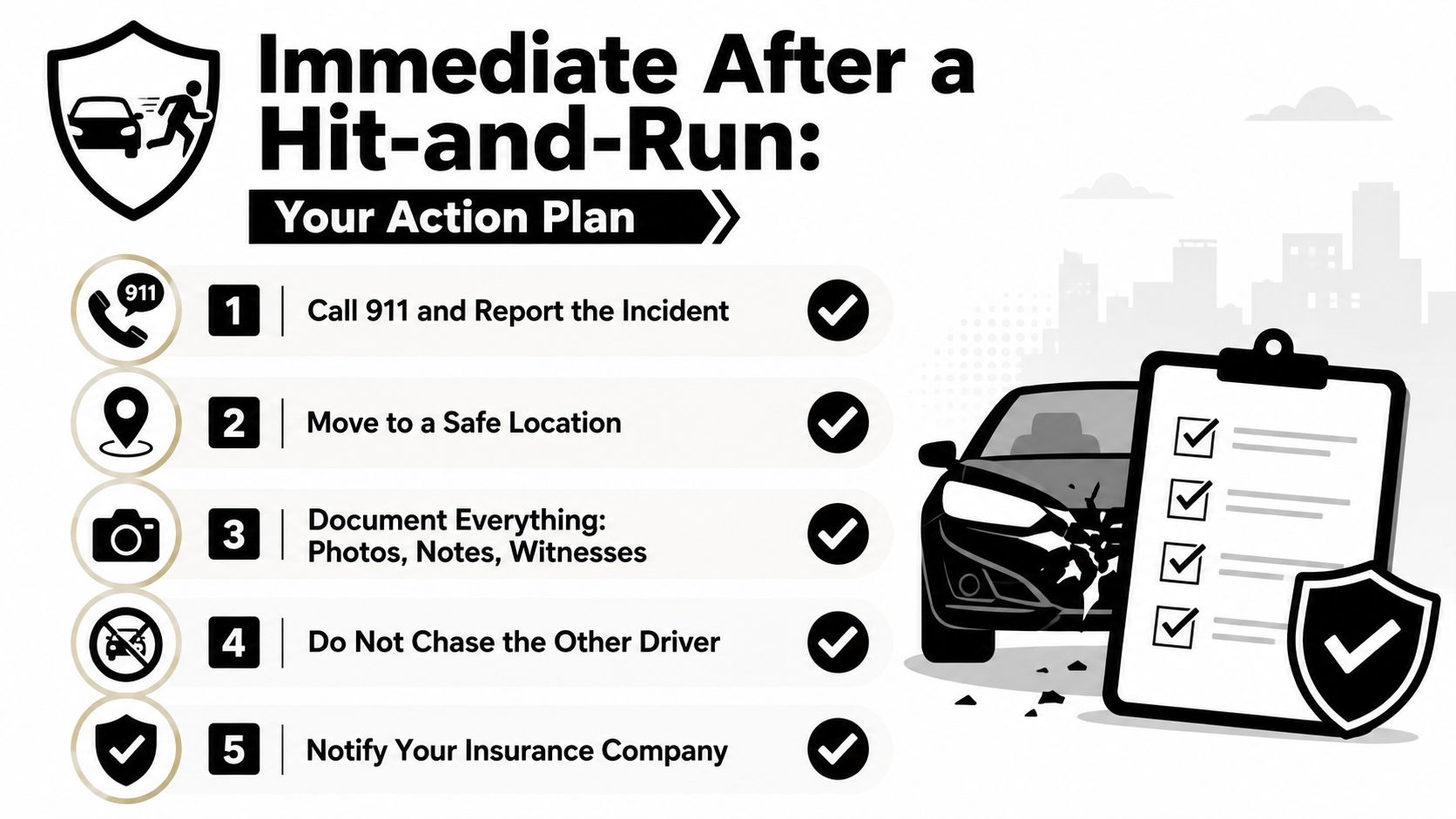
Do not chase the other driver. That move rarely helps and it can create a second problem you don't need.
File the police report quickly, then notify your insurer right away. If you're dealing with pain, stiffness, or a possible concussion, get checked promptly and consider a trusted recovery resource such as car crash rehabilitation services if your injuries need structured care.
If you were the driver who left
Self-reporting is better than waiting for the situation to get worse. Give accurate facts, not a polished story. The sooner you stop hiding, the less room you leave for charges to snowball.
For policy guidance and claims basics that fit California drivers, keep a copy of these auto insurance guides handy. Good documentation and quick notice are what help claims survive contact with the world.
The Reality of Hit and Run Arrest Rates in California
A report tied to LAPD data says fewer than 2% of hit-and-run reports lead to arrests . That is the part that often gets missed. Filing a report does not mean the driver will be identified, and it certainly does not mean the case will end with an arrest.
What actually moves a case forward
Surveillance video moves cases. Dashcam footage moves cases. Witnesses move cases, especially when they can provide a plate number or a clear vehicle description.
Speed matters more than people realize. Security cameras overwrite footage fast, witnesses forget details, and the useful window closes before many victims even know what to ask for. That is why hit-and-run cases feel so frustrating, even for people who do everything right.
The arrest gap changes how you should think about recovery. If the driver is never found, your best route is usually your own coverage, not a lawsuit against an unknown person. That is the hard reality, and it is the part many legal explainers skip.
Report it fast, preserve video fast, and assume the case may never be solved. That is the realistic posture.
Insurance paperwork matters because police cannot always identify the other driver. Your claim file has to stand on its own. If you want the cleanest path to payment, build the proof early, document the loss carefully, and make the adjuster's job simple. A solid policy review also helps. If you do not know how your coverage is set up, compare it against California auto insurance options so you understand what you are relying on after a hit and run.
For repair disputes, keep a benchmark against quality standards for auto repair. That gives you a clearer read on whether the shop is pushing the right parts and labor, especially when the claim itself is already under pressure.
How Auto Insurance Covers Hit and Run Claims
A hit-and-run claim is where insurance gets picky fast. Drivers assume a policy will pay once someone flees, but the carrier cares about coverage type, proof, and whether the facts fit the policy language.
UM coverage helps, but the details control the outcome
In California, uninsured motorist coverage is often the main path to recovery when the other driver disappears. The catch is simple, many policies and California hit-and-run rules require actual physical contact in phantom-vehicle cases California Accident Attorneys Blog, hit-and-run injury claims. If you swerved to avoid a fleeing car and crashed without contact, the insurer may deny the claim.
That is why phantom-vehicle denials happen. The injury can be real and still lose on coverage. If there was no contact and the evidence is thin, the insurer has room to challenge the claim hard.
What moves a case forward
File the police report, notify your insurer quickly, and keep your account consistent. Then gather the basics, photos, witness statements, dashcam clips, repair estimates, and medical records if anyone was injured. For repair disputes, use quality standards for auto repair as your reference point so you can see whether the shop's parts and procedures hold up.
Collision coverage is the other route for vehicle damage, and it is often the practical fix when the fleeing driver is never found. You pay the deductible, then your policy handles the repair side. That does not cover pain, missed work, or the stress of the claim, but it does keep the full repair bill off your shoulders.
For a clearer read on policy structure, review this California auto insurance resource and compare it to your own declarations page. The smart move is to know what your policy says before the crash, not after.
Protecting Yourself with the Right California Car Insurance
A hit-and-run is the worst time to discover your policy is thin. California's minimum coverage may satisfy the legal floor, but it doesn't automatically protect you from a fleeing driver, a repair dispute, or a coverage exclusion that bites later. If you carry only bare-bones limits, you're taking on too much personal risk.
The coverage gaps that matter most
UM/UIM limits deserve a hard look, because that's usually the money that steps in when the other driver can't be found. Collision coverage matters if you want your own carrier to handle the vehicle damage side. If you rent, own a home, or keep valuables in the car, your broader insurance picture matters too, because the financial hit from a crash rarely stays inside one policy line.
Bundling can make sense when it's done for the right reason. Auto, home, and renters insurance should work together cleanly, not create blind spots. Families, new drivers, and people who commute in high-risk areas should ask for a policy review that matches real-world exposure, not just the cheapest quote on paper.
That's where a licensed California agency earns its keep. A good agent compares carriers, explains the tradeoffs in plain English, and spots the coverage holes many people miss, especially when the same household needs auto, home, renters, and life insurance under one plan.
Use a quote request that compares options across carriers before you're in a crisis. The strongest insurance decision is the one that feels a little boring today and a lot useful after a crash.
Frequently Asked Questions About Hit and Run in California
Do I have to report a hit-and-run to the DMV
If the crash caused injury or property damage over the threshold required by state reporting rules, you may need to file the DMV accident report. Don't confuse that with the police report. They're separate, and missing one can create avoidable problems. For a quick reference on reporting questions, see this California claims FAQ.
What if I accidentally left the scene and want to self-report
Do it immediately. Don't wait for a plate search, a witness call, or a letter from law enforcement. Self-reporting won't erase the event, but it's better than acting like nothing happened.
How long do I have to file an insurance claim
Your policy controls the claim deadline, not just the crash date. Some contracts require notice quickly, and delays can weaken a claim even when the facts are good. Report it as soon as you can and keep a copy of everything you send.
Is dashcam footage useful in California
Yes. It can be one of the best pieces of evidence in a hit-and-run, especially when it captures the vehicle, the direction of travel, or the moments leading up to impact. If you drive regularly in California, a dashcam is one of the few tools that can make an unsolved case solvable.
What if nobody was found and the damage was only to my car
Then your own policy matters most. Collision coverage usually helps with repairs, and UM coverage may help if the claim meets the policy rules. That's why people who think they “don't need much insurance” often regret it after a hit-and-run.
If you want help pressure-testing your coverage before a crash happens, talk to Mai & Associates. They help California drivers compare auto insurance, home insurance, renters insurance, and life insurance so the policy you carry matches the risk you live with.