High Risk Auto Insurance California: A Practical Guide
You're driving home through Los Angeles after a DUI, commuting in San Diego after two at-fault claims, or trying to insure a Bay Area household after your teenager received a speeding ticket. The problem isn't just finding a policy. It's finding a carrier willing to write the risk, meeting California's financial-responsibility rules, and avoiding a lapse that can make the next quote even harder.
High-risk auto insurance in California is manageable when you separate the underlying policy premium from compliance filings, compare voluntary and assigned-risk options, and shop again as your record improves. California requires drivers to maintain financial responsibility, and the state says driving without insurance is illegal. Its Department of Insurance also publishes an annual automobile premium comparison tool because comparing rates is central to the state's auto insurance market.
What High Risk Auto Insurance Means in California
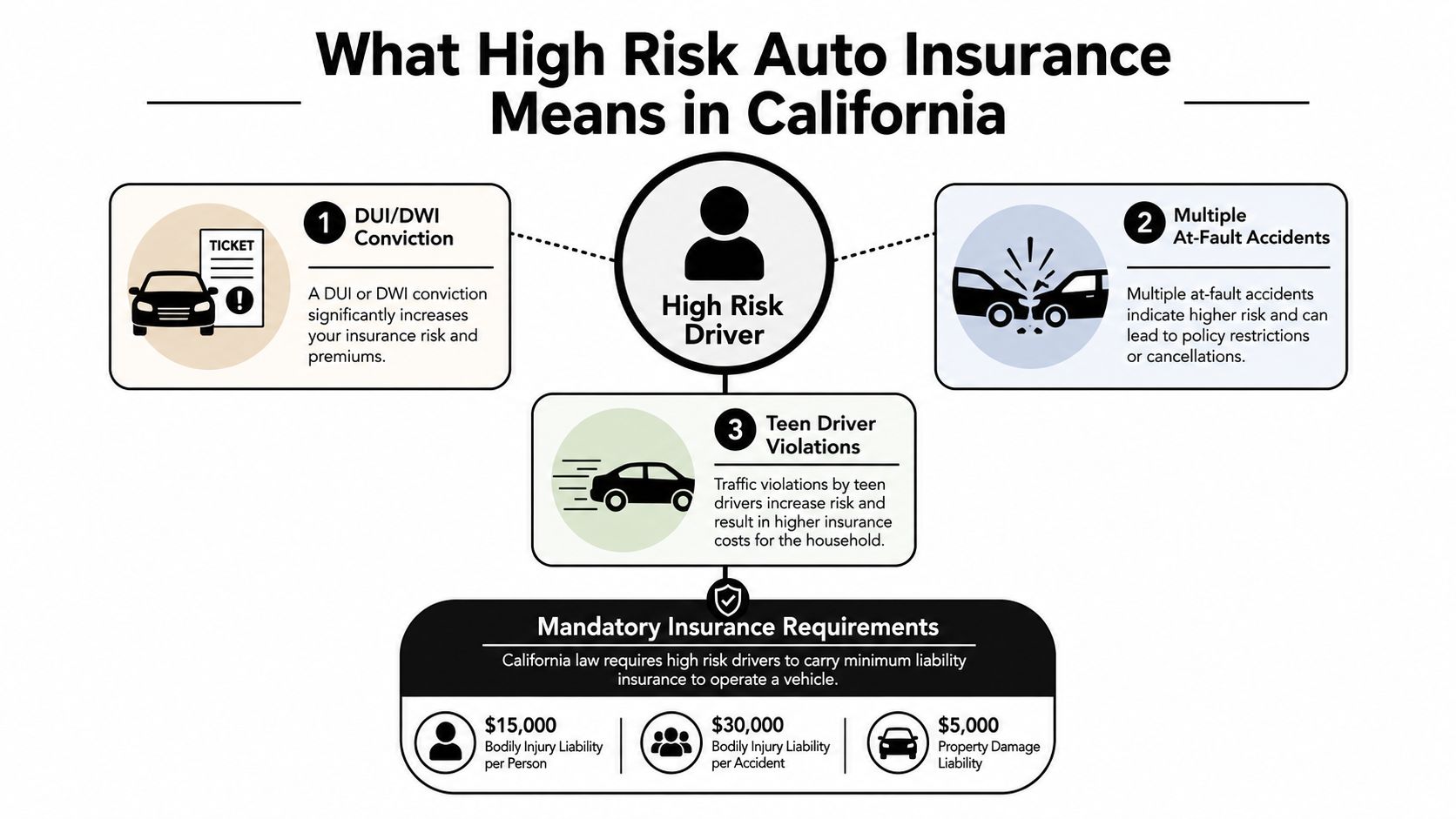
A Los Angeles rideshare driver with a DUI, a San Diego commuter with two at-fault claims, and a Bay Area parent whose teen received a speeding ticket may all receive the same broad label, high risk driver. Their circumstances differ, but each profile can move a household outside the preferred market and limit the carriers willing to quote it.
High-risk auto insurance is a classification insurers apply when a driver's record, coverage history, vehicle use, or other profile details suggest a greater likelihood of a claim. The classification can affect carrier eligibility, the rating schedule applied to the policy, and whether an SR-22 filing is required. An SR-22 is a compliance filing, so its fee is only one part of the cost. The larger financial impact usually comes from the underlying premium increase created by the driver's risk profile.
Three practical market outcomes
California drivers generally have three placement routes:
- Admitted standard carrier: A conventional insurer may accept the driver while applying its approved surcharge and eligibility rules.
- Voluntary nonstandard carrier: A specialist insurer may quote drivers with serious violations, prior lapses, or multiple losses after preferred carriers decline.
- California Automobile Assigned Risk Plan: The residual market assigns coverage to an admitted insurer when voluntary placement is unavailable.
The assigned-risk system affects how you shop. California insurers licensed to sell auto coverage must accept a share of higher-risk drivers in proportion to their written auto policies. The Department of Insurance defines an assigned-risk driver as someone unacceptable to a standard insurer because of a poor driving record. Use the California auto insurance terminology guide to understand the plan's placement role, then compare voluntary quotes before accepting an assigned placement.
Review California auto insurance options with placement first and price second. A nonrenewal can force broader choices, including a nonstandard carrier or the assigned-risk pool, even when the immediate issue is not a new violation. The high-risk label changes the shopping path, while California's liability framework still applies. Its minimum liability structure was historically 15/30/5, covering bodily injury per person, bodily injury per accident, and property damage. Confirm the limits available for the policy before binding coverage.
Common Causes That Put Drivers in the High Risk Category
A single serious violation can change more than the premium. It can affect eligibility, require an SR-22 filing, and push a driver toward nonstandard insurers or California's assigned-risk market. The filing fee is usually small compared with the premium increase created by the underlying DUI, accident, lapse, or license action.
The incidents that matter most
A DUI conviction under California Vehicle Code 23152 is one of the clearest paths into the high-risk market. California may require a license suspension lasting 1 to 3 years and an SR-22 filing lasting 3 years. The provided California high-risk driver rate discussion reports about $180 per month for state-minimum coverage for DUI drivers, compared with $72 per month for clean-record drivers, a 150% increase. Treat those figures as a reference point, not a guaranteed quote. The actual premium depends on the complete record, vehicle, location, and coverage.
Other events can also move a driver into a higher-risk tier:
- At-fault accidents: A collision involving bodily injury or more than $750 in property damage can affect rating and eligibility.
- Reckless driving: A conviction under California Vehicle Code 23103 signals a serious driving event and may reduce carrier options.
- Point accumulation: Reaching 4 points within 12 months or 8 points within 24 months can lead to negligent-operator consequences.
- Uninsured driving: Driving without insurance for a 30-day period during the prior year can create underwriting and eligibility problems.
- License action: A suspended or revoked license makes placement harder, especially when proof of financial responsibility is required.
- Severe criminal violations: An event such as vehicular manslaughter can affect insurability for a very long period.
A recent nonrenewal can create the same shopping pressure even without a new violation. Once a carrier declines to continue coverage, the driver may need to consider a nonstandard insurer, adjust deductibles or limits, or seek placement through the assigned-risk pool. That makes the renewal notice, prior policy history, and reason for nonrenewal part of the insurance file.
Pull the driving record before requesting quotes. Mark each conviction and accident date, confirm whether an SR-22 is required, and separate current events from older ones. Carriers weigh recency and severity differently, so one insurer's decline can be another insurer's offer.
California violations and their high-risk impact
Exact SR-22 periods and premium changes depend on the violation, court or DMV action, carrier rules, and the driver's full record. Use the table to identify the practical shopping issue, then confirm the filing and eligibility requirements before binding coverage.
| Violation | SR-22 Length | Typical Premium Increase |
|---|---|---|
| DUI conviction | California requirements can apply; confirm the DMV order | Substantial, with the underlying DUI driving the increase |
| At-fault accident | Depends on the related violation and DMV order | Higher pricing is likely when the loss is recent or repeated |
| Reckless driving | Depends on the court and DMV requirement | Often treated as a serious underwriting event |
| Multiple points | Depends on the violation history | May move the driver into a restricted rating tier |
| Driving without insurance | May require proof of financial responsibility | Can create both eligibility and pricing problems |
| Suspended or revoked license | Depends on reinstatement requirements | Frequently limits voluntary-market access |
Practical rule: Shop from the complete record, exact dates, required filing, and vehicle coverage needs, not from the violation label alone.
How Premiums Are Calculated for High Risk Drivers
A high-risk quote starts with the carrier's base rate for the driver, vehicle, location, and selected coverage. The underwriting system then applies the record-specific factors that distinguish a preferred driver from someone with a DUI, repeated accident history, or a coverage lapse.
California insurers may evaluate the driving record, accident frequency, DUI recency, prior insurance history, garaging ZIP code, vehicle characteristics, mileage, and coverage selections. A driver in a dense metro area may receive a different base quote from a driver with the same record in another California location. Parts of Oakland, Stockton, and southeast Los Angeles can illustrate why location matters, but a carrier must evaluate the actual garaging address and approved rating plan.
Where the bill comes from
The most important distinction is between liability-only coverage and full coverage. Liability-only protects against covered damage or injury you cause to others. It doesn't pay to repair your vehicle after a collision you cause, theft, or many other physical-damage losses. Full coverage generally adds collision, subject to deductibles and policy terms.
California's listed minimum liability requirements are $30,000 for bodily injury per person, $60,000 per accident, and $15,000 for property damage, according to this California liability coverage reference. The same reference gives a full-coverage example with 100,000/300,000 bodily injury, 50,000 property damage, 5,000 medical payments, 30,000/60,000 uninsured and underinsured motorist bodily injury, and $250/$500 collision deductibles.
Insurers don't replace a clean-driver rate with a high-risk rate. They apply the high-risk factors to the policy's underlying base. A recent DUI, an at-fault loss, a lapse, expensive physical-damage coverage, and a higher-risk garaging area can all influence the final premium.
For a financed vehicle, the lender generally requires physical-damage protection. If the car has low market value and no lender, liability-only may be a rational budget choice, but dropping collision or full coverage means accepting the financial risk of repairing or replacing the vehicle yourself.
Understanding SR-22 Filing Requirements in California
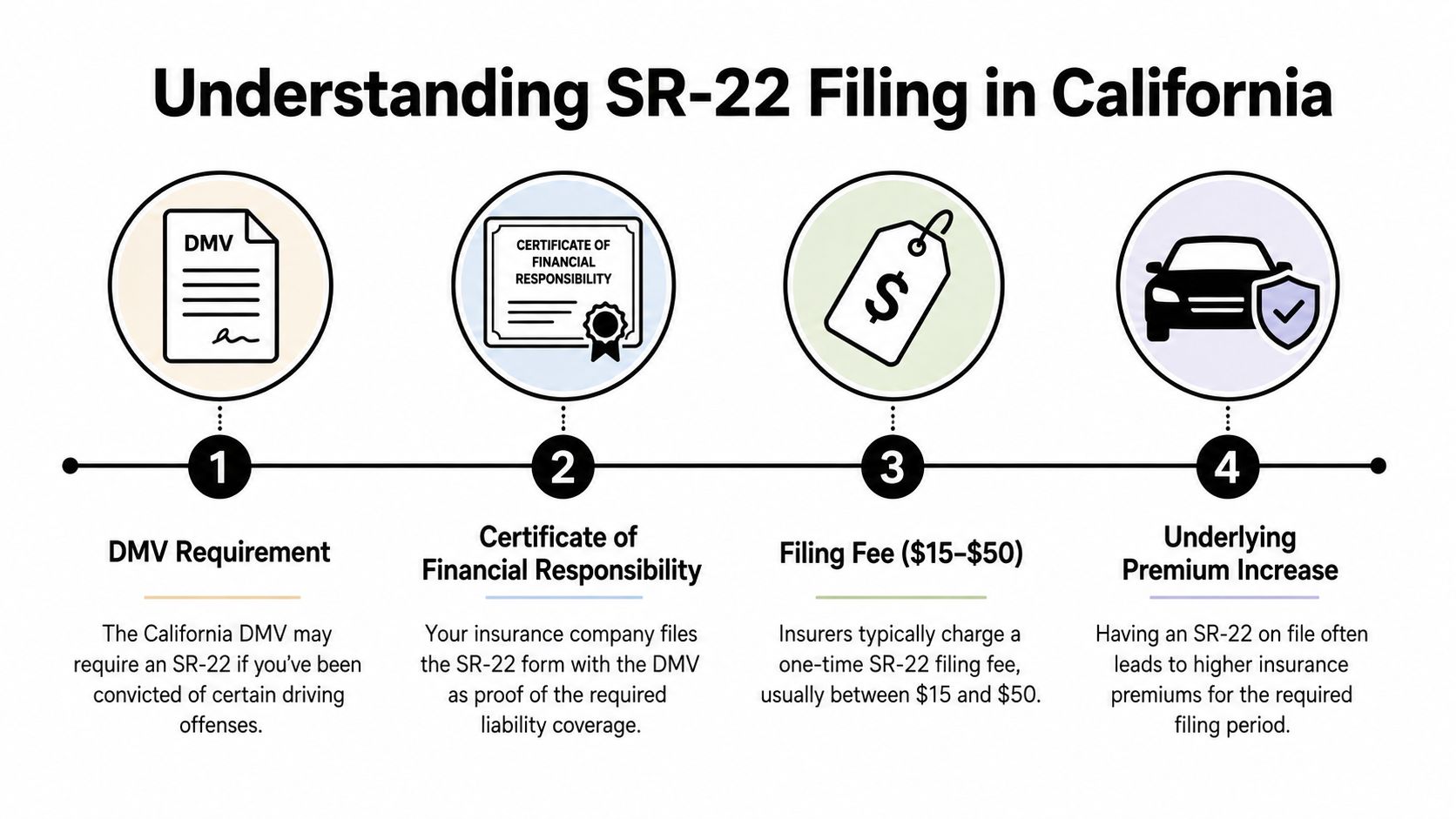
After a DUI, an uninsured accident, or a suspended-license event, California may require an SR-22 before you can restore or maintain driving privileges. An SR-22 serves as a certificate of financial responsibility that an insurer attaches to an eligible auto policy and submits to the California Department of Motor Vehicles. It confirms that the policy carries the liability coverage required for the driver's situation.
The filing fee is usually a small administrative charge. The underlying premium creates the larger financial impact because the violation can raise the driver's rating and limit available carriers. Ask the agent to quote the policy, filing, limits, deductibles, and payment terms together. Comparing only the SR-22 fee misses the cost that matters.
Choose the filing that matches your situation
An owner SR-22 fits a driver who owns and insures a vehicle. A non-owner SR-22 may fit someone without a car who needs financial-responsibility proof while driving borrowed or rented vehicles. An operator-only arrangement can apply in limited circumstances. Have the agent match the filing to the DMV requirement and the vehicles you access.
California SR-22 obligations commonly run for 3 years, but the controlling date comes from the underlying DMV or court matter. Confirm the start date, end date, and required liability limits in writing. The obligation may also affect how you shop: if voluntary carriers decline the risk, an agent can compare nonstandard insurers before turning to California's assigned-risk process.
A cancellation or lapse creates the most serious problem. If the insurer reports that required coverage ended before the obligation is complete, the DMV can act against the driving privilege. Do not cancel until the requirement is confirmed complete and replacement coverage is active.
The filing proves coverage. It does not erase the violation, remove the surcharge, or convert a nonstandard policy into a preferred-market policy.
Nonstandard Carriers Versus the California Assigned Risk Plan
A driver with a DUI, several tickets, a lapse, or a recent nonrenewal should shop the voluntary nonstandard market before accepting placement through the California Automobile Assigned Risk Plan. Nonstandard insurers write risks that preferred carriers often decline, and their underwriting rules differ. One company may reject a record that another will quote.
That difference makes shopping worthwhile. A broker can approach several carriers and compare liability limits, deductibles, vehicle coverage, and payment arrangements. The SR-22 filing fee is usually a small transaction cost. The underlying premium increase reflects the driving record, claims history, lapse, or other underwriting concerns. Paying the filing fee does not make the policy affordable if the carrier's risk-based premium is high.
Nonrenewal pressure changes the decision. If a current insurer will not renew the policy, the driver must protect continuous coverage while comparing replacement options. A voluntary nonstandard carrier may preserve broader choices, including collision and other physical damage coverage, while an assigned-risk placement may focus on meeting liability requirements. Start shopping before the cancellation or nonrenewal date.
Compare the routes before accepting the first quote
CAARP is a safety net for drivers who cannot obtain coverage voluntarily, not an automatic first choice or guarantee of the lowest premium. The assigned carrier and plan rules control available limits, deductibles, payment terms, and physical-damage coverage. Ask specifically whether collision and other optional coverages are available, especially when a lender requires full coverage.
| Feature | Voluntary Nonstandard Carrier | CAARP Assigned Risk Pool |
|---|---|---|
| Market role | Voluntary placement for drivers outside preferred underwriting | Residual-market placement when voluntary options fail |
| Quote flexibility | Carrier-specific limits, deductibles, and coverage choices | Plan and assigned-carrier rules control availability |
| Eligibility | Depends on each carrier's appetite and record rules | Designed for drivers unable to find willing voluntary coverage |
| Physical damage | May be available, subject to underwriting | Must be confirmed and may be limited |
| Shopping strategy | Compare several carriers before binding | Consider after documenting the voluntary-market search |
| Exit plan | Re-shop as violations age and the record improves | Re-shop when voluntary carriers become available |
Do not treat one decline as proof that CAARP is the only route. Ask the agent which carriers were contacted, what each required, and why each response was issued. Keep those records, then reassess at renewal as violations age and the record improves.
How Drivers Can Secure Coverage and Reduce Rates Over Time
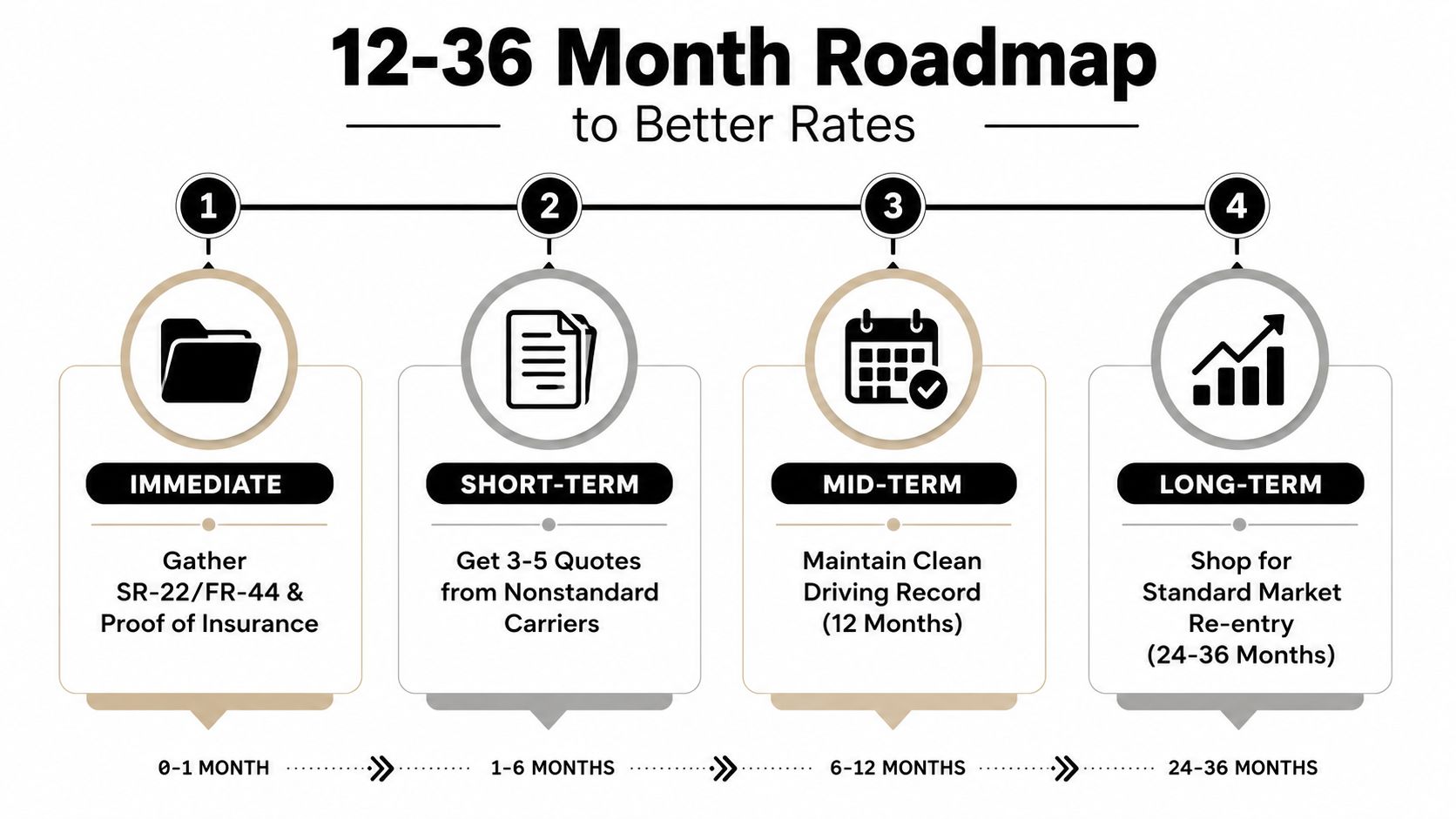
High-risk auto insurance is a timeline problem. The goal isn't to find a magical discount today. It's to secure compliant coverage, prevent a new lapse, and create a record that gives carriers a reason to reconsider you at renewal.
The first 48 hours
Collect the documents before requesting quotes:
- Driving record: Pull the current California DMV record and identify conviction, accident, suspension, and reinstatement dates.
- Filing paperwork: Gather the SR-22 instruction or court documentation. California uses SR-22, not the FR-44 form used in some other states, so verify what the DMV requested.
- Vehicle details: Prepare the VIN, garaging address, annual mileage, lender information, and current declarations page.
- Quote comparison: Ask several nonstandard carriers for the same liability limits and physical-damage deductibles so the prices are comparable.
Use the California insurance guides to organize the questions you'll ask before binding.
The next renewal cycle
Continuous coverage is the strongest controllable move. Set automatic payments, confirm that the insurer has the correct email and mailing address, and respond quickly to cancellation notices. A usage-based telematics program may help if the carrier offers one and you're comfortable sharing driving data.
Review the vehicle's value before paying for collision coverage. Raising a deductible can reduce the premium, but only choose a deductible you can pay after a covered loss. If an older vehicle has limited value and no lender, removing collision may make sense. Keep full coverage when theft, weather, or other noncollision risks remain important to you.
The longer recovery
At every renewal, ask the carrier which violations remain in the rating tier and whether a new quote is warranted. Keep the driving record clean, complete required court or DUI programs, and compare standard-market eligibility as the record ages.
Don't assume the carrier will automatically lower the price when the risk improves. A policy review is where you test that assumption.
How a Licensed California Agency Simplifies the Process
A difficult placement often involves more than completing a quote form. The agent may need to read a DMV record, identify the correct SR-22 filing, explain a prior cancellation, match coverage to a lender, and submit documents without creating a gap between policies. Those details can affect both eligibility and the premium, while the filing fee itself is only a small part of the overall cost.
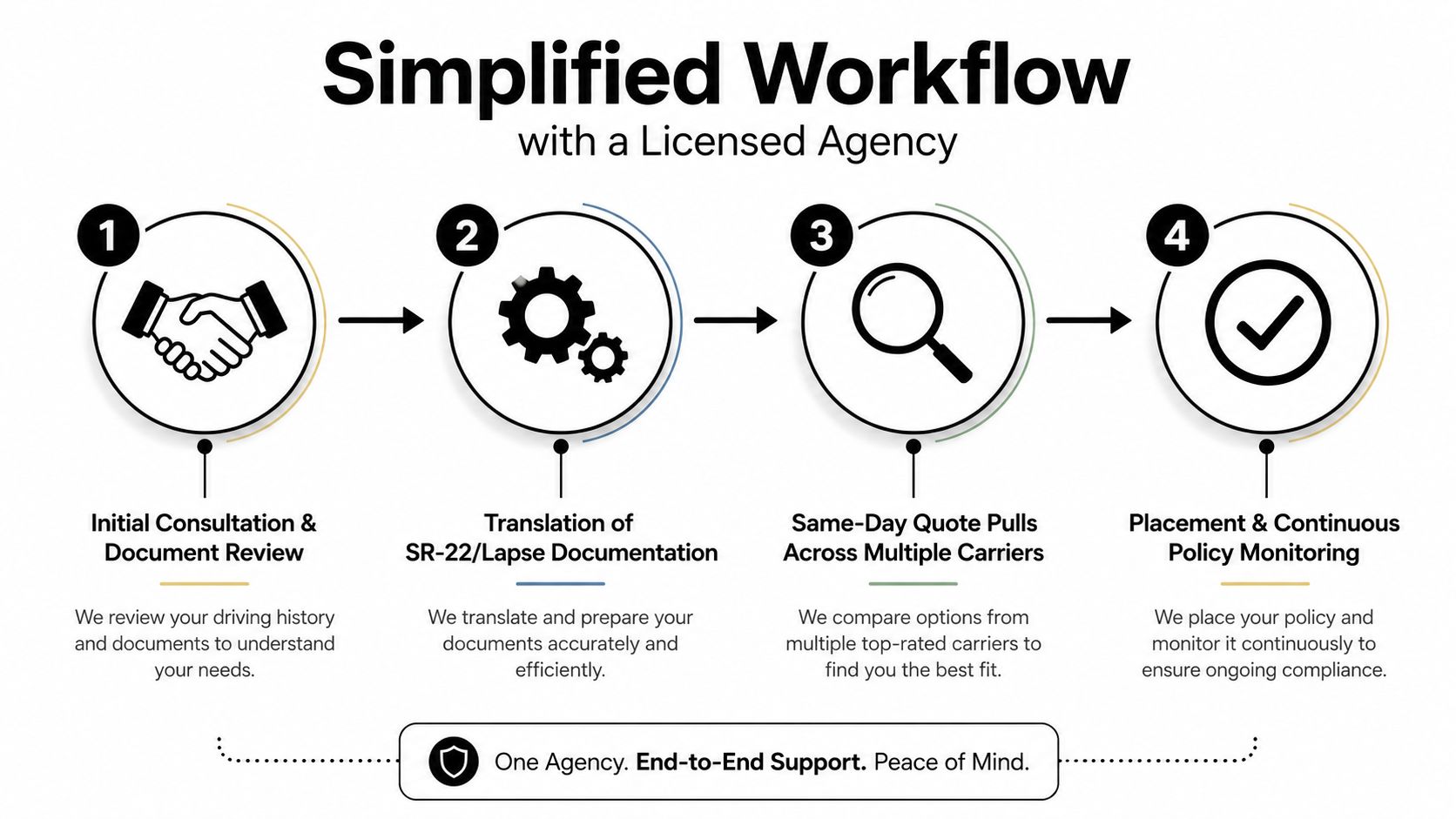
A licensed California agency puts those tasks into one workflow. The agency collects the driving record and vehicle information, reviews lapse or court documents, screens carriers that accept the profile, and compares quotes with matching limits. It can also coordinate the SR-22 filing with the policy, instead of sending the driver to separate offices.
What the workflow should include
- Document review: The agent checks dates, ownership, license status, required filings, and prior coverage.
- Carrier screening: The agent filters carriers by DUI, accident, lapse, vehicle, and payment eligibility before presenting options.
- Coverage matching: The quote reflects the actual requirement, whether that means liability-only coverage, lender-required physical damage, or an owner or non-owner SR-22.
- Household coordination: A household with a high-risk driver and lower-risk drivers may need careful vehicle and driver assignment rather than one policy design for everyone.
- Ongoing monitoring: The agency tracks renewal questions, proof-of-insurance needs, and opportunities to re-shop.
Start by identifying the actual filing and coverage requirement, then request a California auto insurance quote. This order prevents a low premium from masking a policy that fails DMV requirements, leaves a lender uninsured, or creates a cancellation risk the driver cannot manage.
Mai & Associates offers high-risk auto coverage placement along with California auto, home, renters, and life insurance services. Its stated service model includes same-day quote access from multiple carriers, a 24-hour response expectation, offices in Glendale, Westlake Village, Escondido, and Costa Mesa, and multilingual support in English, Spanish, Armenian, Russian, and Vietnamese.
Carrier rules differ. One insurer may accept a DUI but decline a lapse, while another may write the lapse but restrict vehicle eligibility. An agent's value is knowing which facts affect each submission and presenting the complete record accurately. If nonstandard carriers decline the risk, the agency can explain whether an assigned-risk option is the next practical route rather than submitting random applications.
Frequently Asked Questions for California High Risk Drivers
How much notice should I expect before nonrenewal?
California law summaries indicate that nonrenewal notices generally must be sent 60 to 120 days before the end of the term, while other California contexts can involve at least 30 days before expiration. The reason and policy situation matter. Review the notice immediately and start shopping before the current policy ends. The California Insurance Code discussion of nonrenewal notices provides the relevant notice framework.
Can a carrier nonrenew me after a ticket or accident?
It can depend on the carrier's approved rules, the severity of the event, the policy term, and the reason stated in the notice. A ticket or accident doesn't automatically mean the driver is uninsurable, but it can move the household into a different carrier tier.
How long does an SR-22 last after a DUI?
A California SR-22 requirement commonly lasts 3 years, but confirm the start date and completion requirement with the DMV or court order. Keep the policy continuously active throughout the required period. The filing is separate from the longer period during which the violation may influence underwriting.
Will I return to the voluntary market?
Many drivers can return to voluntary coverage after their record improves, but there's no single automatic reassignment date. Request a fresh comparison at each renewal and ask carriers to evaluate the current record rather than relying on an old decline.
Is an FR-44 the same as an SR-22?
No. California generally uses an SR-22 filing for this type of financial-responsibility proof. FR-44 requirements are associated with other state systems, so a California driver should follow the exact form named by the DMV.
What should a household do with multiple vehicles?
Assign each driver and vehicle accurately. A high-risk driver may need a specialist policy, while another household member may qualify for a different carrier. Never omit a regular driver or misrepresent who uses a vehicle. Ask for both a combined-household quote and separate placement review when appropriate.
Do out-of-state violations affect California insurance?
They can. California carriers may consider out-of-state convictions or accidents when reviewing the driving history, especially when the event appears on the record used for underwriting. Provide the complete history instead of waiting for a carrier to discover it.
Is lapse-license auto insurance a separate product?
Usually, the lapse is an underwriting circumstance, not a standalone policy type. The agent looks for a carrier willing to write the driver, confirms whether an SR-22 is required, and builds the policy around the actual vehicle and coverage needs. As described earlier, CAARP remains a residual-market route when voluntary carriers won't accept the risk.
| Question Topic | California Rule or Timeline |
|---|---|
| Nonrenewal notice | Often 60 to 120 days, with other contexts requiring different notice periods |
| SR-22 after a DUI | Commonly 3 years, subject to the DMV or court requirement |
| FR-44 | Not California's usual filing for this purpose |
| Voluntary-market return | Re-shop as the record improves, no automatic reassignment |
| Out-of-state violations | May be considered when included in the driving history |
| Coverage lapse | Can trigger cancellation reporting and DMV consequences during an SR-22 period |
| CAARP | Residual-market placement when voluntary coverage isn't available |
| Multiple vehicles | Requires accurate driver, vehicle, and usage assignments |
For additional policy questions, review the California high-risk insurance FAQ and ask an agent to verify your specific DMV requirement before you cancel or change coverage.
Mai & Associates can review your driving record, SR-22 requirement, lapse history, vehicle value, and household drivers, then compare available California high-risk auto insurance options alongside home, renters, and life insurance needs. Visit Mai & Associates to request a no-obligation quote and speak with a licensed California agent about placing coverage without creating a gap.