Help with Car Insurance Payments: 3 Key Steps
You open your California auto insurance renewal notice between rent reminders and grocery charges. The premium is higher, but your paycheck isn't. The bill is due before your next deposit, and paying it in full could leave you choosing between gas and food.
That situation calls for more than another generic instruction to compare quotes. Help with car insurance payments starts with protecting the policy from cancellation, then reshaping the bill around your cash flow. A manageable installment arrangement is often more useful than a slightly cheaper policy that you can't pay on time.
When the Premium Bill Feels Bigger Than the Paycheck
A driver in Bakersfield may have been paying $185 a month and suddenly face $260 after a renewal change. That extra $75 can represent a week's groceries or two tanks of gas. The driver doesn't need a lecture about budgeting. They need to know which call to make today, what payment arrangement to request, and how long coverage remains active.
Start by checking the exact due date, the amount required to keep the policy active, and whether the notice says “cancellation,” “pending cancellation,” or “payment due.” Those phrases matter. A carrier may offer an installment conversion, accept a late payment during a grace period, or require a new down payment after cancellation.
Practical rule: A policy you can pay on time is usually safer than a cheaper policy that creates a lapse.
A lapse can create serious consequences in California. Operating without the required financial responsibility can create license suspension risk under California Vehicle Code §16028, and a driver who needs proof of financial responsibility may face an SR-22 filing requirement. A lapse can also become part of the insurance record, making future underwriting more difficult and potentially increasing premiums.
Don't cancel the existing policy before the replacement is active. If you find a lower quote, confirm the new effective date in writing, pay whatever is required to bind coverage, and only then arrange cancellation of the old policy. The cheapest quote is irrelevant if the transition leaves you uninsured.
The practical answer is to treat the bill as a cash-flow problem first and a shopping problem second. This guide focuses on the moves that can keep coverage active this week, reduce the immediate payment, and adjust protection without creating a larger financial risk later.
Why Car Insurance Payments Have Become Harder to Manage
A driver can shop carefully and still face a bill that arrives before the next paycheck. That timing problem is becoming common as insurance takes a larger share of household income. The U.S. Treasury's Federal Insurance Office uses 2% of median household income as its auto-insurance affordability threshold. Its review identified 9,172 majority-minority or majority-low-income ZIP codes, about 28% of all U.S. ZIP codes, under that standard. It also found 845 ZIP codes with a combined population above 18.6 million where the affordability index exceeded 2%.Treasury affordability findings
The national figures show why payment assistance may be necessary even after comparing policies. The Zebra's 2026 analysis placed the median annual cost at $2,079, or about $173 per month. Liability-only coverage averaged $811 per year, while full coverage averaged $2,070 with a $1,000 deductible or $2,327 with a $500 deductible.The Zebra's 2026 auto insurance analysis
Insurify reported a separate 2025 national average of $2,314 annually. Its findings also said 38% of Americans viewed car insurance as unaffordable, while 64% reported higher rates over the previous 12 months.Insurify affordability and rate findings Different methods produce different totals, but the cash-flow problem is clear. An annual premium may look manageable on paper while a required installment is impossible before payday.
The payment pressure in plain terms
| Pressure Point | Current Figure | Impact on Payment |
|---|---|---|
| Affordability threshold | More than 2% of median household income | Insurance can take a meaningful share of household income |
| Median annual cost | $2,079, about $173 monthly | Monthly budgeting matters more than the annual total |
| Liability-only average | $811 annually | Lower protection still requires a payment plan |
| Full coverage average | $2,070 to $2,327, depending on deductible | The deductible changes both the premium and emergency exposure |
| ZIP codes above the affordability index | 845 ZIP codes, population above 18.6 million | The pressure affects large communities, not isolated households |
Car insurance is a recurring expense. Put it beside rent, utilities, phone service, and loan payments when mapping monthly obligations. This guide to what are recurring expenses explains how regular bills compete for the same cash and can help you identify pressure before the insurance due date.
Installments give drivers a way to divide the premium into scheduled payments instead of paying the full amount at once. GEICO lists 2-, 4-, 5-, and 6-installment plans, although availability, fees, and eligibility depend on the policy and state.GEICO auto payment options Ask for the total policy cost, not only the monthly amount. A smaller installment can include billing charges, and the cheapest immediate payment may cost more overall.
Using Grace Periods and Installment Plans to Stay Current
A missed payment doesn't always mean coverage ended that same minute, but you can't assume you're protected. Many insurers allow a late-payment window of 7 to 30 days, and state rules often require advance notice before cancellation for nonpayment. California commonly uses a 10-day cancellation notice benchmark, but the policy language, insurer process, and cancellation stage control the result.Insurance.com grace-period guidance
Make the call before the deadline
Call the billing department rather than relying on an online payment screen. Use direct language:
“I want to keep continuous coverage. My payment is due before my next paycheck. What installment options, payment-date changes, or grace-period arrangements are available, and what exact date will cancellation occur?”
Ask the representative to confirm four things:
- The cancellation date: Get the exact date and time shown on the account.
- The minimum payment: Confirm the amount needed to prevent cancellation.
- The arrangement terms: Ask about a four-pay, five-pay, or six-pay structure if offered.
- Written confirmation: Request an email or letter showing the arrangement and coverage status.
If the payment is late, pay within the permitted window, then verify that it posted. If the carrier says the policy was reinstated, request written reinstatement confirmation before driving. Never treat a pending payment as proof that coverage is active.
Choose the payment method carefully
Electronic funds transfer can reduce missed due dates, while a credit card may buy short-term timing flexibility but can create interest or credit-use consequences. Ask whether the carrier charges a billing fee for each installment or payment method. A payment automation discussion can also clarify how scheduled collections reduce missed obligations, as explained in reduce DSO with payment automation, although an individual policyholder should still confirm the insurer's own terms.
Review your account through the California insurance payment FAQ if you need a starting point for billing questions. The important sequence is simple: arrange the payment, confirm it posted, and verify active coverage.
A lapse can leave an insurance record showing a break in continuous coverage and may trigger underwriting penalties later. If your policy has already canceled, don't drive until a licensed representative confirms that replacement or reinstated coverage is active.
Adjusting Coverage in California Without Creating New Risks
California's updated minimum liability limits are $30,000 for injury or death to one person, $60,000 for injury or death to more than one person in one accident, and $15,000 for property damage per accident. The California Department of Insurance says these limits apply to standard policies beginning with renewals on or after January 1, 2025. California Department of Insurance auto guide
Those limits pay for harm you cause to other people and their property. They do not repair your vehicle. Liability-only coverage generally excludes collision and protection for theft, weather damage, and vandalism. A broader policy may add collision, other-than-collision protection, uninsured motorist coverage, and medical payments coverage.
Match the policy to the vehicle
A paid-off 2012 Civic gives you more room to adjust. If its value is modest and you have savings for repairs or replacement, removing collision and other optional protection may lower the bill. The tradeoff is direct: you would pay for your own vehicle damage after theft, weather damage, vandalism, or an at-fault crash.
A financed 2021 RAV4 requires a stricter approach. The lender generally requires collision and full coverage, so removing either can breach the loan agreement. Ask for deductible changes and installment options, but do not remove lender-required protection just to make the next payment smaller.
| Driver Scenario | Recommended Coverage | Estimated Monthly Savings | Risk Created |
|---|---|---|---|
| Paid-off 2012 Civic with accessible replacement funds | Compare liability-only with collision and other-than-collision protection retained | Request a carrier-specific quote | You may have to pay for your own repairs or replacement |
| Financed 2021 RAV4 | Keep lender-required collision and other-than-collision coverage | Request deductible and installment comparisons | Removing required coverage can breach financing terms |
| Driver with an SR-22 filing | Keep the filing and required liability active | Ask for discounts and carrier alternatives | Reducing coverage may violate filing or legal requirements |
The savings column stays blank until an insurer prices your actual vehicle, driving history, location, and selected limits. A fixed savings promise without those details is not a reliable estimate.
Review California auto insurance coverage options and limits side by side, including deductibles and protections. If the bill is due before your next paycheck, ask whether a deductible change or temporary coverage adjustment reduces the immediate installment without creating a lapse. Use that option only when the vehicle, lender, and California requirements allow it. A short-term cash-flow fix should not become an automatic permanent downgrade.
Working With a California Insurance Agency for Payment Help
A licensed agency can help with payment structure, not just price. On the first call, bring your current declarations page, renewal notice, vehicle information, driver details, and the date your existing policy ends. The agent can then compare coverage on an equivalent basis instead of showing you a low quote with missing protection.
Ask for a clear comparison:
- Total premium: What will the policy cost over the full term?
- Down payment: What must be paid to bind coverage today?
- Installment amount: How much will each later payment be?
- Billing fees: Does the payment schedule change the total cost?
- Effective date: When does the new coverage begin?
- Cancellation timing: When can the old policy end without a gap?
Mai & Associates operates four California offices and provides multilingual support, including Vietnamese and Spanish, alongside other language services. Its agents can access carriers such as GEICO, Progressive, and Mercury in one conversation, which lets a driver compare payment requirements as well as premiums. The agency's commission is paid by the carrier, so the driver can ask questions about quotes and billing arrangements without a separate consultation charge.
That doesn't mean every quote will be affordable or every carrier will accept every driver. It does mean you can ask one licensed contact to look for a lower down payment, a workable installment schedule, and coverage that meets California requirements.
Use a precise call script
Say:
“My current premium is [amount], my next payment is due [date], and I need continuous coverage. Please compare carriers by total premium, down payment, installment fees, and effective date. Show me the option I can bind before my current policy lapses.”
If you've been declined, non-renewed, or placed in a difficult payment cycle, ask whether an in-person appointment is available. Bring the notice that explains the decision. A human review can uncover documentation issues, eligibility questions, or a carrier option that a single-company call center can't provide.
You can request a California insurance quote with the specific goal of comparing immediate payment requirements, not just the advertised monthly rate.
Discounts, Bundling, and State Programs That Lower the Bill
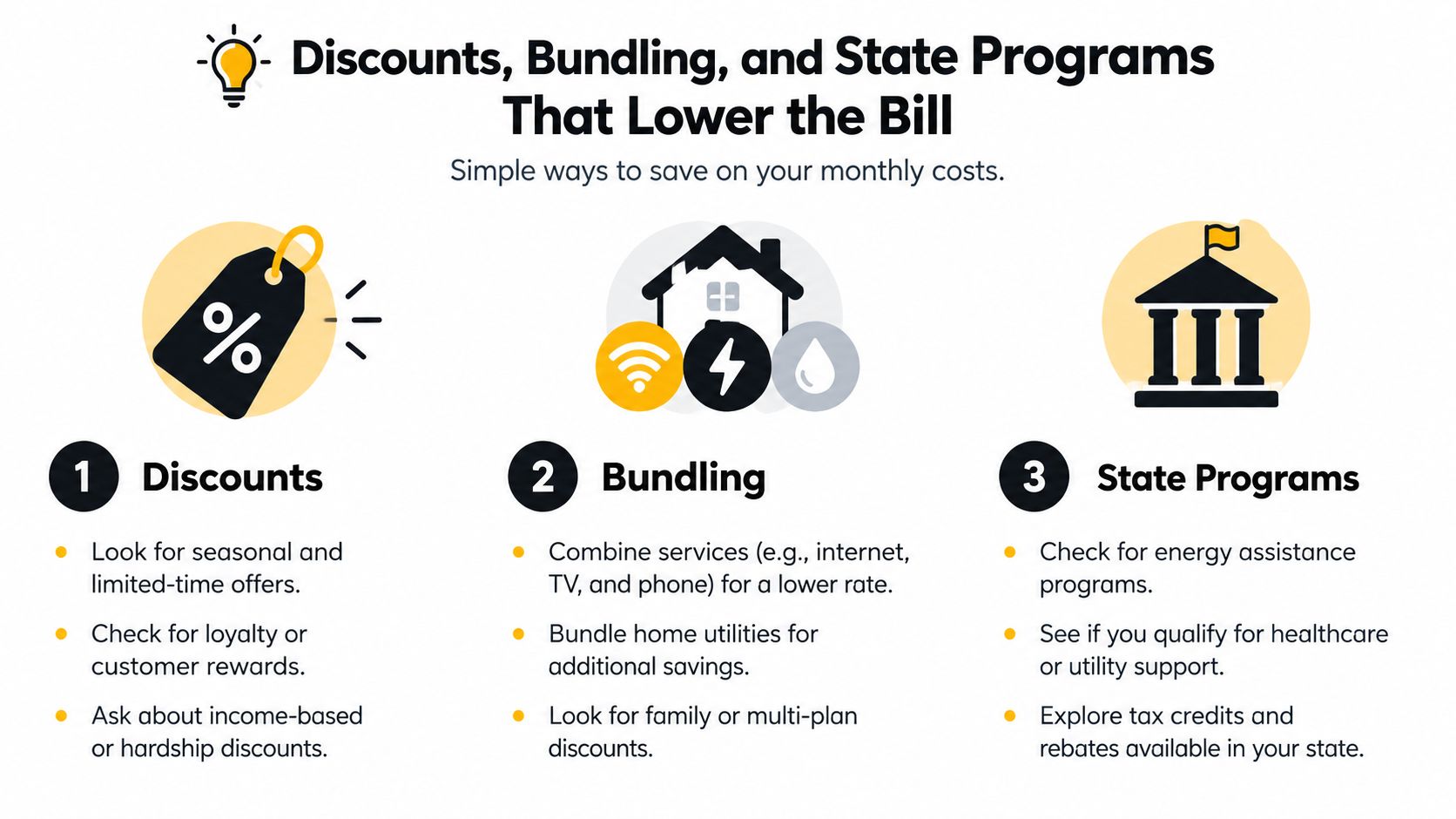
Discounts help most when you ask for them systematically. Start with the information insurers already use, then add programs that require proof.
- Multi-policy: Ask about combining auto with homeowners or renters insurance.
- Multi-vehicle: Include every eligible household vehicle in the comparison.
- Good driver: Confirm whether your clean driving history qualifies.
- Good student: Ask about documentation for a qualifying student.
- Low mileage: Provide accurate usage information if you drive less.
- Defensive driving: Check whether an approved course can reduce the premium.
- Telematics or pay-per-mile: Review the monitoring terms before enrolling.
Discount availability and amounts vary by carrier, driver, and policy. Don't lower mileage estimates to force a discount. An inaccurate application can create problems when you file a claim.
Bundle carefully
Auto plus renters insurance can be a useful combination because renters coverage protects personal property and liability while often adding little to the overall household bill. The California renters market has reported average annual premiums of about $175 to $177, or roughly $15 per month, while one comparison showed annual prices ranging from $160 at $10,000 in personal property coverage to $445 at $100,000.California renters insurance pricing Compare the bundled total, not just the auto line.
For broader household budgeting ideas, Toya AI's practical guide can help you review recurring bills alongside insurance. Then ask the agency to quote auto alone, renters alone, and the bundled combination.
California drivers who meet income and driving-history requirements should also ask about the California Low-Cost Auto Insurance program. Review eligibility, vehicle value limits, participating carriers, and required documentation directly through the program before assuming you qualify.
Drivers unable to obtain standard-market coverage can ask about the California Automobile Assigned Risk Plan. Homeowners in wildfire areas should separately review whether their property situation requires a California FAIR Plan analysis. Official California reporting recorded approximately $458 billion in FAIR Plan exposure in 2024, more than 590,000 policies in force, and roughly 1.4 million Californians insured through the plan.California Department of Insurance FAIR Plan reporting That home insurance issue is separate from auto payment help, but bundling and household coverage decisions should be reviewed together.
Use the California insurance guides to prepare your questions before requesting quotes.
Your 7-Day Plan to Get Help With Car Insurance Payments
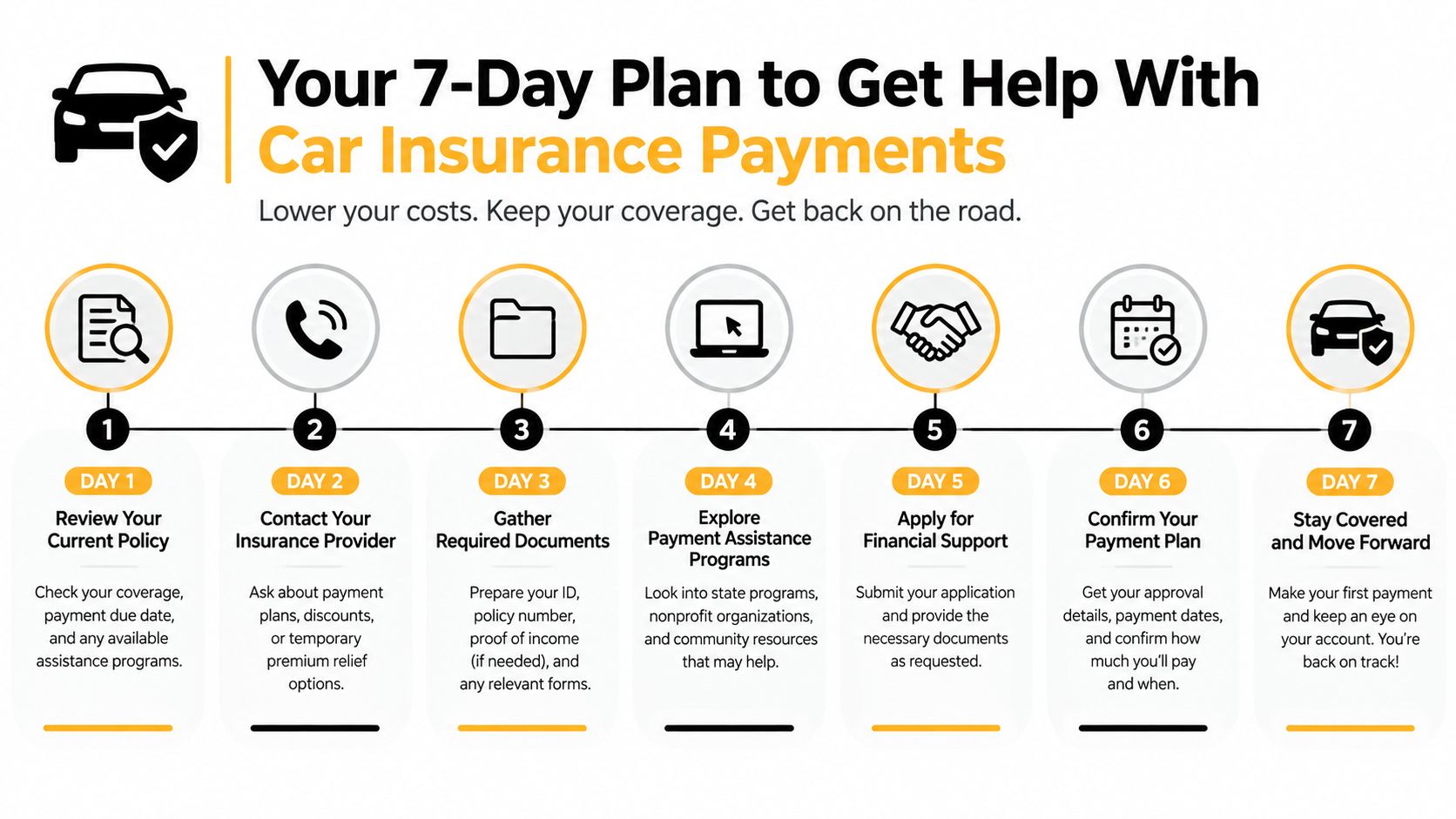
Don't wait for the bill to become a cancellation notice. Use one week to control the dates, the coverage, and the payment method.
Days 1 through 3
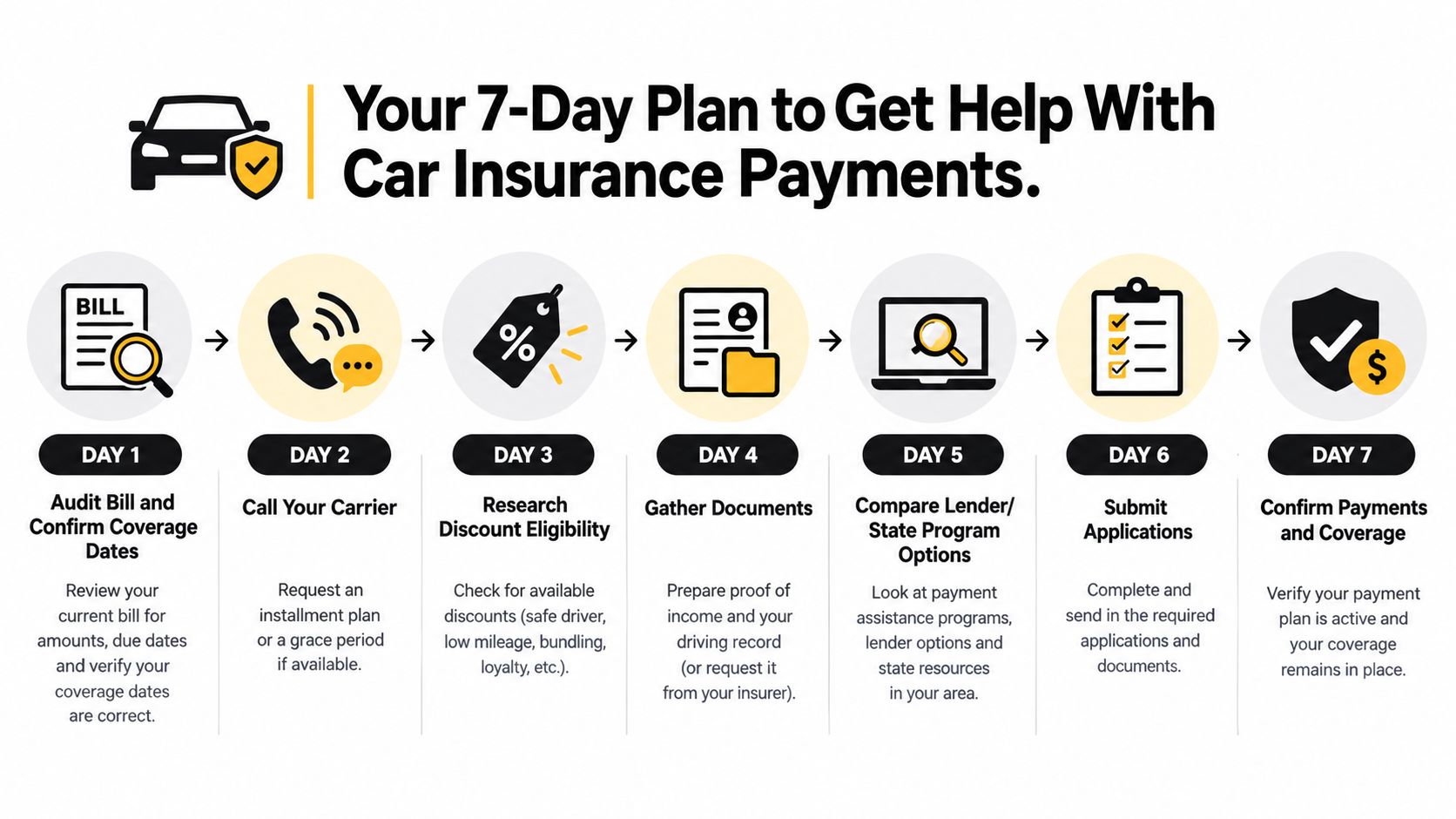
Day 1: Audit the bill. Confirm the policy number, due date, cancellation language, coverage dates, vehicles, drivers, deductibles, and total amount. Check whether the renewal changed limits or added a vehicle-related charge.
Day 2: Call the carrier's billing department. Ask for the minimum payment that prevents cancellation, the available grace period, an installment conversion, and written confirmation of the arrangement. Make the payment while you're on the call if the terms work.
Day 3: Review your coverage against California's current 30/60/15 liability limits. Identify whether collision and full coverage are required by a lender, and don't remove protections you can't afford to replace after a crash, theft, or wildfire-related loss.
Days 4 through 7
Day 4: Contact a licensed California agency for side-by-side quotes. Request the total premium, down payment, installment fees, effective date, and cancellation timing for each option.
Day 5: Apply every discount you can document. Ask about good-driver, good-student, low-mileage, defensive-driving, telematics, multi-vehicle, and California Low-Cost Auto Insurance eligibility.
Day 6: Test the bundle. Compare auto alone with auto plus renters or homeowners insurance. Keep the combination only if the total cost and coverage make sense.
Day 7: Set up autopay or another reliable payment method for the option you can sustain. Confirm that the first payment posted, the policy is active, and the next due date is in your calendar.
A lapse can create DMV reporting obligations, license suspension risk, and higher future premiums. If you can't pay the full bill, call before cancellation, get the arrangement in writing, and don't drive until coverage is confirmed. Taking action this week gives you more choices than waiting until the policy has already ended.
Mai & Associates compares California auto insurance options, payment structures, discounts, and coverage combinations for drivers who need a workable bill without a coverage gap. Visit Mai & Associates to request a quote and speak with a licensed agent about keeping your car insurance active and affordable.