Good Student Discount: Save on California Car Insurance

Adding a teen driver to a California auto insurance policy can feel like a budget alarm going off all at once. A parent in Los Angeles gets the renewal notice, a college student in Orange County buys a first car, or a family in Glendale realizes their newly licensed driver now needs full coverage. The premium jumps fast, and the first reaction is usually the same. Is there any real way to bring this down?
Yes. One of the most practical places to start is the good student discount.
It's one of the few savings opportunities that many families already qualify for but never fully use. If your student keeps strong grades, that academic record may translate into lower car insurance costs. In California, where insurance can already feel expensive, that matters. It can also fit into a wider protection plan if your household is reviewing auto insurance, home insurance, renters insurance, or life insurance together.
A Smart Way to Lower Teen Car Insurance Costs in California
A common California scenario goes like this. Your teenager passes the driving test, you call your carrier to add them to the family car insurance policy, and the new premium is far higher than you expected.
That shock is real, especially in places where many families already feel pressure from housing, commuting, and vehicle costs. Teen drivers are expensive to insure, and if you've been looking into insurance price changes for student drivers, you've probably seen how quickly rates can rise once a young driver is added.
The good news is that the good student discount is built for exactly this moment. It rewards academic performance with a reduction on auto insurance, which means a transcript or report card can sometimes save real money every month.
Practical rule: Ask about student discounts as soon as the teen is added to the policy. Don't wait for the next renewal.
For California families, this is often one of the easiest discounts to pursue because the student may already meet the requirements. No special device to install. No long waiting period. Just proof that the student is doing well in school and meets the carrier's rules.
If you're comparing options across carriers, it also helps to review how student savings fit into your overall California auto insurance choices. That matters because two policies can look similar at first glance but handle youth-driver pricing and discounts very differently.
What Is a Good Student Discount
The good student discount is an auto insurance discount for young drivers who maintain strong academic performance. It's widely available, and the savings commonly range from 10% to 25%, with average annual savings of $546.07 for 16-year-old drivers according to Car and Driver's summary of LendingTree analysis.

Why insurers offer it
This discount isn't random. Insurers use it because underwriting data has long connected strong academic performance with more responsible driving behavior. In simple terms, a student who consistently keeps grades up is often seen as a lower-risk driver than a similar student who doesn't meet that benchmark.
That's why many carriers have built the discount into their standard rating rules for young drivers. In California, where families often compare several policies at once, this can make a noticeable difference in what you pay for car insurance.
What counts as a strong academic record
Many carriers accept one of several academic benchmarks. These often include:
- A B average or 3.0 GPA
- Honor roll status
- Dean's list recognition
- Top 20% class ranking
Some insurers also accept standardized testing or school certification when a traditional grading format doesn't fit the student's situation.
A good student discount is best understood as a pricing adjustment tied to responsibility, not as a school-related perk.
That distinction matters because families sometimes assume the discount is only for top students with perfect grades. It usually isn't. Many students who are doing solid work in high school or college already meet the standard.
Who Qualifies and What Proof You Need
The most confusing part of the good student discount usually isn't the idea. It's the paperwork. Families often know the discount exists but aren't sure who qualifies, what documents count, or how often they need to resubmit proof.

Common eligibility rules
Most carriers look for a combination of age, student status, and academic performance. The most common standards include:
- Age range. Many insurers apply the discount to students roughly 16 to 25.
- School status. Full-time high school or college enrollment is often required.
- Academic standing. A B average or 3.0 GPA, honor roll, dean's list, or top class ranking is commonly accepted.
- Renewal requirement. Verification is typically required again each year.
For many California households, the full-time requirement is where confusion starts. A student may have strong grades but still run into issues if their course load doesn't meet the carrier's definition of full-time.
Documents that usually work
Carriers generally ask for proof from one of three categories. The goal is to verify academic performance clearly enough that underwriting can apply the discount.
A typical document list includes:
- Transcript or report card showing GPA or grades
- Standardized test score report if class ranking or alternate proof is needed
- School letter or certification confirming dean's list, honor roll, or similar standing
Some insurers also accept administrative confirmation for nontraditional programs. If a family isn't sure what a specific carrier will accept, it helps to review common policy questions in an insurance FAQ resource before calling.
Bring more than one document if the student's record is unusual. One extra page can save a follow-up delay.
California families with homeschool or online students
Many generic articles overlook the fact that California families often have students in homeschool programs, charter-based independent study, or online-only education. Those students may qualify, but they often need different proof.
For homeschooled students, carriers often require SAT or ACT scores in the top 20th percentile instead of a traditional GPA, and verification is usually required annually according to CIMA's good student discount guidance.
That matters because homeschool records don't always look like a standard school transcript. Online programs can create the same issue. A parent portal printout, digital transcript, dean's list notice, or school-generated academic summary may help, but the insurer still decides what it will accept.
A quick checklist before you submit
Use this short checklist to avoid the most common slowdowns:
- Check the student status first so you know whether full-time enrollment is required.
- Use the newest records available because outdated report cards often trigger follow-up requests.
- Match the student name exactly to the policy record.
- Set a yearly reminder before fall classes start so the discount doesn't fall off by accident.
Calculating Your Savings on California Car Insurance
Percentages sound good, but most families want to know one thing. What does this mean in dollars?
The exact premium depends on the driver, vehicle, ZIP code, coverage choices, and insurer. California rates can feel especially heavy in places like Glendale, Westlake Village, Costa Mesa, Los Angeles, and Orange County, so even a moderate discount can matter.
A simple way to estimate it
Start with your current annual premium for the student driver. Then estimate what a 15% discount would do. That won't match every carrier, but it gives you a practical planning number for comparison shopping.
| Scenario | Typical Annual Premium | Premium with 15% Discount | Annual Savings |
|---|---|---|---|
| Lower-cost example | $3,000 | $2,550 | $450 |
| Mid-range example | $4,500 | $3,825 | $675 |
| Higher-cost example | $6,000 | $5,100 | $900 |
These are estimates for illustration, not carrier quotes. Your actual policy may be lower or higher depending on the household and vehicle.
One verified benchmark to keep in mind
If you want one real-world benchmark, the average annual savings for 16-year-old drivers from the verified industry analysis cited earlier is $546.07. That gives families a useful reference point when evaluating whether it's worth gathering documents and calling the insurer. It usually is.
If your teen's premium is high, even a discount that seems modest on paper can turn into meaningful monthly breathing room.
For California drivers, the best next step is to compare how each company treats youth-driver pricing, then review broader policy-saving options in these California insurance guides. That's often where families notice that the same student can be priced very differently from one carrier to another.
Stacking Discounts for Maximum Auto Insurance Savings
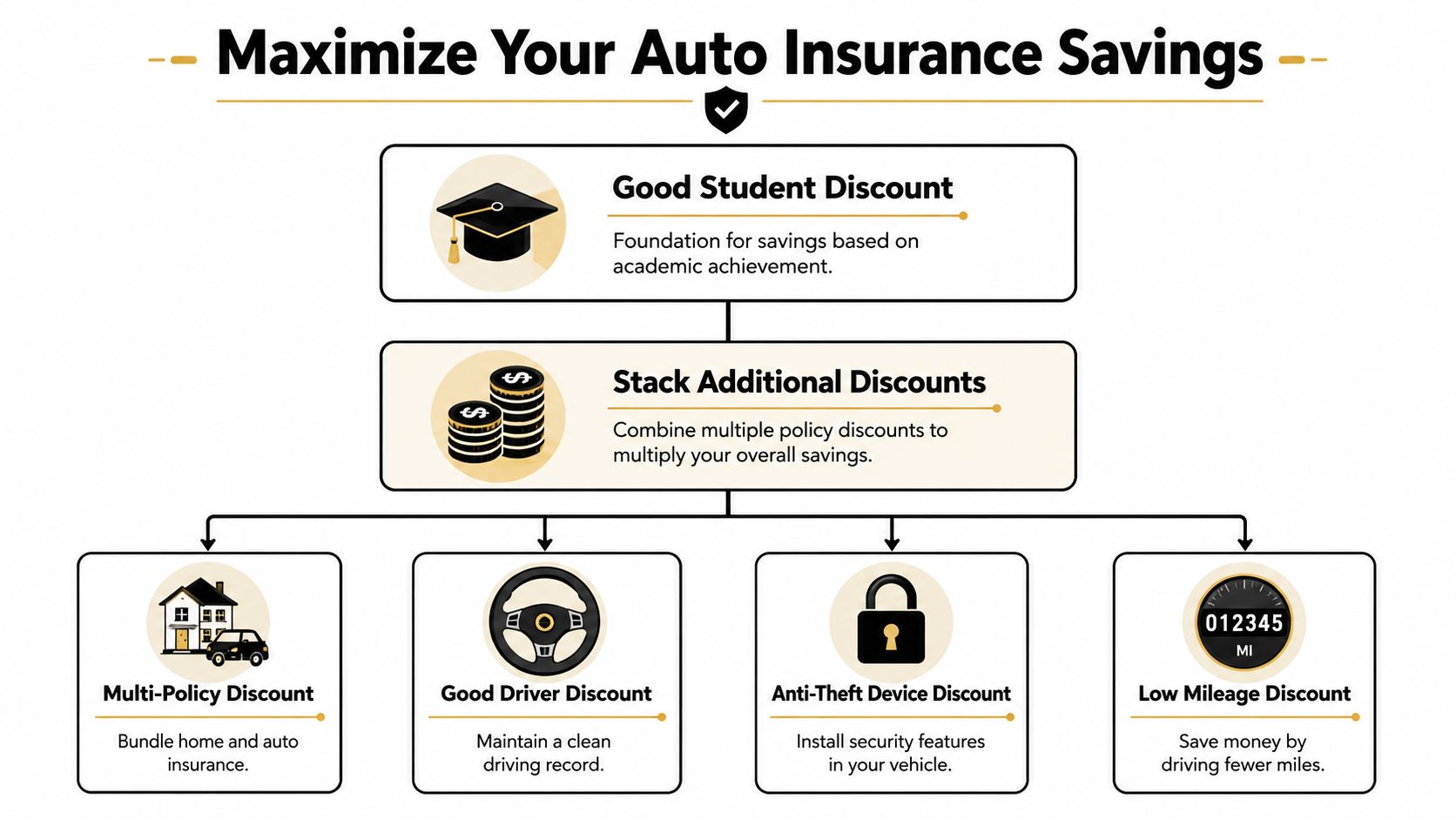
The good student discount works best when you treat it as the starting point, not the finish line. Many insurers let drivers combine it with other discounts, which can reduce the cost of California auto insurance even further.
What stacking means in practice
Stacking means more than one discount applies to the same policy. A student might qualify for the good student discount and also benefit from an away-from-home rule, a multi-car discount, or a safe vehicle discount.
According to Consumer Reports coverage summarized by News4JAX, the good student discount often stacks with perks like an away-from-home discount for students living 100+ miles away without a car, potentially leading to combined savings of 20% to 30%. The same report notes that many insurers also combine it with multi-car or safe vehicle discounts.
Where California households often find extra savings
A student discount can fit into a broader household plan. That's especially relevant if your family is reviewing more than just car insurance.
Some of the most common pairings are:
- Auto plus home insurance if the family owns a home and wants one insurer for both
- Auto plus renters insurance for college students or young adults in apartments
- Multi-car savings when the teen is added to an existing family policy
- Away-from-home discounts for students who leave for school without keeping a vehicle nearby
- Vehicle-based discounts if the insured car has qualifying safety or anti-theft features
This is one reason California insurance reviews should look beyond a single premium line. A family may save on auto insurance directly, then improve the overall household total by coordinating auto, home, renters, or even life insurance with the same carrier.
A practical stacking mindset
Not every discount applies to every household, and not every carrier combines discounts the same way. But the process is simple. Ask what can be layered on top of the student discount, and ask the carrier to check all student-related options at the same time.
If you want another broad list of cost-saving ideas, this roundup of expert advice to cut costs is a useful companion while comparing quotes.
The biggest missed opportunity isn't failing to ask for the good student discount. It's stopping there and never checking what else can be added.
How to Get Your Discount and Expert Help
The fastest way to get the good student discount is to treat it like a short admin task, not a long insurance project. Families who prepare the right documents before calling usually have a much smoother experience.
A simple application process
Confirm the student's status
Check whether the student is full-time and whether the carrier has an age limit for this discount.Gather academic proof
Pull the latest transcript, report card, dean's list letter, honor roll notice, or alternate accepted record.Call or message the insurer
Ask specifically for the good student discount. Don't assume it was added automatically.Submit documents the way the carrier prefers
Some companies accept uploads through an app or portal. Others want email or agent submission.Review the updated premium
Make sure the revised declarations page or billing view reflects the discount.Set a renewal reminder
Since student verification often needs to be renewed, calendar it before the next school year begins.
Common pitfalls to avoid
One of the biggest mistakes is assuming that every student qualifies the same way. They don't.
According to Progressive's student discount guidance, a common pitfall is assuming part-time students qualify. Most major insurers require full-time enrollment, which is a major issue for many California community college students. If a student doesn't meet that rule, it's still worth asking whether the carrier accepts an alternative path.
Other problems show up often too:
- Forgetting annual re-verification, which can cause the discount to disappear
- Sending incomplete records, especially when the GPA or ranking isn't visible
- Assuming homeschool documents will be treated like a traditional transcript
- Not asking about other student-related discounts at the same time
Three common questions
Does the good student discount apply only to teens
No. It often applies to eligible high school and college students within the carrier's age range, as long as they meet the insurer's academic and enrollment requirements.
Can a part-time student still get it
Sometimes there may be alternatives, but many major insurers focus on full-time students. If the student is part-time, ask the carrier to review all available options rather than assuming the answer is yes or no.
Should families review other policies too
Yes. A student driver change is a smart time to review auto insurance, and it can also be a good time to compare home insurance, renters insurance, and life insurance if the household wants to simplify protection and look for broader savings.
If you're ready to compare options, request a personalized California insurance quote online and have the student paperwork ready before you start.
If you want help finding every discount your family may qualify for, Mai & Associates can review your California auto insurance and also help you compare home insurance, renters insurance, and life insurance options. With support in English, Spanish, Armenian, Russian, and Vietnamese, the team can walk you through student eligibility, document requirements, and side-by-side quotes for households across California.