Good Driver Discounts Save 20% in California

You're sitting in your car with a California auto insurance renewal notice in your hand. Your record is clean, you haven't had an at-fault accident, and you can't understand why your premium still feels higher than expected. The answer may involve a good driver discount, but that phrase doesn't mean the same thing with every insurer.
For California drivers, the issue is especially important. California law creates a 20% Good Driver Discount for eligible drivers. That isn't a temporary promotion or a coupon an insurer may withdraw. It's a regulated pricing feature that establishes a minimum reduction from the rate the same driver would otherwise pay for the same coverage.
Core promise: Safe driving should create a clearer path to paying less for auto insurance.
This guide explains what good driver discounts reward, how California eligibility works, how to check whether your policy reflects the discount, and how other savings programs may fit around it. It also separates the California rule from voluntary offers that vary by insurer and state.
If you're shopping for California auto insurance, the practical question isn't just, “How large is the discount?” You also need to ask, “Which definition of good driver is this carrier using, and can its discount combine with other programs?”
Introduction to Good Driver Discounts and Why They Matter
A good driver discount connects your driving history with your insurance price. Insurers generally view a driver with fewer recent violations and claims as a different pricing risk from a driver with a speeding ticket, an at-fault accident, or a serious conviction. The discount turns that difference into a recurring premium reduction rather than a one-time reward.
A store may give better terms to a customer who consistently pays on time. An auto insurer may offer better pricing to a policyholder whose record remains clean during its stated look-back period. The comparison isn't perfect, because insurance pricing also considers the vehicle, coverage limits, location, and other underwriting factors, but it makes the basic idea easier to understand.
California adds an important layer. In many states, a clean-record discount is mainly a carrier-designed offer. Insurers choose the eligibility rules, the reduction, and sometimes whether to offer the discount at all. In California, qualifying drivers are entitled to a statutory rate reduction of at least 20%, subject to the requirements explained below.
That distinction can affect what you do at renewal. A driver who sees a premium increase shouldn't assume that a clean record guarantees the lowest possible price. The policy may not reflect every eligible discount, the carrier may use a different rating structure, or another part of the premium may have changed. Reviewing the declarations page and asking an agent to explain the calculation is more useful than focusing on a single advertised number.
Why the discount deserves attention
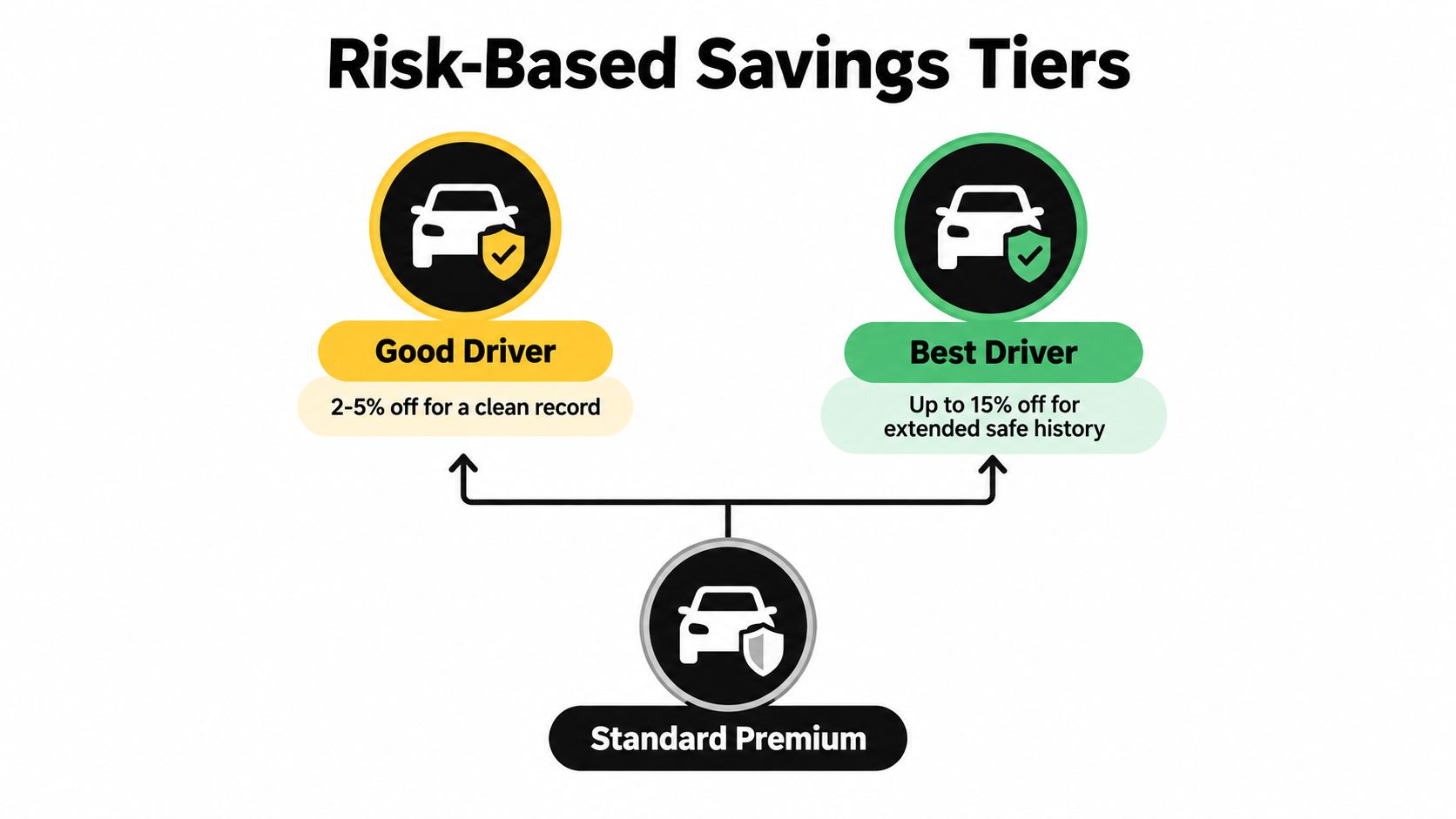
Published industry guides commonly describe voluntary good driver savings as roughly 10% to 30%, with some insurers advertising as much as 40% for drivers who remain accident-free and violation-free, as summarized by Compare.com's safe-driver discount guide. Those figures describe a broad market, not a promise for every California policy.
The benefit is consistency. Once an insurer recognizes that you meet its requirements, the discount may continue at renewal while your qualifying record remains intact. Some carriers apply it automatically, but you shouldn't rely on that without checking your policy documents.
The most useful mindset is simple: your clean record is an underwriting asset. In California, it may also trigger a legal pricing floor.
What Good Driver Discounts Mean for California Drivers
Start with the basic definition. A good driver discount is a reduction in auto insurance pricing based on qualifying driving behavior or history. The traditional version looks at your record over a defined period, often three to five years, according to Way.com's explanation of good driver discounts.
The insurer isn't rewarding a single careful trip. It's evaluating a pattern. A clean record can signal fewer recent violations or serious incidents, while a history with tickets or at-fault accidents may place the driver in a different rating category.
Clean-record pricing versus telematics
There are two broad ways insurers recognize safe driving.
The first is record-based pricing. The carrier reviews motor vehicle record information and applies its rules for violations, accidents, and convictions. This approach looks backward at documented history.
The second is telematics or usage-based pricing. An app or device may measure driving indicators such as hard braking, speed consistency, and time of day. Those measurements act as surrogate risk variables. They don't prove that a driver will or won't have a claim, but insurers use them to refine their pricing models.
That means “good driver” can describe different things. One carrier may focus on a clean record. Another may connect savings to participation in a monitored program. A third may use both.
A mandated discount is different from a promotion
A voluntary discount is part of an insurer's product design. The carrier can define the conditions and may limit availability by state or policy type. California's statutory Good Driver Discount works differently. If you qualify under the legal requirements, the insurer must apply at least the required reduction.
This doesn't mean every California driver pays 20% less than every other driver. The comparison is between the eligible driver's rate and the rate that same insured would otherwise have been charged for the same coverage. Your total premium can still vary because of vehicle type, coverage choices, location, and other rating factors.
The discount also doesn't eliminate the need to compare policies. Two carriers can produce different final premiums even when both recognize your clean record. The smart comparison is policy against policy, with matching liability limits, deductibles, vehicle information, and available discounts.
California Good Driver Discount Rules and Who Qualifies
California's rule is specific enough for drivers to perform a useful self-check. The statutory requirements focus on licensing history, DMV points, serious accidents, and major convictions. They also create a pricing floor that makes California different from markets where good driver savings are entirely discretionary.
The eligibility checklist
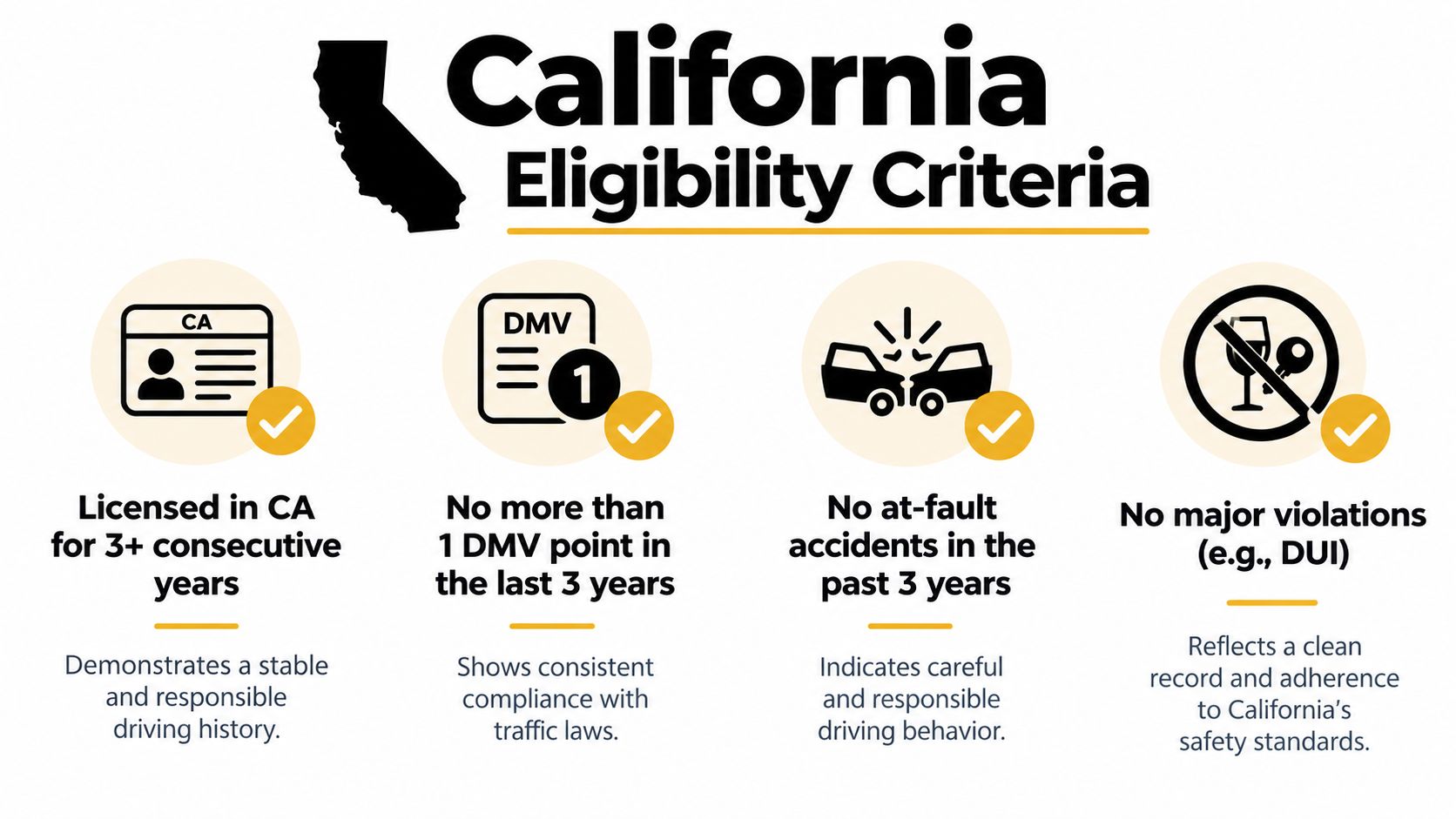
You generally need to satisfy all of the following statutory conditions:
- Continuous licensing: You must have held a valid driver's license for the prior three consecutive years, as described in California Insurance Code Section 1861.025.
- Limited DMV points: Your record must show no more than one point under the applicable eligibility standard.
- Serious accident history: You must not have been principally at fault in a bodily-injury or death accident during the relevant prior three-year period.
- Major convictions: Disqualifying DUI or serious driving convictions can prevent eligibility during the statutory look-back period.
The law says the Good Driver Discount policy rate must be at least 20% below the rate the same insured would otherwise have paid for the same coverage. That wording matters because it describes a comparison within your own policy circumstances, not a universal promise about your final bill.
California rule: An eligible Good Driver Discount policy must be priced at least 20% below the otherwise applicable rate for the same insured and coverage.
Why Proposition 103 matters
California's framework operates under Proposition 103 protections. The California Department of Insurance guidance on Good Driver Discount policies states that insurers subject to the law must not refuse to offer and sell a qualifying Good Driver Discount policy.
This protection makes the discount more predictable than a carrier's optional marketing offer. It doesn't prevent an insurer from asking for information needed to complete an application, and it doesn't make every carrier's overall rate identical. It does mean an eligible applicant should be able to obtain the qualifying policy rather than being turned away through unrelated application requirements.
Outside California's mandated structure, definitions vary more widely. Some insurers use a clean-record look-back, some connect savings to telematics, and some exclude a good driver discount in particular states. Read the eligibility language, not just the headline.
How to Qualify for and Keep Your Good Driver Discount
Eligibility is only useful if you can document it and confirm that the carrier applied it. Treat the process like an annual account review. Your goal is to know what appears on your driving record, understand the insurer's renewal calculation, and correct omissions promptly.
A practical maintenance routine
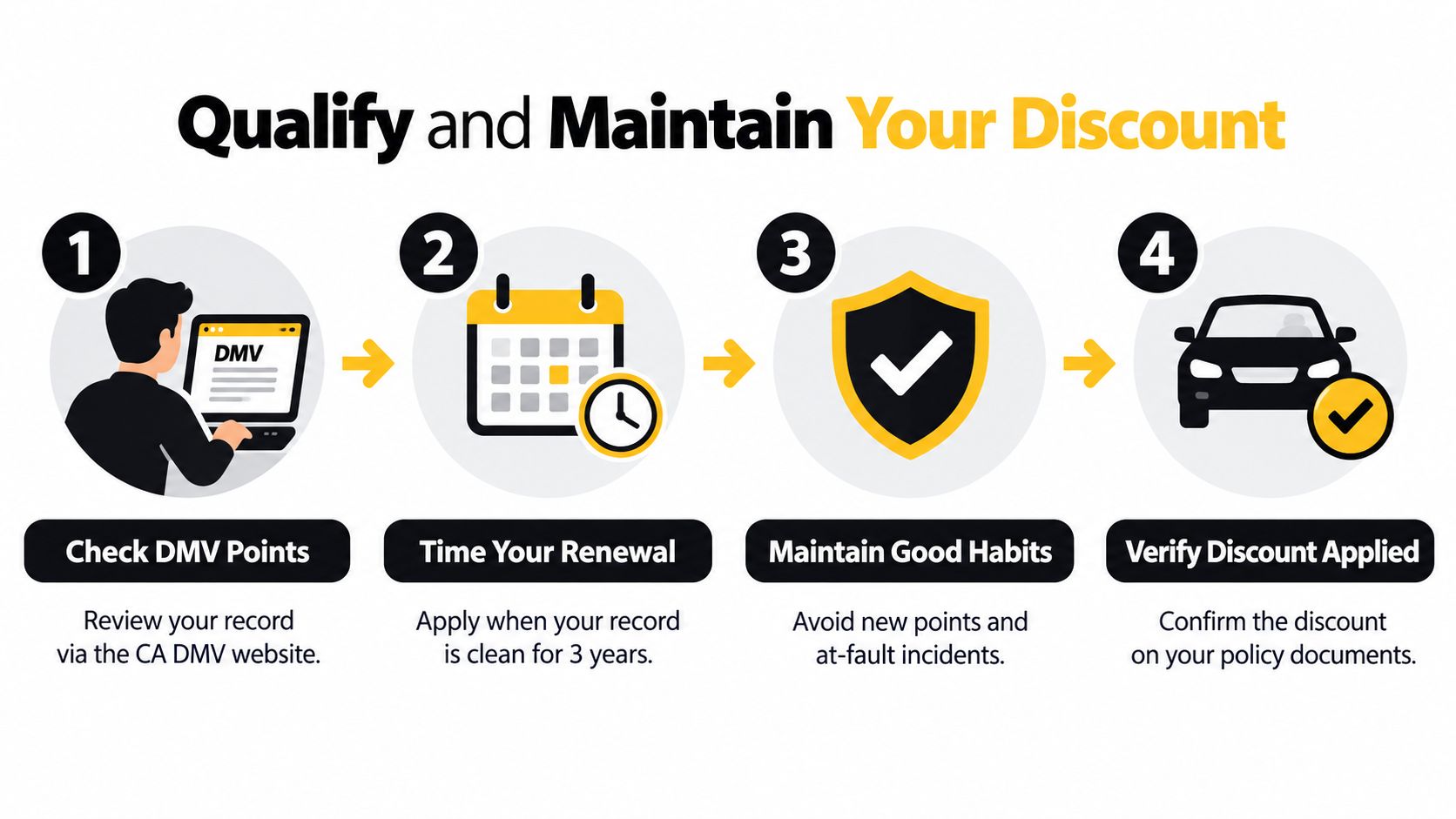
Check your DMV record. Review your California driving record through the California DMV website. Confirm that the license history, points, violations, and accident information match your understanding. Don't assume an old incident has disappeared just because you remember when it happened.
Track dates rather than guessing. Write down the dates of tickets, accidents, and license changes. A carrier may use a specific look-back period, and the date an event falls outside that period can affect re-rating.
Ask for a review after the record changes. If a point or violation is no longer relevant under the insurer's rules, contact the carrier or agent and ask whether your premium can be re-rated. The discount may not appear until the insurer receives updated record information.
Read the renewal documents. Look for the discount or rating classification on the declarations page and policy paperwork. If the document doesn't explain what you expected, ask for a plain-language breakdown.
What qualified applicants should know
California Department of Insurance guidance says an insurer has 15 business days after receiving a completed application to bind coverage for a Good Driver. The application must be complete, so respond to requests for required information and keep copies of what you submitted.
Safe habits also protect your future pricing. Avoiding new points and at-fault incidents is obvious, but so is checking who is listed as a household driver and making sure vehicle use is accurately described. If another person regularly drives your car, their record may affect underwriting even though your own record is clean.
Use California insurance guides to organize questions before renewal. A short checklist can prevent a missed discount from becoming an unexplained premium difference.
How Good Driver Discounts Combine With Other Auto Savings
A good driver discount isn't always the only safe-driving incentive available. The difficult part is that insurers don't use one universal stacking formula. A clean-record discount may combine with a telematics offer at one carrier, while another carrier may treat the programs as overlapping ways to measure the same risk.
Published consumer explanations place voluntary good driver savings anywhere from roughly 5% to 40%, depending on the insurer, state, and program, as discussed by SafeDriver.com's overview of safe-driver discounts. A separate industry guide reports that 62% of policyholders said they received a safe-driver discount, according to MarketWatch's auto insurance discount guide. These figures show broad adoption, not a guaranteed result for your policy.
Good Driver Discount Stacking Options
| Discount Type | Typical Savings Range | Stacks With Good Driver Discount |
|---|---|---|
| Clean-record discount | About 10% to 30% | Often, but carrier rules control |
| Telematics or usage-based program | Up to 40% in some advertised programs | Sometimes |
| Accident-free discount | Varies by insurer | May stack or overlap |
| Claims-free discount | Varies by insurer | May stack or overlap |
| Low-mileage or usage-based pricing | Varies by insurer | Carrier-specific |
| Multi-policy or household discount | Varies by insurer | Often available, subject to policy rules |
The table uses ranges reported in the cited industry material. It shouldn't be read as a quote. Ask the carrier whether each discount is additive, applied in sequence, or substituted for another discount.
What telematics actually measures
Telematics programs may evaluate hard braking, speed consistency, acceleration, and time-of-day exposure. In practical terms, the insurer is trying to observe driving patterns rather than relying only on past tickets and accidents.
Before enrolling, read the program's privacy and pricing terms. Ask whether participation can affect pricing negatively, whether another household driver using the vehicle is included, and whether you can leave the program without losing another policy benefit.
Drivers handling serious violations may also need specialized education. A resource on ways to reduce insurance costs through Georgia DUI schools can provide broader context, although California eligibility and insurer rules still govern a California policy.
Real Savings Examples for California Drivers
The cleanest way to understand risk-based pricing is to compare premiums for drivers with different records. A published 2026 guide cites an average clean-record premium of $1,778, compared with $2,139 for a driver with a speeding ticket, $2,526 after an at-fault accident, and $3,427 after a DUI conviction, as reported in Way.com's good-driver discount guide. These are benchmark examples, not quotes for a particular California household.
Four driver profiles
The clean-record driver starts with the benchmark of $1,778. That driver has the strongest profile among these examples and may qualify for a record-based discount, subject to insurer and state rules.
The speeding-ticket driver reaches $2,139 in the cited example. The difference from the clean-record benchmark is $361. The comparison illustrates why a single violation can matter even when no accident occurred.
The at-fault accident driver reaches $2,526. Compared with the clean-record benchmark, the difference is $748. That gap reflects the way insurers may treat an at-fault loss as evidence of greater future claim risk.
The DUI driver reaches $3,427. The difference from the clean-record benchmark is $1,649. A DUI can also create eligibility problems under California's statutory Good Driver Discount rules, so the issue isn't merely the size of a voluntary discount.
Applying the California floor
For an eligible California driver, the statutory discount is at least 20% below the otherwise applicable rate for the same coverage, under the California Insurance Code rule. On a hypothetical otherwise applicable premium of $2,000, 20% would equal $400, leaving $1,600 before other policy changes or rating factors. That arithmetic illustrates the rule's structure, not a market quote.
The final premium can still change because the insurer may update vehicle information, coverage limits, location factors, or other underwriting inputs. Telematics and additional discounts may create another path to savings, but they don't replace the need to verify the statutory discount first.
For more California insurance pricing perspectives, review the Mai & Associates insurance blog. Use examples to ask better questions, not to predict your exact renewal price.
Next Steps to Get Your Good Driver Discount Quote
Three decisions make the process manageable. First, identify whether California's 20% statutory floor applies to you. Second, verify your licensing history, DMV point count, accident history, and conviction record. Third, compare carriers based on the final premium and the discounts that can be combined.
A quote comparison should use the same liability limits, collision and collision deductibles, listed drivers, vehicle details, and coverage options. Otherwise, a lower premium may reflect less protection. This principle applies across California car insurance, including policies for new drivers, commuters, families, and households with multiple vehicles.
Questions California shoppers commonly ask
Does the discount appear automatically? It may, once the insurer receives or verifies the information showing that you qualify. Still, check your renewal documents and ask for confirmation. A clean record alone doesn't tell you whether the carrier coded the policy correctly.
What documents should I prepare? Have your driver's license information, vehicle details, current declarations page, and any relevant renewal or violation documentation available. The insurer may obtain driving-record information directly, but accurate dates and policy records help resolve discrepancies.
Can I switch carriers and keep my good-driver status? Your driving history travels with your underwriting record, but each insurer may apply its own voluntary discounts and rating rules. California's statutory eligibility requirements remain central, while telematics, accident-free, claims-free, and bundling programs can differ by carrier.
Can home or renters insurance affect the comparison? Yes, a carrier may offer a multi-policy opportunity when you combine auto insurance with home insurance or renters insurance. Life insurance is priced through different underwriting considerations, so it shouldn't be treated as an automatic extension of an auto discount. California homeowners should also review specialized protection needs, including wildfire and earthquake coverage, separately from car insurance pricing.
Mai & Associates provides rate comparisons from multiple top-rated carriers, same-day quotes, and responses within 24 hours from licensed agents serving Glendale, Westlake Village, Escondido, and Costa Mesa. The agency also offers multilingual support in English, Spanish, Armenian, Russian, and Vietnamese, with options for auto, home, renters, and life insurance. Start with a California insurance quote request and ask the agent to show how the Good Driver Discount appears in the comparison.
Mai & Associates can compare your California auto insurance options and check whether your qualifying good driver discount is reflected correctly. Visit Mai & Associates for a no-obligation quote review and practical guidance on combining auto coverage with home, renters, or life insurance needs.