Decoding California Gap Insurance Cost
When it comes to GAP insurance in California, the price tag can swing wildly. You might see it offered for as little as $60 a year tacked onto your auto policy, or as a one-time fee of $500 to $700 at the car dealership. That's a huge difference, and it's exactly why shopping around for your California insurance is so important.
Your Guide To California GAP Insurance Costs
Picture this: you've just driven your dream car off a dealership lot in Los Angeles. It's an amazing feeling, but the second those tires hit the street, the car's value starts to drop. This is called depreciation, and it happens fast.
Now, imagine you get into an accident a few months later and your car is totaled. Your standard California car insurance will only pay out what the car is worth at that moment—its depreciated value. This almost always leaves a "gap" between what your insurer pays and what you still owe on your car loan. Suddenly, you're stuck making payments on a car you can't even drive.
This is the exact financial headache that Guaranteed Asset Protection (GAP) insurance is built to prevent. It’s a crucial addition to a comprehensive auto insurance plan for many drivers.
Understanding The Price Difference
So, why the huge cost difference? It really boils down to where you buy your coverage.
Dealerships sell convenience. They offer GAP insurance as a simple, one-time purchase you can roll right into your auto loan. It's easy, but it’s almost always the most expensive route.
On the other hand, adding GAP coverage directly through your existing auto insurance carrier is usually much more budget-friendly. They can often add this protection for just a few extra dollars a month on your premium. This not only saves you a ton of money upfront but also means you won't pay interest on the cost of the coverage itself, which is exactly what happens when it's bundled into a loan.
For many California drivers, GAP insurance is less of a product and more of a financial safety net. It’s the peace of mind that ensures a total loss doesn't become a long-term financial burden, complementing other essential coverages like life insurance.
A Quick Comparison Of Your Options
Choosing where you get your GAP coverage can easily save you hundreds of dollars. It’s a classic trade-off: convenience versus cost. To help you decide, here’s a quick rundown of how the common options stack up.
GAP Insurance Cost At A Glance
This table gives you a clear snapshot of your choices, the typical costs you can expect in California, and who each option is generally best for.
| Purchase Option | Typical Cost Structure | Average Price Range (One-Time) | Best For |
|---|---|---|---|
| Auto Insurance Carrier | Small increase to your annual premium | $20 - $60 per year | Drivers seeking the most affordable and flexible coverage. |
| Car Dealership | One-time flat fee, often rolled into the loan | $400 - $900+ | Buyers who prioritize convenience at the point of sale. |
| Lender or Credit Union | One-time flat fee, sometimes lower than dealerships | $300 - $600 | Borrowers who want a balance of convenience and moderate cost. |
Ultimately, just taking a few minutes to get quotes can make a huge financial difference. Whether you're sorting through car insurance requirements for a new ride or looking at your other policies like home or renters insurance, being informed is the best way to protect your wallet.
What Is Gap Insurance and Why It Matters?
Picture this: you've just driven your brand-new car off a dealership lot in San Diego. It’s a fantastic feeling. But the second your tires hit that public road, a process called depreciation kicks in. Your car's value starts to fall, and it happens a lot faster than most people realize—often losing up to 20% of its value in the very first year.
Now, let's imagine a few months down the road, a collision totals your new vehicle. You file a claim with your regular California car insurance, thinking you're covered. But this is where a nasty surprise can pop up.
Your insurance company will pay out the Actual Cash Value (ACV) of your car—what it was worth the moment before the accident, not what you paid for it. Because of that steep initial depreciation, the insurance check is often thousands of dollars less than what you still owe on your loan. That difference is the "gap," and without the right coverage, you’re on the hook for paying it out-of-pocket for a car you can't even drive anymore.
The Financial Gap Explained
This stressful situation is what's known as having negative equity, or being "upside down" on your loan. It’s a surprisingly common trap for new car buyers, especially during the first few years of a loan.
Gap insurance is the essential bridge that closes this financial divide. It's an optional coverage designed to pay the difference between your insurance company's ACV payout and the outstanding balance on your loan or lease.
Think of it this way: your standard auto insurance policy protects the value of your car. Gap insurance protects the value of your loan. Understanding that distinction is key to protecting your finances. For a deeper look at common insurance terms, you can check out our detailed insurance glossary.
Defining Key Insurance Concepts
To really understand why gap insurance is so important, let's nail down the two concepts that create the "gap."
- Actual Cash Value (ACV): This is not the sticker price you saw at the dealership. ACV is what your car is worth in the open market at the time of the accident, after accounting for depreciation from its age, mileage, and general wear and tear. This is the number your insurer uses to write the check.
- Negative Equity: This happens when you owe more on your car loan than the car's ACV. If your car’s ACV is $20,000 but you still have a $25,000 loan balance, you have $5,000 in negative equity.
Without gap insurance, that $5,000 is your problem. This is the exact financial headache that gap coverage is built to prevent, making it a crucial safety net for anyone financing or leasing a vehicle in California.
And the need for this protection is only growing. The global market for Guaranteed Auto Protection (GAP) insurance is projected to jump from USD 4.5 billion in 2025 to almost USD 8.8 billion by 2035. This trend is fueled by the simple fact that more people are financing and leasing cars, putting them at risk of depreciation.
What Factors Drive the Cost of GAP Insurance?
Figuring out the price of GAP insurance isn't as simple as looking up a number in a book. It’s more like getting a custom quote for a home insurance project—the final price depends entirely on your specific situation. A handful of key details about your car, your loan, and even you as a driver all get factored into the final premium.
Insurers in California are essentially trying to measure risk. They look at the gap between what you owe and what your car is worth, and then calculate the odds of having to pay out a claim. Someone financing an expensive, fast-depreciating car with a long loan term will see a much higher price than a person with a modest car and a shorter loan.
Let's break down exactly what they're looking at.
Your Vehicle’s Value and Depreciation Rate
The biggest piece of the puzzle is the car itself. The sticker price is the starting point—a $75,000 luxury SUV naturally has a much bigger potential "gap" to cover than a $25,000 commuter sedan. It’s simple math.
But what’s even more important is how quickly that car loses value. This is its depreciation rate. Some cars are known for holding their value incredibly well, while others seem to lose a chunk of their worth the second you drive them home. A vehicle notorious for rapid depreciation is a bigger risk for the insurer, and that risk gets passed on to you in the form of a higher GAP insurance premium.
Loan-to-Value (LTV) Ratio and Your Down Payment
This one is huge. California insurance providers live and breathe by a metric called the loan-to-value (LTV) ratio. It’s just a straightforward comparison of how much you borrowed versus what the car is actually worth. Putting very little money down is the fastest way to get a high LTV and, in turn, a higher GAP insurance cost.
When you make a down payment of less than 20%, you’re almost guaranteed to be "upside down" on your loan from day one. This immediately creates the financial gap that the insurance is designed to cover, making the policy more expensive because the risk of a claim is high right out of the gate.
Think of it this way:
- Small Down Payment (e.g., 5%): This gives you a high LTV. You owe nearly the full sticker price, but the car's value has already dropped. This is a high-risk scenario for the insurer, leading to a higher cost.
- Large Down Payment (e.g., 25%): This results in a low LTV and gives you instant equity. The gap is small or maybe even non-existent, meaning your premium will be much, much lower.
The less skin you have in the game upfront, the bigger the potential shortfall an insurer might have to cover. That's why your down payment directly impacts what you'll pay.
The Length of Your Loan or Lease
The term of your financing is another major factor. Those longer loan terms—60, 72, or even 84 months—are tempting because they lower your monthly payment, but they come with a hidden cost when it comes to GAP insurance. The longer the loan, the more slowly you build equity.
On a long-term loan, your first couple of years of payments are mostly just chipping away at the interest, not the principal. All the while, your car's value is steadily dropping. This keeps the gap between what you owe and the car's worth wide open for a longer period. It's why a 72-month loan will almost always have a higher GAP insurance cost than a 48-month loan for the exact same vehicle.
To illustrate how these choices can pull your premium in different directions, here’s a quick breakdown:
How Different Factors Impact Your GAP Insurance Premium
This table shows how specific characteristics of your vehicle and loan can either raise or lower the cost of your GAP insurance coverage.
| Factor | Increases Cost | Decreases Cost | Why It Matters |
|---|---|---|---|
| Vehicle Value | High-value luxury or sports cars | Lower-value economy cars | The more a car costs, the larger the potential financial "gap" to cover. |
| Depreciation Rate | Models that depreciate quickly | Models that hold their value well | Faster depreciation means the gap between loan balance and car value grows quicker. |
| Down Payment | 0% - 10% down payment | 20% or more down payment | A larger down payment reduces your loan-to-value (LTV) ratio from the start. |
| Loan Term | Long terms (72-84 months) | Short terms (36-48 months) | Longer loans mean you build equity much more slowly, keeping the gap open longer. |
| Credit History | Poor or fair credit | Excellent or good credit | A strong credit history suggests lower risk to insurers, often resulting in a better rate. |
As you can see, every decision you make during the car-buying process, from the model you choose to the financing you accept, has a direct effect on this cost.
Your Credit History and Location
Finally, a few personal details can nudge the price up or down. Many insurers use a credit-based insurance score to gauge risk, so a strong credit history can sometimes earn you a lower GAP premium.
Where you live in California also plays a role. Insurance costs can vary from one part of the state to another based on local claim statistics, theft rates, and market competition. These regional differences are a normal part of the California insurance world and can absolutely affect the gap insurance cost you're quoted.
All these pieces fit together to create a complete picture of your risk profile. Understanding them is key not just for GAP insurance, but for any policy. To see how these same factors influence standard policies, check out our complete guide to auto insurance in California.
Comparing Your Gap Insurance Purchase Options
So, you've decided GAP insurance is a smart move for your new car. Now comes the next big question: where should you actually buy it? This isn't just about picking a product; it's about choosing how much you'll pay and how you'll pay for it. The GAP insurance cost can swing wildly depending on where you sign up.
For most drivers in California, there are three main places to get this coverage, and each has its own set of pros and cons. Understanding them is the key to not overpaying. It usually boils down to a trade-off between convenience and cost.
Option 1: The Car Dealership
Getting GAP insurance right at the dealership is, without a doubt, the easiest option. They'll offer it to you while you're signing all the financing paperwork, and you can just say "yes" and have it all wrapped up in one go. The sheer simplicity is its biggest draw.
But that convenience comes at a premium—a big one. Dealerships typically charge a flat fee that can be anywhere from $400 to over $900. To make matters worse, they often roll that fee right into your auto loan. This means you’re not just paying that high price; you’re also paying interest on it for the entire term of your loan, which can really inflate the total cost over time.
Option 2: Your Auto Insurance Company
A much friendlier option for your wallet is adding GAP coverage directly to your existing California auto insurance policy. Most of the big insurance carriers offer it as an add-on, often called an "endorsement," that you can tack onto your comprehensive and collision coverage. The savings here can be massive.
Instead of a hefty one-time fee, you'll see a small bump in your regular premium. This usually works out to just $20 to $60 per year—a tiny fraction of what the dealership charges. Not only does this save you hundreds of dollars upfront, but it also saves you from paying all that unnecessary interest. It also gives you more flexibility; you can typically drop the coverage once your loan balance is low enough that you no longer need it.
Ready to see how affordable it can be? You can easily compare rates, and when you're ready, you can get a same-day insurance quote from a licensed California insurance agent who can bundle it all together for you.
This infographic breaks down what goes into your premium, highlighting why shopping around pays off.
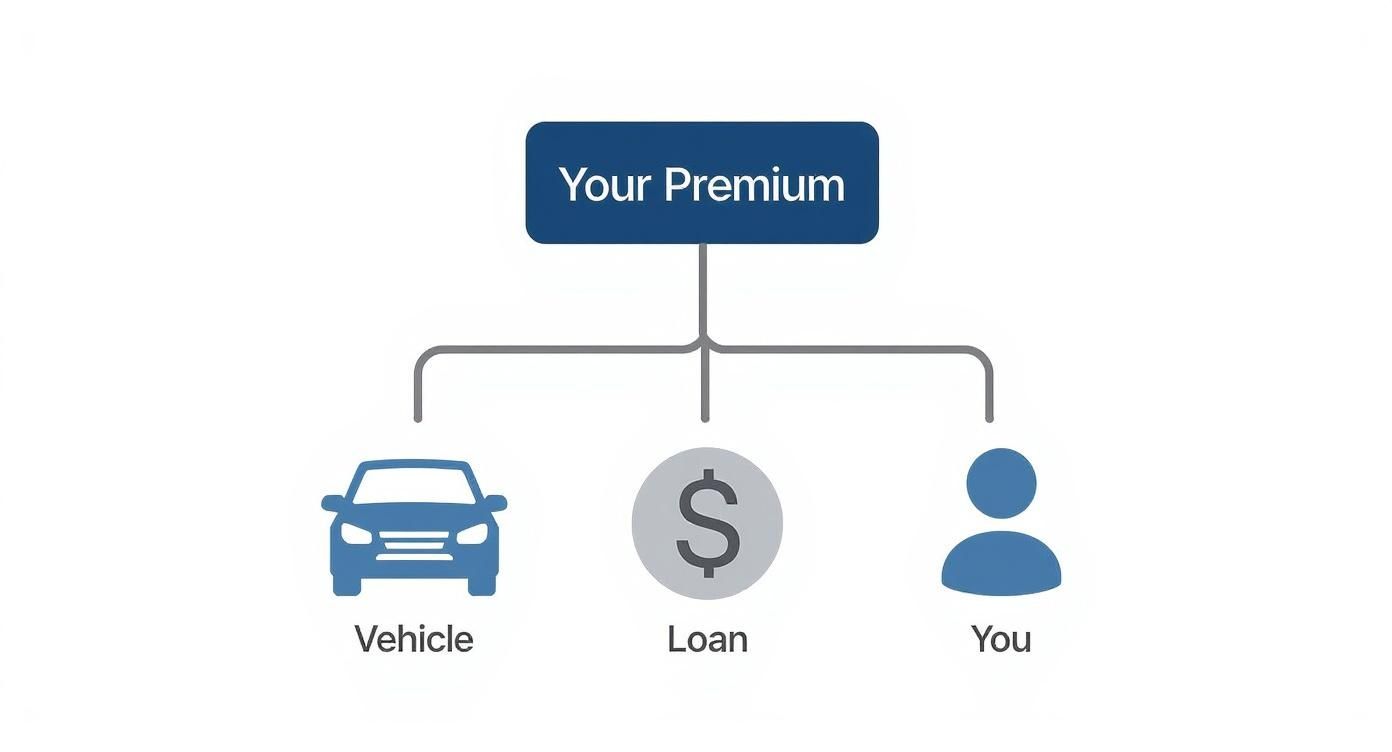
As you can see, the final price is a mix of details about your car, your loan, and your own profile. It really drives home why a one-size-fits-all dealership price isn't always the best deal for your situation.
Option 3: Lenders and Credit Unions
There's a third path you can take: getting GAP coverage directly from the bank, credit union, or financial institution that’s giving you the auto loan. This can be a good middle-ground option, landing somewhere between the high cost of the dealership and the low cost of an insurer.
Lenders often package this as a "debt cancellation waiver." It works exactly like GAP insurance but is technically a promise from them to forgive the rest of your loan if the car is totaled. The cost is usually a one-time fee, much like at a dealership, but it’s often more competitive, typically in the $300 to $600 range. While this can also be rolled into your loan, the lower starting price makes it a more attractive alternative if you prefer a single payment.
The most important thing to remember is that you have choices. Don't ever feel like the first offer you get at the dealership is your only one. A few minutes of research can literally save you hundreds of dollars on your California insurance.
Ultimately, weighing these three options is a crucial step in managing your car's finances. While the dealership offers a smooth, all-in-one process, adding GAP coverage through your auto insurer is almost always the most cost-effective play for California drivers.
When Is GAP Insurance a Smart Financial Move?
Figuring out if you need GAP insurance isn't some complex financial puzzle. It really just comes down to your specific situation with your car loan or lease. Think of it as a quick financial health check for your auto loan. If you find yourself nodding along to a few of the scenarios we're about to cover, then this coverage is probably a very smart move to protect your wallet.
And you're not alone in considering it. The need for this kind of protection has been on the rise. In 2025, the global market for GAP insurance was valued at around USD 5.4 billion, and it's expected to keep growing. Why? Because new car prices keep climbing and loan terms are getting longer, which means more drivers than ever are finding themselves with a significant gap to worry about. You can dig into the numbers and trends in this market projection report from MarketResearch.com.
So, let's walk through the exact situations where the small gap insurance cost is well worth the peace of mind.
Scenarios Where GAP Coverage Is a Must-Have
If any of these sound like your recent car-buying experience in California, you're a prime candidate for GAP insurance. In these cases, the risk of being "upside down" on your loan—owing more than the car is worth—is incredibly high, especially in the first couple of years.
You Made a Small Down Payment (Under 20%): Putting less than 20% down on a new car is one of the fastest ways to have negative equity the second you leave the dealership. Your loan balance starts high, the car’s value takes an immediate hit, and voilà—you’ve created the exact "gap" this insurance is built for.
Your Loan Term Is Long (60+ Months): Stretching your loan out to 60, 72, or even 84 months is great for lowering your monthly payment, but it’s terrible for building equity. For the first few years, your payments are mostly just chipping away at interest while depreciation relentlessly does its thing. This leaves the gap wide open for a long time.
You Are Leasing a Vehicle: This one is usually pretty simple. Most lease agreements here in California actually require you to have GAP insurance. Since you’re not building any equity in a car you don't own, the leasing company insists on it to protect their asset. It’s typically non-negotiable.
You Rolled Negative Equity into the Loan: Did you trade in a car you were still upside down on? That old debt doesn't just disappear; the dealer adds it right on top of your new loan. This move instantly inflates your loan-to-value ratio and makes GAP insurance an absolute necessity.
For drivers in these high-risk categories, GAP insurance isn’t just another add-on; it's a critical safety net. It’s what stops a total loss from turning into a financial nightmare of lingering debt.
When You Can Probably Skip GAP Insurance
On the other hand, GAP insurance isn't for everyone. If your financial picture looks more like the examples below, you can probably save your money and confidently pass on this coverage. Your risk of owing more than the car is worth is much, much lower.
You likely don't need GAP insurance if:
- You Made a Large Down Payment: If you put 20% or more down, you’ve basically created your own equity cushion from day one. The chances of your loan balance ever creeping above your car’s actual cash value are slim.
- You Have a Short Loan Term: With a loan of 48 months or less, you’re attacking the principal balance much more aggressively. You build equity fast, closing any potential gap before it can become a real problem.
- You Paid Cash or Own the Car Outright: Simple enough. GAP insurance is for loans and leases. If you own your vehicle free and clear, there's no loan, and therefore no "gap" to insure.
- Your Car Holds Its Value Well: If you bought a car or truck known for its rock-solid resale value, the gap between what you owe and what it's worth will naturally be smaller and shrink much faster.
In the end, it all boils down to one simple question: Could you comfortably write a check for several thousand dollars tomorrow to pay off a loan for a car that no longer exists? If the answer is no, then the modest gap insurance cost is an investment you'll be glad you made.
Answering Your Top GAP Insurance Questions
It's one thing to decide GAP coverage is a smart move, but it's another to have all your questions answered. And if you still have a few, that’s perfectly normal. This is true for all types of California insurance, from auto insurance to renters insurance. Let's walk through some of the most common questions California drivers ask to clear up any lingering confusion.
Can I Cancel GAP Insurance I Bought from the Dealership?
Absolutely. This is a big one. Many people think they're stuck with the dealership's policy for the entire loan, but that's not the case. If you signed up for GAP at the dealership and then discovered a much better rate with your own auto insurer, you can cancel the dealer's policy.
In California, you're usually entitled to a prorated refund for the time you haven't used. The process typically involves a quick call to the dealership's finance department or the company that administers the policy. Just have your policy and vehicle info handy. It's a great way to fix things if you feel you were rushed into a decision and overpaid.
Does GAP Insurance Cover My Auto Insurance Deductible?
This is a detail you don't want to miss: in most cases, GAP insurance does not cover your auto insurance deductible. When your car is totaled, you still have to pay your comprehensive or collision deductible to your primary insurance company first.
Here’s how the math plays out:
- Your insurer determines your car's Actual Cash Value (ACV).
- They subtract your deductible from the ACV, and that's your final payout.
- Then, GAP insurance steps in to cover the "gap" between that insurance payout and what you still owe on your loan.
So, while it saves you from a massive financial hit, that initial deductible is still on you. Some top-tier GAP policies might include a deductible benefit, but it's definitely not a standard feature.
What Happens If I Total My Car Without GAP Insurance?
This is the exact nightmare scenario GAP coverage was invented to prevent. If your car is declared a total loss and you don't have GAP insurance, the difference between what your insurer pays and what you still owe the bank is 100% your problem.
Imagine this: your insurance company cuts a check for $20,000 for your totaled car, but you still have $24,000 left on your auto loan. Without GAP coverage, you have to come up with that $4,000 difference out of pocket... for a car that's sitting in a salvage yard. This can be a huge financial burden, leaving you making payments on a ghost car while trying to scrape together a down payment for a new one.
Can I Add GAP Insurance After Buying My Car?
Yes, but you have to act fast. While the ideal time to think about the GAP insurance cost is right when you're buying the car, you do have a small window afterward. Most California auto insurance carriers will let you add GAP coverage to your policy, but they have some ground rules.
Typically, the car needs to be pretty new—often less than two or three years old—and you usually have to be the original owner. Dealerships and lenders aren't likely to sell you a standalone policy after the paperwork is signed. So, if you skipped it at the dealership, your best and most affordable option is to call your auto insurance agent right away to see if you still qualify.
For more answers, feel free to check out our complete California insurance FAQ page.
At Mai & Associates, our licensed agents are here to help you sort through your options for auto insurance, home insurance, renters insurance, and life insurance. We can quickly figure out if you're eligible for affordable GAP coverage and get you a same-day quote that fits your budget and gives you real peace of mind.