Full Coverage vs Liability: A Clear Guide to California Auto Insurance
When you're shopping for car insurance in California, the first big choice you'll face is between liability and full coverage. At its heart, the difference is pretty simple: liability pays for the damage you cause to other people and their property, while full coverage also protects your own car.
In California, you absolutely must have liability insurance to drive legally. But full coverage is what gives you peace of mind, protecting your investment in your vehicle from accidents, theft, and a whole lot more.
Decoding Full Coverage and Liability Insurance
Choosing between liability-only and full coverage is a decision that hits your wallet every month and determines your financial safety net if something goes wrong. Getting this right is the first step to building a California auto insurance policy that actually works for you.
Think of liability insurance as the absolute baseline. It's required by law for a reason—it covers the medical bills and property damage for the other person if you're the one who caused the accident. What it doesn't do is pay a single dime for your own car's repairs or your own injuries.
That’s where "full coverage" comes in. It's not one specific policy, but rather a package of protections bundled together. A typical full coverage policy includes:
- Liability Insurance: This is the foundation, meeting all of California's legal requirements.
- Collision Insurance: This pays to fix your car after an accident, whether it was your fault or not.
- Comprehensive Insurance: This handles damage from almost everything else—think theft, vandalism, fire, hail, or even hitting a deer.
All the jargon can get a little overwhelming. If you're ever stuck on a term, a quick look at an insurance glossary can help clarify the details.
Quick Look Full Coverage vs Liability Insurance
Making the right choice is crucial here in California, where car values and repair shop bills tend to be higher than elsewhere. The right car insurance coverage can mean the difference between a small hassle and a huge financial disaster.
To make it easier, here's a simple table that breaks down the key differences at a glance.
| Coverage Aspect | Liability-Only Insurance | Full Coverage Insurance |
|---|---|---|
| Protects Your Vehicle | No | Yes |
| Covers Others' Damages | Yes | Yes |
| Covers Non-Accident Damage | No (e.g., theft, fire) | Yes |
| Meets Lender Requirements | No (for financed/leased cars) | Yes |
| Premium Cost | Lower | Higher |
This side-by-side view shows you exactly what you're paying for. Liability is the affordable, bare-minimum option, while full coverage is a comprehensive safety net for your own vehicle.
What Liability Insurance Actually Covers in California
In California, if you want to drive legally, liability car insurance is the bare minimum you have to carry. Think of it this way: it’s your financial responsibility to everyone else on the road. If you cause an accident, liability coverage pays for the other person's bills—not yours. It's purely there to protect other people from the financial damage you might cause.
This essential coverage is split into two parts: Bodily Injury Liability and Property Damage Liability. Together, they handle the medical expenses for people you might injure and the repair costs for property you might damage.
But here's the crucial part most people miss: it does absolutely nothing for you. If you’re at fault, liability coverage won’t pay a dime for your own car repairs or your own medical bills.
The Three Pillars of Liability Coverage
When you look at a liability policy, you'll always see three numbers, usually written as something like 15/30/5. Let's break down exactly what that means for your California insurance policy.
- Bodily Injury Liability (Per Person): This is the maximum amount your insurer will pay out for a single person’s injuries in an accident you’re responsible for. It’s meant to cover things like their hospital bills, lost income, and even pain and suffering.
- Bodily Injury Liability (Per Accident): This is the total cap your policy will pay for all injuries combined in one accident. It doesn't matter if two people or five people are hurt; this is the absolute ceiling for the medical-related payouts.
- Property Damage Liability (Per Accident): This piece covers the cost to fix or replace whatever property you damaged. Most of the time it’s the other person's car, but it could just as easily be a fence, a storefront, or a city light pole.
California’s legal minimums are $15,000 for bodily injury to one person, $30,000 total for bodily injuries per accident, and a shockingly low $5,000 for property damage. In a state where even minor car repairs cost thousands and medical care is astronomical, those limits can vanish in a heartbeat.
Real-World Scenario: Picture this: you cause a fender-bender on a busy Los Angeles street. The other car, a late-model SUV, has $12,000 in damage. Your $5,000 property damage limit is gone instantly, and you're now on the hook for the remaining $7,000 out of your own pocket. If the other driver also needs physical therapy, their medical bills could easily climb past the $15,000 per-person limit, leaving you exposed to a lawsuit for the rest.
Beyond the Bare Minimum
It’s no surprise that the state minimums offer paper-thin protection. That’s why most seasoned drivers—and insurance professionals—recommend much higher limits. The California Department of Insurance itself outlines examples of more realistic coverage packages that include not just higher liability limits but also medical payments for yourself and uninsured motorist coverage. You can see for yourself how the state of California outlines these coverage examples.
This brings us to a non-negotiable for California drivers: Uninsured/Underinsured Motorist (UM/UIM) Coverage. We have one of the highest rates of uninsured drivers in the country. If one of them hits you, UM/UIM steps in to pay for your car repairs and your medical bills when they can't. Without it, you could be left with a totaled car and overwhelming medical debt from an accident you didn't even cause.
Breaking Down "Full Coverage"

While liability-only insurance gets you legally on the road in California, it leaves a huge hole in your protection: it does absolutely nothing to cover your own car. This is where the term "full coverage" comes in. It’s not an official type of policy but rather a common way of describing a bundle of coverages that creates a real financial safety net for your vehicle.
Think of full coverage as building on top of a basic liability policy by adding two crucial layers that protect your investment. Without them, you’re footing the entire bill for your car’s repairs or replacement, no matter who caused the accident.
The Key Ingredients of Full Coverage
At its core, a full coverage car insurance policy is a package of three distinct insurance types. Each one is designed to handle a different kind of risk you face as a car owner.
Liability Coverage: This is the mandatory foundation, just like in a liability-only policy. The difference is that most drivers with full coverage opt for much higher limits than California's bare-bones 15/30/5 minimum. This provides better protection for your personal assets if you're sued after a serious accident.
Collision Coverage: This is what pays to fix or replace your car if it's damaged in a crash with another vehicle or an object, like a fence or a guardrail. The key here is that it covers you regardless of who is at fault. Whether you back into a pole or someone hits you, collision coverage takes care of your repair bills once you've paid your deductible.
Comprehensive Coverage: You can think of this as protection from nearly every other disaster besides a collision. It handles a wide array of non-driving incidents, from theft and vandalism to fire, falling tree branches, hail damage, or even hitting a deer. If your car gets stolen overnight, this is the coverage that helps you get back on your feet.
Full coverage isn't just an upsell; for most drivers, it's a practical necessity. While liability is the legal minimum, look at what people actually buy. Roughly 80% of insured drivers purchase comprehensive coverage and 77% buy collision. That means about three out of four drivers on the road have a policy that looks a lot like full coverage. You can find more expert insights on why drivers make this choice in this detailed analysis.
How Your Deductible Works
When you add collision and comprehensive, you’ll also need to choose a deductible. This is simply the amount you agree to pay out-of-pocket on a claim before your insurance kicks in to cover the rest. Deductibles can range from $250 all the way up to $2,500.
Your choice directly affects your premium. Selecting a higher deductible means you're taking on more of the initial financial risk, so your insurance company rewards you with a lower premium. On the flip side, a lower deductible means less risk for you and a higher premium.
For instance, say you have a $1,000 deductible and your car suffers $4,000 in damage from a covered accident. You would pay the first $1,000, and your insurer would handle the remaining $3,000. It's a balancing act between what you pay monthly and what you can afford to pay suddenly after an incident.
When you're trying to decide between full coverage and liability-only insurance, it usually boils down to a single, unavoidable question: what's the real cost? The difference in what you pay each month isn't just a few bucks—it's a reflection of a huge shift in who's on the hook for your car. With liability, you're accepting that risk yourself. With full coverage, you're paying an insurance company to take it on for you.
That transfer of risk is the entire reason full coverage costs more. Suddenly, your insurer is responsible for potentially tens of thousands of dollars to fix or replace your car if it's stolen, wrecked in an accident, or damaged in some other way. The higher premium is simply your payment for that powerful financial backstop.
Think of it less as an expense and more as a risk management strategy. You’re balancing the known cost of a higher monthly premium against the unknown—but potentially massive—cost of a major repair or a total loss. For a lot of California drivers, especially those with newer cars or outstanding loans, that trade-off is an easy choice for their peace of mind.
Breaking Down the Premium Difference
Let's be clear: the price gap between a liability-only policy and a full coverage one is significant. It's not a small jump. National data shows time and again that drivers pay a hefty price for the security that comes with protecting their own vehicle.
In most places, full coverage insurance will run you about 2.5 to 3 times more than a bare-bones liability policy. One 2025 analysis found the average annual premium for full coverage was $2,697, while minimum liability was just $820. That’s a staggering 229% difference for adding collision and comprehensive.
Here in California, the numbers are even starker. Local data showed full coverage averaging $4,211 a year, with liability coming in at $1,407. That’s an annual gap of $2,804. You can dig into a more detailed breakdown of these auto insurance costs to see how the numbers stack up. This difference really drives home how much value insurers place on covering the physical car itself.
California Auto Insurance Cost Comparison Liability vs Full Coverage
To make this crystal clear, let's look at what these averages mean for a typical California driver's budget. The table below shows the annual and monthly costs side-by-side. It highlights the savings you get with liability but also shows the real investment needed for complete protection.
| Metric | Minimum Liability Coverage (Average) | Full Coverage (Average) |
|---|---|---|
| Average Annual Premium | $1,407 | $4,211 |
| Average Monthly Premium | Approximately $117 | Approximately $351 |
| Annual Cost Difference | - | +$2,804 |
| Monthly Cost Difference | - | +$234 |
Seeing it laid out like that makes the choice very real. Saving over $200 a month is incredibly tempting, but it comes with a major trade-off: your car has zero protection against physical damage.
Key Takeaway: The goal isn't just to find the cheapest policy. It's about matching your coverage to your financial situation. Ask yourself: could you comfortably write a check for a $5,000 repair or, even worse, the total loss of your vehicle? If the answer is no, then the higher premium for full coverage isn't just a bill—it's a critical shield against financial hardship.
The "true cost" of your policy isn't just the number on your monthly statement. It's also the amount you might have to pay out of pocket if something goes wrong. The only way to know what makes sense for you is to see real numbers based on your own car and driving record.
The next step is to get a personalized insurance quote online and compare your specific options. That's how you can decide if the higher premium for full coverage is a worthwhile investment for your situation.
When to Choose Full Coverage vs. Liability
Deciding between full coverage and liability insurance isn't something you can figure out with a simple formula. The right choice really comes down to your car, your finances, and frankly, your personal comfort level with risk. It’s about looking past the monthly premium and honestly assessing where you stand.
To get to the right answer, you need to ask yourself a few direct questions. Walking through them will paint a clear picture of what you truly need for your California auto insurance, so you’re not overpaying for protection you don't need or, worse, leaving yourself financially exposed.
Do You Have a Car Loan or Lease?
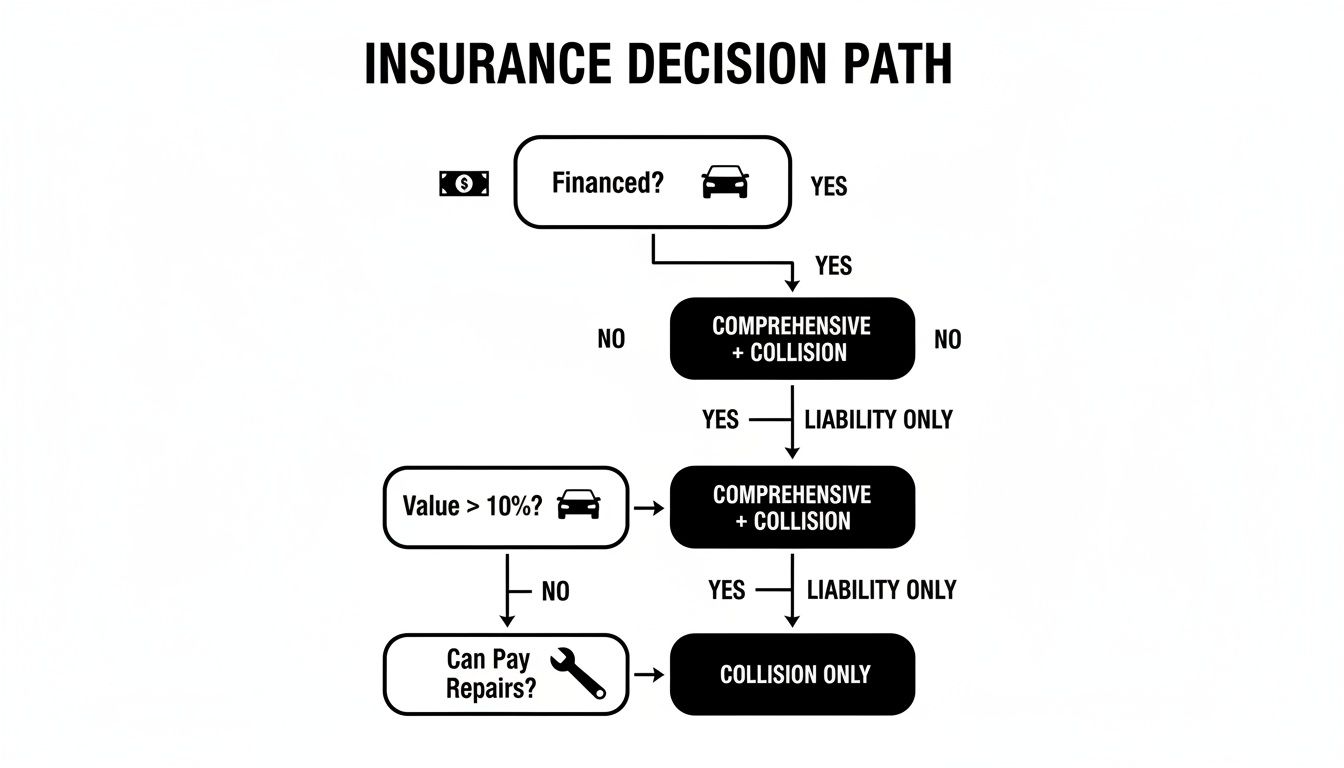
Let's start with the easiest one—this often makes the decision for you. If you are financing or leasing your car in California, your lender or leasing company will almost certainly require you to carry full coverage.
There’s a simple reason why. Until that loan is paid off, the bank technically owns a piece of your car, and they need to protect their investment. If the car were totaled and you only had liability, they'd be stuck with a worthless asset and an outstanding loan. Full coverage guarantees there’s money to either repair the car or pay off what you still owe.
Assess Your Vehicle's Actual Value
Once your car is paid off, the decision is all yours. The next logical step is to look at its current market value. A handy guideline we often use in the insurance world is the "10% rule."
The 10% Rule of Thumb: If what you pay annually for full coverage is more than 10% of your car's current cash value, it might be time to think about switching to liability-only.
Let's say your car is worth $4,000 on a good day, but your full coverage policy runs you $1,000 a year. That premium is 25% of the car's entire value. In that scenario, you’re paying a lot for a relatively small potential payout from a claim. You could probably put that money to better use.
Evaluate Your Financial Safety Net
This is where you have to be really honest with yourself about your finances. Ask this one crucial question: If my car was totaled tomorrow, could I afford to repair it or buy a new one without derailing my life?
- If the answer is no, then full coverage is your best bet. Think of the higher premium as a predictable, manageable expense that shields you from a sudden, potentially crippling out-of-pocket cost.
- If the answer is yes, you might be a great candidate for liability-only. If you have a solid emergency fund and could handle the cost of another car, then you're essentially "self-insuring." Dropping to liability could save you a significant amount of money over the long haul.
Consider Your Driving Habits and Risk
Finally, think about your daily grind. How and where you drive plays a huge part in this decision.
- Higher-Risk Drivers: Do you have a long commute on a packed California freeway every day? Do you park on a busy city street where dings, break-ins, or vandalism are a real possibility? If so, the peace of mind that comes with collision and comprehensive coverage is probably worth every penny.
- Lower-Risk Drivers: Maybe you work from home and only use your car for errands in a quiet neighborhood. Is it always tucked away in a secure garage? If your daily exposure to accidents and other headaches is low, the argument for full coverage becomes much weaker.
Real-World Scenarios in California
Let’s put this into practice with two very different drivers:
The Commuter with a Newer Car: Maria drives her 2021 Toyota Camry, worth about $22,000, for 40 miles every day on the I-5 in Los Angeles. She parks it in a huge, open lot at her office. For Maria, full coverage is essential. The combination of her car's high value and her daily exposure to traffic chaos makes liability-only a massive financial gamble.
The Occasional Driver with an Older Car: David owns a 2008 Honda Civic he paid off years ago, now valued at around $5,000. He works from home in a quiet Sacramento suburb and mostly just uses it for weekend grocery runs. His full coverage premium is $900 a year—that's 18% of the car's value. David also has a healthy savings account. He's the perfect candidate to switch to liability-only coverage, saving a good chunk of change while accepting a level of risk he can comfortably manage.
By walking through these four points—lender rules, vehicle value, your own finances, and driving habits—you can make a smart, confident decision that truly fits your life.
Finding the Right California Auto Insurance for You
Choosing between full coverage and liability-only isn't a one-size-fits-all decision. It really comes down to a personal calculation: what’s your car worth, what’s your financial situation, and how much risk are you comfortable with? You're essentially weighing a lower monthly premium against the possibility of a massive out-of-pocket bill down the road.
Think of it this way: liability insurance is for them, covering damage you cause to others. Full coverage is for you, protecting your own car. If you're driving an older, paid-off vehicle and have a healthy emergency fund, sticking with liability-only can be a savvy financial choice. But for anyone with a newer car, a loan, or less financial wiggle room, that higher premium for full coverage is an investment in your own peace of mind.
We're Here to Make It Simple
Navigating the world of California insurance can feel overwhelming, but it doesn't have to be. Here at Mai & Associates, our entire job is to help California drivers strike that perfect balance between solid protection and a price that makes sense.
As an independent agency, we do the comparison shopping for you. We’ll pull instant quotes from multiple top-rated insurance companies, so you can see exactly how they stack up. Our team is here to cut through the jargon and make the whole process straightforward.
We know California is a diverse place, which is why we’re proud to offer support in English, Spanish, Armenian, Russian, and Vietnamese. With offices throughout the state, our licensed agents are always ready to offer expert advice with zero obligation. We can help you compare policies, bundle your auto insurance with home insurance or renters insurance, and even look at life insurance to protect your family’s future.
The right policy is one that fits your budget and lets you drive with confidence. Our job is to help you find it without all the usual hassle.
Don't leave your financial security to chance. Let our experienced team give you a clear, side-by-side look at your options. Reach out to Mai & Associates today for a free consultation and see how easy it can be to get the right coverage. For a deeper dive into your options, check out our guide to auto insurance in California.
Frequently Asked Questions About California Auto Insurance
It's completely normal to have questions when you're trying to pin down the right car insurance. Let's walk through some of the most common ones California drivers ask when weighing their options. This should help clear things up so you can make a choice you feel good about.
Can I Switch From Full Coverage to Liability at Any Time?
You can, but there's a big "if." You can only switch to liability-only insurance if you own your car free and clear. If you're still making payments on a loan or you're leasing, your lender or leasing company requires you to keep full coverage. It's their way of protecting their investment in the vehicle.
So, when does it make sense to make the switch? A good rule of thumb is when the annual cost of your full coverage policy starts to creep up to 10% or more of your car’s actual cash value. Once the car is paid off and has lost a good chunk of its value, dropping down to liability can save you a significant amount of money.
What Happens If I Only Have Liability and My Car Is Stolen?
This is a tough one, and it’s where the reality of liability-only coverage hits home. If your car is stolen and you only have liability insurance, your policy will not cover the loss. Not a dime.
Liability insurance is strictly for covering the damage you do to other people and their property. Protection against theft comes from comprehensive coverage, which is part of a full coverage package. Without it, you’re on your own to replace your stolen vehicle, paying for a new one entirely out of pocket.
Choosing between full coverage vs. liability often comes down to protecting against scenarios just like this. While liability is cheaper, it offers zero protection for your own vehicle against theft, vandalism, or natural disasters.
Is It a Good Idea to Have Liability on a New Car?
In a word: no. It's almost always a bad financial decision to carry only liability on a new car. For one, if you financed it, the lender won't even allow it. They mandate full coverage to protect their loan.
But even if you bought that brand-new car with cash, skipping full coverage is a huge gamble. You’re putting a major asset at risk. A single at-fault accident, a hailstorm, or a theft could wipe out your entire investment, leaving you with nothing. The high cost of repairing or replacing a new car makes full coverage a must-have.
For more answers, feel free to check out our comprehensive California insurance FAQ page.
Ready to find that sweet spot between great protection and a price that fits your budget? The experienced agents at Mai & Associates are here to help. We'll run the numbers and get you instant quotes from multiple top-rated insurance companies, so you can see exactly what your best options are for car insurance, home insurance, renters insurance, and life insurance.