Full Coverage Auto Insurance in California: What It Covers & Savings
If you’ve spent any time at all shopping for car insurance in California, you've definitely come across the term “full coverage.” It sounds straightforward, but it's not actually a specific policy you can buy off a shelf. Instead, full coverage auto insurance is a combination of different insurance types that create a strong financial safety net for you and your car. For most drivers, it's the standard way to protect their investment far beyond what the state legally requires.
What Full Coverage Car Insurance Really Means
Let's clear up the biggest point of confusion right away: "Full coverage" is more of an industry nickname than an official insurance product. It’s like ordering "the works" on a pizza—you know you're getting more than just cheese. While California's minimum liability insurance just keeps you legal, a full coverage plan bundles several key protections together.
The most important distinction is that this bundle is designed to cover damages to your own car, not just the other driver's property. Think of it as a complete toolkit for handling the many hazards you can face on the road.
The Core Components of Full Coverage
A standard full coverage policy is built on three essential pillars. Each one handles a different type of risk, and when you put them all together, they form a powerful shield against major financial headaches.
- Liability Coverage: This is the foundation and the only part that's legally required in California. It covers the costs for injuries and property damage you cause to other people if you're at fault in an accident.
- Collision Coverage: This is what pays to fix or replace your car if it's damaged in a crash with another vehicle or an object—like a guardrail, a pole, or a fence. It applies whether the accident was your fault or not.
- Comprehensive Coverage: Often called "other than collision," this protects your car from damage caused by things besides a typical crash. We're talking about theft, vandalism, fire, hail, falling trees, and even hitting a deer.
This simple visual breaks down how these three pieces come together.
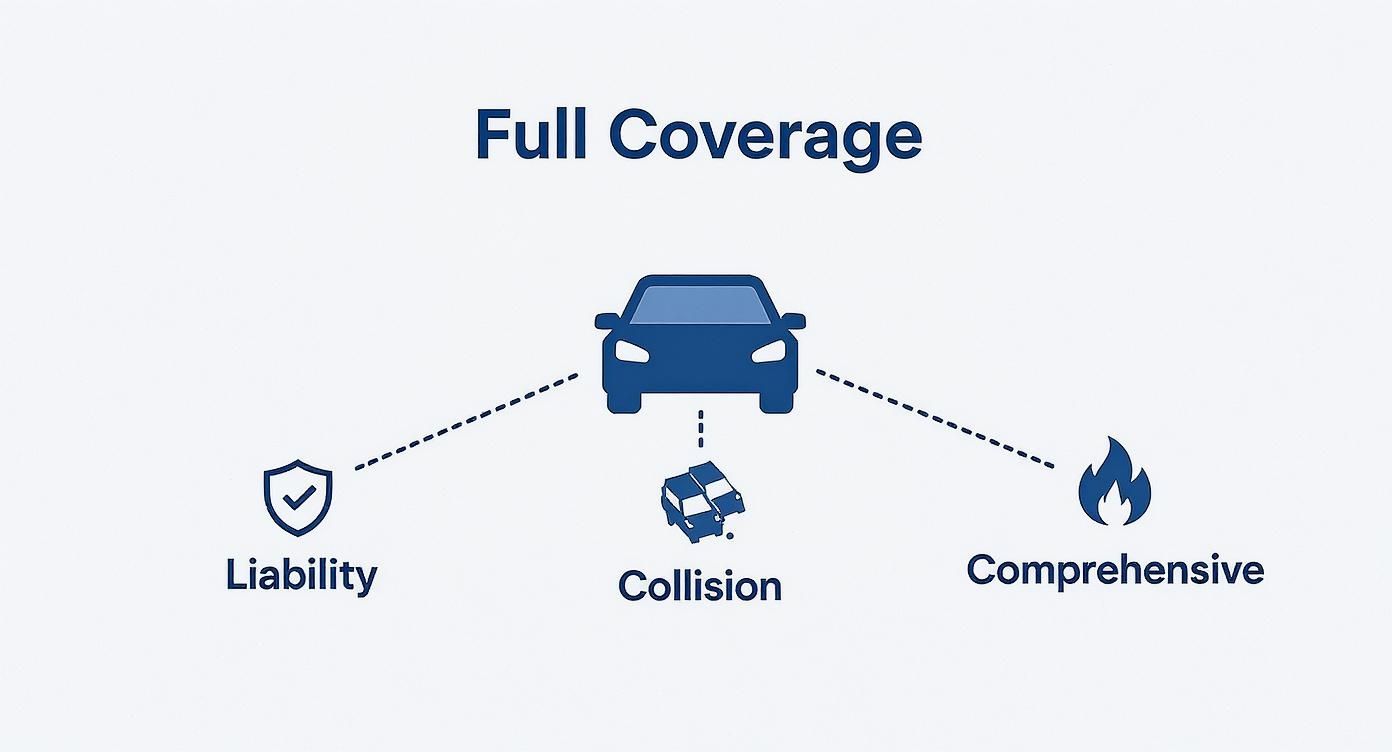
As you can see, when you combine Liability, Collision, and Comprehensive, you get the robust package everyone calls "full coverage."
Why This Combination Matters for California Drivers
Having this kind of multi-layered protection is especially critical here in California. Between the bumper-to-bumper traffic in Los Angeles, high vehicle theft rates in urban areas, and the constant threat of wildfires, the risks to your car are everywhere.
If you only had basic liability, you'd be stuck paying out-of-pocket to repair or replace your car after almost any incident. That could mean thousands of dollars gone in an instant.
The idea of "full coverage" has become a cornerstone of smart personal finance. It marks a shift in mindset—from just meeting the legal minimum to actively protecting what is often one of your most valuable assets.
The global motor vehicle insurance market, which is built on policies like these, is on track to hit an astonishing US$404.5 billion by 2025. This explosive growth is fueled by skyrocketing repair costs and drivers realizing they need more complete protection. All the industry jargon can be a bit much, but our team put together a handy insurance glossary to help explain these key terms in plain English.
The Three Pillars of Your Protection
When you hear the term "full coverage auto insurance," don't picture a single, all-encompassing shield. It's much more useful to think of it as a team of three distinct coverages, each one protecting you from a different kind of risk you face on California's unpredictable roads.
These three pillars—Liability, Collision, and Comprehensive—work together to create a strong foundation for your financial security. Let's pull back the curtain on each one to see what it does, why you need it, and how it applies to real-life situations here in the Golden State.
Pillar 1: Liability Coverage
Liability coverage is the bedrock of any auto insurance policy because it's the one part that's legally required in California. But its most important job isn’t protecting your car—it’s protecting you from financial disaster. It's designed to cover the costs when you’re found at fault for an accident that hurts someone else or damages their property.
Imagine you’re stuck in rush hour traffic on the I-5 and accidentally rear-end the car ahead of you. The other driver complains of neck pain, and their car needs a new bumper. Your liability coverage is what steps in to pay for their medical bills, lost wages, and repair costs, up to your policy limits. Without it, you’d be on the hook for those bills personally, which could put your savings, your home, and your future earnings at risk.
Pillar 2: Collision Coverage
While liability protects others from you, collision coverage protects your own car from damage in a crash. This is the part of your policy that pays to repair or replace your vehicle after an accident with another car or an object (like a guardrail or a telephone pole), no matter who was at fault.
Think about these all-too-common California scenarios where collision coverage saves the day:
- Parking Garage Mishap: You’re trying to navigate a tight spot in a downtown L.A. parking structure and scrape a concrete pillar, leaving a nasty dent down the side of your car.
- Slick Mountain Roads: After a rainstorm, you lose traction on a winding road up in the Sierra Nevadas and slide into a guardrail.
- Freeway Fender-Bender: Someone merges into your lane without looking. Even if it's their fault, you can use your own collision coverage to get your car into the shop right away while the insurance companies sort out the blame later.
In every case, you pay your deductible, and your collision coverage handles the rest of the repair bill. For anyone with a newer or more valuable vehicle, this is a non-negotiable part of full coverage car insurance.
Quick Tip: The term "full coverage" is an industry shortcut, not an official insurance product. It’s a package of individual coverages. How well you’re protected really depends on the specific limits and deductibles you choose for each part.
Pillar 3: Comprehensive Coverage
Our final pillar, comprehensive coverage, is your car’s defense against almost everything else—that is, damage from events that aren’t a collision. It's your protection against the wild, random, and unexpected things life can throw at you, many of which are very real risks here in California.
Comprehensive is designed to cover a whole host of non-crash events, such as:
- Theft and Vandalism: Your car gets stolen from your street in San Francisco, or someone smashes your window to grab a backpack.
- Weather and "Acts of God": A heavy branch from a eucalyptus tree falls on your roof during a winter storm, or your car gets caught in a rare hailstorm.
- Fire: This could be an engine fire or, more specific to our state, damage from one of California’s devastating wildfire seasons.
- Animal Collisions: Hitting a deer on a rural highway is a classic example of a comprehensive claim.
Together, these three pillars—Liability, Collision, and Comprehensive—create the strong financial safety net we call full coverage car insurance. Liability shields your assets, Collision fixes your car after an accident, and Comprehensive protects it from just about everything else. When you have all three, you can drive with true peace of mind.
Understanding What Your Policy Does Not Cover
A "full coverage" auto insurance policy gives you a strong financial safety net, but it's important to know it doesn't cover absolutely everything. Think of it less like an unbreakable shield and more like a core set of protections. Knowing what's left out is just as crucial as knowing what's included, so you can avoid any nasty surprises down the road.
This helps you see where you might need to add a little extra protection to fit your specific situation.
Think of it this way: your policy is the foundation of your financial house. It's solid and protects you from the big stuff. But just as with home insurance or renters insurance, some of the most helpful benefits are optional extras, which the industry calls endorsements or riders.
Common Exclusions and Optional Upgrades
Many drivers are surprised to find that some of the handiest services aren't automatically baked into their plan. Instead of seeing these as gaps, it’s better to view them as optional upgrades you can add to your policy. This à la carte approach means you only pay for what you actually need.
Here are a few common coverages that are almost always sold separately:
- Rental Car Reimbursement: Picture this: your car is in the shop for a week after an accident. This add-on covers the cost of a rental so you can still get to work and run errands. For a daily commuter in California, this can be an absolute lifesaver.
- Roadside Assistance: This is your go-to for things like towing, a dead battery, a flat tire, or locking your keys in the car. It's incredibly convenient, but it isn't a standard part of a core policy.
- Gap Insurance: If your car gets totaled, your insurance pays out its current market value. But what if you owe more on your loan than the car is worth? Gap insurance pays off that difference—the "gap"—so you aren't stuck making payments on a car you can't even drive.
Protecting Your Personalizations
Here’s another big one that catches people off guard: coverage for custom parts and equipment. If you’ve spent money making your car your own, you’ll want to pay close attention to this.
Your standard policy is built to cover the car as it came from the factory. That means your killer sound system, custom rims, or special paint job probably aren't included. If they're damaged or stolen, you could be out of luck. To protect those investments, you need a specific custom parts and equipment (CPE) endorsement. This add-on makes sure your unique upgrades are covered for what they're actually worth.
A standard policy is designed to restore your car to its factory condition. If your car is more than just a standard vehicle to you, your insurance needs to reflect that. Adding endorsements ensures your policy protects what you've actually invested.
At the end of the day, building a full coverage auto insurance plan is about creating a safety net that fits you. By understanding what's left out of the standard package, you can make smart choices about which add-ons make sense, ensuring your policy truly covers what matters most.
Why Is Full Coverage So Expensive in California?
If you've ever shopped for California insurance and felt a bit of sticker shock, you're not alone. And if you've compared notes with friends in other states, you probably noticed that insuring a car in the Golden State, especially with full coverage auto insurance, just costs more.
It’s not random. The higher price tag is a direct result of California's unique mix of risks, economic realities, and legal landscape. Let's break down exactly what's driving up the cost.
More People, More Cars, More Accidents
It all starts with our roads. California is home to some of the most gridlocked cities in the country. Think about your daily commute in Los Angeles, the tight streets of San Francisco, or the packed freeways in San Diego. It’s a constant dance of metal and glass.
When you have that many cars crammed into one space, accidents are simply a matter of when, not if.
- Higher Collision Frequency: It's a numbers game. The more cars on the road, the higher the odds of a fender-bender, a rear-end collision, or even a major pile-up.
- Pricey Repairs: On top of that, getting a car fixed here costs more. Labor rates and parts are just more expensive in California's big cities, which means every insurance claim costs the carrier more money to settle.
Insurers see this high-density traffic as a major risk, and that risk gets factored directly into your collision premium.
Sky-High Rates of Car Theft and Vandalism
California has another unfortunate distinction: we're a national hotspot for car theft. Certain areas, particularly in Southern California and the Bay Area, have some of the highest vehicle theft rates in the U.S.
Your comprehensive coverage is what protects you from theft. When an insurance company sets your rate, they look at theft statistics for your specific ZIP code. In many California neighborhoods, that risk is a big deal.
This isn't just about stolen cars, either. Higher rates of vandalism in urban centers also push up the cost of comprehensive insurance. It's a key reason why your premium can change dramatically just by moving a few towns over.
Wildfires: A Uniquely Californian Risk
In recent years, another threat has become a huge factor in our insurance costs: wildfires. We've all seen the heartbreaking images of entire communities being wiped out. What many people don't realize is that thousands of vehicles are also lost in these fires.
This isn't just a problem for people living in the mountains. Embers can travel for miles on the wind, threatening cars in suburban driveways and city streets. Insurers have paid out billions for vehicles destroyed by fires, and they now have to price that massive, statewide risk into everyone's comprehensive coverage. This risk also significantly impacts home insurance rates across the state.
Our Legal and Regulatory Landscape
Finally, California's legal system adds another layer of cost. State regulations influence how claims are paid and what legal expenses might look like. For instance, drivers with serious violations like a DUI are often required to file an SR-22.
An SR-22 is basically a certificate proving you have insurance, but it also flags you as a high-risk driver. Anyone needing an SR-22 will see their premiums skyrocket. While this doesn't hit every driver directly, the overall cost of covering this high-risk group trickles down and affects the state's entire car insurance market.
To get a better handle on the state's specific rules, it's worth learning more about auto insurance in California. The demand for solid protection here is huge. In fact, the United States is the world's largest market for this type of insurance, expected to generate over EUR1,800 billion in premiums by 2035. That growth is fueled by people just like us wanting to make sure they're fully protected on the road.
Actionable Ways to Lower Your Insurance Premium
Even though California has some unique challenges that can nudge car insurance rates up, you have more power over your premium than you might realize. By taking a few practical steps, you can make your full coverage auto insurance much more affordable without sacrificing the protection your family counts on.
The trick is to be proactive. Small changes and smart choices can add up to big savings over time, keeping more money in your wallet.
Adjust Your Deductibles Wisely
One of the quickest ways to see a lower monthly bill is to take a look at your deductibles for collision and comprehensive coverage. Your deductible is simply the amount you agree to pay out-of-pocket on a claim before your insurance company starts paying.
It's a bit like a see-saw: as you raise your deductible, your premium comes down. For instance, bumping your deductible from $500 to $1,000 can often knock 15% to 30% off your premium. The key is finding that sweet spot—a deductible high enough to save you money but low enough that you could comfortably cover it if you needed to.
Bundle Your Policies for Big Savings
Insurance companies value loyalty, and they often reward it when you trust them with more of your business. This is where bundling your California auto insurance with your home insurance or renters insurance can be a real game-changer. Some carriers even offer discounts for bundling with life insurance.
Most insurers offer a multi-policy discount that can trim anywhere from 5% to 25% off your total cost. It’s not just about the savings, though. It also simplifies your life with one company to manage, and it's easily one of the most significant discounts you can get.
Bundling is more than just a discount; it's about building a relationship with your insurer. When they protect both your car and your home, they're often more motivated to offer their best rates to keep you as a client.
Uncover Every Available Discount
Beyond bundling, there's a whole world of discounts out there, but you often have to ask for them. Insurers offer price breaks for all sorts of things that signal you're a lower-risk driver.
Make sure you ask your agent if you're getting credit for these common discounts:
- Good Driver Discount: This is a big one in California. If you've kept a clean driving record free of accidents or tickets for a few years, you should be rewarded.
- Good Student Discount: Have a high school or college student on your policy? If they maintain a "B" average or higher, you could see some nice savings.
- Anti-Theft Devices: Cars equipped with alarms, GPS trackers, or other recovery systems are less likely to be stolen, which can lower your comprehensive premium.
- Defensive Driving Course: Completing an approved defensive driving class shows you're committed to safety and can sometimes earn you a small but meaningful discount.
The good news is that the market is tilting in the consumer's favor. Global commercial insurance rates, which include full coverage auto insurance, recently fell by 4%—the fifth quarter in a row of decreases. This is mainly due to increased competition, which could mean better pricing for you. You can read more about this in Aon's global insurance market overview.
Digging into these strategies can make a real difference. For more tips on managing your policies, check out our other helpful insurance guides.
Finding the Right California Coverage for You

Choosing the right full coverage auto insurance isn’t just another item on your to-do list; it’s a crucial investment in your financial security. With so many options for California insurance, it’s easy to feel overwhelmed. But you don't have to navigate this complex world on your own.
That's where we come in. At Mai & Associates, our entire job is to make this process simple and clear for you. Think of us as your local expert partner—we do all the legwork, shopping multiple top-rated carriers to find you fast, same-day quotes that actually make sense for your budget.
Your Local California Insurance Partner
Our dedication to our clients goes way beyond just finding a cheap rate. We’re proud to serve California's wonderfully diverse communities, which is why we offer multilingual support. You deserve clear, straightforward answers, whether you're most comfortable speaking English, Spanish, Armenian, Russian, or Vietnamese.
We believe every driver deserves to feel confident and completely understand their policy. Our goal is to be your trusted resource, helping you secure the right protection for your car, home, and family right here in California.
The real key to great California insurance is striking the perfect balance between robust protection and what you can comfortably afford. We specialize in finding that sweet spot for you. We'll take the time to review your specific needs for auto insurance, home insurance, renters insurance, and even life insurance to build a plan that truly has your back.
Ready to see how easy it can be? Let's find you the best rate and coverage available. You can get a free insurance quote from our team and review your options in just a few minutes.
Your Full Coverage Questions, Answered
Alright, let's clear up some of the common questions and gray areas that pop up when drivers in California start looking into full coverage auto insurance. Getting these details straight can save you a lot of headaches down the road.
Does California Law Say I Have to Get Full Coverage?
Nope. California state law doesn't force you to buy full coverage. The only legal requirement is that you carry at least the state-minimum liability insurance, which pays for damage you cause to other people and their property.
But here’s the catch: your lender or leasing company probably does. If you're still making payments on your car, they have a financial interest in it. To protect that investment, your loan or lease agreement will almost always require you to maintain both collision and comprehensive coverage until the vehicle is paid off.
When Is It Smart to Drop Full Coverage?
That's a fantastic question, and it really boils down to simple math. Your car's value goes down every year. Eventually, you might reach a point where the cost of your collision and comprehensive premiums is higher than what the coverage is actually worth.
A good rule of thumb many people use is the "10% rule." It's a quick way to check if your coverage still makes financial sense.
- First, figure out the annual cost of just your collision and comprehensive policies.
- Next, look up your car's current market value on a site like Kelley Blue Book.
- If your yearly premium is more than 10% of what your car is worth, it might be time to think about dropping those coverages.
Think about it: if you're paying $800 a year to protect a car that's only valued at $5,000, you’re dedicating a big chunk of cash to a relatively small asset. Just remember, if you do drop it, you're on the hook for any repair or replacement costs out of your own pocket.
The decision to drop full coverage is a personal one. The best way to decide is to ask yourself this: "If my car was totaled tomorrow, could I comfortably afford to fix it or buy a new one?" Your honest answer is your best guide.
Will My Full Coverage Policy Pay for a Rental Car?
This is probably one of the biggest myths out there. A standard full coverage auto insurance policy—even with collision and comprehensive—does not automatically include rental car coverage.
Rental reimbursement is an optional add-on, but it's one I highly recommend. It usually only adds a few dollars to your monthly premium. In return, if your car is laid up in the shop after a covered accident, your insurance will help pay for a rental so you can still get to work and run your errands. For most Californians, that's not a luxury; it's a necessity.
Navigating the world of California insurance can feel overwhelming, but you don't have to go it alone. Here at Mai & Associates, our job is to give you clear, straightforward advice and shop the top carriers to find you a great rate on your auto insurance, home insurance, and more.
Get your free, no-obligation insurance quote today from Mai & Associates
Article created using Outrank