Forced Placed Insurance: What It Means and How to Stop It
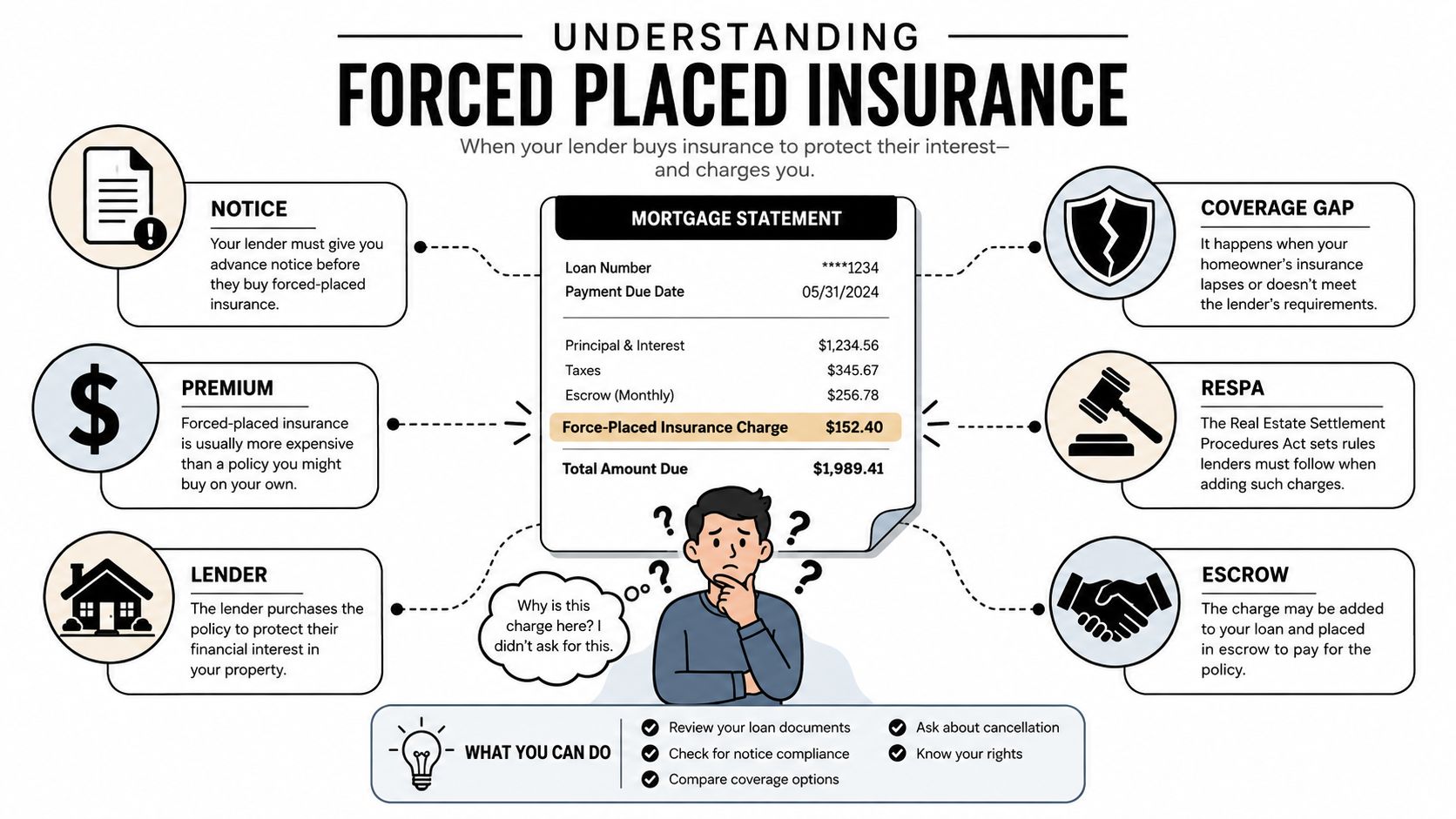
Forced placed insurance is a hazard policy a mortgage servicer buys on your property when it believes your coverage has lapsed, and you can be charged for it even though it only protects the lender. In U.S. mortgage markets, it generally affects 1% to 2% of mortgaged properties each year, so if you just found a surprise insurance charge, you're not looking at a rare glitch, you're looking at a known servicing problem.
That surprise is usually the moment a homeowner opens a mortgage statement, spots a new insurance line, and wonders how a policy they never chose ended up on their loan. The confusion makes sense, because the bill is real, the policy is real, and the coverage is often narrower than what most homeowners think they already have. The consumer rules on force-placed insurance explain why the charge exists, but they don't make the notice any less jarring when it lands in your mailbox.
If you've ever compared coverage terms while trying to cancel PMI on a California mortgage, the same habit helps here, because the first problem is often paperwork, not the house itself. The rest of this guide walks through what the charge means, why lenders trigger it, what the policy covers, and how to prove you already had valid insurance so you can challenge a wrongful placement fast.
The Notice That Lands on Your Mortgage Statement
A homeowner usually sees the problem before anyone explains it. The mortgage statement shows a new charge, the amount is bigger than expected, and the label sounds like something the lender bought without asking. That's because it did.
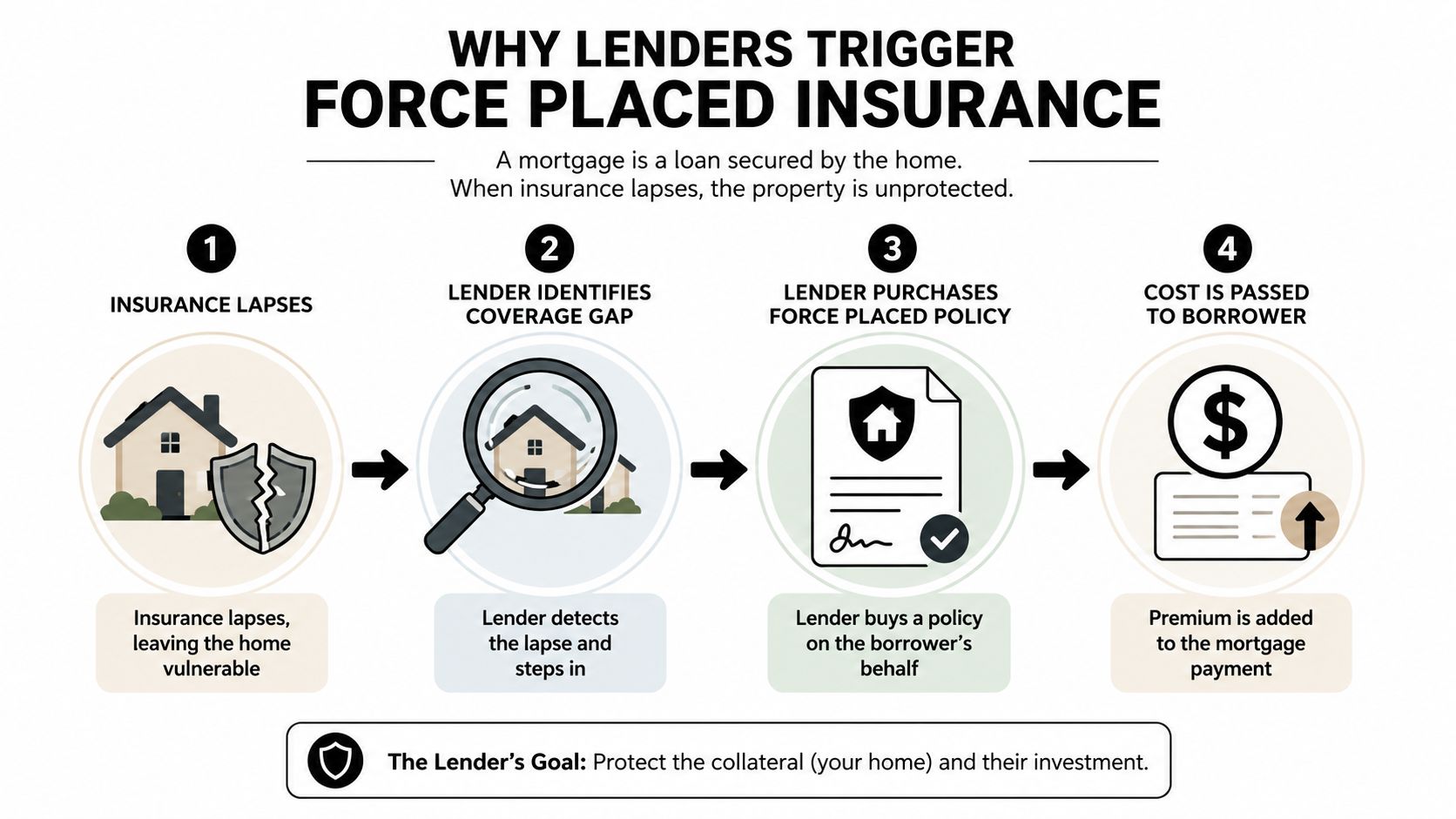
Forced placed insurance is a hazard policy the mortgage servicer obtains on the property when it believes required coverage has lapsed, been canceled, not renewed, or fallen below the loan's minimum standard. Under U.S. mortgage-servicing rules, the servicer can bill the borrower for that policy, and if it later gets proof of compliant coverage, it has to terminate the force-placed policy and refund overlapping premiums and related fees within 15 days (CFPB regulation text).
Why the charge feels so personal
Many people get stuck here. They assume they're buying a normal homeowner policy, then they realize they're paying for a policy that mainly protects the lender's collateral, not their household. That distinction matters, because a mortgage lender is focused on keeping the home insurable as security for the loan, while the family inside the house still needs broader protection.
The issue also shows up in servicing files, not just in insurance records. A carrier may have renewed the policy, but the servicer never received the update. A borrower may have switched policies and sent the paperwork, but the new declarations page never got matched to the loan file. In those moments, the problem looks like a coverage lapse from the lender's side even when the homeowner thinks everything was handled.
If your statement has a charge you don't recognize, read the notice like a compliance letter, not just a bill. Look for the dates, the insurer name, and the reason the servicer says coverage was missing or insufficient. Then keep the notice, because the date it was sent often matters later.
A simple way to think about it
A standard homeowner policy is like a full jacket. Forced placed insurance is more like a shell over the structure. It's still insurance, but it isn't built to protect everything you care about in the same way.
The practical question is not just “What is this?” It's “Did my servicer make a billing decision because it couldn't verify my coverage?” That's the question homeowners need answered before they can fight the charge or fix the file.
Why Lenders Trigger Force Placed Coverage in the First Place
A mortgage lender isn't trying to make your life difficult for sport. It's trying to protect the property that secures the loan. If the home burns, floods, or becomes otherwise damaged while insurance is missing, the lender's collateral can lose value fast, so the lender steps in to avoid being exposed.
In the mortgage market, this backstop is not unusual. The Government Accountability Office reported that lender-placed insurance affects about 1% to 2% of mortgaged properties each year and became less prevalent after the 2007 to 2009 financial crisis as foreclosures declined, but it still matters whenever coverage lapses, is canceled, or isn't renewed (GAO report). The same report noted that borrowers without escrow accounts, who make up about 25% to 40% of borrowers, are more likely to run into the kind of premium-payment problems that can trigger lender action (GAO report).
The trigger points lenders watch
A lender may act when:
- A renewal payment is missed, so the policy lapses.
- A carrier sends a non-renewal notice, often after changes in risk.
- A policy is canceled after inspection or underwriting review, including high-risk property issues.
- Coverage looks too low under the loan contract, so the servicer treats it as insufficient.
That last point confuses a lot of people. The borrower may have insurance, but if the amount doesn't meet the mortgage contract's hazard-insurance standard, the servicer can still treat it as a problem. The California Department of Financial Services explains that lenders may act not only on lapse, but also on coverage insufficiency, and servicers must send advance notices before charging the borrower (NY DFS guidance).
Practical rule: if a servicer says “no proof of coverage,” it may be reacting to missing documents, not a real uninsured gap.
That's why some conscientious homeowners still get hit. A carrier changes systems. A renewal notice goes to the wrong address. An escrow setup changes after a refinance. In a high-risk area, the chain of paperwork is often what breaks first.
What You Actually Get for the Premium
The hardest part for most homeowners is realizing they're paying a premium for a policy that isn't built around their needs. Forced placed insurance is usually designed to protect the structure that secures the loan, not the household living in it. That means the lender gets the coverage it wants, while the borrower often gets much less than a standard homeowner policy would provide.
For a clearer insurance vocabulary reference, the California home and auto insurance glossary is useful when you're comparing policy language, especially if terms like dwelling coverage, liability, and declarations pages are getting mixed together.
Side by side with a standard homeowner policy
A standard California homeowner policy usually includes broader protection. It's meant to cover the dwelling, personal property, liability, medical payments, and additional living expenses. Forced placed insurance usually strips that down to the structure or hazard portion that protects the lender's interest.
In plain terms:
| Coverage area | Standard homeowner policy | Force-placed policy |
|---|---|---|
| Dwelling / structure | Usually included | Usually included |
| Personal belongings | Usually included | Usually not included |
| Liability | Usually included | Usually not included |
| Additional living expenses | Usually included | Usually not included |
| Who it mainly protects | You and your lender | The lender |
That's why the bill feels so unfair. You're paying money, but you're not getting the same kind of safety net you thought you already had. The policy may satisfy the lender's requirement, yet still leave your family exposed if there's a loss.
Why the coverage mismatch matters
Think about a kitchen fire or major water damage. A regular policy can help with the house, the contents, and temporary living costs while repairs happen. A force-placed policy usually doesn't reach that far.
The premium is therefore not just a little inconvenient, it's a billing product tied to a narrow purpose. If the servicer believes you're out of compliance, it buys what it needs to protect the loan file, then charges you for it. That's why the first thing to challenge is often the record, not the insurance concept itself.
A homeowner who understands that difference can ask the right question immediately, which is whether the servicer has the correct proof of coverage on file.
The Real Cost of Forced Placed Insurance
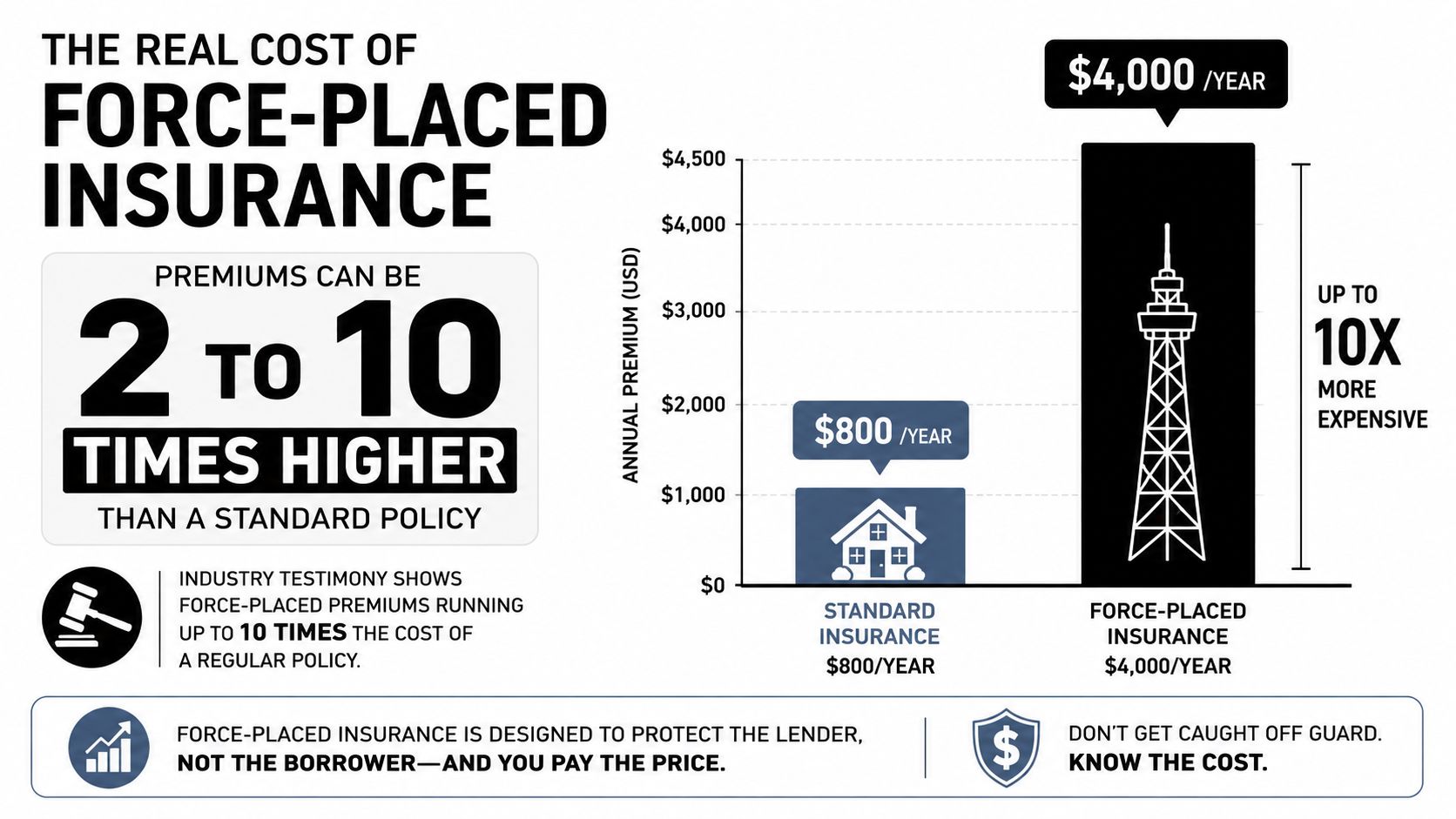
The financial shock is often what pushes people to act. Forced placed insurance is widely described as more expensive than coverage a borrower could buy independently, and the historical record shows why that reputation exists. In Senate hearing materials summarizing the New York Department of Financial Services investigation, premiums for force-placed insurance were often 2 to 10 times higher than voluntary homeowners coverage, even though the coverage was narrower (Senate hearing record).
Why the price gap is so large
That same hearing record reported that from 2004 through 2012, the average loss ratio for force-placed insurance was 25.3%, compared with 63.0% for homeowners insurance overall in the same period (Senate hearing record). In individual years, the force-placed loss ratio was as low as 29.0% in 2006 and 30.8% in 2012, while homeowners loss ratios were 48.2% and 60.4% in those same years (Senate hearing record).
Those numbers explain the frustration. Borrowers are paying more for a policy that pays out a smaller share of premiums in claims than standard homeowner insurance does. The hearing materials also show premium growth from $1,485 in 2004 to $5,115 in 2012, which is why the product became such a focal point in policy debates (Senate hearing record).
What that means on your monthly bill
When the servicer adds the premium, it can flow through the mortgage payment or escrow account. That creates a payment shock, and if the lender later applies the policy retroactively, the borrower can end up with a shortage that keeps the payment increased until the file is corrected. The pain is not just the one bill, it's the compounding effect on the monthly mortgage.
The useful thing to know is that the system is built to unwind when you bring the right proof. In the U.S. mortgage market, insurers refund premiums when borrowers later prove they had valid coverage, and the GAO said that happens on about 10% of policies (GAO report). That means wrongful or duplicative placements are part of the system, not just a theory.
When readers ask why a charge is so high, the answer is usually simple. The lender selected the policy unilaterally, not by shopping the market for the borrower. That choice affects both price and coverage.
The plumbing insurance guide for homeowners is a good reminder that not all protection is interchangeable, and the same idea applies here, because the policy attached to the mortgage statement may not protect the household the way a normal policy does.
Federal Rules That Protect You Before the Charge Hits
The most important thing many homeowners miss is that the servicer can't usually just wake up one day and bill you. Federal mortgage-servicing rules require a notice process first. Under RESPA and Regulation X, the servicer must send a first written notice, then a second written notice at least 30 days later with the same core information before charging for force-placed coverage (CT report on notice timing).
What the notices must tell you
The notices have a job to do. They must remind you to keep insurance in place, state that the servicer doesn't have evidence of coverage, explain how you can prove coverage, and warn that force-placed insurance may be purchased at your expense if proof doesn't arrive in time (CT report on notice timing).
That timing matters because it creates a real window to fix the issue. If your carrier already renewed the policy, or if you switched insurers and the servicer hasn't updated its file, this is the period when you can stop the charge before it becomes a billing problem.
Keep every notice, every email, and every declarations page. If you need to dispute the charge later, the paper trail is the case.
The CFPB mortgage-servicing guide on force-placed charges also says the charges must be bona fide and reasonable, which gives borrowers another point to raise if the amount looks out of line or the policy was imposed without proper verification.
The 15-day refund rule
If you prove you had compliant coverage, the servicer must terminate the force-placed policy and refund overlapping premiums and related fees within 15 days (CFPB regulation text). That deadline gives homeowners something concrete to request, not just a vague complaint.
Many disputes become easier than they look. The borrower doesn't need to argue philosophy. The borrower needs to show dates, policy numbers, and declarations pages that match the required coverage period. If the servicer still charges after that, the issue is no longer just insurance, it's a servicing error.
For California homeowners juggling wildfire non-renewals or policy changes, the home insurance guidance for California is worth keeping handy because timing mistakes are often what turn valid coverage into a lender-side “gap.”
Your Step-by-Step Plan to Prevent or Dispute a Force Placed Charge
The best defense is to make the servicer's file easy to verify before there's a problem. If your policy renews soon, send the updated declarations page as soon as you get it, and save the email or fax confirmation. If you switch carriers, do the same on the day the new policy starts, not a week later.
If you haven't been charged yet
Use this simple routine:
- Store your declarations pages in one folder. Keep the current policy, the prior policy, and any renewal letters together.
- Check the effective dates. Make sure the new policy starts before the old one ends.
- Send proof proactively. Don't wait for the servicer to ask if you already have the document.
- Confirm receipt in writing. Ask the servicer to note that coverage was received and accepted.
A trackable method matters more than people think. Certified mail, secure upload, or a portal message that generates a confirmation number can keep you from having to prove you sent proof months later. If your insurer issues updated paperwork slowly, ask for the declarations page right away so you're not waiting on a renewal packet that hasn't arrived.
If the charge is already on your statement
Act like you're building a file, not just complaining. Gather the policy declarations page, the payment receipt, and any renewal notice from the insurer. Then write a dated proof-of-insurance letter that states the policy number, the effective dates, and that coverage was continuous during the period the servicer billed you for.
Send that packet through a trackable channel and ask the servicer to remove the force-placed policy and reverse the overlapping charges. If you already have proof, cite the refund requirement from the federal rule and ask for the correction within the required timeframe. The homeowner dispute and guide resources can help you organize the documents before you send them.
When to escalate
If the servicer ignores your proof, the next step is escalation, not guessing. Contact the CFPB, the California Department of Insurance, or a licensed agent who can help you compare what's on file against what your carrier issued. If you're dealing with a short lapse, an escrow problem, or a high-risk renewal, ask for written confirmation of every correction.
The goal this week is simple. Find the declarations page, verify the dates, send proof, and keep a copy of every transmission. That one habit solves more force-placed disputes than most homeowners expect.
California-Specific Risks and How a Local Agent Helps
California homeowners run into this problem more often because the insurance market here changes fast. Carriers non-renew in wildfire-prone and other high-risk areas, some homeowners move into the California Fair Plan as a last-resort option, and earthquake coverage is often written separately, which can confuse both borrowers and servicers. A mortgage file can look incomplete even when the homeowner believes every piece is in place.
The California home insurance overview is a useful reminder that coverage in this state often needs more coordination than a single policy renewal notice. If the servicer expects one kind of hazard proof and the homeowner has a different mix of policies, the records can drift apart quickly.
Why a local review helps
A licensed California agent can compare carriers, identify gaps that might trigger lender action, and get documentation out fast when the servicer questions a policy. That matters because the dispute is often about timing and proof, not whether the homeowner intended to stay insured. A clean, current file is the difference between a normal renewal and a lender-placed charge.
The fastest fix is often not a new argument, it's a correct declarations page sent to the right place.
For many families, language also matters. Clear communication in English, Spanish, Armenian, Russian, or Vietnamese can help prevent a simple renewal question from becoming a billing dispute. When a homeowner understands the notice, the renewal date, and the coverage terms, the chance of a mistaken placement drops sharply.
A good local review is low pressure and practical. It should tell you whether your current policy still matches your mortgage requirements, whether your documents are ready for the next renewal cycle, and whether you need an extra layer of protection because of wildfire, Fair Plan, or earthquake exposure.
If you're staring at a force-placed notice right now, Mai & Associates can review your California coverage, help you compare options, and make sure your proof of insurance is ready before the next renewal cycle. Visit Mai & Associates for a free, no-obligation rate and coverage review, and get help building a cleaner insurance file before the servicer sends another notice.