Flexible Premium Adjustable Life Insurance: A CA Guide
Your insurance life probably doesn't move in a straight line. In California, that's normal.
One year you're buying a home, updating your car insurance, and thinking about wildfire risk. The next year you're changing jobs, welcoming a child, helping a parent, or dealing with income that swings from month to month. A fixed financial product can feel out of step with a very real life.
That's where Flexible Premium Adjustable Life Insurance gets attention. It's a type of permanent life insurance built for change. Instead of locking you into one rigid pattern forever, it gives you room to adjust key parts of the policy within the insurer's rules. For many California families, that flexibility can fit better with how money flows.
Is Your Life Insurance as Flexible as Your Life
A California family might look stable from the outside and still have a financial life that changes constantly.
Maybe one spouse works in tech with bonus-heavy compensation. Maybe the other is self-employed. Maybe they just bought a house in a higher-risk area and now carry mortgage payments, home insurance, auto insurance, and a growing list of monthly obligations. On paper, they need life insurance. In practice, they also need breathing room.
That's where people often get frustrated with more rigid policies. They understand the value of protecting their family, but they worry about being trapped in a payment pattern that won't match real life a few years from now. A policy that feels manageable today can feel tight later if income dips, childcare costs rise, or another major priority shows up.
A common California scenario
Think about a couple in Glendale. They've got two cars, a mortgage, and a child in elementary school. Their insurance picture isn't just one policy. It's a full protection plan that includes car insurance, home insurance, and life insurance.
Then life changes. One spouse cuts back work hours. The other gets a raise. They may need more life coverage than before, but they may also want flexibility in how they fund it.
A fixed structure doesn't always handle that well.
By contrast, flexible premium adjustable life insurance is designed for people whose needs evolve. It can be useful when your income rises and falls, when family responsibilities expand, or when you want permanent coverage without replacing the policy each time life changes.
Practical rule: The more your income or family obligations change over time, the more important policy flexibility becomes.
Why this matters beyond life insurance
California families rarely make insurance decisions one at a time. They're looking at the full picture.
If you're reviewing renters insurance after a move, updating auto insurance after adding a teen driver, or reassessing home insurance because rebuilding concerns are top of mind, life insurance belongs in that same conversation. The best policy isn't just the one that looks good in isolation. It's the one that fits your broader protection strategy and your actual cash flow.
Understanding Flexible Premium Adjustable Life Insurance
Flexible Premium Adjustable Life Insurance is a form of permanent life insurance that lets the policyholder change the premium amount, death benefit, and cash value allocation within insurer-defined limits, so the policy can adapt to income changes or family milestones without replacing the contract, as explained by Ethos in its overview of adjustable life insurance.
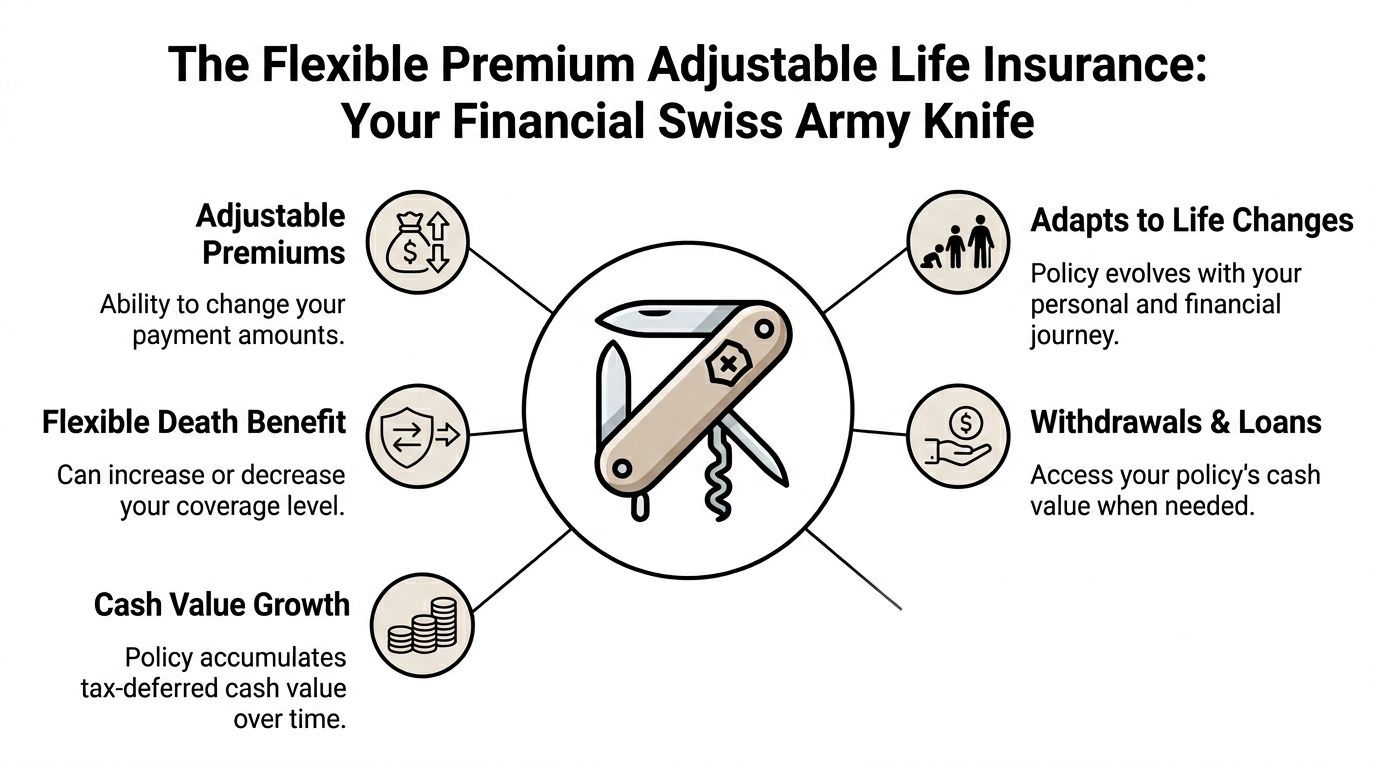
A simple way to think about it is this. If whole life is like built-in cabinetry, flexible premium adjustable life is more like an adjustable shelving system. The structure is still there. But you can move parts around as your needs change.
The three moving parts
This policy usually makes the most sense when you understand its three main levers.
Premiums
The word “flexible” starts here. You may be able to pay more in strong-income years and less in tighter years, within the policy rules. Ethos notes that in leaner periods, the policy can use accumulated cash value to help cover internal charges until that cash value is depleted.
That sounds appealing, and it is. However, many people find this aspect confusing. Flexible doesn't mean free. It means you have options, and those options affect the policy over time.
Death benefit
The death benefit is the amount your beneficiaries may receive when you pass away. With this kind of policy, that amount may be adjustable. If your family grows or your obligations increase, you may want more protection. If your needs later shrink, you may want to review whether the original amount still fits.
Some changes can be straightforward. Others may come with added cost or require insurer approval.
Cash value
The cash value is the savings-like portion inside the policy. Part of how the policy works is that money can build inside it over time, and that value can help support the policy's internal charges.
A good analogy is a backup fuel tank. When you're funding the policy well, you're adding to the tank. When you pay less, the policy may draw from that reserve. If the reserve runs down too far, the policy can run into trouble.
Why people mix up adjustable life and universal life
This product often sounds very similar to universal life because the design is closely aligned with universal life-style flexibility. The key idea is the same one many families care about most. The funding pattern can change without requiring a brand-new contract.
If you want a refresher on policy language before comparing options, a plain-English California insurance glossary can help decode common terms.
The real selling point isn't just permanent coverage. It's the ability to separate the insurance promise from a rigid payment schedule.
How This Policy Adapts to Your Financial Journey
The value of flexible premium adjustable life insurance shows up best in real life, not in product labels.
The category also isn't some brand-new experiment. The Interstate Insurance Product Regulation Commission adopted standards specifically for “Flexible Premium Adjustable Life” products, reflecting that the form became standardized enough for interstate regulation and allowing the owner to vary the amount and/or timing of premium payments rather than commit to a rigid schedule, as described by the Interstate Insurance Product Regulation Commission standard record.

Scenario one with uneven income
A freelance designer in Los Angeles has a good year. Several large contracts come through, so cash flow is strong. Instead of keeping life insurance on autopilot, that person chooses to put more into the policy within the allowed limits.
That does two things. It maintains permanent protection, and it can help build more cash value inside the policy.
Then a slower season arrives. New projects take longer to close. Because the policy was funded more aggressively during stronger periods, there may be more room to reduce payments for a while without immediately replacing coverage.
Scenario two after a growing family changes the math
A couple in Westlake Village buys a home and then has a second child. Their original life insurance amount may no longer reflect what the family would need if one parent died.
With an adjustable policy, they may have the ability to request a higher death benefit rather than starting from scratch with an entirely different contract. For a household that already reviews home insurance, earthquake options, and auto coverage after major milestones, that continuity can be attractive.
Scenario three near retirement
A homeowner in Escondido is nearing retirement. The kids are grown, the mortgage balance is lower, and the family's financial goals have changed. The need for protection may still be there, but it may not look the same as it did years ago.
In that situation, a person might review whether the current funding level still makes sense or whether the policy should be adjusted to match a different phase of life.
Flexibility matters most when your obligations change faster than your paperwork.
What readers often misunderstand
People often assume flexible premium means they can pay whatever they want, whenever they want, forever. That's not how the policy works.
The insurer still applies policy rules, internal charges still exist, and the policy still has to remain adequately funded. A better way to think about it is controlled flexibility. You get room to maneuver, but not unlimited freedom.
Here's where this design can fit a California household especially well:
- Irregular earnings: Contractors, consultants, small business owners, and commission-based workers may prefer a policy that can track uneven income.
- Life-stage changes: Marriage, children, homeownership, and caregiving can all change how much protection feels appropriate.
- Broader insurance planning: Families often review life coverage alongside renters insurance, home insurance, and car insurance rather than as a stand-alone purchase.
Evaluating the Benefits and Risks of Flexibility
Flexibility can be a strength. It can also create more responsibility.
That's the central tradeoff with this type of policy. If you want a life insurance contract that can bend with your circumstances, you have to stay engaged with how it's performing.
Where this policy can shine
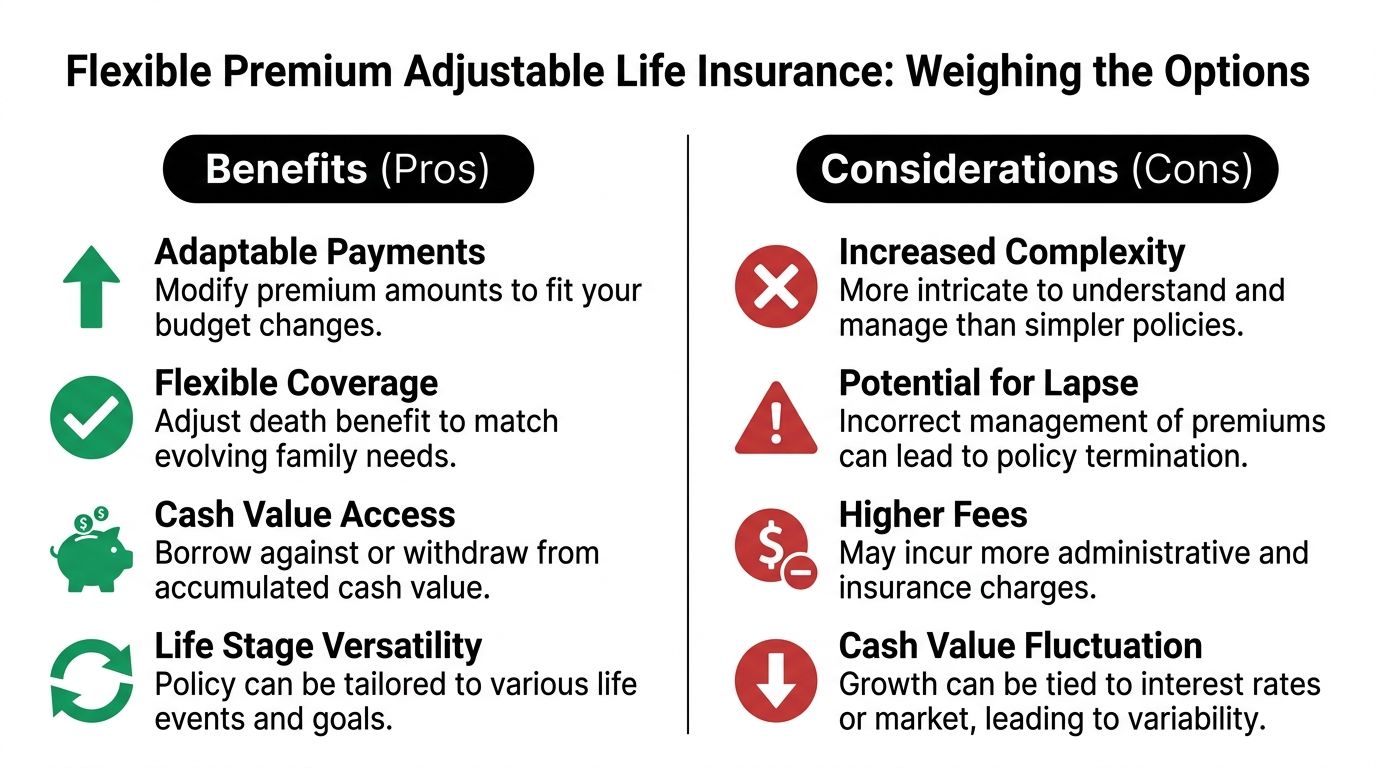
Some families are excellent candidates for this structure because the advantages line up directly with how they earn and spend.
- Payment adaptability: If your income isn't perfectly predictable, the ability to adjust premium timing and amount can be helpful.
- Coverage that can evolve: A family can revisit protection needs after major milestones instead of assuming the original setup should stay untouched forever.
- Built-in cash value component: The policy can accumulate cash value over time, which is one reason many people consider permanent life insurance in the first place.
- Long-term continuity: You may be able to adapt the policy instead of replacing it each time your situation changes.
Where people get into trouble
The same features that make the policy useful can also make it easier to misunderstand.
Flexible premium adjustable life insurance is not a “set it and forget it” product for most households. If you underfund it for too long, the policy can lapse. If you make changes without understanding the effect on costs, you may be surprised later.
A key actuarial feature is that premiums are not guaranteed and are based on age, gender, tobacco status, and health at issue, while future cost increases can occur as the policy ages and expense charges rise. Western & Southern also notes that increasing the death benefit may trigger higher costs and, in some cases, additional underwriting, which means flexibility is limited by internal cost-of-insurance mechanics rather than being fully open-ended, as explained in its adjustable life insurance guide.
A balanced view
Understanding this requires plain language for many buyers. “Flexible” sounds like lower stress. Sometimes it is. But flexibility can shift more monitoring onto the policy owner.
A useful review process might include:
| Decision area | Why it matters |
|---|---|
| Premium pattern | Lower payments may affect how long the policy remains healthy |
| Death benefit changes | More coverage can mean more cost and possible underwriting |
| Cash value use | Accessing value can affect long-term policy performance |
| Ongoing reviews | The policy works better when someone checks it regularly |
If you're comparing policy types and want broader educational material before talking to an agent, these California insurance guides can help frame the right questions.
Key consideration: This policy rewards active owners. It can punish neglect.
How It Compares to Whole and Universal Life Insurance
Most buyers don't choose life insurance in a vacuum. They're usually comparing it against whole life and universal life, and the essential question is less about labels than about fit.
The big-picture difference
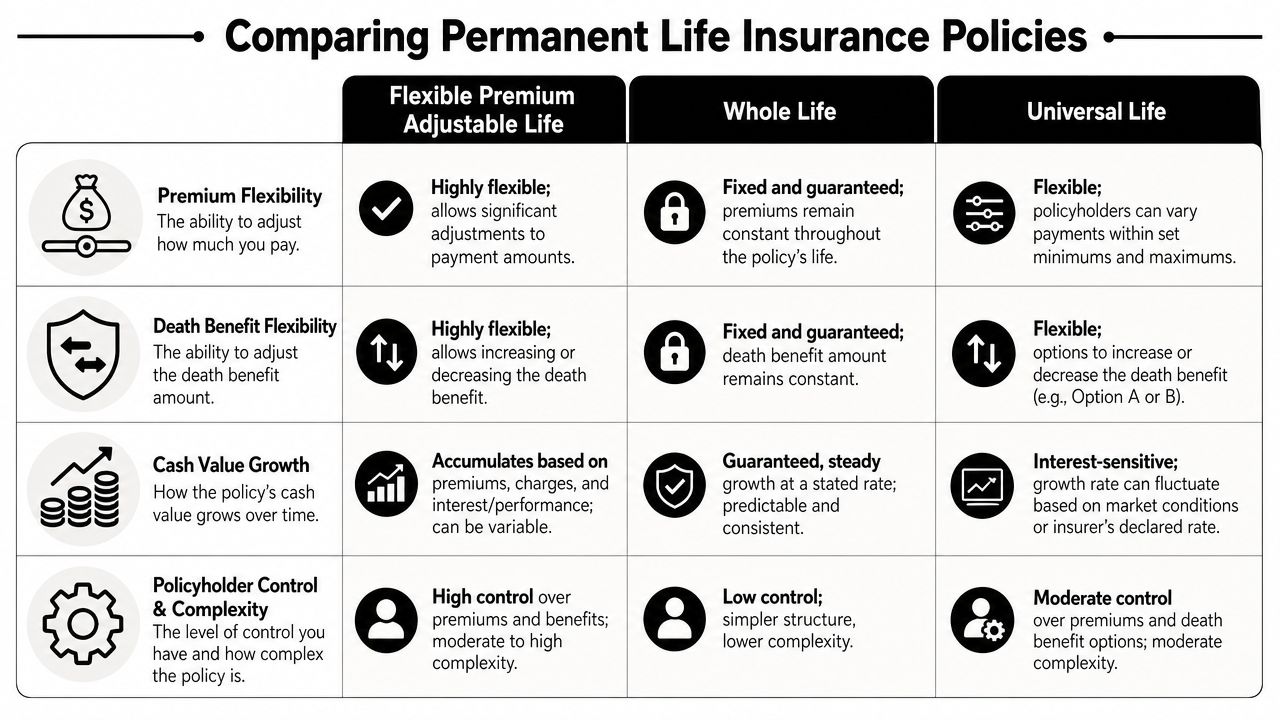
Whole life generally appeals to people who value predictability. They want fixed structure, fewer moving parts, and less day-to-day management.
Flexible premium adjustable life insurance appeals to people who want more control over how the policy is funded and how coverage may change over time.
Universal life often sits nearby in the conversation because it also emphasizes flexibility. In many discussions, adjustable life feels like a close cousin. For many readers, the practical takeaway is simple: whole life is usually more rigid, while flexible premium adjustable life and universal life offer more room to adjust.
Life Insurance Policy Comparison
| Feature | Flexible Premium Adjustable Life | Whole Life | Universal Life |
|---|---|---|---|
| Premium structure | Adjustable within insurer limits | Generally fixed | Flexible within policy rules |
| Death benefit | May be adjusted | Generally fixed | Often flexible |
| Cash value | Builds inside policy and affects funding flexibility | More structured and predictable by design | Tied to policy mechanics and funding |
| Complexity | Higher | Lower | Moderate to higher |
| Best fit | People with changing income or evolving needs | People who prefer consistency | People who want flexibility in a permanent policy |
Which buyer tends to prefer each one
Whole life
This can fit someone who wants simplicity and doesn't want to manage many moving parts. If steady structure helps you sleep better, whole life often attracts that kind of buyer.
Flexible premium adjustable life insurance
This can fit a household with changing obligations, variable income, or a strong desire to revisit coverage over time without replacing the contract every time life shifts.
Universal life
This often fits someone who wants permanent coverage with flexibility but is comparing different cash value mechanics and design choices.
If you're also sorting out the broader question of choosing between whole and term life, that resource can help clarify where permanent insurance belongs in your planning before you narrow the choice to adjustable or universal designs.
For California-specific policy options, it also helps to review a dedicated page on life insurance in California.
Finding the Right California Life Insurance Policy
The right policy starts with honest self-assessment.
Flexible premium adjustable life insurance can be a smart fit, but only when the policy design matches the household using it. Some families need flexibility. Others need simplicity more than anything else.
A quick self-check
This policy may deserve a closer look if several of these sound like you:
- Your income changes: You're self-employed, commission-based, seasonal, or bonus-heavy.
- Your family needs may grow or shrink: You expect major milestones such as children, a home purchase, or future caregiving responsibilities.
- You want permanent coverage: You're not only looking for temporary protection.
- You're willing to review the policy: You won't ignore statements and annual check-ins.
- You value coordination across policies: You want life insurance to fit alongside California auto insurance, home insurance, or renters insurance.
Questions worth asking an agent
A good conversation gets more specific than “Is this policy good?”
Ask questions like these:
- How much flexibility is available? Not every policy allows the same kinds of adjustments.
- What happens if I reduce premiums for a period? You want to understand lapse risk in plain English.
- If I want more death benefit later, what would that require?
- How should I monitor the policy over time?
- How does this fit with the rest of my insurance plan? That includes cars, property, and family protection.
Ask for explanations you can repeat back to your spouse. If the policy only makes sense in technical language, keep asking.
If you're ready to compare options, request a California insurance quote and review the policy in the context of your full protection plan, not as a stand-alone purchase.
If you want help sorting through life insurance alongside auto, home, or renters coverage, Mai & Associates can help you compare options with a licensed California agent. With offices in Glendale, Westlake Village, Escondido, and Costa Mesa, plus multilingual support in English, Spanish, Armenian, Russian, and Vietnamese, the team can walk you through how flexible premium adjustable life insurance fits into a practical California protection strategy.