Fitness Instructor Liability Insurance in California Guide

You're probably in a familiar spot. You've built a client list, you're coaching classes, and you're focused on results. Then a simple thought cuts through the day: what happens if a client gets hurt and blames you?
That question matters more than most new instructors realize. If you coach people for money, your risk doesn't stop at the gym floor. A claim can reach your business income, your savings, and in the wrong setup, your personal finances too. In California, where many instructors piece together income from studios, private sessions, online coaching, and travel to clients, that risk gets broader fast.
A lot of instructors buy equipment before they buy insurance. I think that's backwards. Your kettlebells, mats, and resistance bands don't protect you from a legal demand letter. Proper coverage does.
Why Your Fitness Career Needs Financial Protection
A new instructor often thinks skill is the safety plan. Good programming, careful cueing, and strong client communication all matter. They just don't eliminate claims. Clients can fall, strain something, misunderstand an instruction, or say your modification made an existing issue worse.
That's why fitness instructor liability insurance belongs in the same mental bucket as your California car insurance, homeowners insurance, renters insurance, and life insurance. Each policy protects a different part of your financial life. Your auto policy protects you on the road. Your home or renters policy protects your living situation. Life insurance protects your family. Liability coverage protects the income you earn from training people.

The market itself shows where this is headed. The fitness instructor liability insurance market was valued at $2.1 billion in 2024 and is projected to reach $4.8 billion by 2033, with a projected 9.5% CAGR, according to Market Intelo's fitness instructor liability insurance market report. My takeaway is simple: this isn't niche protection anymore. It's becoming a standard operating cost for serious fitness professionals.
Passion doesn't cover lawsuits
Passion helps you coach better. It doesn't pay an attorney. It doesn't respond when a client claims your exercise progression aggravated an injury. It doesn't solve a dispute with a studio that required you to carry coverage and name them on paperwork.
Practical rule: If you earn money by giving fitness instruction, insurance isn't optional. It's part of the job.
Many instructors make the mistake of viewing liability insurance as a business expense they'll handle later. That's like driving around California planning to buy car insurance after your first accident. The smart move is to get protected before the problem shows up.
If you want another practical perspective on business risk, this guide to protecting your training business gives useful context on why trainers need liability protection in the first place.
Your business risk can become personal risk
A claim against your training work doesn't stay neatly inside your calendar app. It can affect your ability to keep earning, renew contracts, and protect your savings. That's especially true if you're operating informally and haven't lined up the right coverage.
Think of your insurance stack as one financial system, not a pile of unrelated policies:
- Professional coverage: Protects your training work from liability claims.
- Car insurance: Matters if you drive to clients, studios, or parks for sessions.
- Home or renters insurance: Protects your personal property and liability at home, but it usually isn't built for a coaching business.
- Life insurance: Helps protect the people who depend on your income.
For broader insurance education that connects these pieces, a solid starting point is this California insurance guides library.
Decoding Your Fitness Insurance Coverage Options
Most new instructors hear “liability insurance” and assume it's one thing. It isn't. There are two core coverages you need to understand, and confusing them is one of the fastest ways to end up underinsured.
I explain it as slip vs. script.
A slip claim comes from everyday operations. A script claim comes from your professional instruction, programming, or advice.
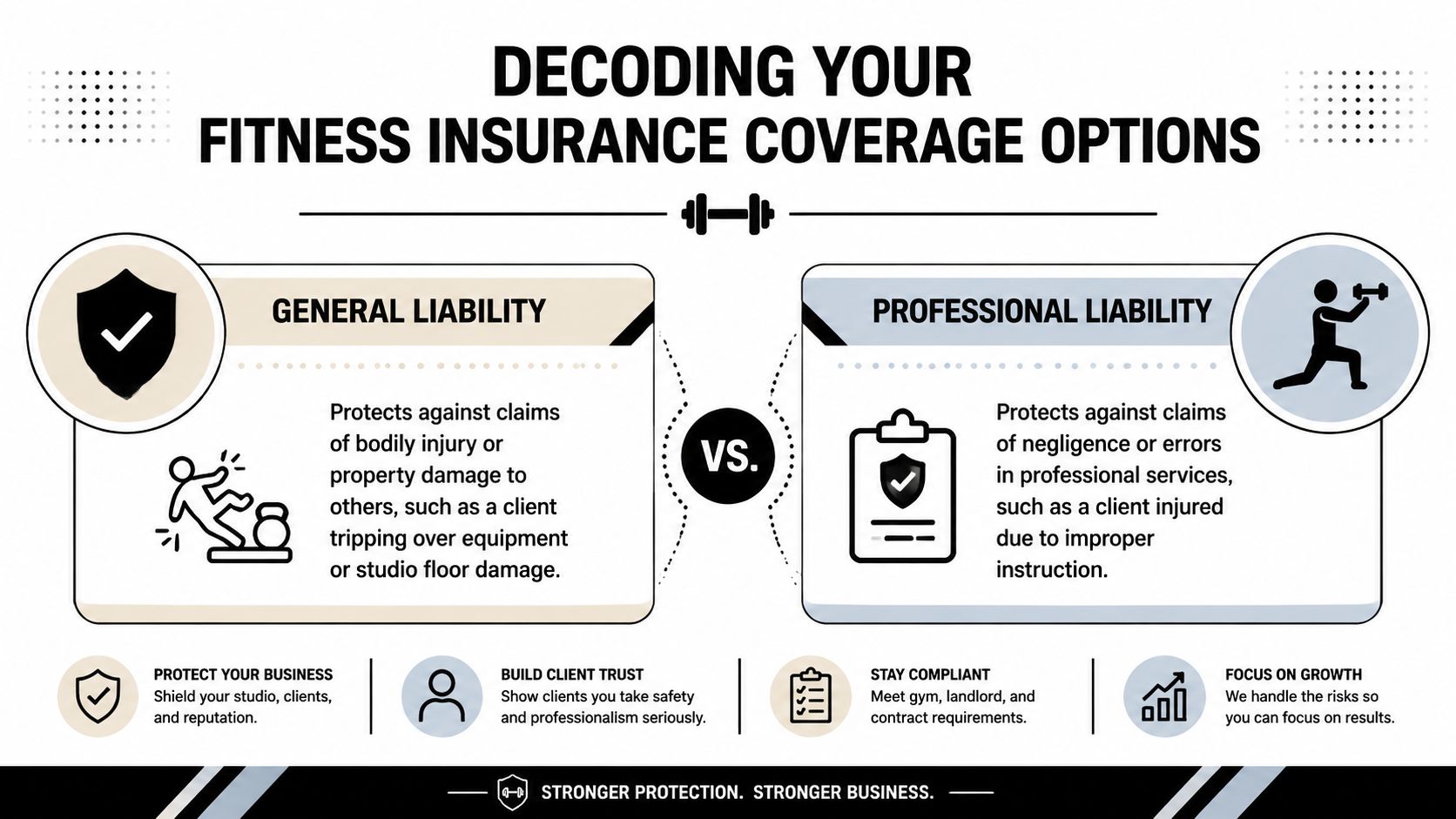
According to Insurance Canopy's explanation of general liability versus professional liability for personal trainers, general liability covers third-party bodily injury from operations, such as a dropped dumbbell, while professional liability responds to allegations that an instructor's advice or programming caused harm, such as an improper form correction leading to injury.
General liability handles the accident
General liability is the coverage people picture first. A client trips over equipment. Someone slips in your workout space. You damage a studio floor or a client's property while setting up.
That's operational risk. It's the “something happened” category.
Use general liability to think through events like these:
- Client fall in a session: A participant trips over a resistance band you left stretched across the floor.
- Property damage: A weight or piece of equipment damages a mirror, hardwood floor, or a client's furniture during an in-home session.
- Basic premises injury: A person gets hurt because of the setup or physical environment around your work.
Professional liability handles the coaching allegation
Professional liability is where many instructors get exposed. This coverage responds when the complaint is about your judgment, not just your surroundings.
A client says your progression was too aggressive. Another says you missed a contraindication. A prenatal client argues your modifications weren't appropriate. That's not a slip claim. That's a service claim.
The dangerous assumption is thinking, "I already have liability insurance, so I'm covered." If the policy only handles premises accidents, that assumption can fail at exactly the wrong moment.
In one-on-one training, corrective exercise, yoga, Pilates, and highly customized coaching, professional liability is especially important because your value comes from instruction. The more individualized the service, the more you need protection for the advice itself.
Other coverages that may matter
Not every instructor needs the exact same policy. Your business model should drive the extras.
| Coverage type | When it matters | Why it can matter |
|---|---|---|
| Product liability | If you sell gear or branded products | A client may tie an injury or damage claim to something you sold |
| Sexual abuse and molestation coverage | If a gym, studio, or facility requires it | Some venues won't contract with instructors without it |
| Commercial auto | If you regularly drive for business | Personal car insurance usually isn't designed for business use |
If insurance language feels dense, don't guess. Use a plain-English California insurance glossary and make sure you understand what each policy covers before you buy it.
Understanding Policy Limits and Typical Costs
A lot of instructors focus on premium first. That's understandable, but it's not how I'd make the decision. Start with exposure, then look at price.
The key terms are per occurrence and aggregate. Per occurrence is the maximum the policy will pay for a single covered claim. Aggregate is the total amount available across covered claims during the policy term. So when you see $1M/$3M, that usually means one limit for any single event and a larger total for the full policy period.
Cheap coverage isn't automatically smart coverage
Published program pricing shows annual premiums can be around $172 for $1M/$3M limits and increase to about $215 for $2M/$4M, based on K&K Insurance's fitness instructors and personal trainers program details. That pricing matters because the jump in premium isn't necessarily dramatic when limits increase.
Here's the practical lesson. Don't buy the smallest limit just because it's the cheapest option on the screen. If a modest premium increase gets you materially broader protection, that's usually worth serious consideration.
What the price is really telling you
A low premium can mean a few different things. It may reflect a basic policy with narrower coverage. It may leave out activities you perform. It may also work fine for a lower-risk instructor with a simple model.
A quote needs context. Ask what activities are covered, where you're covered, and whether instruction itself is included.
Buy limits based on the size of the problem you could face, not based on the smallest bill you can pay today.
What underwriters usually look at
Price often turns on the nature of your work more than your enthusiasm or certifications. Common pressure points include:
- Training style: Highly customized work usually creates different risk than a large basic class.
- Business setting: Training in studios, parks, homes, and online can trigger different underwriting questions.
- Services offered: Coaching that overlaps with specialized populations or modern digital delivery often needs closer review.
If your quote looks cheap, don't celebrate too quickly. Read the specifics of the coverage.
California Specific Insurance Rules for Instructors
California instructors run into a practical reality fast. The venue often sets the standard before the law ever enters the conversation. Gyms, studios, condo fitness rooms, schools, and community centers commonly want contract instructors to carry their own liability coverage and provide proof before teaching.
That requirement shouldn't irritate you. It should clarify the market. If the facility wants you insured, it's because they know claims happen and they don't want your problem turning into theirs.
Your business setup matters
Many new instructors operate as sole proprietors because it's simple. Simple is fine for getting started, but don't confuse a business name with legal separation. If you haven't structured the business properly and backed it up with insurance, your personal finances can remain exposed.
An LLC can help with business organization and risk separation, but it doesn't replace insurance. If someone alleges bodily injury or negligent instruction, you still want a policy built for that exposure.
California insurance thinking should be consistent
California residents already understand this logic in other parts of life.
- Car insurance: State driving rules make liability protection part of responsible vehicle ownership.
- Home insurance: Wildfire exposure has taught many homeowners that location-specific risk changes the coverage conversation.
- Renters insurance: Even tenants need protection for property loss and personal liability.
- Life insurance: Income protection matters when other people depend on you.
Your training business deserves the same disciplined thinking. If you're driving your own car to clients, parks, or studio appointments, that raises another issue. Your personal auto policy is built for personal driving. It may not be the right answer for routine business use tied to your instruction work.
A common California mistake is assuming one personal policy can stretch across every part of life. Insurance doesn't work that way. Each risk needs the right policy.
What to check before you accept a contract
Before you start teaching at any California location, ask for the insurance requirements in writing. Review:
- Required policy types
- Any requested additional insured wording
- Whether online or off-site sessions are permitted
- Whether your travel to clients creates separate auto exposure
That short review can save you from signing a contract you can't satisfy.
Beyond the Basics Policy Endorsements You Might Need
Basic coverage is a starting point, not a finish line. Modern instructors rarely operate in one narrow lane. You may teach in person, text clients through an app, send workout plans, recommend basic nutrition habits, and host virtual sessions in the same week.
That mix creates gaps if your policy wasn't built for how you work.
Online coaching changes the exposure
A lot of low-cost plans are marketed to solo instructors because affordability sells. The problem is that affordability doesn't tell you whether the policy follows your real business model.
According to Markow Training Systems' discussion of common fitness instructor insurance questions, many low-premium plans may lack coverage for higher-risk or modern services, and instructors offering online sessions, client apps, or specialized coaching should verify that their policy includes endorsements for those activities to avoid being underinsured.
If you coach through video, messaging platforms, or subscription programming, ask directly whether the policy covers:
- Live virtual sessions
- Recorded workouts
- App-based coaching communication
- Digital program delivery
Don't assume “fitness instruction” automatically means all formats.
Nutrition and specialized coaching need extra scrutiny
Many instructors drift into gray areas without realizing it. A client asks about meal structure. You provide lifestyle guidance. Another client is pregnant, postpartum, young, older, or recovering from prior limitations. The more specialized the coaching, the more carefully you should check the policy language.
Some instructors also need to think about business personal property and equipment protection if they carry portable gear. Others may need coverage aligned with work inside a client's home or at temporary locations.
Here's my opinion. Budget policies are fine only when they clearly match the work. If they don't, they're false savings.
Tailor the policy to the business you actually run
Use this test. List every way you make money from fitness. Then compare that list to your policy.
- In-person classes: Covered where, and under what conditions?
- Private training: Included or excluded?
- Virtual coaching: Specifically endorsed or left vague?
- Special populations: Accepted by the carrier or carved out?
- Equipment and add-on advice: Covered, limited, or not addressed?
If your policy doesn't match that list, it needs to be fixed.
Your Checklist for Comparing Insurance Quotes
Shopping for fitness instructor liability insurance gets messy when every quote looks similar at first glance. The premium catches your eye, but the exclusions and missing endorsements usually reveal the truth.
Use a checklist. It forces you to compare substance, not just marketing.

What to verify on every quote
- Both core liability coverages: Confirm the quote includes general liability and professional liability. If it only handles accidents and not your instruction, keep looking.
- Exclusions tied to your niche: Hot yoga, corrective exercise, youth training, prenatal work, and specialized coaching should be reviewed carefully.
- Online services language: If you coach virtually, sell app-based programming, or communicate through digital platforms, make sure the policy says so.
- Where coverage applies: Home studio, rented studio, client homes, outdoor parks, and online delivery don't always get treated the same way.
- Claims handling: Ask how claims are reported and how quickly you can get proof of insurance or policy documents.
- Contract compatibility: If a gym or studio requires certain wording or documentation, make sure the policy can satisfy it.
Questions that expose weak quotes
A weak quote often falls apart under direct questions. Ask the broker or carrier:
- Does this policy cover my instruction itself, not just accidents around me?
- Are my online sessions and digital programs included?
- Are there activity exclusions that affect my specialty?
- If I train at client homes or multiple locations, does coverage follow me?
- Can this policy meet the paperwork standards a California gym may ask for?
Don't compare quotes by monthly cost alone. Compare them by what happens when a client says your training caused harm.
If you want a consumer-friendly place to review common insurance questions before buying, browse this California insurance FAQ page.
Get Your Same-Day California Insurance Quote Today
If you're teaching clients without reviewing your coverage, fix that now. Waiting until a contract requires proof or a client raises a complaint is the expensive way to learn this lesson.
The smart move is to get a quote and review your entire protection picture at the same time.

A California instructor usually has overlapping risks. You may need liability protection for your business, but you may also be driving between clients, renting an apartment, buying a home, or thinking about family protection. Looking at each policy in isolation is inefficient and often leaves gaps.
A better way to handle your insurance review
Use one conversation to review the major categories that affect your financial life:
- Fitness instructor liability insurance for your training work
- Car insurance if you commute or drive to appointments
- Homeowners insurance if you own property in California
- Renters insurance if you lease and want liability and property protection
- Life insurance if someone depends on your income
That broader review matters because insurance decisions interact. A trainer who drives to clients has different exposure than one who only teaches at a single studio. A renter coaching from home has different concerns than a homeowner in a wildfire-prone area.
Keep the quoting process simple
You don't need to overcomplicate this. Start with a straightforward same-day California insurance quote request, then have a licensed agent review where your business risk and personal risk overlap.
That kind of review is especially useful for California residents because your insurance life rarely fits into one box. Business liability, auto exposure, renters or home coverage, and life insurance all connect back to one goal: protecting your income and your assets before a problem gets expensive.
If you're serious about building a fitness career that lasts, insurance belongs on your setup checklist right alongside certifications, contracts, and client onboarding.
If you want help reviewing your fitness instructor liability coverage alongside your car insurance, home insurance, renters insurance, or life insurance, Mai & Associates can help you compare options and close coverage gaps with a same-day, no-obligation California quote.