Fire Insurance Exchange: CA Homeowner's Guide
You open the mailbox or your email and see the notice nobody wants. Your homeowners policy isn’t being renewed. Or the renewal arrives and the premium jumps so hard you start wondering whether keeping the house properly insured is even realistic.
That’s where a lot of Californians are right now. Not reckless homeowners. Not people who ignored maintenance. Regular families with mortgages, kids, cars, and a budget that already feels stretched.
If you’re searching for answers about a fire insurance exchange, you’re usually not casually shopping. You’re trying to solve a live problem. You need coverage that will satisfy your lender, protect your home, and not leave you with ugly surprises after a wildfire loss. You also need to understand how this choice affects the rest of your insurance picture, including California home insurance, auto insurance, renters insurance, car insurance, and life insurance. The policies shouldn’t work against each other.
The California Home Insurance Challenge
A lot of homeowners call for help after the bad news has already landed. The carrier that insured them for years suddenly won’t continue the policy. Or the quote comes back so high that they assume they have no real options left.
That assumption is usually wrong.
California’s property market has become harder, especially in wildfire-exposed areas. Carriers have tightened underwriting. Some homes that once fit a standard homeowners policy now get pushed into narrower or more expensive solutions. That doesn’t mean you’re uninsurable. It means you have to stop thinking like a casual shopper and start thinking like a risk manager.
What people get wrong first
Most homeowners focus only on one question: “Who will cover my house?” That’s too narrow.
The better questions are:
- What kind of policy am I being offered
- What perils are included
- Is liability included or missing
- Will the claim settlement be enough to rebuild or replace
- Can I combine this with my other insurance cleanly
A fire-focused solution can be useful. It can also be incomplete.
The worst insurance mistake in California right now isn’t paying a high premium. It’s buying a policy you don’t fully understand because you were under pressure.
Why this topic matters
A fire insurance exchange sits in a category many homeowners have heard of but don’t really understand. The name sounds technical. The structure is different from a standard stock insurer. And in California, where wildfire risk drives tough underwriting decisions, that difference matters.
You need practical answers. Not marketing language. Not vague reassurance. You need to know where a fire insurance exchange fits, when the California FAIR Plan makes sense, and when a standard private homeowners policy is still the better deal.
What Exactly Is a Fire Insurance Exchange
A fire insurance exchange is best understood as a shared risk pool. It operates as a member-run system where policyholders participate in a collective arrangement to insure one another against covered losses. It’s not the same as a traditional insurer owned by outside shareholders.
That structure matters because it affects how risk is organized, how policies are issued, and how people should think about the relationship between the company and the policyholder.

The simplest way to think about it
In plain English, a reciprocal exchange works like this:
Policyholders join the pool
When you buy a policy, you’re entering a shared insurance arrangement rather than just buying from a typical investor-owned corporation.The exchange handles the insurance relationship
The exchange exists to spread risk among participants.A manager runs the operations
In reciprocal structures, an attorney-in-fact generally handles administration, underwriting operations, premium collection, and claims functions.
That’s the concept. Shared risk, centrally managed.
Why it exists
This model wasn’t created for novelty. It exists because pooling similar risks can be an effective way to insure property exposures, especially fire risk. Historically, fire insurance grew out of the hard lesson that concentrated losses can wipe out insurers that don’t spread risk broadly enough.
The broader fire insurance industry learned that lesson brutally after the 1835 Great New York Fire, which caused between $15 million and $26 million in damage and bankrupted 23 of the 26 local fire insurance companies in the city, according to the Economic History Association’s overview of fire insurance in the United States. Geographic diversification became essential after that.
Where Fire Insurance Exchange fits
Fire Insurance Exchange was established in 1942 as the third reciprocal insurer, specializing in home insurance. It operated under a mutual ownership model where policyholders collectively owned shares of the risk. By 1950, it had grown enough to acquire Mid-Century Insurance Company as a subsidiary, according to the Farmers Insurance Group history summary.
That history tells you two things. First, this isn’t a new experiment. Second, the reciprocal model has been a real part of American home insurance for a long time.
Plain test: If you don’t understand whether you’re buying from a stock insurer, a mutual insurer, a reciprocal exchange, or the FAIR Plan, you’re not ready to judge the quote.
Comparing Your California Fire Coverage Options
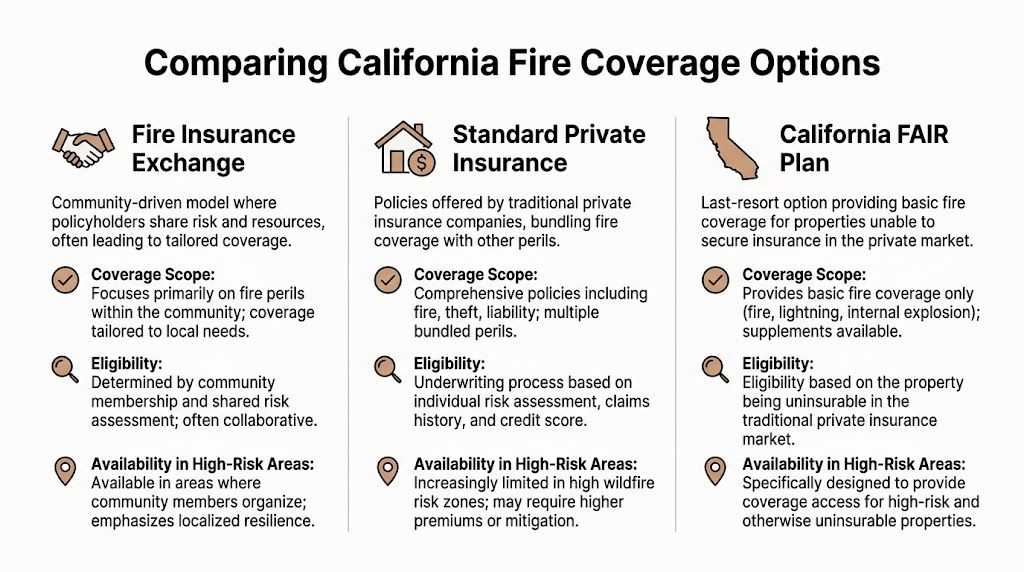
If you own a home in California, you usually end up choosing between three paths. A fire insurance exchange policy, a standard private homeowners policy, or the California FAIR Plan. These are not interchangeable.
The right option depends on availability, coverage scope, and how much compromise you’re willing to accept.
The side by side reality
| Option | Best for | Main strength | Main problem |
|---|---|---|---|
| Fire insurance exchange | Homeowners needing a private-market style solution when standard options are tighter | Can offer a more workable path than a full market rejection | You still need to scrutinize coverage terms and pricing logic |
| Standard private insurance | Homeowners who still qualify in the voluntary market | Usually the cleanest all-in-one solution | Availability is the problem in many wildfire-exposed areas |
| California FAIR Plan | Homeowners who can’t secure normal coverage | Keeps basic fire coverage available as a last resort | It is limited and often needs a second policy to fill gaps |
Why the FAIR Plan is not a normal replacement
The California FAIR Plan is a syndicated fire insurance pool. All licensed property insurers writing basic property insurance in California must participate. As of December 2025, the FAIR Plan’s total exposure reached $724 billion, which the plan says is a 230% increase since September 2022, according to the California FAIR Plan overview.
That number matters because it shows how many homeowners are getting pushed into this backup system.
But the bigger issue is coverage design. Standard FAIR Plan policies cover actual cash value for only four named perils: fire, lightning, internal explosion, and smoke. They also create a liability gap, which means homeowners generally need a separate policy to fill in what the FAIR Plan doesn’t provide. If you’re trying to understand how those pieces fit into a broader California home insurance market, this is the line you can’t afford to miss.
Which option usually makes the most sense
Here’s the blunt version.
- Choose standard private insurance first if you can still qualify for a strong homeowners policy with reasonable terms.
- Use a fire insurance exchange when the private market gets narrow but you still want something with broader coverage than a last-resort pool.
- Use the FAIR Plan only when necessary, and only with a full understanding that it often needs wraparound coverage.
A FAIR Plan policy can solve the “I need fire coverage now” problem while creating a second problem if you forget liability, broader property protections, or replacement-related costs.
What renters and drivers should keep in mind
This doesn’t only affect owners. Renters in wildfire-prone areas need to verify whether a landlord’s policy leaves them exposed. Drivers should also review whether policy changes on the home side affect bundling, discounts, or carrier appetite for car insurance and auto insurance with the same household. Insurance decisions rarely stay in one lane.
Understanding Coverage Limits and Common Exclusions
A lot of homeowners ask, “Does it cover fire?” That’s too basic. A better question is, how far does the policy go once the fire loss starts unfolding.
A fire policy can look acceptable at first glance and still leave you badly underprotected.
What to review in the quote
For any fire insurance exchange policy or fire-focused coverage setup, review these parts carefully:
Dwelling coverage
This is the amount allocated to repair or rebuild the home itself.Other structures
Detached garages, fences, sheds, and similar structures may have separate limits.Personal property
Your contents may be covered differently than the building, and sublimits can matter.Loss of use
If you can’t live in the home after a covered loss, this section may help with temporary living costs.Liability protection
Many people make a serious mistake in this area, especially when a fire plan is paired with limited or pieced-together coverage.
The exclusions that hit people hardest
The worst surprises aren’t exotic. They’re ordinary items people assumed were included.
Watch for gaps involving:
Replacement cost versus actual cash value
Those are not the same thing. Actual cash value reflects depreciation. That can leave a major shortfall after a serious loss.Debris removal
Wildfire cleanup can be expensive, and homeowners often assume it’s automatically generous. Don’t assume anything.Building code upgrades
Rebuilding under current code can cost more than restoring an older home to its prior condition.Other structure treatment after wildfire
Fences, detached spaces, and exterior features may not be protected the way you think.Liability omissions
A fire-only framework without liability is not complete protection for a homeowner.
Ask harder questions
Bring a list to the conversation. Don’t rely on verbal summaries.
Ask:
- Is settlement based on replacement cost or actual cash value?
- Are wildfire-related cleanup costs specifically addressed?
- Does the policy include liability, or do I need a separate layer?
- Are endorsements available for broader protection?
- What is excluded that homeowners commonly assume is covered?
If an insurance term isn’t clear, use a plain-language insurance glossary and then go back to the quote. Never sign off on a policy just because the declarations page looks familiar.
Practical rule: If you can’t explain your own coverage in plain English, you probably have a gap.
The bigger mistake
People under pressure often compare only premium and deductible. That’s lazy shopping, and in California it can become expensive shopping.
Coverage quality matters more than marketing language. A cheaper fire policy that skips important protections can cost far more than a better-built package if your home burns.
Decoding the Costs What Drives Your Premium
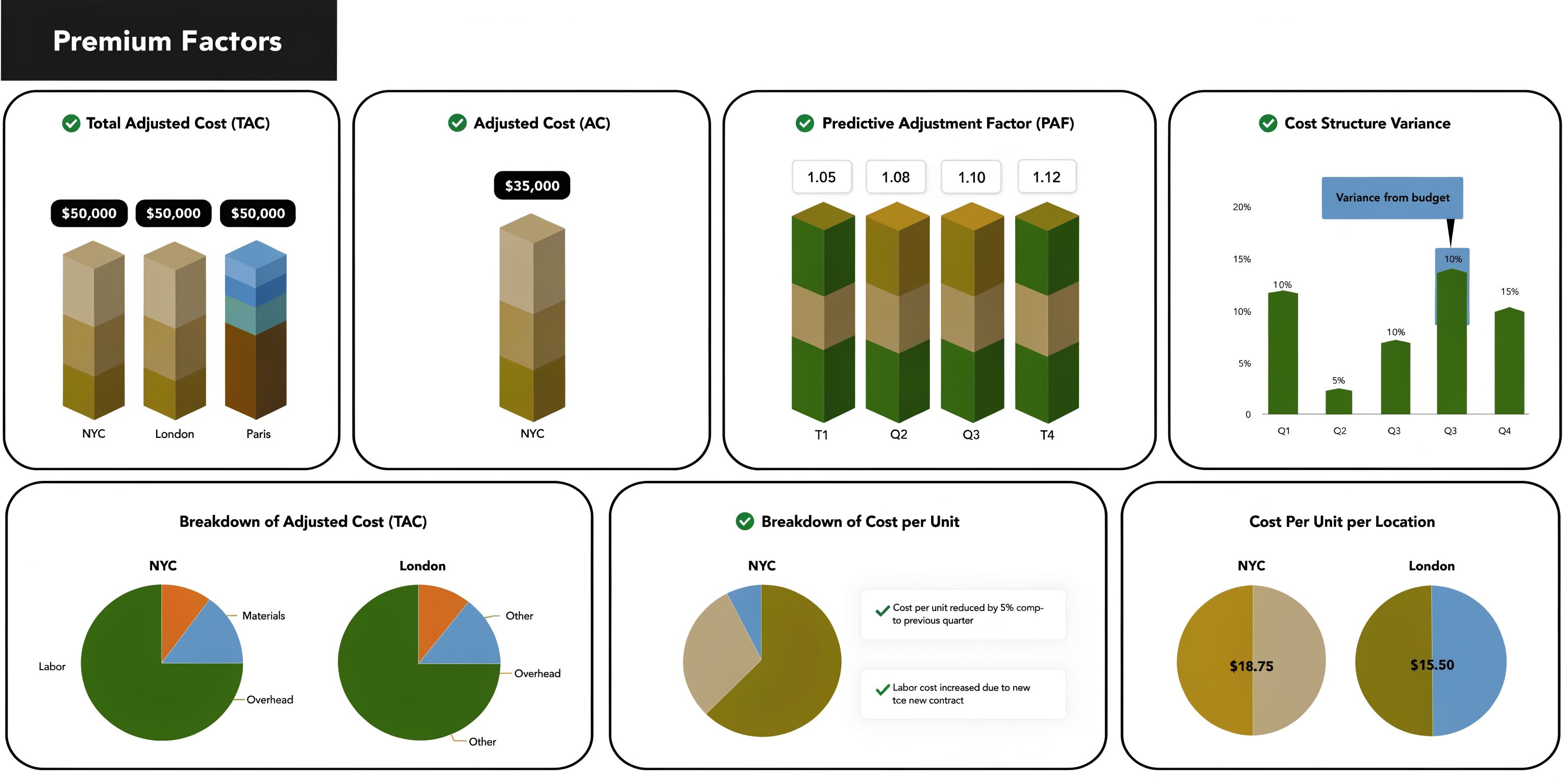
Homeowners usually assume the premium is high because of one thing: the address. Location matters, but that’s not the whole story. The bigger issue is that pricing often combines property details, community conditions, claims experience, and insurer modeling that you can’t easily see.
That lack of visibility is a real problem.
What usually affects the price
Your fire-related premium can move based on factors such as:
The home itself
Roof condition, building materials, age, and configuration all matter.Defensible space and visible mitigation
If you’ve cleared vegetation, hardened parts of the home, or improved access, that should matter. The problem is that not every pricing model seems to reflect it well.Claims history
Prior losses can affect how underwriters view the property.Local fire response conditions
Access, nearby protection resources, and broader geographic risk all shape pricing.
The problem with broad catastrophe models
This topic elicits strong opinions. Homeowners are right to be frustrated.
Insurers like Fire Insurance Exchange are under investigation for using broad, non-transparent catastrophe models for rate-setting that may fail to account for individual property-level mitigation efforts, according to United Policyholders’ discussion of western-state insurance issues at UPHelp. If you spent time and money hardening your home, and the rate still treats you like a generic map pin, that’s a legitimate complaint.
What to do about it
Don’t just accept the first quote as mathematically sacred.
Push on these points:
Ask what property characteristics were used
You may not get a full model explanation, but you should still ask.Document mitigation clearly
Photos, receipts, inspection details, and any defensible-space work should be organized before you shop.Request a review if the quote looks disconnected from reality
If your home has meaningful mitigation features, raise them directly.Compare carriers, not just prices
Some carriers assess risk more thoughtfully than others.
A premium can be expensive and still be justified. What homeowners shouldn’t tolerate is pricing they can’t meaningfully understand or challenge.
Don’t ignore the household-level insurance impact
A tough home quote can ripple into the rest of your insurance planning. If a carrier won’t take the home, that can affect your auto insurance bundle. If you’re a renter moving out of a high-risk property, your renters insurance needs change. If protecting family stability is the goal, review life insurance at the same time. A wildfire doesn’t just test a property policy. It tests the household’s financial resilience.
Is a Fire Insurance Exchange Right for You
A fire insurance exchange is not automatically the best answer. It’s a tool. Sometimes it’s a smart private-market alternative. Sometimes it’s the wrong fit. The right call depends on what happened to your current coverage, what kind of property you own, and how much policy complexity you’re willing to manage.
It may be a strong fit if
You were non-renewed by a standard carrier
Especially if your home is still insurable but no longer easy to place.You want something more complete than a bare last-resort option
Many homeowners want to avoid dropping straight into the FAIR Plan if a private-market path still exists.You’re prepared to review the quote line by line
This market punishes blind trust.
It may not be the best fit if
Some homeowners would be better served by a standard voluntary-market homeowners policy if one is still available with stronger terms. Others may need the FAIR Plan plus wraparound coverage because no private solution will bind the risk acceptably.
The key is not to become emotionally attached to the label. “Exchange” sounds appealing to some people because it feels more community-based. Fine. But structure alone doesn’t guarantee a better outcome for your family.
The market reality you have to accept
This market is messy, and some companies have played games with it. A 2023 investigation found that some insurers, including Farmers, which operates Fire Insurance Exchange, dumped policyholders to lower baseline numbers so they could meet a state-mandated 5% coverage expansion in “distressed areas” with minimal actual new coverage, often while avoiding the highest wildfire risk zones, according to Consumer Watchdog’s review of the filing.
That tells you something important. Don’t confuse a company’s public positioning with your personal insurability.
The right decision test
Ask yourself:
- Do I need immediate placement, or can I still shop carefully?
- Am I comparing complete policy packages, not just names?
- Do I understand which gaps I’d still need to fill?
- Have I documented the property well enough to support a better underwriting review?
If the answer to those questions is shaky, slow down. The premium matters. The structure matters. But the final coverage outcome matters more.
How to Secure the Right Fire Coverage in California
You need a plan, not panic. Good insurance shopping in California starts before the application goes out.

Step one, document the property like an underwriter would
Walk the home and the lot with your phone and a notepad. Record roof condition, exterior materials, clearance around structures, access points, and any visible mitigation improvements.
If you’ve done tree trimming, brush clearance, ember-resistant upgrades, or similar work, save proof. This also helps when you’re renewing house insurance and want to present the home as a better risk rather than just hoping the carrier notices.
Step two, gather the paperwork before shopping
Have these ready:
- Prior insurance history
- Current declarations page
- Property details and updates
- Loss history if applicable
- Mortgage requirements
This speeds up quoting and reduces mistakes.
Step three, shop the full solution, not just the fire piece
If you need a fire insurance exchange quote, review it alongside any standard homeowners option still available and any FAIR Plan combination that could be required. Compare the whole package.
That means looking at:
- Fire coverage
- Liability
- Personal property treatment
- Loss-of-use protection
- Any companion policy needed to close gaps
Step four, review the rest of the household insurance
Smart shoppers save themselves future headaches in this way. If your home policy changes, review your car insurance, renters insurance for household members who may live elsewhere, and life insurance needs too. A household with weak coordination across policies usually discovers it after a stressful event, not before it.
Step five, get a professional comparison done
Use an independent agency that can compare multiple paths and tell you where the gaps are. If you’re ready to gather quotes and sort through your options, start with a direct California insurance quote request. That’s faster than bouncing between carriers and trying to decode every policy on your own.
Good insurance advice doesn’t start with “Here’s the cheapest premium.” It starts with “Here’s what would actually happen if you had a claim.”
Protecting Your Home in a Changing Climate
California homeowners still have options. They’re just not simple anymore.
A fire insurance exchange can be a practical answer when standard coverage gets harder to find. The FAIR Plan can keep fire protection available when the private market won’t. A standard homeowners policy is still the cleanest solution when you can get one. The job is picking the right tool without fooling yourself about the trade-offs.
Risk reduction still matters. If you’re improving defensible space or looking into outside help, local fire mitigation services can be part of the protection strategy, especially before you ask a carrier to reconsider how your property is classified.
Keep learning, keep documentation tight, and review your broader insurance picture regularly through a reliable California insurance blog. In this market, knowledge isn’t optional. It’s protection.
Mai & Associates helps California families compare home, auto, renters, car, and life insurance options with real guidance, not generic scripts. If you need help reviewing a fire insurance exchange quote, comparing it against the FAIR Plan, or finding a cleaner coverage package for your home and household, contact Mai & Associates.