Your Guide to Family Life Insurance in California

Let's be honest: family life insurance isn't a single, off-the-shelf product. It's better to think of it as a personalized financial strategy, one designed to shield your family from the financial fallout if the unthinkable happens. As a key part of any California insurance plan, it’s a promise to provide a tax-free payment—the death benefit—to the people who depend on you most.
Why Family Life Insurance Is Your Financial Safety Net
Picture your family's financial life as a ship navigating the open seas. Your income is the engine, powering you toward your goals and covering the journey's expenses—the mortgage, car payments, groceries, and savings for big destinations like college and retirement.
So, what happens if the engine suddenly cuts out? A family life insurance policy is your financial lifeboat. It ensures that if something happens to you or your partner, your family isn’t left stranded.
This protection steps in to replace that lost income, allowing your loved ones to carry on. It gives them the breathing room to:
- Pay off the mortgage and stay in the family home.
- Cover daily living expenses without upending their standard of living.
- Fund future goals like college tuition for the kids or a secure retirement for your spouse.
- Handle final expenses, such as funeral costs or lingering medical bills, without draining their savings.
A Renewed Focus on Protection
If the last few years have taught us anything, it’s the importance of having a solid plan. The COVID-19 pandemic completely reshaped how families think about life insurance, creating a huge surge in demand. In fact, U.S. individual life premiums are on track to hit a new high of $15.9 billion in 2024 and are expected to keep growing.
This isn't just a statistic; it represents a massive shift in mindset. Families everywhere realized that protecting their dependents' financial future was more important than ever.
Building Your Family’s Financial Armor
For families all across California, from Sacramento down to San Diego, building a complete protection plan is just smart. This comprehensive approach, which combines life insurance with policies like auto insurance and home insurance, is the cornerstone of sound financial planning. Think of it like this: life insurance protects your income, while something like renters insurance protects your actual stuff.
Seeing how these policies work together creates a much stronger safety net. A robust California insurance portfolio ensures all your assets are covered.
Truly effective financial planning for married couples is about more than just saving money; it’s about strategically protecting what you’re building together. Life insurance is a cornerstone of that protection. The first big question you'll face is deciding on the right structure. Should you and your partner each get separate policies, or does a single joint policy make more sense?
Life insurance isn't about planning for a worst-case scenario. It’s about securing peace of mind today by guaranteeing your family's dreams are protected, no matter what the future holds.
Sorting through all the options, especially with California's unique market, can feel overwhelming. That’s where working with someone who lives and breathes this stuff can make all the difference. An experienced agent who handles everything—auto insurance, home insurance, and life insurance—can help you weigh the pros and cons, calculate the right coverage amount, and find a solution that actually fits your family’s life and budget.
Choosing Your Coverage: Term vs. Whole Life Insurance
When it comes to family life insurance, one of the very first conversations we have with clients is about the type of policy that makes the most sense for them. The decision usually boils down to two main paths: Term Life and Whole Life. Figuring out the difference is the first step to matching your coverage with your family's real-world needs here in California.
A simple way to think about it is to compare it to housing. You can rent a home for a specific amount of time, or you can buy a home to own for the rest of your life. Neither is automatically better—it all depends on your budget, your goals, and where you are in life.
The “Renting” Approach: Term Life Insurance
Term life insurance works a lot like renting. You pay for protection for a set amount of time—the "term"—which is usually 10, 20, or 30 years. If you pass away during that period, your family gets a tax-free payout. If the term ends while you're still living, the coverage simply expires. No harm, no foul.
It's straightforward and generally the most affordable option, which is why it’s a go-to for so many families, especially when budgets are tight but protection needs are high.
- Who It's For: Young families, people with new mortgages, parents who want to make sure their kids are covered until they're grown, or anyone with large debts that have a clear end date.
- Problems It Solves: It’s designed to cover you during your most financially vulnerable years. A 30-year term policy, for instance, can give you peace of mind that your mortgage will be paid off and your kids can afford college, even if you’re not around to see it through.
- The California Scenario: Picture a couple in Irvine who just bought a home with a 30-year mortgage and have two young children. A 30-year term policy is a perfect fit. They can get enough coverage to replace an income and pay off the house, ensuring their family’s lifestyle doesn't have to change while the kids grow up.
The “Owning” Approach: Whole Life Insurance
On the other side of the coin is whole life insurance, which is more like owning your protection. This is a type of permanent life insurance, meaning it’s designed to last for your entire life. As long as you keep paying the premiums, it will never expire.
But there’s more to it than just a lifelong death benefit. Whole life policies also have a built-in savings element called cash value. This account grows over time at a guaranteed rate, creating a financial asset you can actually use. You can take out loans against it or even cash out the policy if your needs change down the road.
The real power of a whole life policy is its ability to create a lasting financial legacy. The guaranteed payout and steady cash value growth offer a level of certainty for your family's future, whether you're planning your estate or just want to leave a meaningful inheritance.
Because it offers both protection and savings, the premiums are quite a bit higher than for term insurance. But for those who can fit it into their budget, it provides lifelong security and an extra tool for building wealth.
To help you see the differences at a glance, here’s a quick comparison of the most common policy types for families.
Family Life Insurance Policy Comparison
This table provides a side-by-side comparison of the most common life insurance types to help California families decide which option best fits their budget, duration needs, and financial goals.
| Policy Type | Best For | Coverage Duration | Typical Cost | Key Feature |
|---|---|---|---|---|
| Term Life | Young families, mortgage protection, budget-conscious buyers | 10-30 years | $ (Most Affordable) | Pure death benefit protection for a specific period. |
| Whole Life | Estate planning, building legacy, lifelong coverage needs | Lifetime | $$ (Highest) | Guaranteed death benefit and cash value growth. |
| Universal Life | Those needing permanent coverage with payment flexibility | Lifetime | $ (Moderate-High) | Flexible premiums and adjustable death benefit. |
| Joint Life | Couples covering shared debts (mortgage) or for estate planning | Varies | $-$ (Varies) | Covers two people under a single policy. |
Ultimately, choosing between these options depends on what you want the insurance to do for you—solve a temporary problem or build a permanent asset.
Finding Flexibility With Universal Life Insurance
What if you like the idea of permanent coverage but need something a little more flexible than the fixed structure of whole life? That's where Universal Life (UL) insurance enters the picture. UL is another form of permanent insurance that builds cash value, but its main selling point is adaptability.
With a UL policy, you often have the freedom to adjust your premium payments—paying more in good years and less when money is tight. You may even be able to change your death benefit amount as your life evolves. This is a great fit for families whose income isn't always predictable. If you want to dig deeper into the nuances, you can find more information in our detailed article on life insurance in California.
Options For Couples: Joint Life Insurance
For married couples or domestic partners, another key decision is whether to buy two separate policies or a single joint one. This flowchart can help you think through that initial choice.
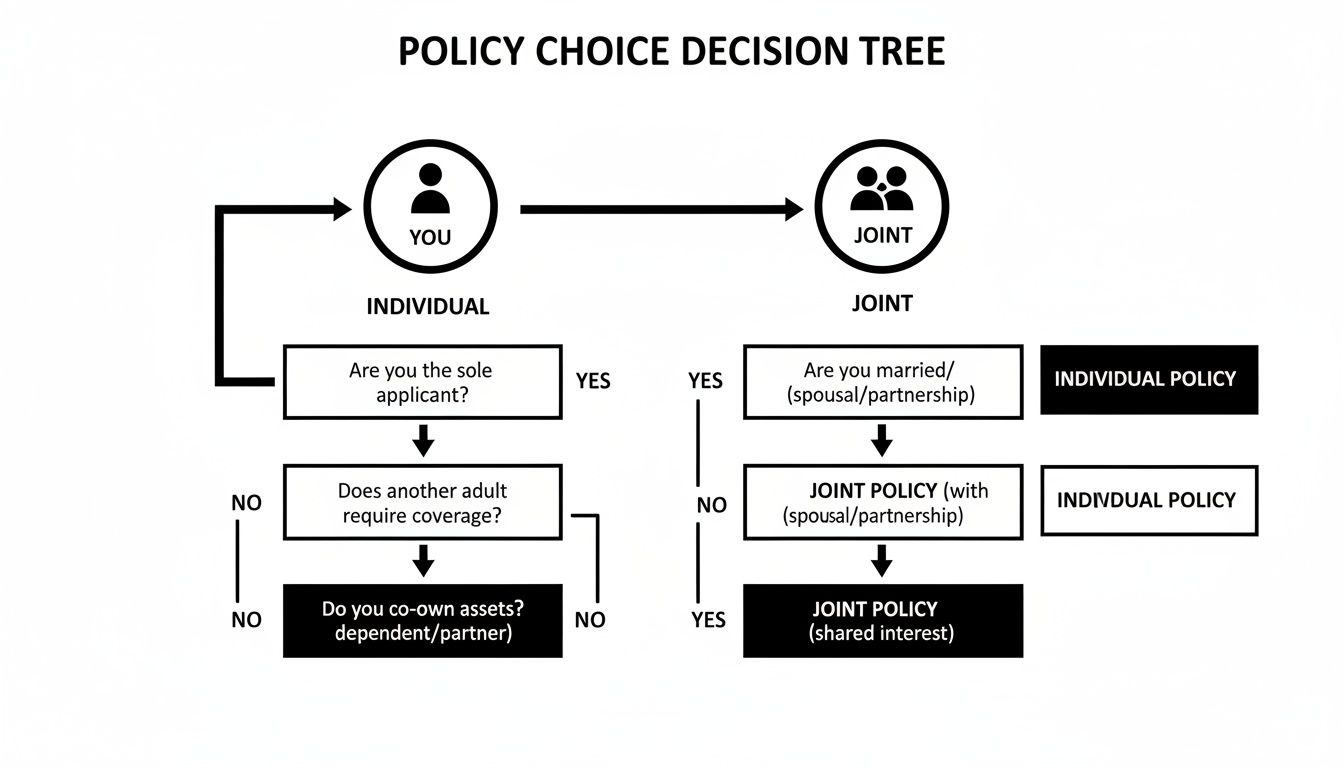
As you can see, the first question is whether you want to cover one person or both, which is the foundation of any family protection plan.
If you go the joint route, there are two main types:
- First-to-Die: This policy covers two people but pays out the death benefit just once—after the first person passes away. It's a common strategy for paying off a mortgage or providing immediate cash for the surviving partner.
- Second-to-Die (Survivorship): This policy also covers two individuals, but it only pays out after both of them have passed away. It’s almost exclusively used for estate planning, creating funds to pay estate taxes or leave a large, tax-free inheritance to heirs.
Deciding between term, whole, universal, or joint life insurance is deeply personal. A family in a high-cost area like Glendale might prioritize the affordability of a term policy to protect their mortgage, while another may be more focused on the legacy-building features of a whole life policy. The right answer always depends on your unique circumstances, and an experienced California insurance advisor can help you weigh the pros and cons to find the perfect fit.
How Much Life Insurance Your Family Actually Needs

Alright, we’ve covered the types of family life insurance. Now for the big question I get from every client: "How much coverage do we actually need?"
It's tempting to grab a number out of thin air. You've probably heard the old "10 times your annual income" rule of thumb. While it's a start, it's far too simple. That advice doesn't account for your family's specific debts, your spouse's earning potential, or the sky-high cost of living and college here in California.
Getting this number right is everything. Too little, and you leave your family vulnerable. Too much, and you're paying for coverage you don't need. The real goal is to build a safety net that fits your family's life perfectly.
A Practical Framework: The DIME Method
To get a much more accurate number, I always walk my clients through a simple framework called the DIME method. It’s not a rigid formula, but a powerful checklist to make sure you don't miss any major financial obligations.
Think of it as the four pillars that will support your family’s financial future if you’re no longer there.
D – Debt I – Income M – Mortgage E – Education
By adding up these four categories, you can move from a rough guess to a solid, personalized estimate of the coverage your family truly requires.
Calculating Your Coverage Step-by-Step
Let's see how this works in the real world. Imagine a family—we'll call them the Millers—living in a California suburb. They have a mortgage, a couple of car loans, and they're determined to give their two kids a college education.
Here's how they'd use the DIME method to figure out their needs.
1. Settle the Debts (D)
First, add up all your non-mortgage debts. These are the bills that would immediately fall on your family's shoulders, like car payments, student loans, and credit card balances. We'll tackle the house payment next.
- Car Loans: $40,000
- Student Loans: $25,000
- Credit Card Balances: $10,000
- Personal Loans: $5,000
Total Debt: $80,000
2. Replace Your Income (I)
Next, think about your paycheck. How many years of your income would your family need to maintain their lifestyle? We typically recommend planning for at least 10 to 15 years. This gives your spouse breathing room to grieve and adapt without immediate financial pressure to find a new or higher-paying job.
- Your Annual Salary: $100,000
- Years to Replace: 10
Total Income Replacement: $1,000,000
3. Pay Off the Mortgage (M)
Your mortgage is almost certainly your biggest liability. By including the full remaining balance in your calculation, you ensure your family has a paid-for roof over their heads, no matter what. This is one of the greatest gifts you can leave them.
- Remaining Mortgage Balance: $550,000
Total Mortgage: $550,000
4. Fund Their Education (E)
Finally, let’s plan for the kids' futures. College isn't getting any cheaper, so it’s crucial to set aside funds for their education. A good starting point is to estimate the future cost for each child.
- Cost per Child: $100,000
- Number of Children: 2
Total Education: $200,000
Putting It All Together for the Miller Family
Now we just add it all up.
- D (Debt): $80,000
- I (Income): $1,000,000
- M (Mortgage): $550,000
- E (Education): $200,000
Total Recommended Coverage: $1,830,000
For the Miller family, a life insurance policy of around $1.8 million creates a comprehensive financial backstop. It’s not an arbitrary number; it’s a figure directly tied to their debts, their income, their home, and their dreams for their children.
This calculation is the perfect starting point for a deeper conversation. When you work with an agent at Mai & Associates, we can use this number to fine-tune your plan, making sure it aligns perfectly with your budget and goals.
More and more families are having these exact conversations. In fact, recent research on insurance market trends highlights a growing demand for policies that provide robust family protection. For instance, in 2025, sales of guaranteed universal life policies grew by 11%. While the average U.S. policy face amount rose to $178,000, many families, like the Millers, realize they need more to cover big-ticket items like a mortgage or college tuition. We've also seen the use of riders for critical illness and long-term care jump by 17%, showing that people want a plan that protects their family from more of life's uncertainties.
What Determines the Cost of Life Insurance in California
After figuring out how much family life insurance you need, the next big question is always, "Okay, but what's this actually going to cost me?" A life insurance premium isn't just a number pulled out of a hat. It's a carefully calculated price based on a handful of key factors that help insurers understand their risk. For families here in California, getting a handle on what drives these costs is the first step toward finding great protection that doesn't break the bank.
It’s clear that families everywhere are recognizing this need. In 2024, the global life insurance market swelled to a staggering $3.1 trillion, with North America leading the charge. Here in the U.S., individual life insurance premiums hit a record $15.9 billion this year. As you can see in this deep dive into life insurance statistics, these aren't just numbers—they represent a fundamental shift where families view life insurance as a core part of their financial foundation.
Core Factors Influencing Your Premiums
Insurance carriers look at your personal profile to figure out your premium. It's a lot like how a bank reviews a loan application—they're gauging the level of risk. The main difference here is that the younger and healthier you are, the better the rate you'll get. It’s that simple.
Here’s what they zero in on:
- Your Age: This is the big one. The younger you are when you buy your policy, the lower your payments will be, and you lock in that rate for the entire term.
- Your Health: Expect questions about your medical background, any current health issues, and even your family's health history. A simple medical exam is usually part of the process to get a clear picture of your health.
- Your Lifestyle: What you do for fun and the habits you keep matter. Things like smoking or enjoying high-risk hobbies (think skydiving or rock climbing) will definitely push your premiums up. A smoker can easily pay 2 to 3 times more than a non-smoker for the exact same coverage.
- Policy Type and Amount: The kind of policy you choose and how big you want the death benefit to be are huge factors. A $500,000 term policy is going to be far more affordable than a $2 million whole life policy.
The best time to buy life insurance is always right now. By locking in a rate while you're young and healthy, you can secure affordable protection for your family for decades, even if your health takes a turn down the road.
Realistic Price Ranges for California Families
So, what does this look like in real dollars? While your situation is unique, we can look at some typical scenarios to give you a ballpark idea. These are estimated monthly costs for a standard 20-year term life insurance policy for a resident of California.
Example Scenarios
- A healthy 35-year-old male looking for $500,000 in coverage can expect to pay around $25 to $40 per month.
- A healthy 35-year-old female with the same $500,000 policy might see rates between $20 to $35 per month.
- Now, if that same 35-year-old male was a smoker, his premium could easily shoot up to $90 to $120 per month.
These examples really highlight how much your age, health, and lifestyle choices can swing the final price.
How to Manage Your Life Insurance Costs
The good news is that you're in the driver's seat. You have more control over the cost than you might think, and even small, positive changes can add up to serious long-term savings.
Here are a few practical steps you can take:
- Improve Your Health Habits: If you're a smoker, quitting is the single most powerful thing you can do to lower your rate. Getting your weight, blood pressure, and cholesterol in check will also help you qualify for a much better price.
- Choose the Right Term Length: Don't overbuy. A good rule of thumb is to match your policy's term to your longest financial responsibility, whether that's your 30-year mortgage or the 20 years until your youngest child is out of college.
- Work With an Independent Agent: An agent at Mai & Associates is on your team, not the insurance company's. We shop the entire market for you, comparing rates from dozens of top-rated carriers to find the most competitive pricing for your specific needs, whether that's for your car insurance, home insurance, or family life insurance plan.
Real-Life Scenarios for Family Life Insurance

Theory is one thing, but seeing how family life insurance works in the real world is where it all clicks. The numbers and policy types really come to life when we apply them to situations that California families face every day.
Let's walk through a few common examples. You’ll probably see a little of your own family in one of them.
The New Parents and Their First Home
Meet David and Maria, a young couple who just stretched to buy their first house in a Los Angeles suburb. They've got a new baby and a $650,000 mortgage hanging over their heads. Their biggest worry? If one of them were to pass away, the other would be left struggling with house payments, let alone saving for their child’s future.
- The Challenge: They needed a budget-friendly way to cover a massive mortgage and lock in future college funds.
- The Solution: We set them up with two separate 30-year term life insurance policies. David, as the primary earner, took out a $1.5 million policy. Maria got a $750,000 policy. The 30-year term was no accident—it's timed to vanish right around the time their mortgage is paid off. The coverage gives them enough breathing room to clear the house debt, replace years of lost income, and seed a college fund.
This strategy gave them powerful protection precisely when their financial risk is at its peak. It’s peace of mind, knowing a personal tragedy won't become a financial one.
The Single-Income Household
Now, think about Sarah, a software engineer in San Jose. She’s the sole breadwinner for her family, supporting her husband and their two kids. Her income is the engine that keeps everything running—the rent, the car insurance, the groceries. If her paychecks stopped, their financial world would grind to a halt.
For a single-income family, the breadwinner's life insurance policy isn't just a part of the financial plan—it is the financial plan. It serves as the ultimate backup, guaranteeing that the family's world doesn't stop if their income does.
- The Challenge: Sarah needed to create a safety net that could completely replace her income, allowing her family to maintain their lifestyle without her.
- The Solution: Sarah opted for a $2 million, 20-year term policy. We calculated this amount to do more than just pay bills. It would replace her income for over a decade, cover both kids' college tuition, and give her husband the freedom to focus on raising their children without the immediate, crushing pressure to find a new job.
The Stay-at-Home Parent
Finally, let’s talk about Mark. He's a stay-at-home dad in San Diego while his wife pursues a demanding career. Mark doesn't bring in a paycheck, but the value he creates is enormous. Childcare, cooking, cleaning, coordinating schedules—if they had to pay someone to do all that, it would cost tens of thousands of dollars a year.
- The Challenge: They had to insure the huge, non-salaried economic value Mark contributes to the family every single day.
- The Solution: Mark took out a $500,000 life insurance policy on himself. If he were to pass away, that death benefit would give his wife the funds to hire the help she'd need—a nanny, a cleaning service, you name it. This allows her to keep her career on track instead of being forced to cut back hours or even quit her job to manage the household. It’s a powerful way to acknowledge that a stay-at-home parent's contribution is anything but free.
These stories aren't just hypotheticals; they’re the conversations we have every day. They prove there’s no one-size-fits-all answer. The best family life insurance strategy is the one built around your specific debts, goals, and people. At Mai & Associates, our licensed agents excel at helping California families find the right fit—for their life and their budget.
What's Next? Securing Your Family's Future
We've covered a lot of ground, from the different types of family life insurance to figuring out how much coverage you actually need. Now it’s time to put that knowledge into practice.
Taking this next step is one of the most powerful things you can do for your family. It's not just about buying a policy; it's about building a financial foundation that ensures they'll be taken care of, no matter what happens down the road.
A Simple Path to Peace of Mind
Getting the right coverage doesn't have to be overwhelming. We've helped countless California families navigate this process, and it really boils down to three straightforward steps.
Here’s how you can move forward with confidence:
- Run the Numbers: Start by using the DIME method we walked through earlier. This will give you a solid, personalized estimate of your family's needs and a great starting point for any conversation.
- Get Real Quotes: The best way to see what's possible is to look at actual numbers. Getting a quote shows you exactly what top-rated insurance carriers can offer for your specific situation, without any guesswork.
- Talk to an Expert: Schedule a quick chat with a licensed agent here at Mai & Associates. We'll go over your DIME estimate, compare the quotes you've received, and help you pinpoint the perfect policy that fits both your budget and your family's goals.
Securing your family's future with the right life insurance is one of the most impactful financial decisions you will ever make. It provides immediate peace of mind and long-term stability, ensuring your loved ones are protected no matter what.
Getting an expert's perspective is invaluable when you're looking at life insurance in California. A good agent can help you see the big picture, making sure all your policies—from car insurance to home insurance—work together to create a complete California insurance safety net.
You can start the process right now by getting a personalized insurance quote from our team. It’s a simple first step toward lasting security for the people who matter most.
Common Questions We Hear About Family Life Insurance
When you start looking into family life insurance, a lot of questions come up. It's completely normal. We've talked with hundreds of California families, and a few key concerns pop up time and time again. Let’s walk through them.
I’m Young and Healthy. Do I Really Need Life Insurance Now?
This is probably the most common question we get, and it makes perfect sense. But the truth is, this is the absolute best time to buy life insurance. The reason is simple: you'll get the lowest possible price.
Think of it like locking in an unbelievably low rent on a great apartment for the next 20 or 30 years. By getting a policy when you're in good health, you secure that affordable rate for the entire term. If you wait, you'll pay a lot more for the exact same coverage later on, and you risk a change in your health making it even more expensive—or harder to get.
Can I Get Coverage If I Have a Pre-Existing Health Condition?
Yes, you absolutely can. Having a condition like diabetes, high blood pressure, or a past health scare doesn't automatically disqualify you. It might mean your premiums are a bit higher, but you definitely have options.
The key is knowing which insurance carrier to go to. Some companies are much more understanding about certain conditions than others. This is where working with an independent agent at Mai & Associates really pays off. We know the California insurance market inside and out and can shop around to find the insurer that will give you the most favorable review, saving you the time and stress of trying to figure it out alone.
What Happens If Our Family's Needs Change?
Your life isn't static, so your life insurance shouldn't be either. The policy you need today to cover a mortgage and diapers will look very different from the one you need in 15 years when the kids are heading off to college.
Your life insurance policy should be a living document that adapts to your family’s journey. Regularly reviewing your coverage ensures it continues to meet your needs, protecting what matters most as life evolves.
Fortunately, policies are built to be flexible. Many term policies have a conversion option, allowing you to switch to a permanent policy later without another medical exam. You can also layer policies or adjust your coverage as your income grows or your debts shrink. If you come across terms like "conversion" or "rider" and want a quick explanation, our insurance glossary is a great resource.
The best practice? A quick annual check-in with your agent. It’s the easiest way to make sure the protection you have for life insurance, auto insurance, and home insurance is still the protection you need.