Fair Plan Homeowners Insurance: California's Only Option?

A FAIR Plan policy covers only named fire-related risks, including fire and lightning, so it's incomplete homeowners insurance that most California homeowners must supplement. By June 2026, the plan covered 696,562 policies and carried $768 billion in exposure, showing how many households now depend on this limited safety net.
You may be facing that decision after a nonrenewal, a wildfire-risk denial, or a quote that suddenly disappeared from the private market. The FAIR Plan can keep your lender satisfied and provide a basic layer of protection, but it isn't the same as a standard home insurance policy. The practical solution is usually a layered program that combines FAIR Plan coverage with private policies or endorsements for the risks the basic plan leaves out.
What Is the California FAIR Plan and Who Is It For
A homeowner in a foothill community receives a nonrenewal notice before wildfire season. Several private insurers decline the property, even though the roof is maintained and vegetation has been cleared. The family still needs coverage, but the voluntary market no longer accepts the risk.
The California FAIR Plan serves as California's insurer of last resort for property owners who cannot obtain coverage from private carriers. FAIR means Fair Access to Insurance Requirements. Established in 1968 after the Watts riots and brush fires of the 1960s, the plan provides basic property protection when insurers decline a home.
The FAIR Plan operates as a pooled program backed by all property insurers licensed in California. Private carriers write most homes, while the plan accepts properties they decline. That shared structure keeps a basic route to coverage open for owners facing wildfire-related underwriting barriers.
A safety net, not a first choice
The plan's role becomes clearer when you separate access from coverage breadth. It may provide a basic fire policy for a property that private insurers reject, but it does not automatically address theft, water damage, or personal liability. A homeowner may therefore need separate private policies or endorsements to complete the protection package.
The California Department of Insurance says the plan covers fewer than 3% of residents, leaving a competitive market option for more than 97%. Residential policies still rose from 202,987 in 2020 to 451,799 in 2024, more than doubling during that period, according to the California Department of Insurance FAIR Plan overview.
That growth helps explain why a FAIR Plan policy is rarely a complete solution. It functions more like one layer of a roof than the entire house. The FAIR Plan may address named fire risks, while a private policy can help cover other property losses and liability.
Owners comparing a private policy, FAIR Plan coverage, or a combination can review this guide for California homeowners in fire zones before applying. An agency familiar with high-risk properties can also explain California home insurance options and help identify which gaps require separate coverage.
Understanding FAIR Plan Coverage Limits and Exclusions
The key distinction is simple: the FAIR Plan is generally a named-peril policy. That means the contract covers only the causes of loss specifically listed in it. A standard homeowners policy often provides broader protection, while the FAIR Plan starts with a narrow list.
The basic residential policy covers:
- Fire: Damage caused by a covered fire.
- Lightning: Direct damage from lightning.
- Internal explosion: Certain explosions occurring inside the insured property.
- Smoke: Smoke damage connected to a covered cause.
The California Department of Insurance residential coverage guidance confirms that the residential FAIR Plan policy covers fire, lightning, internal explosion, and smoke, but doesn't include liability or burglary coverage.
What the basic policy leaves open
Suppose a visitor slips on your front steps and asks you to pay medical costs. Or a burglar takes electronics from the house. Or a supply line breaks under the kitchen sink and ruins cabinets and flooring. Those events may create serious financial obligations, but they aren't automatically covered by the basic FAIR Plan policy.
The main gaps include:
| Risk | Basic FAIR Plan treatment |
|---|---|
| Fire and lightning | Covered named perils |
| Internal explosion and smoke | Covered named perils |
| Personal liability | Not included |
| Burglary and theft | Not included |
| Water damage | Not included in the basic fire policy |
| Wind, hail, and some other risks | May require an endorsement |
| Earthquake | Requires separate consideration |
This doesn't mean every possible addition is unavailable. California regulators note that optional endorsements can add extended coverage for windstorm, hail, explosion, riot or civil commotion, aircraft, vehicles, and volcanic eruption, along with vandalism and malicious mischief. The endorsement changes the policy's protection, but it doesn't turn the FAIR Plan into a standard all-purpose homeowners policy.
Practical rule: Read the policy as a list of covered causes, not as a promise to cover anything that happens to the house.
Property owners should also think beyond the building. Businesses that work around homes, such as window-cleaning contractors, need their own liability protection, and this insurance guide from Aloha Window Bros illustrates why liability questions matter in everyday property-related work. For personal policy questions, a California insurance FAQ can help identify issues to raise with an agent.
How to Supplement Your FAIR Plan Policy
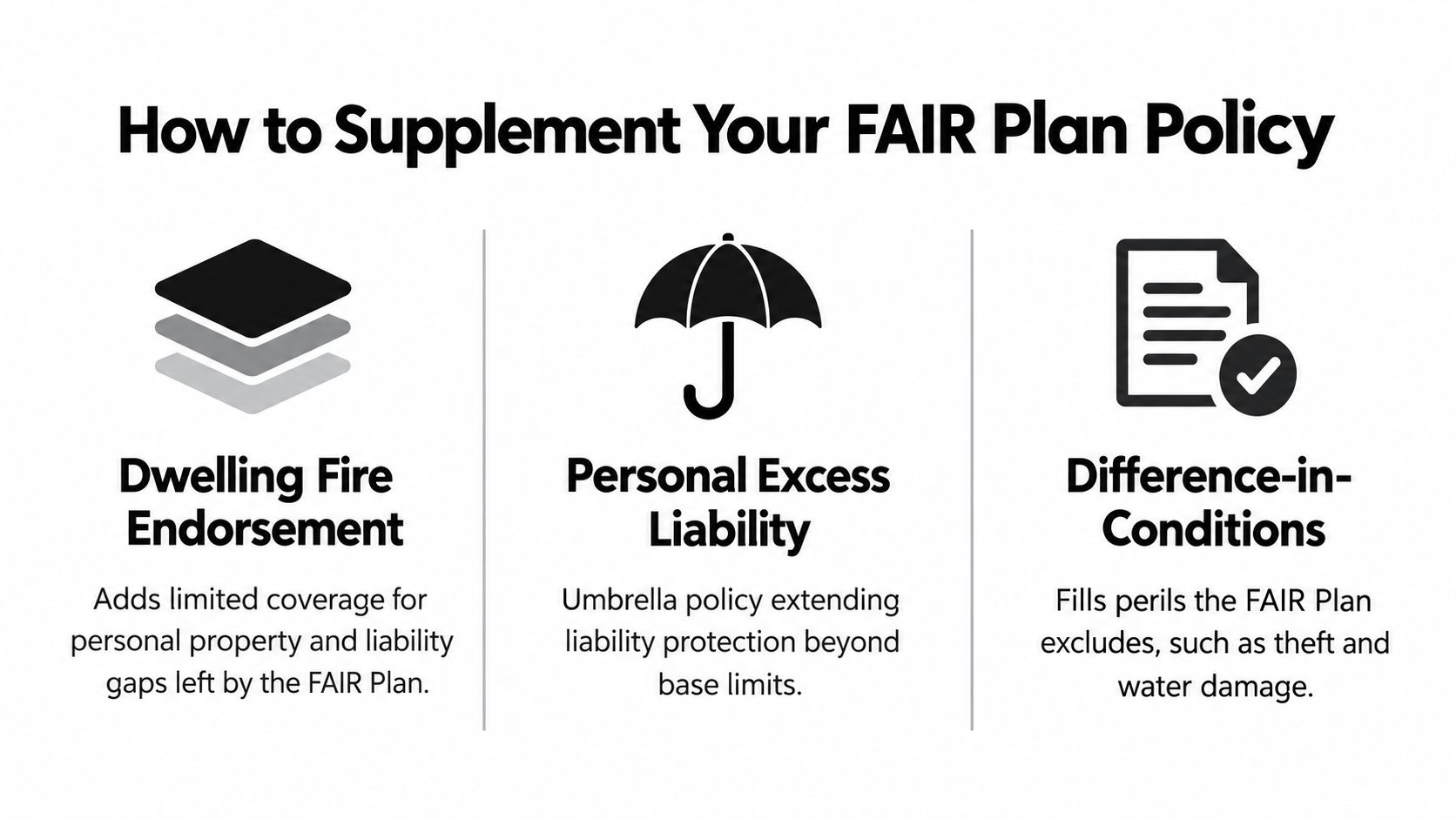
The most useful way to view FAIR Plan homeowners insurance is as the first layer, not the entire protection plan. You might use the FAIR Plan for the covered fire risk, then add separate coverage for liability, theft, water damage, personal belongings, or other causes of loss.
Start with the options attached directly to the FAIR Plan. California regulators identify endorsements for risks such as windstorm, hail, explosion, riot or civil commotion, aircraft, vehicles, volcanic eruption, vandalism, and malicious mischief. These additions can close certain gaps, but they only address the risks named in the endorsement.
Compare the layers before you buy
FAIR Plan dwelling coverage protects against the basic covered fire perils. It gives you a foundation for the structure, subject to the policy terms and limits.
Optional FAIR Plan endorsements add selected perils. For example, an endorsement may address windstorm, hail, or vandalism. The important question is whether the endorsement fills a risk you face and whether its exclusions still leave a meaningful gap.
A separate Difference-in-Conditions policy can provide broader protection for risks such as theft and water damage, along with liability and other homeowners-style coverage, depending on the policy. It's designed to work beside the FAIR Plan rather than replace its fire layer.
Separate earthquake coverage deserves individual attention. Earthquake protection isn't part of the basic FAIR Plan fire policy, so homeowners in earthquake-prone areas should ask whether a standalone policy or another supplemental structure is appropriate.
Build the program around real scenarios
Consider three claims:
- A wildfire damages the home. The FAIR Plan is the first policy to examine because fire is one of its named covered perils.
- A pipe bursts while the family is away. The basic FAIR Plan doesn't provide the same water-damage protection as a broader homeowners policy, so a supplemental policy may be necessary.
- A guest alleges that unsafe property conditions caused an injury. The basic FAIR Plan doesn't include personal liability, making a separate liability layer important.
The goal isn't to buy every available add-on. It's to map each major exposure to a policy that responds. Ask whether the structure, personal property, liability, temporary living costs, water damage, theft, and earthquake risks are each addressed somewhere in the program.
Coverage should work like a coordinated team. One policy handles the covered fire risk, another handles excluded everyday losses, and you verify that the limits and exclusions don't conflict.
Steps to Get a FAIR Plan Review and Quote
A FAIR Plan application becomes easier when you gather the property information first. You'll want details about the home's location, occupancy, construction, roof, condition, and existing insurance history. The purpose is to help the agent or plan evaluate the property accurately and identify whether a private carrier remains available.
Follow a practical sequence
Search the voluntary market first. The FAIR Plan is intended for properties that can't obtain coverage through ordinary insurers. Ask a licensed agent to check available private options before moving to the residual market.
Document the difficulty obtaining coverage. Keep nonrenewal notices, declination messages, and details from insurer conversations. These records help explain why you're seeking a FAIR Plan policy.
Describe the property accurately. Include whether the home is owner-occupied, rented, seasonal, or part of a small multi-unit building. The FAIR Plan serves owner-occupied 1–4 unit dwellings, seasonal rentals, and rentals leased for at least one year, according to the California FAIR Plan dwelling policy information.
Estimate rebuilding needs, not sale price. The amount needed to rebuild can differ from the property's market value. Ask how labor, materials, local access, and specialized construction affect the dwelling limit.
Request a coverage review with the quote. Don't stop after receiving the FAIR Plan price. Ask which exclusions remain and what endorsements, Difference-in-Conditions coverage, liability insurance, or earthquake protection could address them.
Check the final documents. Confirm the named insured, property address, occupancy, limits, deductibles, covered perils, endorsements, and payment schedule before accepting the policy.
You can start the conversation through a California insurance quote request. A quote is only the beginning. The review matters because a low-looking premium may reflect a policy that covers a much narrower set of events.
How Mai and Associates Can Help Californians
Choosing FAIR Plan homeowners insurance often requires more than submitting one application. A homeowner may need a private home policy, FAIR Plan coverage, supplemental property protection, earthquake insurance, and personal liability coverage. These policies work like layers: the FAIR Plan may address a narrow group of property risks, while other policies can help cover gaps that would otherwise remain the homeowner's responsibility.
Mai & Associates is a licensed California insurance agency that reviews home insurance needs, including FAIR Plan placement, earthquake options, and wildfire-related protection strategies for higher-risk properties. Its agency information and insurance services can help homeowners understand which parts of their protection belong in one policy and which may require separate coverage.

What a policy review should identify
A useful review begins with the property and household rather than a preset package. An agent can help examine:
- The dwelling limit: Does it reflect the expected cost to rebuild the structure?
- The named perils: Which losses does the FAIR Plan cover, and which require an endorsement or separate policy?
- Personal property: Where are belongings insured, and do category limits or exclusions apply?
- Liability: Which policy responds if someone is injured or their property is damaged?
- Displacement costs: Would another policy help pay for temporary living arrangements after a covered loss?
- Earthquake and wildfire exposure: Are these risks addressed through separate coverage or mitigation planning?
- Other household policies: Do auto, renters, or life policies need review alongside the property plan?
The goal is to prevent the FAIR Plan quote from becoming the entire insurance strategy. An agent can compare available options, explain whether an endorsement addresses a specific gap, and identify when a separate policy is needed. For example, a FAIR Plan may protect the building against covered fire damage, while another policy handles liability or belongings.
The same agency can also review auto, renters, and life policies, which matters when a household wants property and financial protection assessed together. This broader review helps connect separate decisions without treating every policy as interchangeable.
Why Relying Solely on the FAIR Plan Is Risky
A wildfire can damage the structure, while a stolen laptop, burst pipe, or injured visitor creates a separate bill. A FAIR Plan policy may address the first problem, but it is not designed to handle every risk tied to owning a home. The state FAIR Plan consumer information describes coverage for fire, lightning, internal explosion, and smoke, while liability and burglary coverage remain outside the basic policy.
That makes the FAIR Plan one layer of protection rather than a complete insurance strategy. Picture the policy as a roof over the dwelling. Other policies or endorsements may be needed to protect the contents beneath it, respond to injuries, address water damage or theft, and help with temporary living costs after a covered loss. Without those layers, the homeowner may need to pay uncovered expenses personally.
The plan's growth also shows why households should review how each policy fits. Exposure rose from $599 billion in March 2025 to $768 billion by June 2026, according to the California Assembly FAIR Plan hearing presentation. A larger safety net does not change the basic policy's narrow purpose.
Before calling coverage complete, list each major risk, including fire, water damage, theft, liability, earthquake, and displacement. Then identify the policy that responds to each one. Mai & Associates can review FAIR Plan coverage alongside home, earthquake, auto, renters, car, and life insurance. Visit Mai & Associates to discuss a layered approach.