Extended Dwelling Coverage A California Homeowner's Guide
You buy a home in California, set up your policy, and assume the dwelling limit on the declarations page means you're covered. Then a major fire moves through the area, contractors get booked out, material prices jump, permits slow everything down, and the rebuild estimate comes back higher than the amount your policy lists for the house itself.
That gap is where many homeowners get blindsided.
Extended dwelling coverage is one of the simplest ways to reduce that risk. It doesn't make a policy magical, and it doesn't replace the need for a good Coverage A limit. What it does is add room above that limit when rebuilding costs run past the original estimate.
Why Your California Home Insurance Might Not Be Enough
A lot of California homeowners only discover the weak spot in their policy after a serious loss. They look at their declarations page, see a dwelling limit, and assume that number will carry them all the way through reconstruction. In calm markets, that assumption may feel reasonable. In California, it often isn't.
A wildfire is the clearest example. One house burns, and it's tragic. A whole neighborhood burns, and the local rebuilding economy changes overnight. Contractors are in demand, materials get harder to secure, and every part of the process costs more than it did when the policy was first written.
The gap most people don't see
A 2023 Policygenius survey on home insurance inflation found that 80% of U.S. homeowners lacked extended replacement cost coverage, including those who weren't sure whether they had it, and only 14% had raised dwelling limits or added key coverages in the prior year. That's a big warning sign for anyone who hasn't reviewed their policy recently.
Many readers first start asking these questions after handling a smaller claim, like a leak behind a wall or a burst pipe that leads to repairs in several rooms. If you're trying to understand the difference between what home insurance may cover in a plumbing-related loss and what it won't, this guide on how your homeowners insurance covers plumbing is a useful companion read.
Standard home insurance can be solid and still leave a rebuilding shortfall if local costs spike after the loss.
Why this matters more in California
California homeowners face a harder insurance market than many other states. Coverage terms matter more. Endorsements matter more. Reviews matter more. That's especially true if your home sits near brush, canyon, or hillside areas where wildfire exposure affects both availability and pricing.
If you want to understand the broader structure of California home insurance options, start there. Then come back to the specific add-on that often separates a manageable rebuild from a financially painful one.
Extended dwelling coverage exists for the moment when the original estimate stops being enough.
Understanding Extended Dwelling Coverage Simply
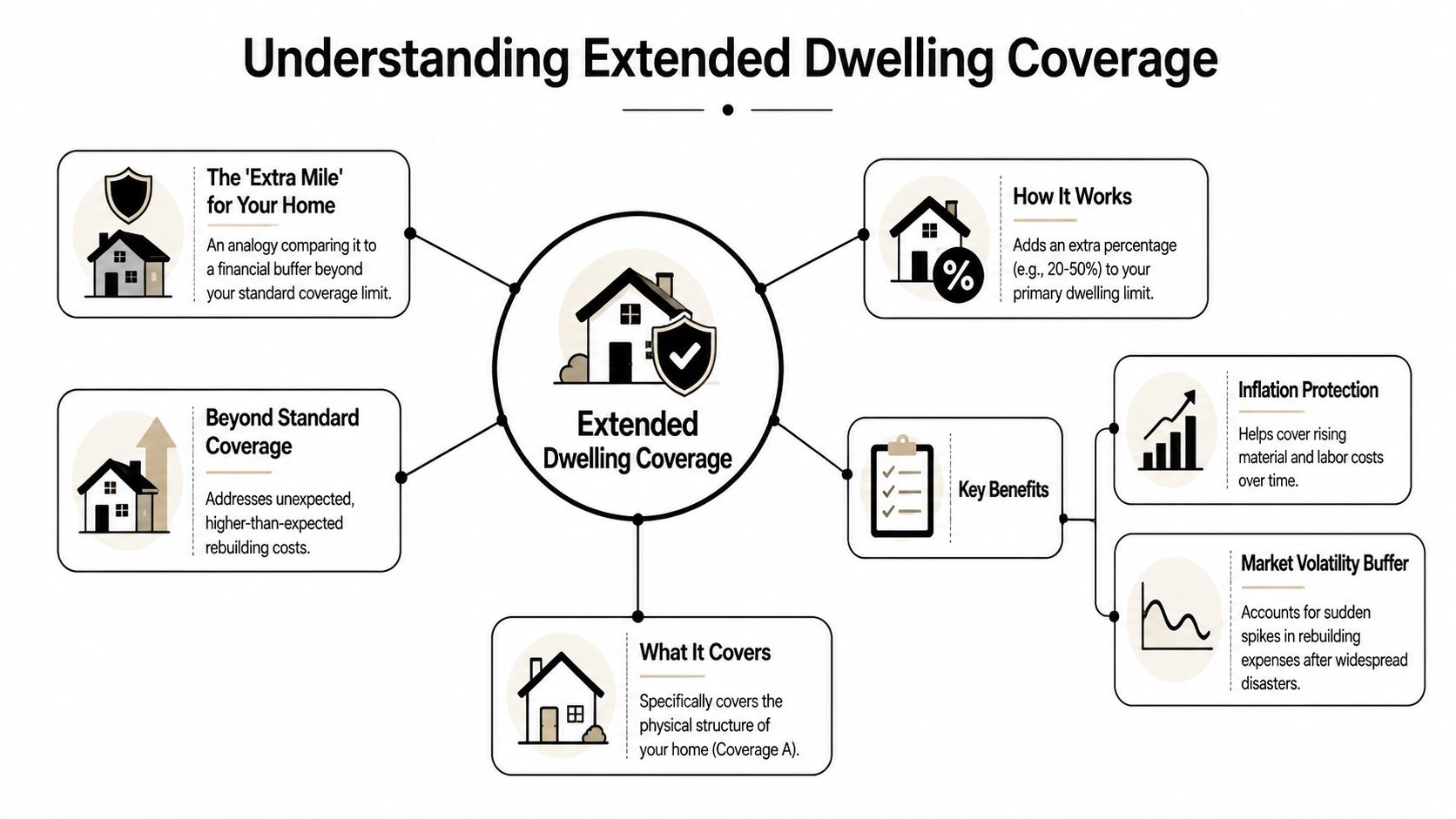
Think of your dwelling limit as the main balance in a rebuilding fund. Extended dwelling coverage works like a built-in cushion above that balance. If the covered rebuild runs over the original amount, that extra layer may be available to help absorb the overrun.
That doesn't mean it covers everything under every circumstance. It means the policy can reach beyond the base dwelling cap when the cost to rebuild the insured structure comes in higher than expected.
What it is in plain English
Extended dwelling coverage is an endorsement added to a homeowners policy. According to this explanation of extended replacement cost from F&O Agency, it's typically offered at 10% to 50% above the base dwelling amount. The same source gives a simple example: a home with a $400,000 dwelling limit and 25% extended coverage can have $500,000 available for a rebuild.
That extra amount is there for the house itself, not for every category on the policy. It applies to the dwelling portion, often labeled Coverage A.
When the extra coverage matters
Homeowners usually get confused on one point. They ask, "If my policy already says replacement cost, why would I need anything more?"
Because replacement cost still works within a limit.
If your policy says the home is insured up to a stated dwelling amount, that's the main cap. Extended dwelling coverage adds a defined percentage above that cap when rebuilding costs rise because of things like:
- Material price increases: Lumber, roofing, drywall, and finish materials can cost more by the time repairs begin.
- Labor shortages: After a regional disaster, skilled crews may charge more or have less availability.
- Demand surges: When many people rebuild at once, local construction pricing can jump quickly.
A quick example
Let's keep it simple.
- Base dwelling limit: $400,000
- Extended dwelling coverage: 25%
- Maximum available for rebuild: $500,000
If the final covered rebuild cost lands above the original $400,000 but within that higher maximum, the endorsement can help close the gap.
Practical rule: Extended dwelling coverage doesn't replace accurate insurance. It gives accurate insurance a margin for real-world cost spikes.
If some of these terms still feel slippery, a plain-language insurance glossary can help decode labels like Coverage A, replacement cost, and endorsement.
Extended vs Standard vs Guaranteed Replacement Cost
Three terms often get blended together, and that creates bad assumptions at claim time. Standard replacement cost, extended dwelling coverage, and guaranteed replacement cost all aim to help rebuild a home, but they don't promise the same thing.
The easiest way to understand them is to focus on where the cap sits.
The fixed cap option
With standard replacement cost, the insurer agrees to pay the cost to rebuild the home with materials of like kind and quality, up to the dwelling limit shown on the policy. If that limit is too low when the loss happens, the homeowner may have to cover the difference.
This is the version many homeowners think they have fully understood when they really haven't. They hear "replacement cost" and mentally translate it to "whatever it takes." That's not always how it works.
The buffer option
With extended dwelling coverage, the policy still starts with a dwelling limit, but it adds a built-in layer above that amount. This is the middle ground. It recognizes that a home can be properly insured at the time the policy is written and still run into trouble later if the rebuild market changes.
For many California homeowners, this is the practical sweet spot. It isn't unlimited, but it gives breathing room.
The broadest option
With guaranteed replacement cost, the idea is broader protection for rebuilding even if costs exceed the original insured amount. In plain terms, this is the most expansive form of protection in the comparison.
Homeowners should be careful here. Availability can vary a lot, and policy conditions matter. Some people assume they have this level of protection when they have standard replacement cost with no extension. Others have heard the term from a neighbor and assume it's common. It often isn't.
Home Insurance Dwelling Coverage Comparison
| Coverage Type | What It Covers | Pros | Cons / Risks |
|---|---|---|---|
| Standard replacement cost | Rebuilds the home up to the dwelling limit on the policy | Simple structure, often easier to understand at first glance | The policy can stop at the stated limit if rebuilding costs rise above it |
| Extended dwelling coverage | Rebuilds up to the dwelling limit plus the added endorsement amount | Adds a financial buffer when labor or material costs climb unexpectedly | It's still capped. If the extension is too small, a shortfall can remain |
| Guaranteed replacement cost | Broader rebuilding protection beyond the original dwelling amount, subject to policy terms | Strongest protection in this group | May be harder to find, more restrictive, or more expensive depending on carrier and property |
How to tell what you actually have
Pull out the declarations page and endorsements, not just the billing summary. Look for wording that specifically refers to extended replacement cost, extended dwelling coverage, additional replacement cost, or guaranteed replacement cost.
If you don't see clear language adding coverage above the dwelling limit, don't assume it's included.
If your policy language isn't clear to you in two minutes, it's worth asking your agent to point to the exact endorsement by name.
A lot of confusion comes from marketing language. A policy can say it offers replacement cost on the dwelling and still leave you with a hard cap. That's why the label matters less than the endorsement wording.
California Insurance Risks Wildfires and Rebuilding Costs
California puts unusual pressure on home insurance because the risk isn't only the loss itself. It's also the rebuilding environment that follows. A fire, earthquake, or widespread storm event can create a traffic jam of repairs, inspections, permits, and contractor demand all at once.
That's the setting where extended dwelling coverage starts to make practical sense.

Why California losses get complicated fast
Wildfires change pricing quickly because many homes can need rebuilding in the same region. Earthquakes can create a different kind of strain, with structural experts, engineers, and specialty contractors all entering the picture. Mudslide and post-fire slope issues can add more complexity depending on the location.
Even architectural style matters. Homes with custom details, hillside design constraints, or region-specific building demands can be harder and slower to rebuild. For a local example of how design and site conditions shape reconstruction difficulty, this look at Fountaingrove's architectural challenges helps explain why rebuild pricing isn't always straightforward.
California law gives homeowners time
A major loss rarely moves in a straight line. People are displaced. Debris removal takes time. Plans have to be approved. Contractors may not be available when you need them.
California gives homeowners an important protection here. According to this discussion of California rebuilding timelines after wildfire losses, insurers must allow a minimum of 36 months from the date of loss for homeowners to collect full replacement or extended coverage benefits, and that period can be extended when delays are outside the homeowner's control.
That matters because a policy benefit isn't very useful if the rebuild stalls and the time window closes before work can progress.
How this fits with other California coverage choices
Extended dwelling coverage doesn't replace earthquake insurance. It doesn't replace a FAIR Plan policy. It doesn't replace ordinance or law coverage. It sits beside those decisions.
Think of California protection in layers:
- Home insurance: Covers the dwelling and other property interests named in the policy.
- Extended dwelling coverage: Adds room above the dwelling limit when covered rebuilding costs exceed the original number.
- FAIR Plan and companion policies: May be part of the solution in higher-risk areas where standard market options are limited.
- Earthquake coverage: Addresses a separate hazard that standard homeowners insurance typically handles differently.
- Auto, renters, and life insurance: Protect the rest of the household's financial stability while the home remains the anchor asset.
A strong insurance plan in California isn't one policy. It's a set of protections that work together when life gets messy.
Deciding If You Need This Extra Home Protection
Some homeowners absolutely need extended dwelling coverage. Others may have enough margin elsewhere, or they may be weighing it against other policy priorities. The best way to decide is to pressure test your own situation.
Start with a blunt question. If your home had a major covered loss this year, how confident are you that the dwelling number on your policy still matches what it would cost to rebuild in your part of California?
Questions worth asking yourself
- Where is the home located: If you live near brush, foothills, canyon areas, or neighborhoods that face high wildfire exposure, rebuilding conditions can get expensive quickly after a regional event.
- How old is your dwelling estimate: If the limit was set a while ago and hasn't been carefully reviewed, it may not reflect current construction realities.
- Have you improved the home: Kitchen upgrades, built-ins, custom finishes, room additions, and major remodels can all change rebuild cost.
- Would a gap hurt your finances: Some homeowners could absorb an overrun. Many can't. The larger the risk to your savings, the more valuable a buffer becomes.
Signs this add-on deserves a close look
A homeowner should pay extra attention if any of these sound familiar:
- You rely on a California FAIR Plan setup: Complex policy structures often need careful review so the dwelling amount and endorsements work together.
- Your home has custom or non-standard features: Specialty materials and design details usually don't get cheaper after a catastrophe.
- You've focused on monthly premium first: That's understandable, but it can leave hidden weak spots in dwelling protection.
- You haven't compared the dwelling limit to today's rebuild reality: Market value and rebuild cost are not the same thing.
A simple way to think about it
Extended dwelling coverage is less about pessimism and more about margin. A homeowner doesn't buy it because disaster is guaranteed. They buy it because estimates can be wrong, prices can move, and California rebuilds rarely happen under ideal conditions.
If you read your policy and feel a little uneasy about whether the dwelling limit leaves enough room, that's already useful information. Insurance decisions don't have to be driven by fear. They should be driven by whether your current numbers still make sense.
Calculate Your Needs and Get a California Insurance Quote
You don't need to be an insurance professional to do a first-pass review of your own policy. You do need to know where to look and what questions to ask.
The starting point is your declarations page. Find the line for the dwelling itself, often listed as Coverage A. That's the base amount the policy sets aside for rebuilding the house.

Step one, identify your current numbers
Before making any changes, gather:
- Your dwelling limit from the declarations page.
- Any endorsement language that mentions extended replacement cost or extended dwelling coverage.
- Recent home changes such as remodels, additions, or upgrades.
- Policy structure details if your coverage includes a FAIR Plan and companion coverage from another carrier.
This doesn't replace a professional estimate, but it gives you a clean starting point.
Step two, check whether the buffer is reasonable
A useful way to think about the endorsement is cost versus added protection. According to Enders Insurance's explanation of extended dwelling coverage, adding 25% extended dwelling coverage typically raises the total homeowners premium by less than 10%, while serving as an inflation hedge against reconstruction cost spikes that can exceed the original estimate.
That doesn't mean every home needs the same extension. It does mean the added premium is often modest compared with the size of the potential coverage gap.
Small premium changes can buy a large amount of breathing room when a rebuild estimate moves after the loss.
Step three, ask better quote questions
When you request quotes or a policy review, don't stop at "What's the price?" Ask:
- How was the dwelling amount calculated
- Is extended dwelling coverage available on this policy
- What percentage extension is offered
- Does the home's location affect the recommendation
- How would this work with a FAIR Plan arrangement if I have one
If you're ready to request a California insurance quote, bring those questions with you. They matter just as much as the premium.
Step four, review your whole protection picture
A home policy shouldn't sit in isolation. California households often save money and reduce coverage gaps by reviewing all major policies together, including home insurance, auto insurance, renters insurance for family members who don't own, car insurance for household drivers, and life insurance for income protection.
That broader review won't change what extended dwelling coverage does. It helps you decide how this endorsement fits into your total insurance budget.
Sample Claim Scenarios A Tale of Two Homeowners
The value of extended dwelling coverage gets clearer when you compare outcomes instead of definitions. Consider two California homeowners with similar houses in a high-risk area. Both suffer a major covered wildfire loss. Both want to rebuild in the same community.
Their paths separate when the final rebuilding price comes in above the original dwelling amount.

Homeowner one had the buffer
The first homeowner carried a policy with a base dwelling limit and a large extension above it. After the wildfire, local contractors were overwhelmed. The estimate that once looked solid became inadequate due to shifts in labor demand, scheduling delays, and material pricing.
Because the policy included extended dwelling coverage, there was room above the original amount. That didn't make the process easy. Rebuilding was still stressful, and paperwork still mattered. But the homeowner wasn't forced into immediate choices like draining savings, borrowing against retirement, or scaling down the rebuild just to fit the old number.
The family could focus on decisions that mattered, such as contractor quality, timeline, and design consistency with the original home.
Homeowner two hit the cap
The second homeowner had standard replacement cost only. The base limit looked fine when the policy was issued. After the loss, it wasn't enough.
That creates a different kind of claim experience. Instead of asking, "When can construction start?" the homeowner starts asking, "How big is the shortfall?" Then come the harder questions. Can we cover the difference ourselves. Do we rebuild smaller. Do we take on debt. Do we leave features out and hope to add them back later.
The practical difference
Both homeowners paid premiums. Both had insurance. Only one had enough flexibility built into the dwelling coverage to absorb a cost surge.
That difference often shows up in everyday language, not legal language:
- The protected homeowner says: "The claim was difficult, but we could rebuild."
- The underinsured homeowner says: "Insurance helped, but we still came up short."
Coverage gaps don't feel theoretical after a total loss. They feel like design cuts, emergency loans, and years of financial catch-up.
The point isn't that extended dwelling coverage solves every problem. It doesn't. The point is that two similar claims can end in very different financial realities depending on whether the policy gave the dwelling limit enough room.
Your Top Questions on Extended Dwelling Coverage Answered
Homeowners usually understand the basic idea once they see the examples. The lingering questions are more specific. That's where the details start to matter.
Does extended dwelling coverage only help after a catastrophe
No. It can also matter on smaller covered rebuild situations if the cost to repair or reconstruct the dwelling goes beyond the original limit because prices have climbed since the policy amount was set. According to GSP Insurance's explanation of extended replacement cost coverage, U.S. building costs were rising around 7.5% annually in 2025, and the article notes that this coverage can help protect homeowners from out-of-pocket costs on smaller claims when chronic inflation has outpaced the policy's original dwelling figure.
A kitchen fire is a good example. It may not be a neighborhood-wide disaster, but if the repair and reconstruction work costs more than expected, the endorsement can still matter.
Is extended dwelling coverage the same as ordinance or law coverage
No. They address different problems.
Extended dwelling coverage helps when the cost to rebuild the dwelling exceeds the insured amount because prices have risen or demand has changed. Ordinance or law coverage deals with costs tied to code-related rebuilding requirements. If local code requires upgrades during reconstruction, that can be a separate issue.
A homeowner shouldn't assume one endorsement automatically fills the role of the other.
Can this work with a California FAIR Plan setup
Sometimes the answer depends on how the FAIR Plan policy and any companion policy are structured. The important point is not to assume all parts fit together the way you expect. If you have a FAIR Plan arrangement, ask for a line-by-line review of the dwelling amount, endorsements, exclusions, and companion coverages.
Complex California policies reward careful reading.
How much extended dwelling coverage should I choose
That depends on the home's characteristics, the local rebuilding environment, and how much uncertainty you want your policy to absorb. Some homeowners are comfortable with a smaller cushion. Others want a larger one because their property has custom features, sits in a higher-risk zone, or would be expensive to rebuild in a strained market.
The right answer isn't always the cheapest option. It's the amount that leaves you comfortable with the remaining risk.
Does it cover my land value too
No. Dwelling coverage is about the structure. Land value is different from rebuild cost. A home's real estate value can be high because of lot location, school district, or neighborhood demand, but that doesn't tell you exactly what it would cost to reconstruct the house itself.
That's why market value and insurance value often don't match.
How do I confirm whether I already have it
Look for the declarations page and endorsements. Search for wording such as extended replacement cost, additional replacement cost, or extended dwelling coverage. If the policy documents aren't clear, ask for the exact endorsement name and a plain-language explanation of how far above the dwelling limit it can go.
If you want more guidance on common policy questions beyond this topic, the broader California insurance FAQ resource is a helpful place to continue.
What should I do before renewal
Review the dwelling amount, note any home improvements, and ask whether the rebuild estimate still reflects current local conditions. Don't wait until after a claim to learn whether the cap was too low.
A short renewal conversation now is easier than a financing problem later.
If you want help reviewing your homeowners policy, comparing extended dwelling coverage options, or checking how your home insurance fits with your auto insurance, renters insurance, car insurance, and life insurance needs, Mai & Associates offers no-obligation guidance for California households. Their licensed team can compare carriers, review complex FAIR Plan setups, and help you spot coverage gaps before they become expensive problems.