Exotic Car Insurance: Your 2026 California Guide
You finally bought the car. Maybe it's a Ferrari in Rosso Corsa, a McLaren with a carbon package, or a Porsche 911 Turbo S you've wanted for years. The dealer hands over the keys, the photos go out to friends, and then reality shows up fast. You need insurance before that car spends much time on a California road.
Smart owners separate themselves from expensive mistakes. Standard California car insurance isn't built for an exotic vehicle. It isn't priced for rare parts, it isn't structured for specialized repairs, and it often isn't written with the right valuation method. If you insure an exotic the way you insure a daily driver, you're taking a completely unnecessary financial risk.
California adds another layer. Theft exposure, dense traffic, storage questions, coastal climate issues, and wildfire risk near where the car is garaged all matter. If you're also coordinating broader California insurance planning, including home insurance, renters insurance, car insurance, auto insurance, and life insurance, your exotic policy shouldn't sit in a silo. It should fit into the rest of your protection strategy.
Your Dream Car Is Here Now How Do You Insure It
A lot of owners hit the same moment. The wire transfer clears, the car arrives, and then the insurance quote lands with terms that sound familiar but don't mean what they mean on an ordinary sedan policy.
That's a problem.
A client buys a high-end weekend car and assumes his existing California auto insurance carrier can just “add it on.” Sometimes the carrier can issue something. That doesn't mean the policy is good. On paper, it may look like ordinary car insurance with higher limits. In practice, it can leave huge gaps around valuation, repairs, modifications, and usage.
California owners have even more to think about than the generic national advice covers. Where the car is stored matters. A gated garage in a lower-risk area is a different underwriting story than a hillside property in a wildfire-prone zone. If your home insurance already requires careful risk planning because of brush exposure or Fair Plan issues, your exotic car storage setup deserves the same level of scrutiny.
Your car may be rare, but the insurance mistake is common. Owners assume the hard part was buying the car. The hard part is making sure a claim doesn't turn into a fight over value.
You also need to be honest about how you'll use the vehicle. If it's a weekend car, insure it like one. If it's going to see regular city driving, valet parking, and packed freeway traffic in Los Angeles, Orange County, or the Bay Area, your policy needs to reflect that reality.
The goal isn't just to get a proof-of-insurance card. The goal is to build a policy that protects the actual economics of ownership. That means the car's value, your storage conditions, your driving habits, your modification list, and your liability exposure all need to be handled correctly from day one.
What Exactly Is Exotic Car Insurance
Exotic car insurance isn't just more expensive California auto insurance. It's a specialty product.
Insurers usually don't look only at price. They look at the full risk profile of the vehicle. Performance matters. Rarity matters. Limited production matters. Foreign manufacturing often matters. So does the practical reality that a specialized repair can become a major claim very quickly.
What carriers are really evaluating
When an underwriter reviews an exotic, they're looking beyond your driving record. They want to know:
- Where the car sleeps: Garage storage is often central to eligibility.
- How the car is used: Weekend pleasure use is different from daily commuting.
- Who can drive it: A loose household-driver setup can create problems fast.
- How exposed the car is: Public parking, event use, and theft exposure all matter.
- How the vehicle is configured: Factory spec is one thing. Modified is another.
That's why a pristine record alone won't carry the day. If the vehicle is kept in the wrong environment, driven too casually, or insured under a generic personal auto framework, you can still end up with weak protection.
Exotic is not the same as classic
Owners often blur these categories. Don't.
A modern Lamborghini, Ferrari, McLaren, or Porsche performance model may need exotic coverage because the risk profile centers on present-day replacement cost, performance, repair complexity, and specialized claims handling. A vintage collectible usually belongs in a different lane, with a different underwriting philosophy.
If any of the policy language feels vague, review the key terms before you sign. A solid California insurance glossary helps you decode how carriers use words like liability, collision, deductible, and agreed value.
Practical rule: If the car's value, rarity, or repair process would make a standard adjuster uncomfortable, you probably need an exotic specialist policy.
Why a standard policy usually falls short
A normal car insurance policy is built for common vehicles with broad parts availability and predictable depreciation. Exotic vehicles break that model. They aren't ordinary transportation assets. They're high-value property with unusual claim severity.
That's why I'm blunt about this. If you own an exotic in California and you're relying on a standard policy because it was convenient, you're probably underinsured where it matters most.
The Core Coverages Your Exotic Policy Must Have
Your 911 Turbo gets clipped leaving a valet in Beverly Hills. The visible damage looks minor. A deeper problem starts when the adjuster treats it like a common repair, sends it to the wrong shop, and argues over value after the claim is done.
That is exactly why exotic coverage has to be built differently in California. Between wildfire exposure, theft risk, expensive transport, and a short list of shops that should touch these cars, the policy details matter more than the policy label.
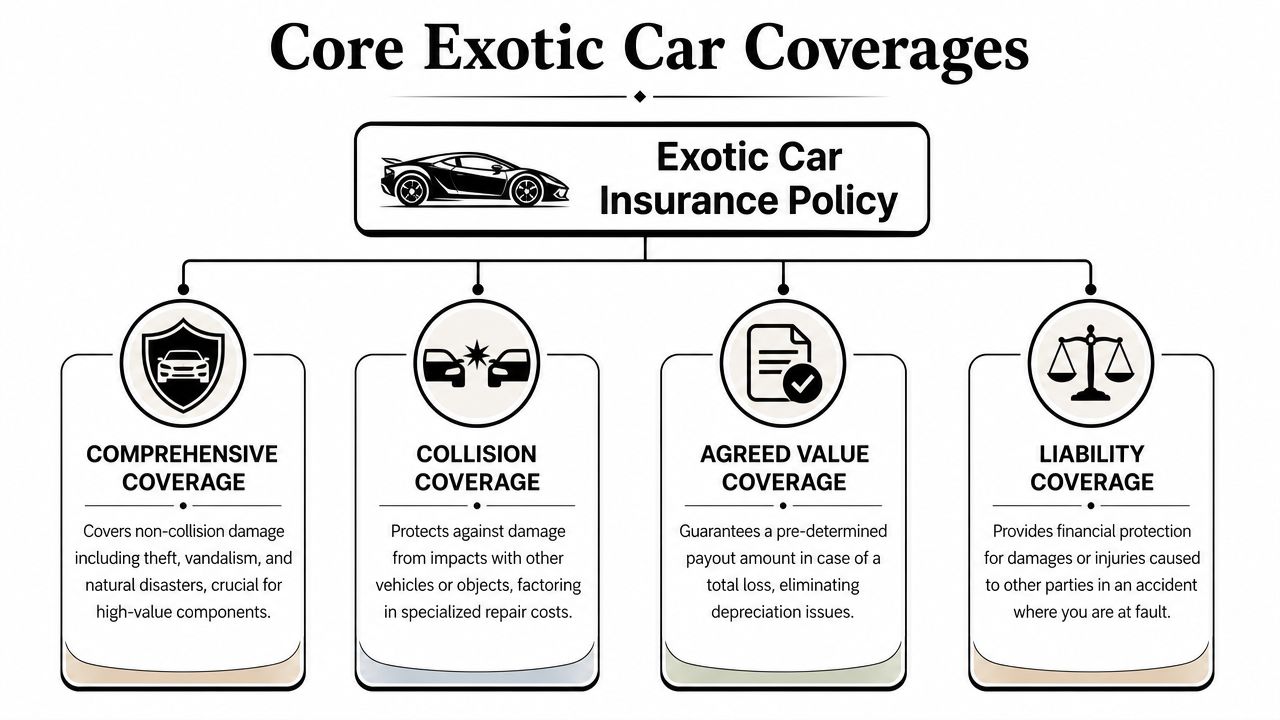
Agreed value comes first
If you remember one term, make it agreed value.
You want the car's value settled before the loss, not during a claims dispute. That means the insurer and owner agree on a number up front and document it clearly in the policy. For an exotic, that avoids the usual argument over depreciation, market scarcity, and whether a clean replacement can even be found at the carrier's number.
This is the coverage that keeps a total loss from turning into a negotiation exercise.
Comprehensive coverage and collision must match how exotics are actually repaired
On an ordinary policy, these coverages often get skimmed. On an exotic, they deserve line-by-line review.
Extensive insurance protection should address theft, vandalism, fire, falling objects, and weather-related losses. In California, storage is part of the underwriting story. If the car is garaged in a wildfire-prone area, say so and insure around that reality. A local broker like Mai & Associates should be asking where the car is kept, how often it is moved, and whether the storage setup reduces smoke, fire, and theft exposure.
Collision coverage must be strong enough to handle specialty labor, factory parts delays, transport to the right repair facility, and the higher cost of correcting even low-speed damage. If the policy pushes you toward a generic shop, you bought the wrong policy.
For a broader framework on choosing auto insurance coverage in California, start there, then tighten the terms for the specific car.
Liability protects your balance sheet
Exotic owners sometimes obsess over the car and underinsure the actual risk. That is a mistake.
If you injure someone in a serious California accident, liability coverage is what stands between the claim and your assets. High-value vehicles draw attention. Plaintiff attorneys notice that. Carry limits that reflect your net worth, and pair the auto policy with a personal umbrella if the household asset picture calls for it.
Two add-ons deserve special attention
These are often missed, and they matter.
| Coverage area | Why it matters |
|---|---|
| Modification coverage | Custom wheels, carbon fiber parts, exhaust work, paint protection, tuning, and other upgrades should be scheduled and documented so they are not treated as afterthoughts at claim time. |
| Diminished value support | An exotic with an accident history can lose market appeal even after proper repairs, especially when buyers scrutinize Carfax and prior damage records. |
If you want a practical explanation of post-accident resale loss, Auto Appraisal Expert's guide to diminished value is worth reading before you assume a clean repair made you whole.
Decoding the High Cost of Exotic Car Insurance
The premium shocks people because they compare the quote to an ordinary car. That comparison is useless.
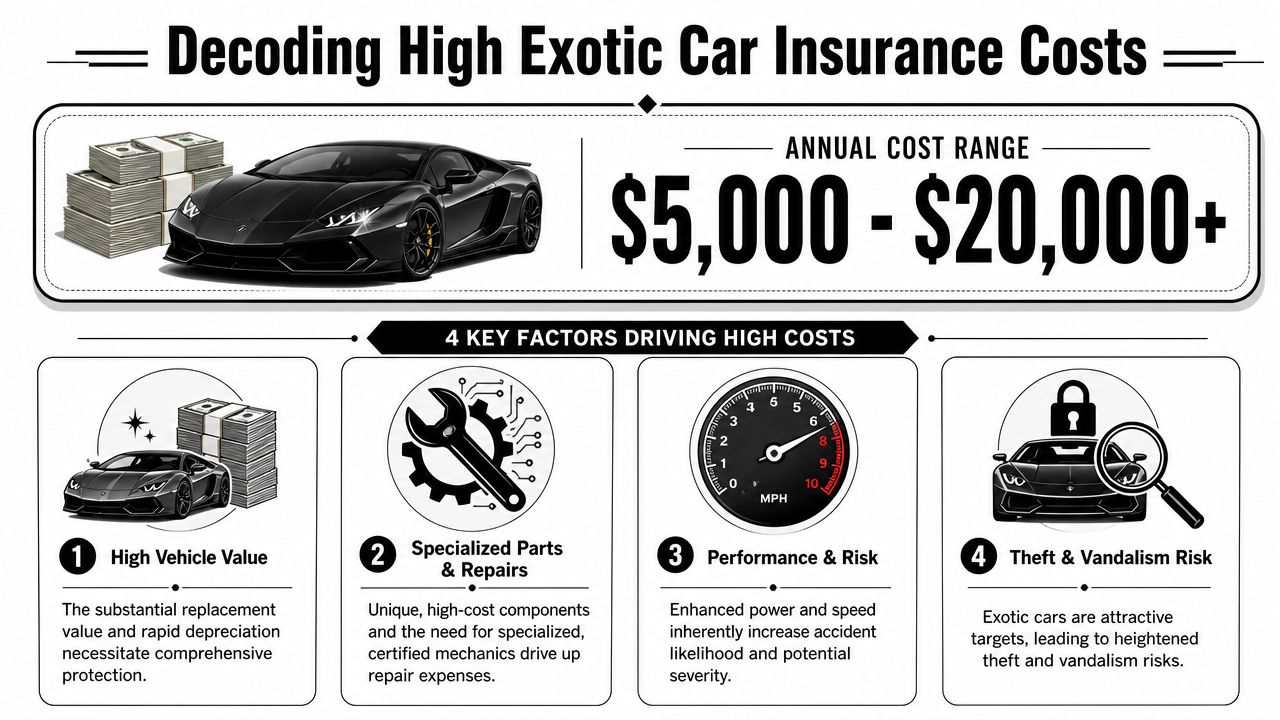
Annual premiums for exotic car insurance typically range between $5,000 and $20,000, driven by limited production numbers, parts that cost 10–20 times more than standard components, and a shortage of certified technicians, according to FirstMark Insurance Group's explanation of exotic car insurance.
Why the numbers climb fast
A standard insurer can predict a lot about repairing a common vehicle. They know parts channels, labor patterns, and salvage behavior. Exotic claims are different.
Here's what raises the cost basis:
- Rare parts: A damaged component may require factory sourcing, not a convenient local supply chain.
- Specialized labor: Not every body shop should touch a Ferrari, McLaren, or Lamborghini.
- Longer claim complexity: More coordination, more documentation, more room for valuation disputes.
- Theft appeal: These cars attract attention from both admirers and thieves.
The premium isn't arbitrary. It reflects a claims environment where even modest physical damage can become expensive in a hurry.
California adds its own pressure points
California roads are hard on specialty vehicles. Dense traffic increases collision exposure. Public visibility can increase theft risk. Coastal conditions can affect storage decisions. Inland heat changes how owners think about garage conditions. In wildfire-prone areas, where and how the car is stored isn't just a convenience issue. It's part of the underwriting story.
That's why a generic national quote often misses the point. A California exotic owner needs the policy built around the car's local operating environment, not around a broad national average mindset.
If the insurer doesn't ask detailed questions about storage, use, and the car's exact configuration, that's not efficient underwriting. That's a warning sign.
Don't ignore the hidden cost drivers
Some owners focus only on base premium and skip the rest of the file. That's a mistake.
A few things can materially change the quote and the quality of the coverage:
| Cost driver | What it means for you |
|---|---|
| Limited production | Fewer comparables, harder parts sourcing, more uncertainty after a loss |
| Certified repair shortage | Fewer qualified technicians can increase claim severity |
| Custom upgrades | Added value must be accounted for properly in the policy |
| Usage violations | If you ignore policy rules, you can pay more and still fight over a claim later |
The right question isn't “Why is this so expensive?” The right question is “Does this premium reflect a policy that can perform when the claim is ugly?”
Exotic vs Classic vs Standard Car Insurance
Misclassify the car, and the claim gets ugly.
That happens all the time with California owners who assume a high sticker price automatically means classic coverage, or who leave a six-figure exotic on a standard auto policy because it was faster to bind. Both are expensive mistakes. The right policy depends on how the car is built, how it is used, and how the insurer will value it after a loss.
What separates the three
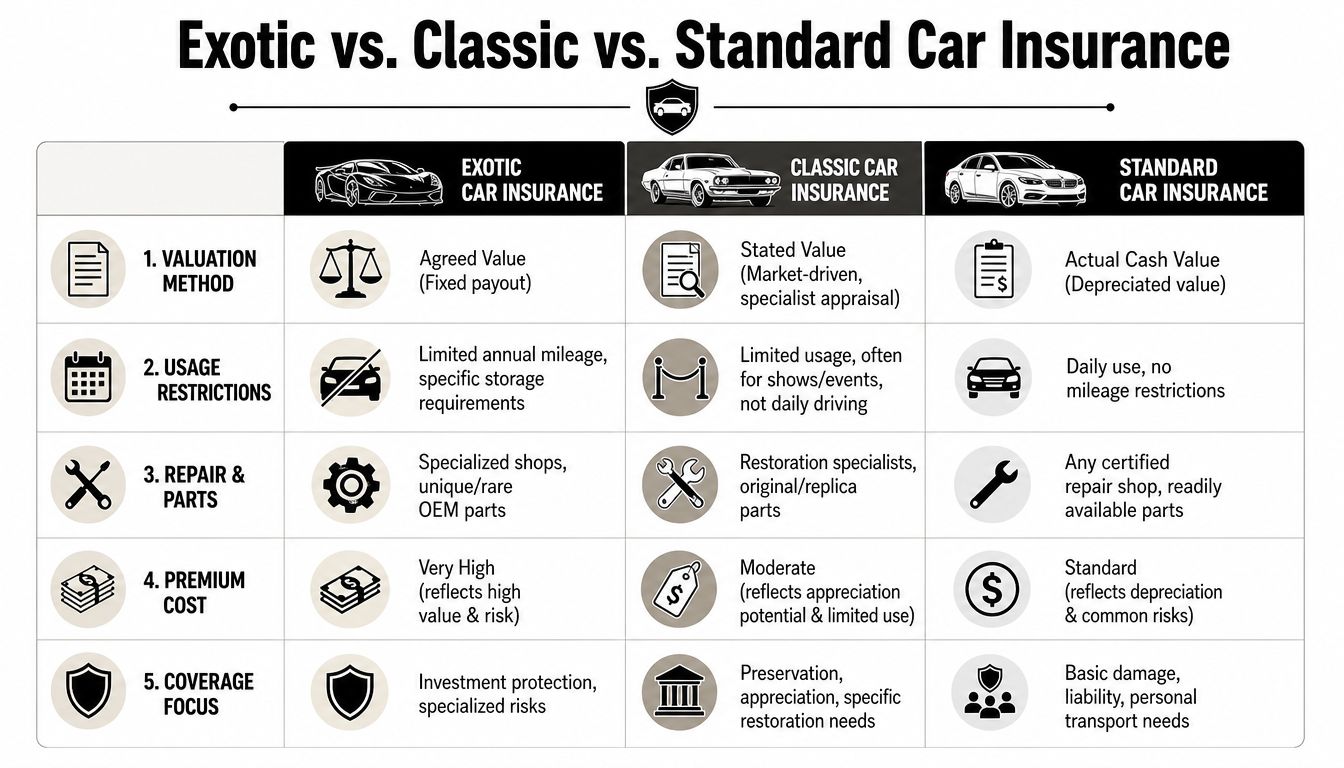
| Policy type | Best fit | Main valuation approach | Typical use pattern |
|---|---|---|---|
| Standard car insurance | Daily drivers | Actual cash value | Regular transportation |
| Classic car insurance | Older collectible vehicles | Agreed value or collector-specific valuation | Limited pleasure use, shows, events |
| Exotic car insurance | Modern high-performance, high-value vehicles | Agreed value with tighter underwriting | Limited use, specialty storage, specialized repair expectations |
Here is the clean way to view it.
A standard policy is built for ordinary depreciation, broad repair networks, and routine transportation risk. A classic policy is built for collector ownership, low annual mileage, and vehicles whose value comes from age, rarity, provenance, or restoration quality. Exotic coverage is for modern machines with expensive materials, limited production, specialized parts, and repair requirements that standard carriers often mishandle.
The difference is not academic. It shows up the minute a claim involves a total loss, OEM parts delays, or a theft recovery with hidden damage.
Why category matters more in California
California adds its own pressure points. A Ferrari in Los Angeles, a McLaren in Orange County, and a GT3 stored in a Napa or foothill property all present different underwriting facts. Usage, storage, wildfire exposure, and access to approved repair facilities affect which policy structure fits.
A generic national guide usually misses that.
A local broker should be asking whether the car lives in a conditioned garage, whether the property sits in a brush zone, whether the vehicle crosses state lines for events, and whether you need flexibility for modern collector use. That is the kind of file review Mai & Associates handles well because they understand California risk patterns instead of forcing an exotic into a mass-market template. If you want more California-specific guidance, review these California insurance guides for high-value vehicles.
Claims are where bad policy choices get exposed
Put an exotic on a standard policy and the fight usually starts with value and ends with repairs. Actual cash value can leave too much room for argument on a car with a thin market and expensive options. Put a modern exotic on a classic form and you can run into mileage, use, or storage restrictions that do not match the way the car is owned.
Theft claims are a good example. High-value performance cars attract organized theft crews because they can be moved fast, stripped fast, and sold in pieces. The lesson from how CarLock saved a Hellcat is simple. Security, tracking, and policy structure need to work together. A cheap policy with weak theft planning is not a bargain.
The wrong policy can sit quietly for years, then fail the first time you need a serious valuation or a specialty repair approval.
Reappraisal is part of ownership
If your policy uses agreed value, update it regularly. Do it after major service, major modifications, market movement in the marque, or any material change in the car's condition. Owners who skip this step often discover they insured yesterday's value, not today's.
That matters even more for exotics that trade in a thin market. A stale agreed value can leave money on the table after a total loss. An inflated one can push premium higher without giving you practical benefit if the underwriting file does not support it.
A quick test
You likely need exotic coverage if these points describe the car:
- It is a modern high-performance vehicle
- Repairs require factory-trained or marque-specific technicians
- Parts are limited, slow to source, or unusually expensive
- The car is not used like an ordinary commuter vehicle
- You want payout terms negotiated in advance, not argued after the loss
If that sounds like your garage, insure it like an exotic. Do not let convenience decide the policy category.
How to Lower Your Premiums Without Sacrificing Coverage
You probably won't make exotic car insurance cheap. You can absolutely make it smarter.
The best savings come from reducing real risk, not from stripping the policy down until it's useless. Owners who understand that usually get better long-term pricing and fewer claim headaches.
Storage is the first lever
If you own an exotic in California, start with the garage.
A secure storage setup does more than protect the car physically. It tells the insurer you take risk seriously. That means controlled access, strong physical security, and an environment that doesn't expose the vehicle to unnecessary theft or weather-related problems. In wildfire-prone parts of California, storage location deserves the same level of planning as your home insurance decisions. If your property has brush exposure or evacuation concerns, be realistic about that when discussing where the car is kept.
Security tech pays for itself
Security systems can reduce premium pressure because they reduce theft probability. Policygenius notes that anti-theft technology, gated garage storage, and GPS tracking can provide measurable discounts for exotic vehicles.
That's one of the easiest decisions in this space. If your car doesn't already have layered theft protection, fix that.
A practical setup often includes:
- A monitored garage environment: Controlled access beats an open driveway every time.
- Vehicle-based anti-theft technology: Use systems designed to interrupt or deter unauthorized movement.
- GPS tracking: Recovery potential matters to insurers and owners alike.
- Driver discipline: Don't leave the car where it becomes an easy target.
If you want a real-world example of how tracking technology can matter in a theft scenario, this story about how CarLock saved a Hellcat is worth your time.
Use the policy the way it was designed
A lot of premium pain comes from avoidable behavior.
Choose a mileage plan that matches reality. Don't insure the car as a limited-use vehicle and then start treating it like a daily commuter. Don't let casual drivers use it if the policy expects a tightly controlled driver list. And don't assume every performance event is covered just because the car is insured.
For broader practical advice on structuring personal coverage in California, these insurance guides for California drivers and households are a good reference point.
Cheap coverage on paper becomes expensive coverage the moment a claim gets denied or repriced.
Where I'd cut and where I wouldn't
If you want to trim premium, I'd look at deductible strategy before I'd weaken the policy's core structure. Higher out-of-pocket tolerance can make sense for owners who can comfortably absorb smaller losses.
I would not cut corners on valuation, liability, or theft protection. Those are the areas that turn a manageable incident into a painful financial event.
Get Your Optimal California Policy with Mai & Associates
Buying the right exotic policy starts with preparation. If your file is sloppy, your quote process will be sloppy too.
Start with a clean package of documents. Gather a professional appraisal if the carrier requires one, clear photos, current registration, VIN details, service records, and a written list of modifications. If the vehicle has custom parts or recent work, document it clearly. Ambiguity hurts you.
A simple checklist that works
Confirm how the car is used
Weekend use, collection use, or frequent road use should be stated accurately.Document storage conditions
Garaging details matter in California, especially if your area has theft concerns or wildfire exposure.List every modification
If it adds value, put it in writing.Review valuation language carefully
Don't assume. Verify the payout method and the wording.Compare specialist options, not just broad carriers
The cheapest quote often leaves out the most important protections.
The process gets easier when you work with a California agency that understands more than just cars. Exotic owners often need coordinated protection across auto insurance, home insurance, renters insurance, car insurance, and life insurance. That broader view matters when assets, liability, and property risks overlap.
If you're ready to start, use this California insurance quote request to get the conversation moving.
Mai & Associates helps California drivers and households build smarter protection across auto insurance, home insurance, renters insurance, car insurance, and life insurance. If you own an exotic vehicle and want a policy built around real California risks, including storage concerns, wildfire exposure, liability planning, and specialty coverage details, reach out for a no-obligation review.