Evidence of Coverage: A Practical Guide for Californians
You're staring at a stack of paperwork, and one page keeps coming up in different conversations. The DMV wants proof, your lender wants proof, and your agent keeps saying the answer is in the Evidence of Coverage. If you've ever wondered whether that's the same as your policy, your declarations page, or just another insurance form, you're not alone.
The short version is simple. Evidence of coverage is the document that tells you what's covered, what's excluded, and what you're paying for under an insurance contract. In regulated health coverage, California and Texas both treat it as a serious contract-level document, not a brochure, and California law requires it to be clearly titled, organized, and complete about benefits, limits, exclusions, and deductibles. For Medicare members, it's the annual reference point that explains plan coverage and costs before the next year's benefits take effect, and Medicare says plans send it each year, usually in the fall, so members can review it ahead of January 1.
Think of it as the document you use when the nice summary on page one doesn't answer the core question. If a claim gets denied, if a lender asks for hazard proof, or if you're trying to understand whether a deductible applies, this is the paper that settles the argument. For a plain-English companion on documentary evidence, Documind's guide to evidence is a useful reference, and if you want a California glossary for common insurance terms, this state-specific glossary can help.
What Evidence of Coverage Really Means
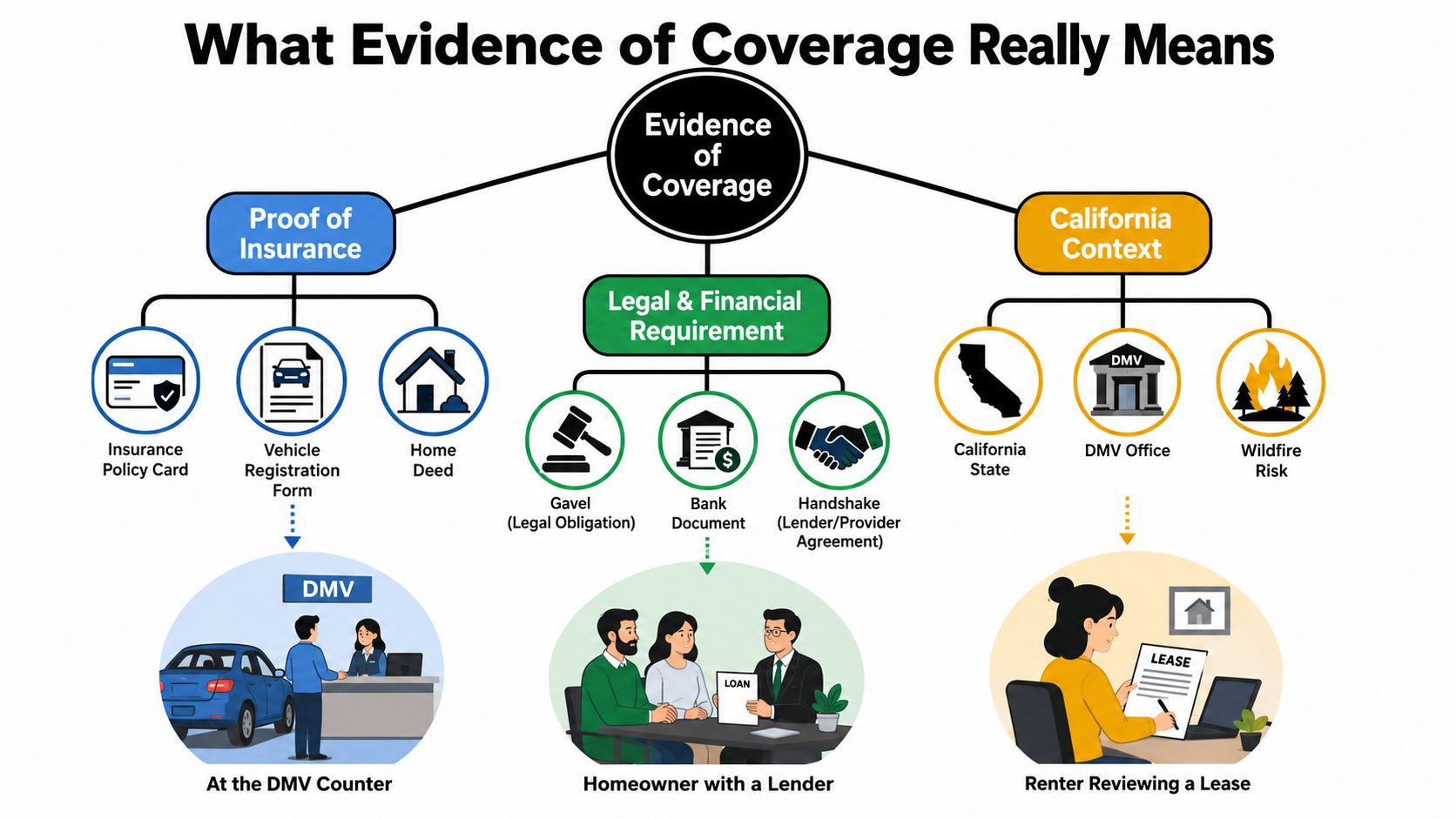
You may hear evidence of coverage at a Medicare meeting, at a claims desk, or during a California insurance closing, and the term can sound more formal than it is. The document is the written record of what the insurer promised, what it did not promise, and what you are expected to pay or do when a claim comes up. That matters whether the policy is for Medicare, auto, renters, homeowners, or life coverage.
In plain English, the Evidence of Coverage is the rulebook for the plan. It lays out what is included, what is excluded, and how cost sharing works when you use the coverage. In regulated health plans, California's Department of Insurance treats the EOC as a written contract guide for benefits, exclusions, and payment terms. Texas law uses similar language, requiring the document to state covered services, other benefits, limits, and how to obtain services, which shows how seriously regulators treat it as part of the contract record.
For Medicare members, timing matters too. Medicare says the EOC is an annual document your plan must send each year, usually in the fall, and it becomes the reference point before benefits take effect on January 1 of the next year. That is why people who wait until they need care, or wait until a claim is denied, often feel caught off guard.
Practical rule: if the sales pitch and the contract seem to disagree, trust the contract.
The same idea shows up outside health insurance. A homeowner may receive a binder at closing, a renter may get a certificate, and a driver may carry only a proof-of-insurance card. Those papers help in the moment, but they do not answer every coverage question. For a plain-English companion on documentary evidence, Documind's guide to evidence is a useful reference, and if you want help with common insurance terms, this insurance glossary can translate the vocabulary into something easier to read.
The easiest way to explain it to a family member is this. The evidence of coverage says, “Here is what the insurer promised, here is what it did not promise, and here is what you pay if something happens.”
Why the formal wording matters
The formal language is there for a reason. If a claim turns into a dispute, the contract language controls the outcome, not the sales conversation, not a text from an agent, and not a memory of what someone said over the phone. California's insurance rules make that clear by requiring the document to disclose benefits, exclusions, reductions, copayments, and deductibles in a fair, readable way.
That is why you should treat the evidence of coverage like the source document, not background noise. Read it early, while there is still time to spot gaps before they become expensive problems later.
Evidence of Coverage vs Declarations Page vs Proof of Insurance
At the DMV, at a mortgage closing, or at a claims desk, Californians often hand over the wrong insurance paper because the names sound similar. Each document answers a different question, and the difference matters when someone needs a fast answer about a car, a house, a rental, or a life policy.
| Document | What It Tells You | When You'll Use It |
|---|---|---|
| Evidence of Coverage | The full contract details, including covered services, exclusions, limits, and cost-sharing | When you need to understand rights, responsibilities, and claim language |
| Declarations Page | The quick summary of who is insured, what is insured, and the basic limits | When you want a fast snapshot of the policy |
| Proof of Insurance Card | That coverage is active and in force right now | When you need to show immediate proof to a requestor |
The declarations page is usually the first page people notice because it is short and easy to scan. It gives the policy number, the named insured, the covered property or vehicle, and the main limits. The evidence of coverage goes further and serves as the contract behind that summary.
The proof-of-insurance card serves a different purpose again. It is the card you keep in a glove box or on your phone when someone only needs confirmation that coverage exists right now. That is the page you may show at the DMV or during a traffic stop, while the EOC is the document you reach for when there is a dispute over what the policy includes.
Use this test: if the question is “Am I covered right now?”, the proof card may be enough. If the question is “What exactly is covered and what does it cost?”, you need the evidence of coverage.
For readers trying to separate policy paperwork from enrollment forms, Coveredly explains EOI requirements and shows how insurers use different forms for different decisions.
The short version is simple. The declarations page summarizes, the proof card confirms, and the evidence of coverage explains.
What's Inside a Typical Evidence of Coverage
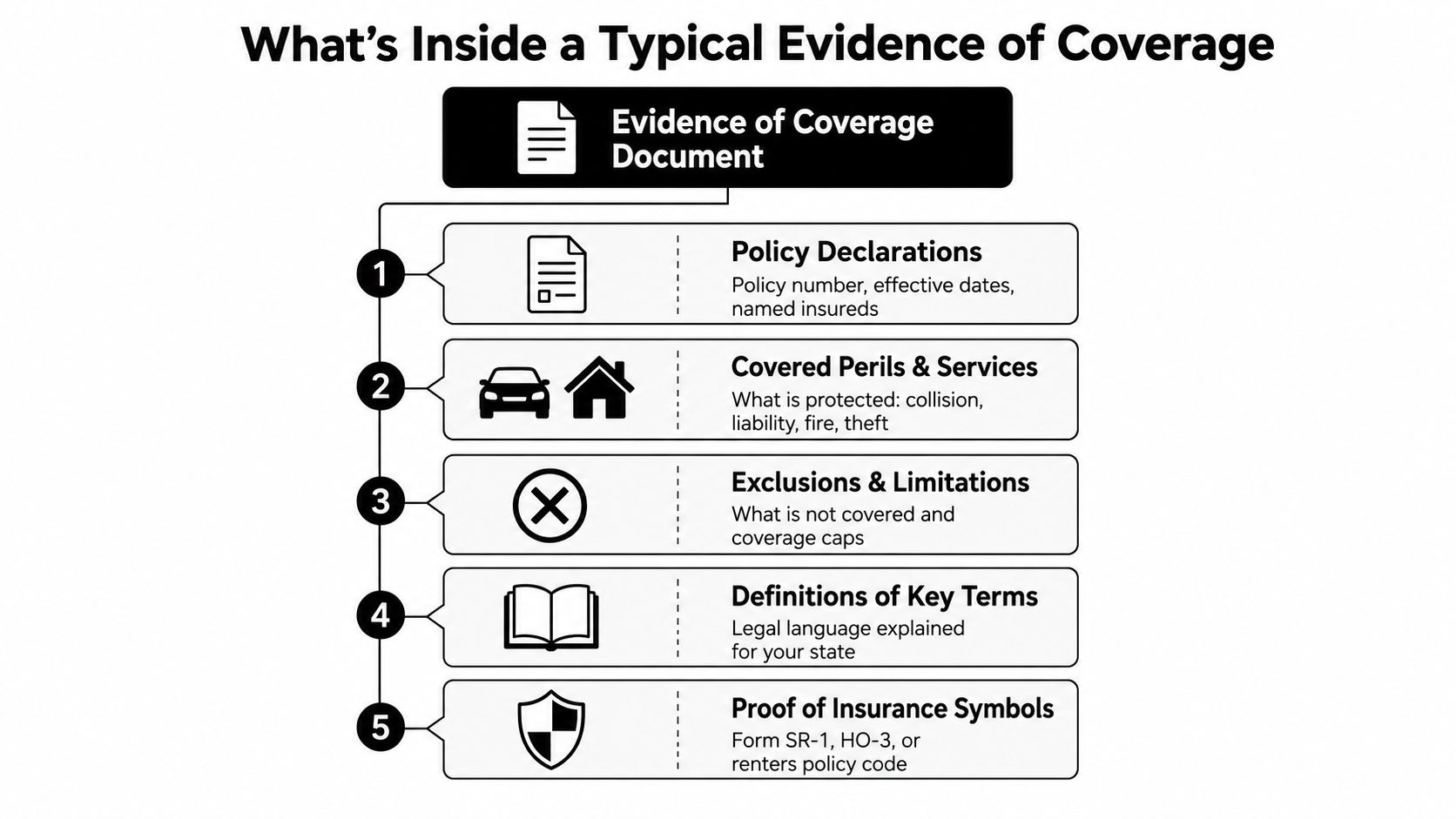
A client usually opens an Evidence of Coverage after a loss, a renewal notice, or a stubborn question about what the policy promises. The pages can feel dense, so start with the parts that affect money, exclusions, and claims handling. That is where the document does its real work.
Start with the parts that change your out-of-pocket cost
Look for definitions, covered services or perils, exclusions, and cost-sharing. In California health-plan materials, the EOC has to include sections on benefits, exclusions, reductions, copayments, and deductibles. It also has to show when coverage starts and ends, cancellation rules, renewal or reinstatement rules, and contact information. In a property or auto policy, the layout changes, but the logic stays the same. You are still checking what is covered, what is not, and what you may owe if a claim comes in.
Then find the claims and dispute section
Read the part that explains how to file a claim, how appeals work, and where complaints go. If a claim was delayed because one word in the policy did not match what you expected, this section controls the discussion. California and Texas both require the document to spell out covered services and limits, which is why agents and adjusters keep returning to the wording instead of memory.
Don't skip the front and back pages
The opening pages often list the plan name, business address, phone number, effective date, and termination rules. Those details help you confirm that the version in your hands is current. A stale copy can mislead you after a renewal, a rider, or another policy change.
| What to Scan First | Why It Matters |
|---|---|
| Definitions | Insurance words can mean something narrower than everyday language |
| Covered items | Tells you what the policy promises to pay for |
| Exclusions | Shows what you should never assume is included |
| Deductibles and copayments | Lets you estimate your actual out-of-pocket cost |
| Claims and appeals | Shows where to go if something is denied |
| Cancellation and renewal rules | Helps you avoid gaps when a policy changes |
If you need the document in another language or a format that is easier to read, ask the insurer or agency for help right away. Households that need insurance policy translation services often find that a translated copy makes the contract language easier to review before they sign, renew, or file a claim.
How the Document Looks Across Auto Home Renters and Life Policies
A policy document often feels abstract until a claim, a loan closing, or a DMV question puts it on the table. The wording changes by line of insurance, but the job stays the same, it shows what the insurer promises, what it excludes, and what proof you can point to when someone asks for the details.
Auto insurance
A California driver usually runs into this paperwork at the roadside or after an accident, not during a quiet review at home. The auto policy's evidence of coverage, or the contract document the insurer issues, is where you check liability limits, collision triggers, uninsured motorist coverage, and rental reimbursement rules. If you want a plain California auto policy overview, this auto insurance resource helps anchor the basics before you compare them to the contract itself.
For auto coverage, the declarations page gives the headlines, but the policy language explains how a claim is handled. That matters if you are trying to sort out whether a loss falls under collision, whether a theft loss fits the full coverage parts of the policy, or whether the insurer pays for a rental car. If you have an SR-22 filing, the policy paperwork matters even more because the filing and the active policy need to match.
Homeowners and renters insurance
Homeowners policies are where Californians often miss the fine print. The document spells out dwelling coverage, personal property limits, loss of use, and exclusions that may leave out risks unless you buy separate endorsements or a different policy structure. That same structure helps explain renters coverage, because the policy usually centers on personal property, liability, and additional living expense instead of the broader structure of a house.
A renters policy is easier to read once you know the parts that matter most. If you are comparing forms and trying to understand what a landlord may ask for, this California renters insurance guide is a practical starting point, because the contract language often looks different from what people expect when they only think about belongings and liability.
Life insurance and Medicare
Life insurance uses the same contract logic, but the document speaks in a different vocabulary. It explains the death benefit, beneficiary rules, contestability, and riders, so the family knows what happens when a claim is made. Medicare adds another layer of confusion because its Evidence of Coverage is an annual member document, usually sent in the fall, and it explains plan benefits and costs for the coming year. That is a different use of the term than the one most auto and home policyholders expect.
If you are reading paperwork in a bilingual household, insurance policy translation services can help when the meaning of a clause matters more than the marketing summary. A translated copy can make the policy easier to review before you sign, renew, or file a claim.
When California Drivers Homeowners and Renters Need It
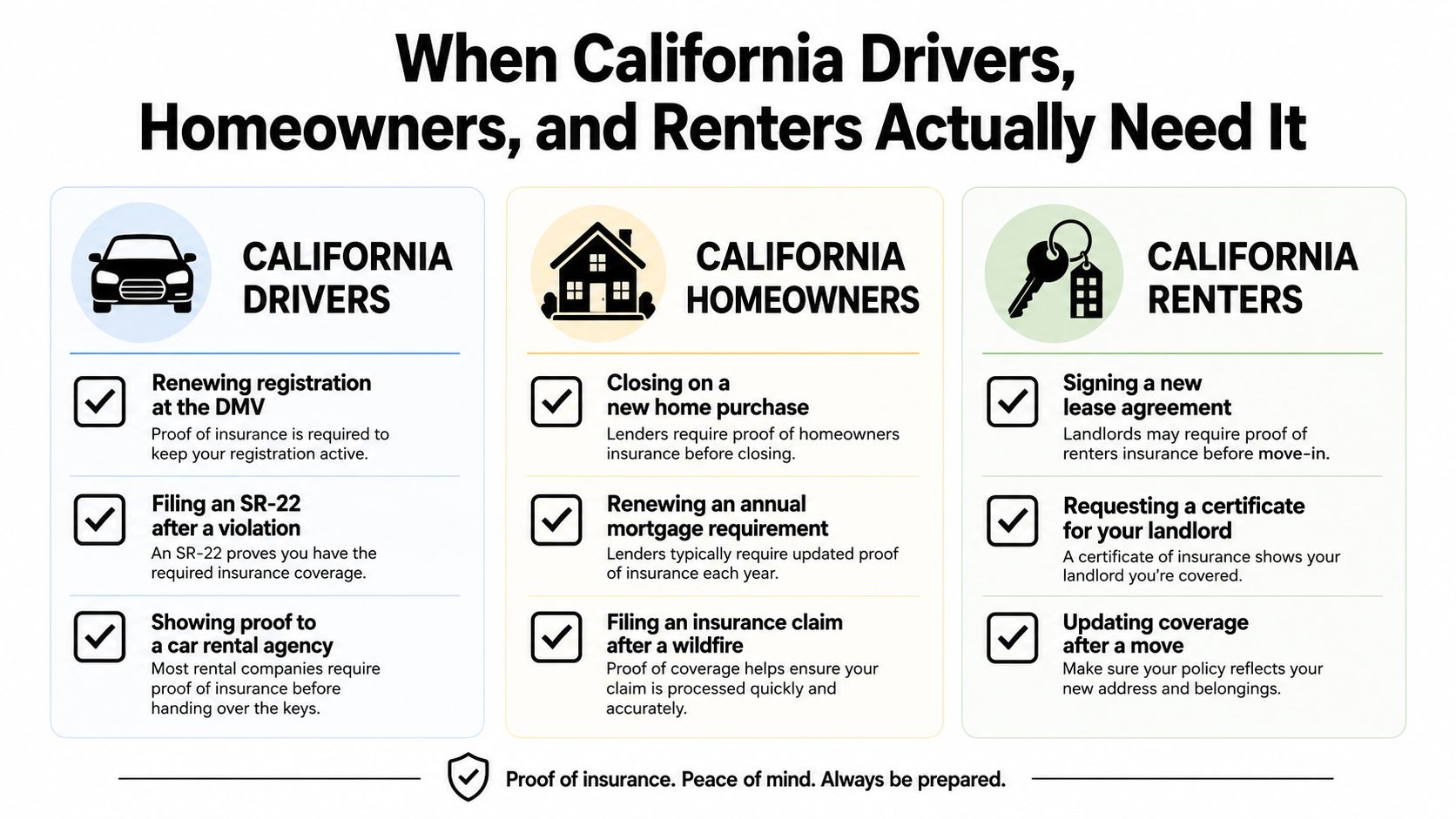
The document stops being abstract the moment someone asks for it. In California, that usually happens during a registration issue, a home purchase, a rental move, or a claim review. A policy can sit in a file for months, then suddenly matter because a clerk, lender, landlord, or adjuster wants the terms in writing.
The DMV and the driver
At the DMV, the request is usually for proof that coverage is active. That often means a proof-of-insurance card, not the full contract. If the issue involves a violation or an SR-22 filing, the paperwork needs to show that the required filing is in place. Keep the contract document with it so you can check the policy details if questions come up, especially if the DMV record and the insurance record do not seem to match.
Mortgage closing and lender reviews
Lenders usually want hazard coverage proof at closing and again at renewal. Sometimes the declarations page is enough. Other times they want the policy details that show the dwelling is insured at the right amount, and that is when the evidence of coverage becomes the backup document that lists the limits, exclusions, and effective date. If you are comparing what a lender asks for with what your carrier sent, this California auto insurance page is a useful reference for the kind of coverage paperwork California clients are often asked to produce.
Renters and landlords
Landlords often want a certificate or proof page, not the full policy file. Still, if you are renting in California, the underlying contract matters when you need to know whether your personal property, liability, and living expense coverage fit the lease requirement. If you move, check the document again so the coverage still matches the new address. A landlord may only ask for the summary page, but the policy language tells you what protection you have if there is a loss.
Claims and disputed losses
The document earns its keep at the claims desk. If an adjuster questions a loss, you need the section that defines the covered event and the exclusions. A contractor asking for a policy copy before a remodel is usually trying to verify that the right kind of property protection exists, not just that you are insured. That same document can also settle confusion when the carrier and the policyholder read the loss differently.
Keep the document near the proof card, not buried in a separate folder you never open.
For drivers who want a broader California auto policy checklist, the page linked above is a practical companion when you are matching paperwork to a real situation.
How to Request Your Evidence of Coverage Step by Step
Start with the policy number on your declarations page. That is the fastest way to get the right file, especially if you have more than one policy or more than one household member on different coverage types. Then call your carrier, log in to the member portal, or ask your agent to send the full document in writing.
- Find the policy number. Use the declarations page, not a memory or an old text message.
- Request the full document. Ask for the evidence of coverage, not just the summary pages.
- Check the effective version. Make sure the version you received is the one currently in force.
- Save both digital and paper copies. Keep one where you can reach it fast and one where it won't get lost.
- Follow up if it stalls. If the carrier treats the EOC like the same thing as the policy and doesn't send the right version, escalate through your agent or the California Department of Insurance.
Most carriers now keep the document in a customer portal, which makes retrieval easier, but portal access isn't the same as understanding the content. You still need to know whether the policy changed at renewal, whether an endorsement replaced an older page, or whether a separate rider should be attached.
If you prefer a guided walkthrough of insurance forms and document requests, this California insurance resource hub is a useful place to start when you're trying to match the right paper to the right question.
California-Specific Checklist for SR-22 Fair Plan and Wildfire Coverage
California insurance gets complicated faster than people expect, especially when a driver, homeowner, or renter is trying to confirm a special filing or a high-risk property detail. The evidence of coverage is the place to verify those details on paper, not just on a sales call.
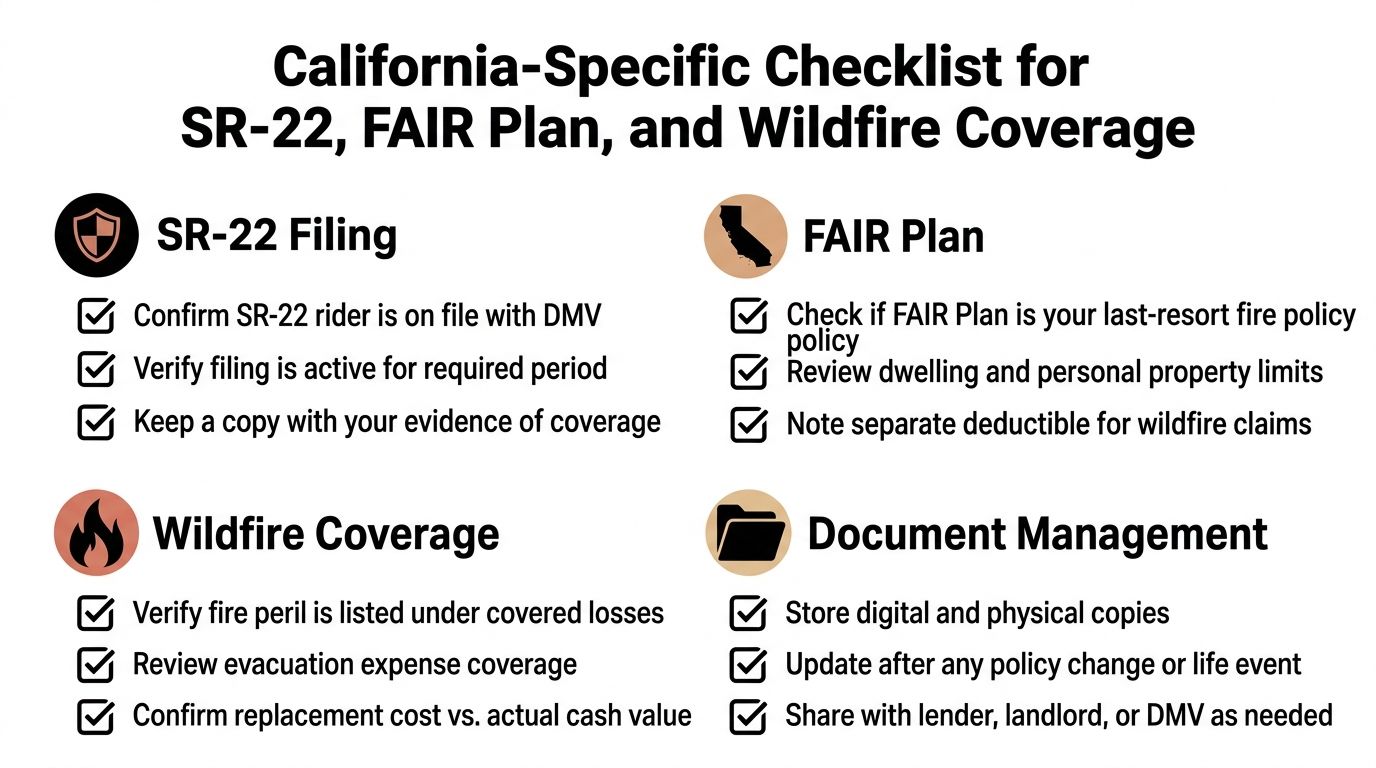
SR-22 filing
If you need an SR-22, confirm that the filing is active and tied to the correct policy. Keep a copy with your evidence of coverage so you can show the policy details if anyone asks for backup. The key is not just whether the filing exists, but whether the policy supporting it is current.
FAIR Plan review
California homeowners in higher-risk areas often need to read the policy more carefully than they expect. The Fair Plan review should show whether it is the last-resort fire policy, what the dwelling limits are, what personal property protection exists, and whether a separate deductible applies to wildfire claims. That information belongs in the contract, not only in the quote.
Wildfire and earthquake coverage
Wildfire and earthquake risk need a careful read because people often assume the base policy handles both. Check the covered perils list, then look for endorsements or separate policies that add the protection you want. If the document doesn't say it clearly, treat that as a warning sign and ask for the exact page that does.
Document management
Store a digital copy and a paper copy, then update both when the policy changes or your life changes. A new mortgage, a new car, a move, or a lease update can all change what you need to show and what you need to know. When a lender, landlord, or DMV asks for proof, you'll be ready without scrambling.
The cleanest policy file is the one you can open in under a minute and understand in under five.
This is also where a local review can help. A California agency like Mai & Associates can compare the contract language against the coverage you think you bought and flag missing pieces before they become a claim problem.
Practical Tips and Common Questions From California Clients
People usually ask the same four questions. First, is the evidence of coverage the same as the policy? In practice, it's the contract document that explains the policy, so if there's a conflict, the written terms matter more than the summary. Second, how often does it change? Usually when the policy renews, when an endorsement is added, or when a plan updates its contract language.
Third, what if the declarations page and the evidence of coverage don't match? Don't guess. Ask for the current version in writing and compare the effective dates, limits, exclusions, and endorsements line by line. Fourth, can an agent request it on your behalf? Yes, and in many households that's the easiest way to get the correct file without missing the version that applies.
If you want a fast personal checklist, use this order. Pull your declarations page, request the full evidence of coverage, scan the exclusions, and confirm any California-specific riders, including SR-22, Fair Plan, wildfire, or earthquake-related changes. That sequence catches the problems people usually discover too late.
A practical note for households that need language support. Mai & Associates works with clients in English, Spanish, Armenian, Russian, and Vietnamese across Glendale, Westlake Village, Escondido, and Costa Mesa, which helps when a policyholder needs the document explained instead of just handed over.
The smartest move is simple. Don't wait until a claim, a closing, or a DMV deadline to find out what your paperwork says. Get the contract, read the exclusions, and keep the right version where you can reach it fast.
If you want help comparing your California auto, home, renters, or life paperwork against the contract language, Mai & Associates can review your coverage and point out the pages that matter most. Visit Mai & Associates to request a quote or ask for a policy review, and bring the evidence of coverage questions you've been putting off.