Errors and Omissions Insurance: A California Guide
You're quoting a contract, renewing a policy, or helping a client sign off on work, and the uncomfortable question shows up at the worst time, what happens if the client says your advice caused their loss? In California, that question comes up often for agents, consultants, designers, accountants, and tech professionals, because one missed deadline or unclear recommendation can turn into a costly dispute. Errors and Omissions Insurance exists for that gap, the part of a business risk that general liability usually doesn't touch.
For California buyers, the tricky part isn't just learning the definition. It's understanding what E&O covers, who needs it, how claims-made timing works, and why documentation can decide the outcome of a claim. If you're comparing insurance for your business, or even reviewing your own professional risk alongside auto insurance, home insurance, renters insurance, car insurance, and life insurance, this is the kind of coverage that protects the advice and services that keep your income moving.
What Errors and Omissions Insurance Actually Covers
A Los Angeles marketing consultant misses a client deadline, the campaign launch slips, and the client claims the delay cost real money. No one got hurt, and nothing broke in the physical sense, but the client still wants compensation for the business loss. That's the kind of situation where Errors and Omissions Insurance, also called professional liability insurance, is built to respond.
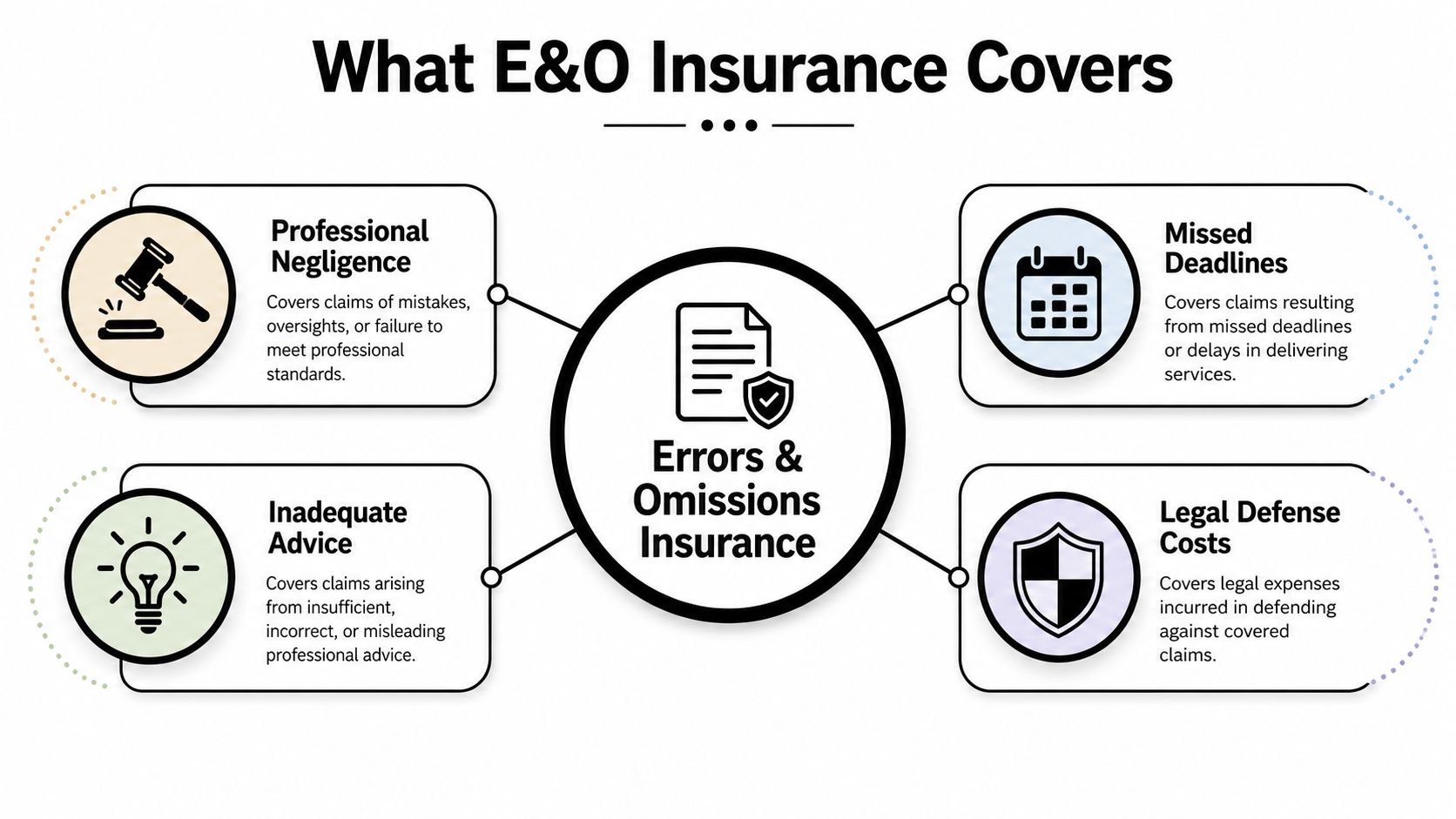
At the simplest level, E&O covers financial-loss claims tied to professional advice, services, errors, or omissions. It's meant for allegations like negligence, misrepresentation, missed deadlines, inaccurate advice, and incomplete work. A policy generally helps pay defense costs, settlements, and judgments when the claim fits the policy terms, which is why this coverage exists as its own line instead of sitting inside general liability.
Why the claim starts with the service, not the injury
The key idea is that E&O follows the professional service itself. If a client says your advice, plan, filing, design, or deadline failure created economic harm, the dispute can land in E&O territory even when commercial general liability would not respond. A helpful plain-English overview of E&O coverage for agencies shows how often this comes up in service businesses that sell expertise, not products.
Practical rule: if the complaint is about the quality of your work, your advice, or your judgment, E&O is the policy to check first.
That's why a California buyer should learn the difference between a service mistake and a physical accident. For a quick glossary of common insurance terms, this California reference guide can help you separate the language before you compare policies.
Which California Professionals Need E&O Coverage
Not every business needs E&O, but a wide range of California professionals do. The common thread is simple, if clients pay you for judgment, guidance, technical work, or a specialized service, your exposure is usually professional, not just physical. That's why this policy shows up again and again for real estate agents, insurance agents, accountants, consultants, IT and software contractors, architects, engineers, marketing firms, design firms, therapists, and counselors.
The groups that tend to need it most
A real estate agent can face a claim over a missed disclosure, a consultant can be accused of giving faulty advice, and an accountant can get pulled into a dispute over a filing or deadline issue. A software contractor may be blamed when a platform doesn't perform as promised, while an architect or engineer can be challenged when a plan error creates added project costs. These are the kinds of losses that live in the world of E&O, not general liability.
Some professionals assume their business liability policy covers every client complaint. That's where many first-time buyers get surprised.
Freelancers and solo operators get caught in this misunderstanding too. If your work is mostly advisory, creative, technical, or licensed professional service, your risk profile is different from a retail shop or a contractor whose main exposure is customer injury or property damage. For buyers checking California professional requirements, the CPA requirements by state guide is a useful reminder that licensing and service obligations often shape the insurance conversation.
A simple self-check
If your work includes any of these, E&O deserves a close look.
- Advice or recommendations: You tell clients what to do, how to file, or how to move forward.
- Deadlines or filings: You're responsible for timing, submissions, or compliance steps.
- Technical output: You build, design, code, calculate, or draft something clients rely on.
- Licensed judgment: Your credential is part of what the client is buying.
California professionals who work across multiple service lines should be especially careful, because the more advice you give, the easier it is for a client to argue financial loss.
Coverage Triggers, Limits, and Common Exclusions
The biggest mistake buyers make is assuming a policy works like a general promise to defend any complaint. E&O usually works on a claims-made basis, which means the claim has to be first made during the policy period, not just tied to an old mistake. That timing matters a lot for California service businesses that keep long client relationships, renew contracts often, or switch carriers after a busy year.
The policy details that decide whether a claim pays
A standard E&O policy usually includes a per-claim limit and an aggregate limit. The per-claim limit is the most the policy will pay for one claim, while the aggregate limit is the cap for the whole policy term. Deductibles also matter, because the insured typically has to absorb part of the loss before coverage starts paying.
Prior-acts dates and reporting rules are just as important. If your work happened before the policy's retroactive date, or you fail to report the claim in time, coverage can get narrow fast. In practice, many disputes turn into paperwork fights instead of simple coverage approvals.
What E&O usually excludes
E&O is designed for professional financial-loss claims, not every business problem. It generally does not respond to bodily injury, property damage, fraud, criminal acts, intentional misconduct, or knowingly false statements. It also won't help with work that falls outside the professional services described in the policy.
A common claim scenario looks like this. A client emails about a problem, the insured assumes it's only a complaint, and the response sits in a folder until after the reporting deadline. By the time the insured calls the carrier, the timing issue has become a coverage issue. Good contract wording and better recordkeeping can matter as much as the original mistake.
Keep the email trail, the proposal, the scope, and the deadline notices. When E&O is disputed, proof often matters as much as the facts.
For a broader consumer-level comparison of policy mechanics, the California insurance guides page is a practical starting point before you ask for quotes.
E&O vs General Liability for California Businesses
A lot of California owners buy general liability and assume they're done. That works fine until the claim is about professional advice instead of a slip-and-fall, a broken item, or damage at the job site. E&O and general liability protect different parts of the business, and most service firms need both because one policy doesn't replace the other.
Side by side comparison
| Coverage Area | Errors and Omissions | General Liability |
|---|---|---|
| Main risk | Client financial loss from advice, service, or professional work | Third-party bodily injury or property damage |
| Typical claim | Missed deadline, bad recommendation, incomplete work | Slip-and-fall, damage to a customer's property |
| Loss type | Economic harm | Physical harm or physical damage |
| Best fit | Advisors, agents, consultants, designers, tech firms, licensed professionals | Most businesses with premises, customer contact, or physical operations |
A San Diego contractor with a faulty design issue is a good example. If the client's loss is financial because the service was wrong, E&O is the policy line to inspect. If a ladder falls and damages a client's property, general liability is the one that usually gets involved. The distinction is especially important when one incident creates both kinds of exposure.
Why both policies often work together
California businesses rarely have clean, one-policy problems. A consultant can face a claim about bad advice and also a separate allegation about property damage during a client visit. In that situation, the policies can complement each other, but only if the insured understands which one responds to which loss.
If you're trying to sort out the difference quickly, the safest rule is this, E&O handles client financial harm tied to professional services, while general liability handles third-party injury or property damage. That's why service firms shouldn't buy one and assume the other is unnecessary.
What Drives E&O Premiums and Typical Price Ranges
Once a buyer understands the coverage, the next question is cost. E&O pricing moves around because the insurer is pricing the specific risk you bring, not just your business name. A freelance designer, a software consultant, and a licensed accounting practice can all need E&O, but they won't always receive similar quotes.
What changes the premium
The biggest drivers are profession, contract size, claims history, revenue, geographic exposure, and the kind of work you perform. Advice-heavy and mission-critical work tends to cost more because a single error can create a larger client loss. Technology work often gets extra attention too, because a software failure or missed implementation deadline can affect many people at once.
The market benchmarks commonly cluster small-business premiums around $500 to $1,500 per year per covered employee, with examples around $735 per year on average and technology-focused policies often around $500 to $1,000 per employee Investopedia's E&O insurance overview. Those ranges are only a sanity check, not a quote. A California buyer with larger contracts, more exposure, or a longer claims history can land above them.
A real-world way to read a quote
If one carrier is much cheaper than the others, check the service description, the exclusions, the deductible, and whether defense costs reduce the limit. A low premium can hide a narrow policy form. A higher premium can make sense if the carrier is giving broader protection for the exact service you sell.

How to Choose and Buy E&O Coverage in California
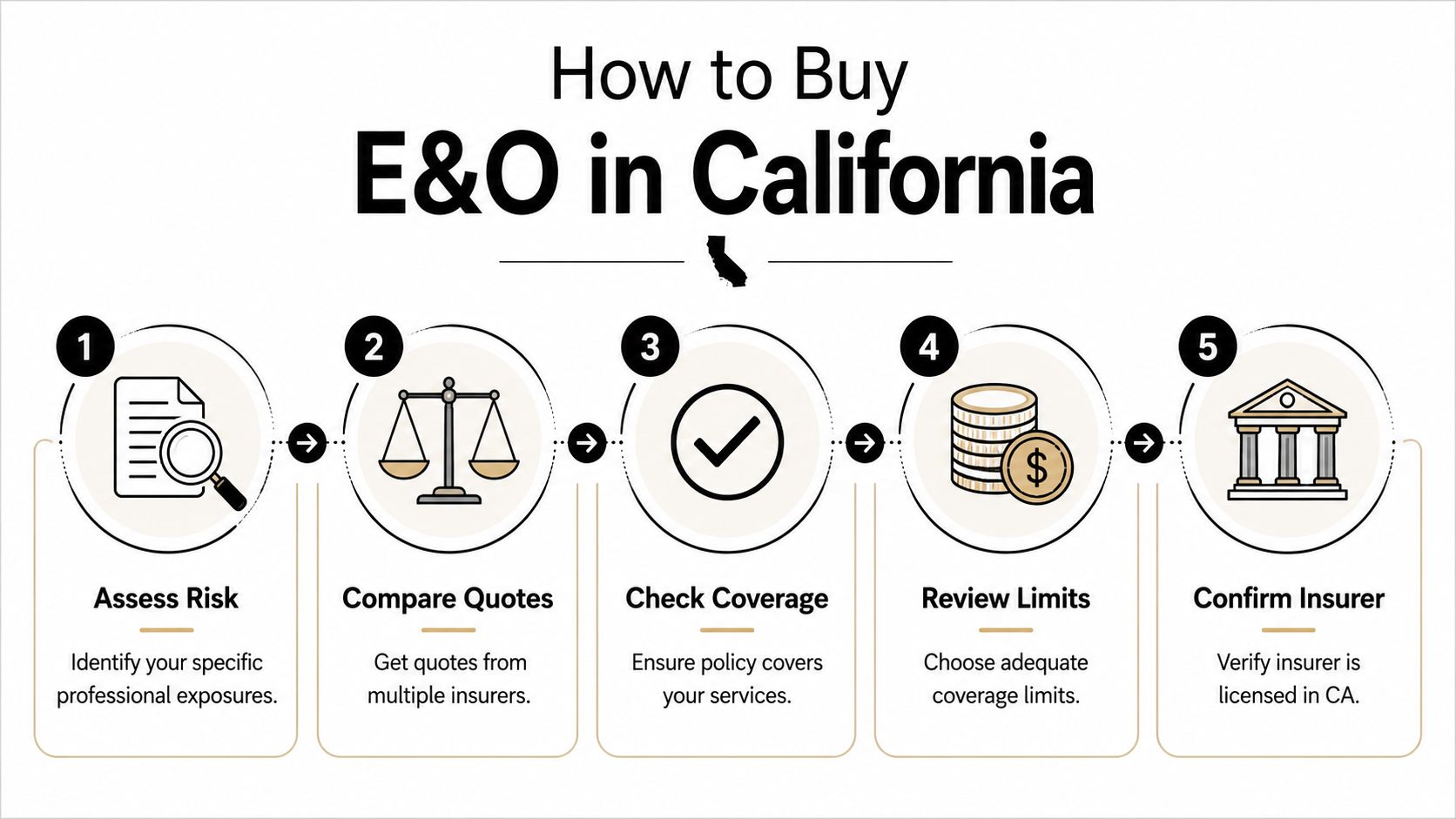
The cleanest way to buy E&O is to treat it like a risk review, not a commodity purchase. Start with what you do, then ask which parts of that work could trigger a client financial-loss claim. That simple step prevents the most common mismatch, buying a generic policy for a specialized service business.
What to gather before you ask for quotes
Have these items ready before you compare carriers.
- License numbers: Helpful for regulated professionals and multi-state work.
- Prior-acts history: Important if you've carried E&O before.
- Sample client contracts: These show service scope, deadlines, and promises.
- Revenue figures: Carriers use this to judge exposure.
- Existing certificates of insurance: Some contracts require specific proof of coverage.
How to compare the policy forms
The premium matters, but the wording matters more. Ask how the policy handles claims-made timing, whether defense costs erode the limit, and whether the quote includes endorsements for the services you provide. If your work uses AI-assisted drafting, subcontracted work, or cross-state licensing, you need to know whether those realities are addressed or excluded.
Best buying habit: compare the policy language line by line, not just the monthly or annual price.
Documentation also matters after the policy is in force. Keep proposals, revisions, emails, call notes, and client sign-offs in a place you can retrieve quickly. If a claim ever comes in, a clean file can make the defense easier to manage.
Before you bind coverage, use a California insurance quote request page to organize the conversation with an agent or broker so you're comparing the same service scope across multiple carriers. The goal isn't just to buy a policy. It's to buy the right policy for the way your business works.
Policy Review Tips and Common Questions From California Buyers
An E&O policy should be reviewed every renewal, not just when a client threatens a lawsuit. Check the claims-made date, update your revenue, confirm that your service description still matches what you do, and flag any new service lines or contractors you've added. If your work changed and your policy didn't, the gap usually shows up later, when you least want it.
Quick renewal checklist
- Confirm the dates: Make sure the policy period and prior-acts language still fit your history.
- Update the services: Add any new offerings, software support, or advisory work.
- Review contract changes: New promises can create new exposure.
- Save documentation: Keep proof of advice, disclosures, and client approvals.
A few questions come up again and again. Tail coverage can matter when you change carriers, because claims-made policies depend on timing. Missed deadlines can be covered when they're tied to professional services, but a pure contract fight may turn on wording and reporting rules instead. Documentation practices affect claim outcomes because the carrier will often look at what was said, when it was said, and whether the insured can prove it.
For buyers who want more context on specialty coverage conversations, quoting high net worth coverage is a useful example of how insurers often tailor protection to the client's risk profile, and E&O works the same way for professional services. If you still have open questions, the California insurance FAQ page is a smart next stop for general policy terms and buying basics.
If you want help sorting out E&O for your California business, Mai & Associates can compare options, explain the policy wording in plain English, and help you line up coverage with the way you work. Visit Mai & Associates to request a quote and get practical guidance from a California team that understands how service businesses, contracts, and claims-made policies fit together.